Home /
Is the climate-controlled upsell even written for a British winter?
You have probably seen the question come up in your research. Half the results tell you climate-controlled storage is essential. The other half want to rent you one. Most of what you have read was written for somewhere with Texas summers and Minnesota winters, and quietly assumes your main enemy is a 40-degree temperature swing. It is not.
Here is a plain answer from a company that does not sell climate-controlled storage and therefore has absolutely no reason to push it on you: for most UK households, a clean, dry and secure unit is enough. You do not need to pay extra. What you need is the right unit, packed sensibly, in a place that actually stays dry. Let us explain why, and what the exceptions look like.
The Short Honest Answer: For Most UK Households, No

For most people storing furniture, white goods, everyday clothes and household belongings in a UK market town, a standard clean, dry and secure unit is all they need. You do not need climate control. What you need is a unit that stays genuinely dry, seals properly, and keeps pests out. That is what we offer. Here is why we can say that without any conflict of interest, and what it means in practice for your things.
Why We Are Telling You This When We Do Not Sell It
Wigwam does not offer climate-controlled storage. We do not have units with thermostats or humidity regulators. Which means we have nothing to gain by telling you that you need it, and nothing to gain by telling you that you do not.
That is the point. A company that sells only one type of storage and tells you it is usually the right choice is not giving you advice. It is giving you a pitch. We are giving you the honest answer, because that is the only thing we have on offer here: the plain truth about what UK households actually need, from people who run storage sites in real UK market towns and see what happens to people’s belongings when they are stored properly.
What Climate-Controlled Storage Actually Is

Climate-controlled storage keeps a unit within a fixed temperature and humidity band, typically somewhere between 15 and 21 degrees Celsius and 30 to 50 percent relative humidity. It was developed for climates that regularly swing from extreme cold to intense heat, where a metal container can freeze pipes one month and bake electronics the next.
Temperature and Humidity Control: and Why the US Sets the Tone Online
The product makes sense for its original context. If you are storing belongings in Phoenix, Arizona in August, or in Minneapolis, Minnesota in January, a thermostat matters. The problems those climates create for stored goods are real and the product addresses them.
The difficulty is that when you search for information about climate-controlled storage in the UK, the results are dominated by American operators, American forums, and American frames of reference. The AI overview defaults to Fahrenheit. The top organic results cite Extra Space Storage, Guardian Storage, and Reddit threads from Houston. Climate control is discussed as though every storage unit sits between a desert and a snowfield. None of that applies to Wigwam Self Storage Lincoln, Lincolnshire or Wigwam Self Storage Bath, Somerset. You are searching an American question on a British problem. That is worth knowing before you spend more than you need to.
The UK Climate Is Not Extreme: It Is Damp
The UK climate is genuinely mild. Our winters rarely drop below freezing for sustained periods. Our summers rarely reach temperatures that would stress stored goods in a sealed unit. What the UK does reliably is damp. Persistent, low-grade, year-round moisture in the air. Condensation in cold corners. Soft mould on neglected surfaces.
That is a different problem. And the solution to damp is not a thermostat. It is a unit that stays clean, properly sealed, and genuinely dry when you move in. A climate-control system does not fix a poorly maintained unit. A well-maintained dry unit handles UK damp without one. The market towns where we operate, from Lincoln, Lincolnshire to Bath, Somerset, have damp British winters, not Arizona summers. The product sold for Arizona summers does not need to come with you to Cheltenham, Gloucestershire.
The Three Questions That Actually Decide It

Three questions settle this for almost every UK customer. What are you storing? How long for? And where are you? Work through them in order and the answer becomes clear.
What Are You Storing?
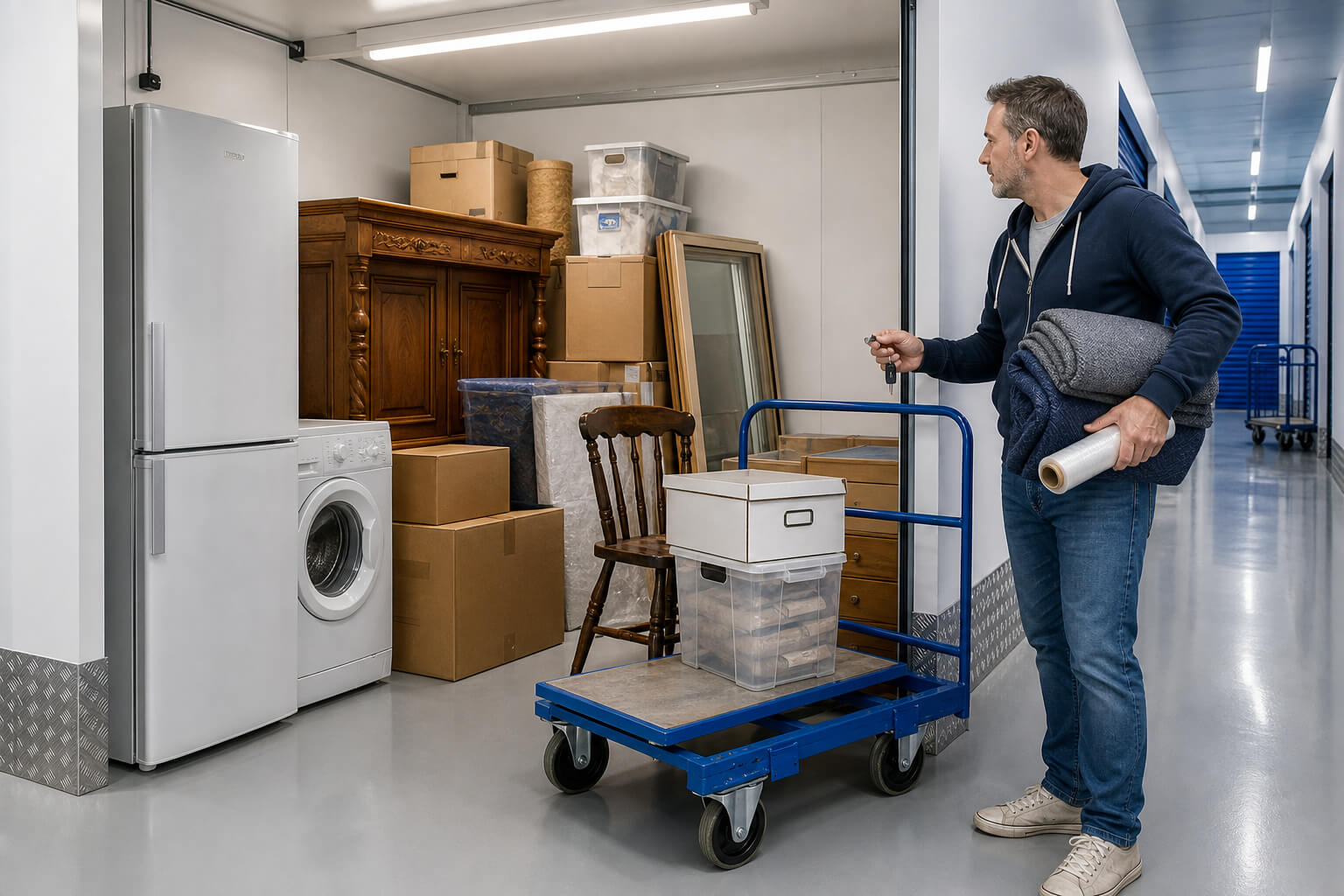
Standard household furniture, white goods, clothes, books and kitchenware are all fine in a clean, dry standard unit. We see people store sofas, dining tables, washing machines, fridges, boxes of clothes and crates of kitchenware in our market-town sites every day. Packed properly, they come out in exactly the condition they went in.
The small number of items that genuinely deserve extra thought are listed further down this page in the “when to take extra care” section. They include fine art, solid-wood antiques, certain musical instruments, vinyl records, and original irreplaceable documents in very long-term storage. If your list is mostly furniture and boxes, you can stop worrying about climate control.
How Long For: A Few Months or a Few Years?
Duration matters, but perhaps not in the way you expect. For a short stay, from a few weeks to around six months, damp has very little time to act in a properly sealed unit. This covers almost every house move, renovation project, and temporary relocation. Standard storage is the right call and the only sensible one at this timescale.
For longer stays, over a year, the answer is still usually standard storage. What changes is how much care goes into the packing. Airtight boxes matter more. Off-floor racking matters more. A moisture absorber in the unit makes sense. Good packing is a more effective and far cheaper response to time than a climate-control premium.
Where: Does a UK Market Town Change the Answer?
It does. A UK market town in a damp British winter is not the same environment as a US climate that inspired the product. The borrowed American question, the one that dominates your search results, was never about your belongings in your local market town. It was about a different climate, different temperature extremes, and different seasonal swings.
When you strip away the American framing, the UK answer becomes obvious. Damp is the real risk. Sealed, dry storage handles damp. The thermostat is solving a problem you do not have.
When Standard Storage Is Plainly Fine: Most of the Time

If you are moving house and need somewhere dry and secure for your furniture and boxes for a few months, the answer is straightforward: a standard unit is fine. Most of what British households own was built to sit in a wardrobe, a garage or a shed for years at a time. A clean, dry, sealed unit is at least as good as any of those, and better than most garages.
House Moves and Short Stays
The typical house-move scenario plays out like this. The chain is moving slowly. The new place is not ready. You need somewhere to put everything between completion dates. A standard unit handles this without any drama. Furniture, appliances, boxes of household kit, seasonal items, the contents of a loft or garage cleared for renovation. All of it can sit comfortably in a dry, secure unit for weeks or months.
Renovation Robert, period-property owner and protective of his furniture, will want to know about antiques and wooden pieces specifically. The answer is in the “extra care” section below. For everything else in a renovation clearout, standard storage is the right home.
Everyday Furniture, White Goods and Household Kit
Sofas, beds and dining tables do well in storage when they are covered. Dust sheets or plastic wrap keep surfaces clean. Mattresses should stand upright rather than flat. Fridges and washing machines should be clean and dry before they go in, doors left slightly open if possible to prevent any mustiness.
None of this is complicated and none of it requires a thermostat. It is the same care you would take in a garage or a utility room. White goods are built for British conditions and a clean, dry storage unit in a UK market town is not a hostile environment for them.
Clothes and Textiles: Packed Properly
Clothes and textiles respond almost entirely to how they are packed, not to what kind of storage unit holds them. Vacuum bags are the simplest option for bulky items like duvets, coats and cushions. Airtight plastic boxes work well for folded clothes and soft furnishings. A few moth sachets placed inside give extra peace of mind for wool and natural fibres.
Sentimental Sienna, storing children’s keepsakes and treasured items, will find that airtight boxes are her best friend here. This is a packing question, not a storage-grade question. Pack carefully, and climate control becomes irrelevant.
When to Take a Little Extra Care

There is a short, honest list of items that genuinely benefit from more controlled conditions. If your storage plan includes any of these, read this section before you decide.
The Short Honest List
Fine art. Oils and watercolours on canvas or paper are sensitive to humidity fluctuations over long periods. For museum-quality pieces or anything irreplaceable, specialist art storage is the right answer. We are honest about that.
Antiques with veneer or inlay. Solid wood handles British conditions well when packed properly. Veneered or inlaid pieces, particularly those with thin decorative surfaces on Victorian or Georgian furniture, are more sensitive to sustained damp. Wrapping wooden surfaces in breathable protective material and elevating pieces off the floor covers most of the risk.
Musical instruments. Bowed string instruments, solid-wood acoustic guitars, and woodwind instruments with cork or skin components are genuinely sensitive to humidity changes over time. If the instrument has real value or sentimental importance, take specialist advice.
Vinyl records. In good airtight sleeves inside a sealed box, vinyl does well. Stored loose and stacked in conditions that allow moisture, it warps. The solution is storage rather than a thermostat: proper sleeves, upright orientation, sealed container.
Irreplaceable original documents. Copies of documents are fine in a standard unit in airtight containers. Originals that cannot be replaced, old deeds, family documents, photographic negatives, deserve archival-quality boxes and are worth handling with more care.
Some high-specification electronics in very long-term storage. Most consumer electronics are fine in a dry unit. High-end audio equipment or precision instruments in storage of over twelve months are worth wrapping well and protecting from any moisture. A silica gel pack in the box handles the practical risk.
Our clean, dry and secure units are the right choice for 95 percent of what UK households store. For the 5 percent on this list, we would rather tell you that now than after the event. We do not offer specialist art storage or climate-regulated facilities, and if those are what your collection needs, we will say so plainly.
One more honest note on insurance. Atmospheric and climatic damage is excluded under the RSA Self Storage Customers’ Goods policy that customers can take out through us. This is another reason to pack carefully rather than assume that cover will handle what a thermostat would have. See contents protection details for the full policy terms.
Insurance is regulated in the UK by the Financial Conduct Authority. Policy terms are subject to UK law. For questions about claims or exclusions in Scotland or Northern Ireland, where legal remedies can differ from England and Wales, speak to the insurer or an independent adviser directly.
What to Do Instead of Paying for Climate Control
For most of the items on that list, the honest answer is that good packing makes a bigger difference than a thermostat. Silica gel packs absorb ambient moisture. Archival-quality airtight boxes protect documents and vinyl. Breathable furniture wrap handles wooden surfaces. Off-floor racking keeps anything from contact with concrete. Bubble wrap for fragile surfaces, proper instrument cases for instruments.
Most of the items on that list respond better to ten minutes of careful packing than to a 20 to 50 percent monthly premium. Packing costs a few pounds. Climate control does not.
For truly irreplaceable pieces, including museum-quality art and fine instruments, specialist storage is the right answer and we will not pretend otherwise. Our job is to be honest about what we offer and what we do not.
What “Clean, Dry and Secure” Really Protects Against

In UK conditions, the things most likely to damage stored belongings are damp, dust, pests, and theft. A clean, dry, secure unit addresses all four. A thermostat addresses none of them.
Damp, Dust and Pests: The Real UK Risks
Condensation in a cold, poorly maintained unit is a genuine risk. Dust ingress in a poorly sealed unit coats surfaces over time. Rodents and insects in units that are not properly sealed will find their way to cardboard and fabric. These are the actual UK risks. They are real, and they are what our units are designed to prevent.
A Wigwam unit is clean and dry when you move in. It is sealed properly. Your unit has its own individual alarm: if the door is forced, an alert triggers. You are not sharing an alarm system with twelve other customers. Yours is specific to your unit.
The climate-control conversation assumes you are in Dallas. You are in a UK market town. The product being sold on that American SERP was built for conditions that do not apply here. A well-maintained, properly sealed, individually alarmed dry unit is the right answer for the UK climate. That is what we run, across our UK market-town locations.
Not sure which unit size or type suits your items? Get a straight answer without the sales pressure. Get a quote at quote.wigwamstorage.co.uk
The Cost Question: Is Climate Control Worth the Extra?

Climate-controlled units typically cost more than standard storage. Industry-wide, the uplift is significant, and if you are storing items that do not need it, you are paying a premium for a problem you do not have in the UK climate.
The Cost Gap Weighed Against Sensible Packing
The right comparison for most UK households is not “standard unit versus climate-controlled unit.” It is “standard unit plus good packing materials versus a monthly climate-control premium.” Airtight boxes, a few rolls of furniture wrap, some silica gel packs and a dust sheet will cost you a fraction of a single month’s difference in tariff. They also handle the actual UK risk, which is damp, far more directly than a thermostat does.
If your items are furniture, white goods, clothes, books and everyday household kit, the sensible packing route is cheaper and more effective. If your items include the specific categories in the “extra care” section above, the cost question looks different. But even then, good packing is usually the first answer.
See Real UK Storage Prices
We do not quote storage prices on this page. Prices depend on unit size, location, and how long you need it. You can see real UK self-storage prices and work out what a unit would cost at our pricing page.
How We Keep Things Safe at Wigwam: Without Climate Control
Here is what you actually get when you store with Wigwam. Clean, dry units that have been prepared before you arrive. An individual alarm on your unit. Smart entry so you can reach your belongings from 6am to 10pm, seven days a week.
The Unit, the Alarm, the Access
Your unit is clean and dry when you move in. We do not hand over a damp or dusty space and expect you to sort it out. The unit is sealed, and your alarm is specific to your unit, not shared across a block. If someone forces access to your unit, an alert triggers. Your belongings are not relying on a passive deterrent.
Smart entry means you can access your unit from 6am to 10pm, seven days, without needing to arrange anything with us in advance. Your things are available when you need them, and locked behind your own alarm when you do not.
Our sites are unmanned. You access your own goods. If you are expecting a delivery while your items are in storage, someone from your side needs to be present at the site to handle it. Our sites are not staffed to sign for parcels or receive goods on your behalf.
Terms That Reinforce the Honest Stance
The deposit is refundable. It is returned after you give 14 days’ notice, once you have vacated and the account is settled. If you leave before your agreed period is up, unused days are refunded. The minimum stay is two weeks.
These terms are part of the same honest story as everything else on this page. We do not lock you in, and we do not hold your deposit without reason. You can see our full terms if you want to read the detail before you commit.
Contents Protection: What the RSA Policy Covers and What It Does Not
Contents cover is mandatory when you store with Wigwam. You can take out our RSA Self Storage Customers’ Goods policy or prove that your own cover extends to your stored belongings. Either is fine. What is not fine is storing your belongings without cover.
If you take the RSA policy, settlement is on a New-for-Old basis. There is a £50 excess. Declare the full replacement value of what you are storing. If you declare less and make a claim, under-insurance is settled in proportion, not in full.
One thing the RSA policy does not cover is atmospheric or climatic damage. If damp gets to your belongings because they were packed without care, the policy will not make that right. This is one more reason to pack properly rather than rely on a product, whether a thermostat or an insurance policy, to fix what good packing would have prevented.
For the full policy terms and what is included, see contents protection details.
Insurance products are subject to UK regulatory requirements. Policy terms apply. For questions about coverage in Scotland or Northern Ireland, where legal remedies differ from England and Wales, speak directly to the insurer or an independent financial adviser.
Ready to Store? Find a Unit Near You
The honest answer, for most UK households, is that a clean, dry and secure unit is enough. Pack carefully, choose a site that is properly maintained and individually alarmed, and your belongings will be fine.
If you have items on the short list above and you want to talk it through before you decide, we are straightforward to reach. We will not push you toward something you do not need.
See our UK market-town locations to find a site near you, or get a straight quote without any obligation at quote.wigwamstorage.co.uk.
Frequently Asked Questions
Can I run a dehumidifier or plug in a moisture device inside my unit?
No, units are not set up for you to run mains-powered appliances, and you do not need to. There is no power supply inside a storage unit for you to plug a dehumidifier into, and running electrical equipment unattended in a closed unit would not be appropriate in any case. The good news is that for the UK damp problem, a plug-in dehumidifier is not the right tool anyway. The thing that actually keeps your belongings safe is a unit that is genuinely dry and well sealed to begin with, combined with sensible packing.
The practical alternatives are simple, passive and effective. Disposable moisture absorbers, the tub-style ones sold in any supermarket and hardware shop, sit quietly in the unit and pull ambient moisture out of the air without any power. Silica gel sachets tucked into boxes do the same job at item level, which is ideal for electronics, documents and anything in a sealed container. Off-floor racking or a couple of pallets keep boxes away from contact with the concrete. None of these needs electricity, none needs supervision, and together they handle ordinary UK conditions comfortably. If you are storing for a long period, replace or dry out the absorbers periodically when you visit. The honest position is that a dry, sealed unit plus a few pounds of passive moisture control does more for your belongings than any powered gadget would, which is exactly why we do not build power points into units or pretend you need a climate system.
If I bring items in from a cold van on a damp day, will condensation form on them in the unit?
It can, briefly, which is why how you pack and move things matters more than the unit’s temperature. Condensation forms when a cold surface meets warmer, moister air, the same reason a cold drink sweats on a summer afternoon. If you bring a cold metal filing cabinet or a glass-topped table straight in from a freezing van and the unit air is slightly warmer, a thin film of moisture can settle on those surfaces for a short while as they equalise. This is normal physics, not a fault with the unit, and it is easily managed.
The way to avoid any problem is in the preparation rather than the storage. Make sure everything going in is dry to start with: a fridge or washing machine should be fully dried out with the door left ajar, garden furniture should be wiped down, and anything that has been outdoors should be allowed to reach room temperature before it is sealed into a box. Wrap metal and glass surfaces in breathable material rather than airtight plastic, because trapping a film of moisture against a cold surface is worse than letting it breathe and dry. Leave a small gap around stacked items so air can move. A couple of moisture absorbers in the unit will deal with any transient dampness as things settle to a stable temperature. Within a day or two everything reaches equilibrium with the unit and stays there. A thermostat would not change any of this; careful, dry packing does.
Whose responsibility is it if mould or damp damage occurs, and would insurance cover it?
Responsibility for packing your goods sensibly sits with you, and the contents-protection policy specifically does not cover atmospheric or climatic damage, so this is worth understanding before you store anything sensitive. We provide a unit that is clean and dry when you move in, properly sealed and individually alarmed. What we cannot control is what you put in, how you pack it, and whether it was already damp when it arrived. A wet rug sealed into a plastic box will grow mould regardless of how good the unit is, and that is a packing issue, not a building issue.
On the insurance side, the position is clear and honest. The RSA “Self Storage Customers’ Goods” policy that customers can take through us excludes atmospheric and climatic damage. So if damp reaches your belongings, that is not a claim the policy will pay. This is not a quirk; it is standard across storage contents cover, and it is precisely why we keep telling people to pack well rather than rely on either a thermostat or an insurance certificate to rescue careless packing. The practical takeaways are: store only dry items, use breathable wrap on furniture and silica gel in sealed containers, keep boxes off the floor, and add a moisture absorber for long stays. Contents cover remains mandatory, and you must either take the RSA policy or prove your own equivalent cover, declaring the full replacement value either way. For anything irreplaceable, read the policy wording on the contents protection page and speak to your insurer. We signpost the cover; we do not give insurance advice.
Are there any times of year when standard storage is more of a risk?
The genuine UK risk is moisture rather than temperature, and that is fairly steady through the year rather than spiking in one season. The British climate does not give you the brutal summer heat or hard, sustained winter freeze that climate control was invented to handle. What it gives you is persistent dampness in the air, more noticeable in the cooler, wetter months from late autumn through winter, when condensation is most likely to form on cold surfaces in any building. Summer brings warmer air that can hold more moisture, but the swings are mild by international standards and a sealed, dry unit handles them without difficulty.
The practical implication is not to avoid storing at any particular time of year, but to pack with the damp months in mind whatever the season, because a long stay will pass through them anyway. If you are moving things in during a cold, wet spell, take extra care that nothing goes in wet and give cold items time to reach the unit temperature before sealing them up. If you are storing across a winter, a moisture absorber and off-floor racking earn their keep. None of this requires a controlled environment. The same approach that protects against UK damp in January protects equally in July: dry goods, breathable wrapping, sealed boxes for vulnerable items, and a unit that stays genuinely dry. The season changes the air a little; it does not change the right answer, which remains a clean, dry, secure unit packed with a bit of thought.
Can I check the condition of my belongings myself, and how often should I?
Yes, you have full access to your own unit and can check on your belongings whenever it suits you within access hours. Smart entry runs from 6am to 10pm, seven days a week, and because the sites are unmanned you do not need to book a slot or wait for anyone to let you in. For a long stay, a periodic visit is a sensible habit and a good substitute for the reassurance some people imagine a climate-controlled unit would give them. There is nothing to stop you popping in to look things over, air a box, or top up a moisture absorber.
A reasonable rhythm for a long-term store is a quick check every couple of months. On each visit, glance over the unit for any sign of moisture on surfaces, lift a lid or two on sealed boxes containing anything vulnerable, and replace or dry out any moisture absorbers that have done their work. If you want hard data rather than a feel for it, a cheap humidity gauge, the small battery hygrometers sold for a few pounds, can sit in the unit and tell you the relative humidity when you visit. That gives you the same visibility a controlled unit’s readout would, at a fraction of the cost. If you ever find something you are not happy with, you can act straight away: rewrap an item, add absorbers, or move a vulnerable piece to better packing. The point of having your own access is exactly this kind of control. You are not handing your belongings to a sealed facility and hoping; you can see them, check them, and look after them yourself whenever you choose.
Customer Reviews