House just flooded or caught fire — what do you do in the first hour?
If your home has just flooded or caught fire, the first few hours feel like chaos. The house is damaged, half your belongings are at risk, and everyone seems to be asking you questions you do not yet have answers to. Take a breath. There is an order to this, and following it calmly protects two things at once: your belongings, and your insurance claim.
The first job is always safety. The second is getting the things you can save somewhere clean and dry, before a quieter set of problems begins. Damp spreads, mould takes hold, and smoke works its way into everything that was spared. This page is that sequence, step by step, written by people who have helped local movers and householders through exactly this.
If you are standing in a damaged home right now, start here:
- Do not re-enter until the property has been declared safe (gas, electrics, structure).
- Call your insurer before you move anything.
- Photograph and list every room and item before it leaves the house.
- Move only dry, clean, uncontaminated items into storage.
- Get a quote for a local unit today at quote.wigwamstorage.co.uk.
The first 24 to 48 hours: what to do before you move anything
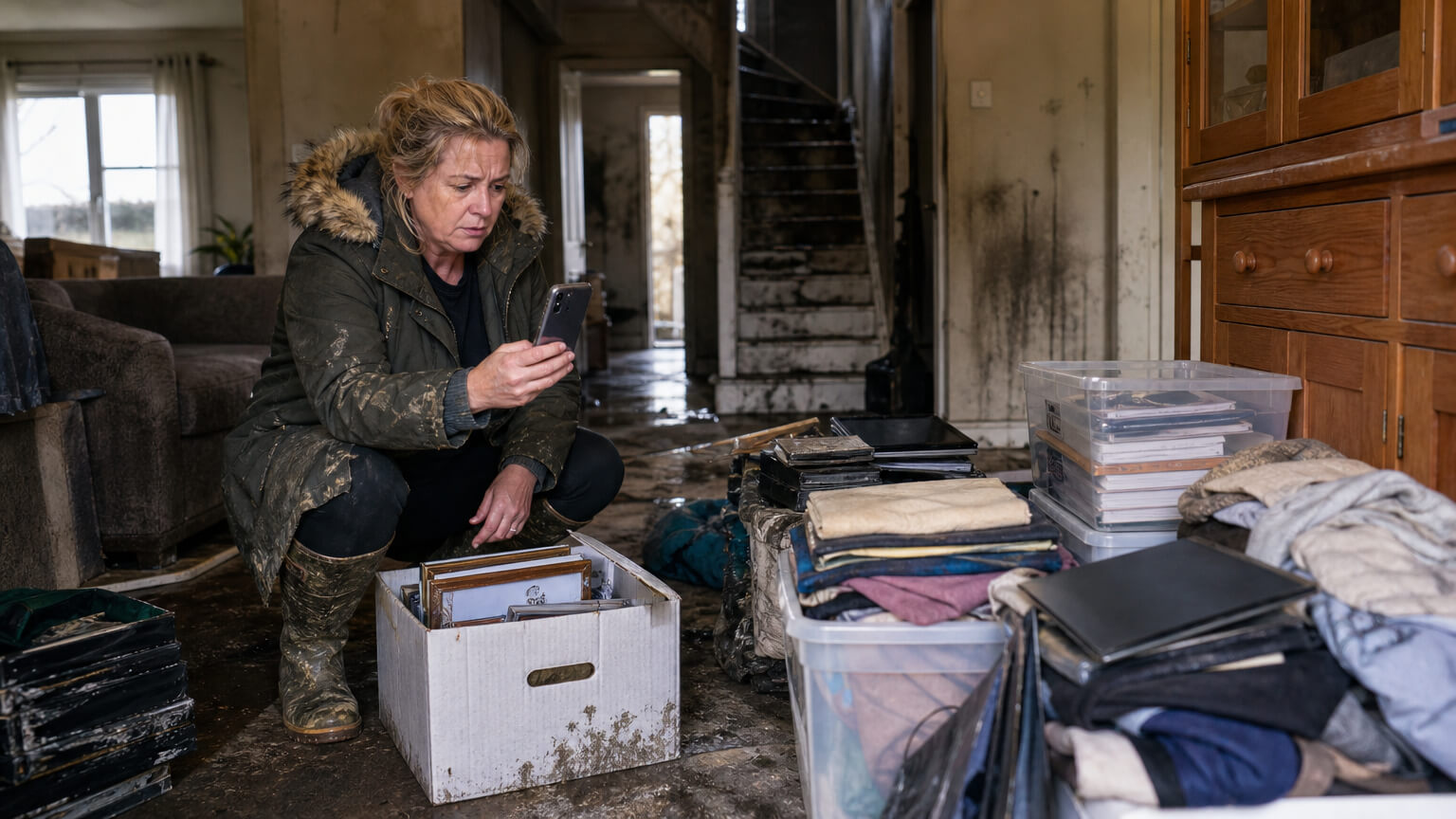
Before a single box leaves the house, three things need to happen in order: make sure the property is safe, tell your insurer, and document the damage. Get those right and everything afterwards is simpler. Rush them and you risk your safety and your claim.
Make the property safe before you go back in
Do not re-enter a flooded or fire-damaged home until the right people have said it is safe. Floodwater can hide structural damage and contaminate everything it touches, and it can make electrics lethal. Fire weakens structures and leaves air that is not safe to breathe. Let the fire service, your insurer, or a qualified professional give the all-clear first. The official flood recovery advice on GOV.UK and the support pages at the National Flood Forum set out the safety steps in detail, and they are worth reading before you act.
Call your insurer before you move anything
Ring your insurer as soon as you safely can, and before you start moving belongings out. They may need to assess the damage, or send a loss adjuster, and moving things before the damage is recorded can complicate your claim. Ask them what they need from you and whether they cover the cost of storing or moving your contents while the home is repaired. We will come back to that question later. For now, the rule is simple: speak to them first.
Photograph, list, then move
Before anything leaves the house, photograph it. Every room, every damaged item, every wall. Then make a simple written or phone list of what you are taking out and what is staying. It feels like a chore in the middle of a crisis, but this record is what supports your claim, and it is far easier to do now than to reconstruct later. Photograph first, list second, move third.
What you can save, and what you should not put into storage
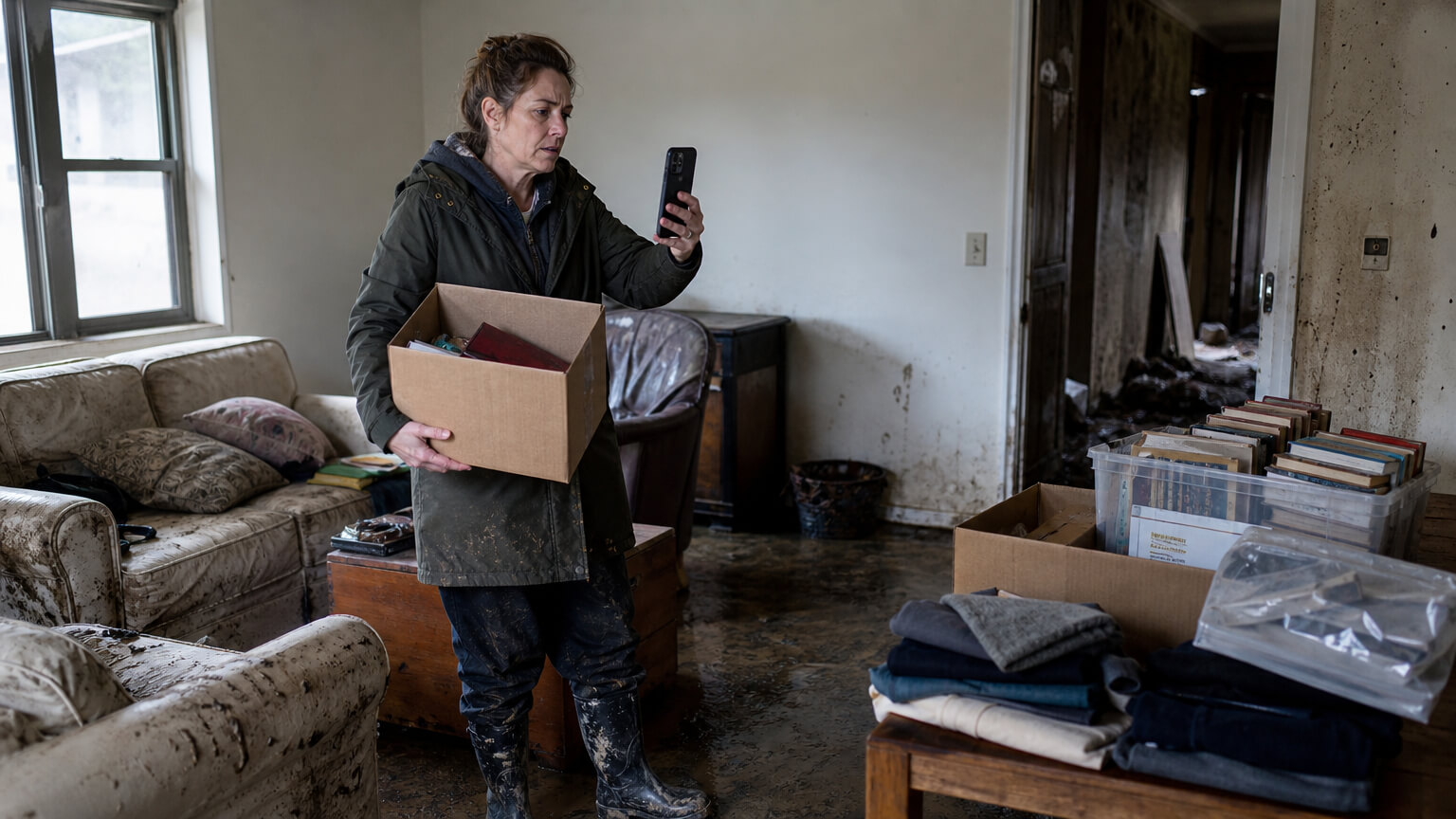
The clear line is this: only dry, clean, undamaged belongings should go into a storage unit. Anything wet, contaminated, or smoke-soaked needs dealing with first, because it will spoil in store and can damage everything around it.
Dry and intact: what is safe to store
Furniture that stayed dry, clothing that has been washed and properly dried, books and documents in sealed boxes, and electronics that a professional has checked and confirmed are dry, can all go into a clean, dry unit. These are the things you want out of a damp or smoke-tainted house quickly, so they are not sitting in harm’s way while the building is dried and repaired.
Wet, contaminated, or mould-touched: what must not go in
Nothing wet or contaminated goes into a storage unit. Damp items grow mould in a closed space and pass it to clean belongings stored nearby. Anything touched by floodwater carrying sewage or chemicals is a health risk and should be assessed, cleaned, or disposed of, not boxed up. This is also why most contents-protection policies exclude mould and damp damage. Storing wet goods does not pause the damage, it spreads it.
Items that need a professional look first
Some things sit in between. Electronics, upholstered furniture, and anything with soft padding that has been exposed to water or smoke should be assessed by a restoration specialist before you decide to keep and store them. We are storekeepers, not restorers, so we will not pretend to judge whether your sofa can be saved. Your insurer or the National Flood Forum can point you to firms that do exactly that.
Why the first couple of days matter
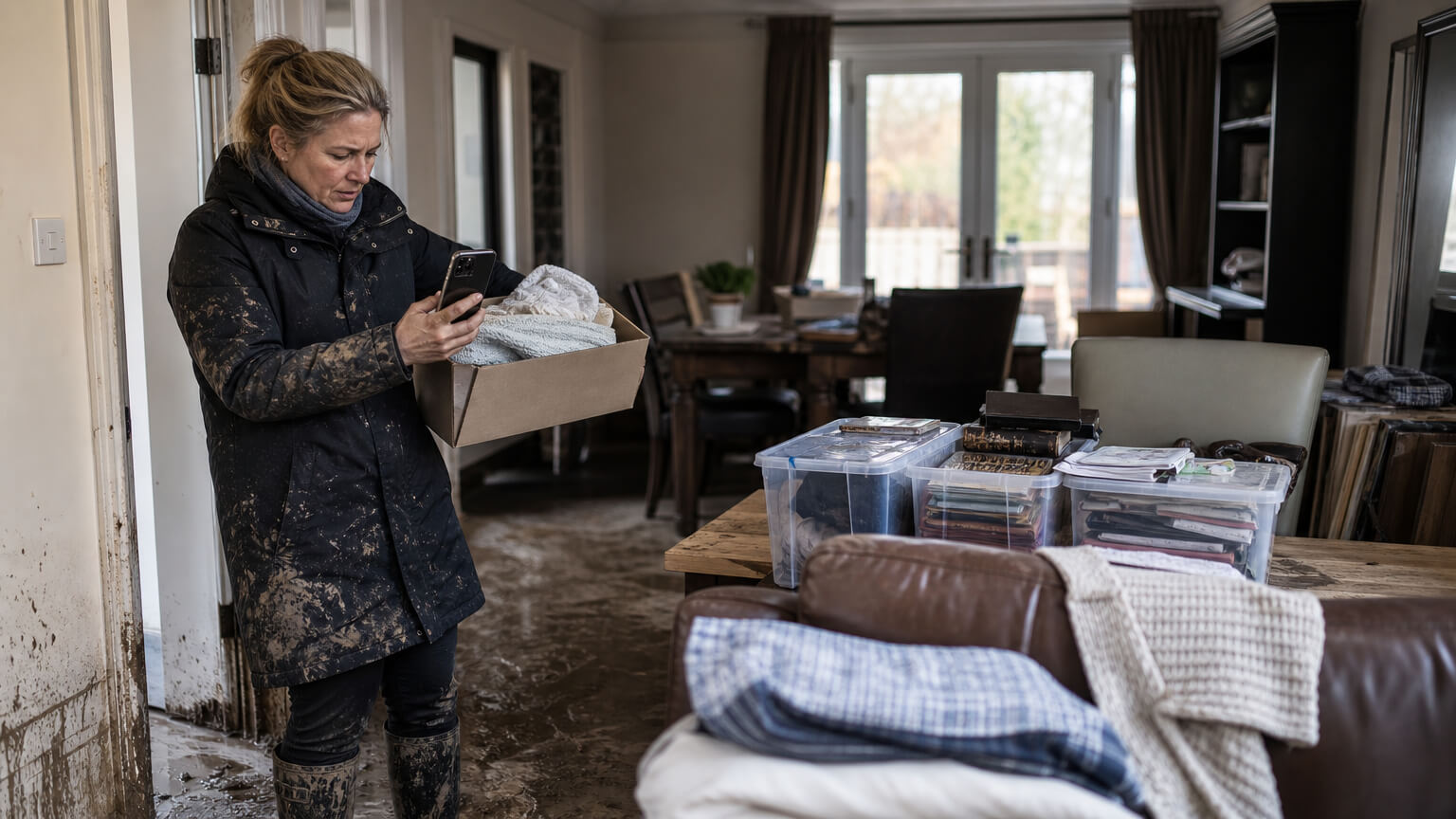
Here is the part people often do not calculate: the damage does not stop when the water drains or the fire is out. In a damp, still space, mould can begin to take hold within a day or two, and smoke odour bonds into fabrics and soft furnishings over the days that follow. Getting your dry, salvageable belongings out of that environment quickly is not a convenience, it is salvage.
How damp and mould spread once the doors are shut
Mould spores are present in almost any indoor air. Moisture is what wakes them up. In a closed, unheated room full of damp belongings, growth can appear quickly and then spread from item to item. That is the real reason to move dry goods into a clean, dry unit promptly, and the real reason never to put a damp item in alongside them.
Smoke and odour after a fire
Fire leaves a similar hidden clock. Smoke odour works its way into textiles, curtains, and upholstery over days, and items stored together can pass that smell between them. Where possible, have smoke-affected soft furnishings assessed and treated before they go into storage, and keep anything still carrying odour separate from clean goods.
Getting dry goods into a clean, dry unit
This is where a storage unit earns its place. A clean, dry, individually alarmed unit takes the time pressure off the belongings themselves, so you can focus on the house. Our quote form is open from 6am, and smart entry runs from 6am to 10pm, seven days a week, so you or your removal team can bring things in at a time that works around the people drying and repairing your home.
How emergency self storage works, and how quickly you can start
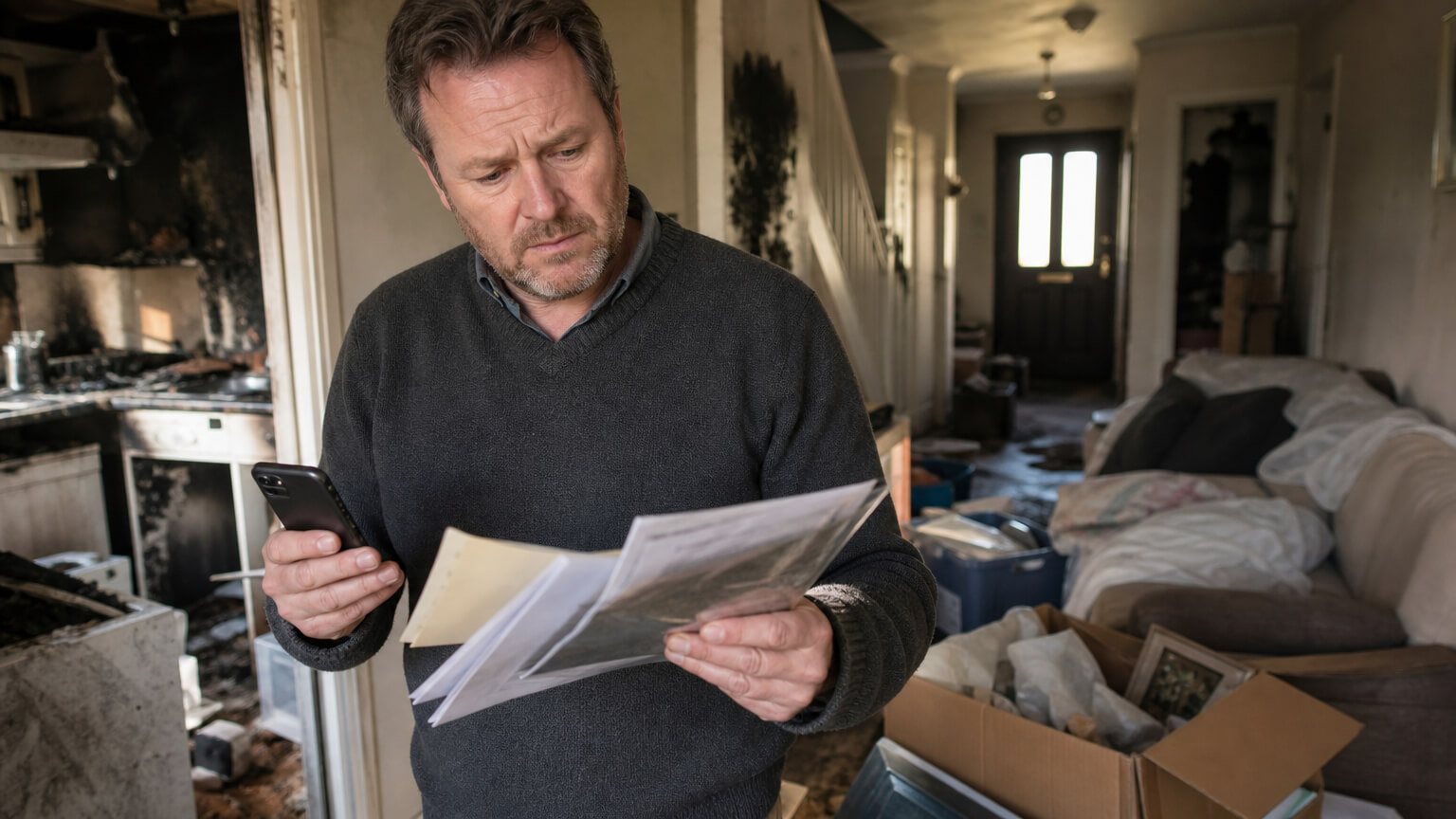
People often assume storage takes days to arrange. It does not. You can get a quote online in minutes and have a unit ready at short notice, without waiting on office hours.
From quote to unit
Get a quote at quote.wigwamstorage.co.uk and we can have a unit ready quickly. Our sites are unmanned and you access your own goods with smart entry, so you are not waiting for a staffed handover that only happens nine to five. It is built to be fast and to fit around a difficult week.
What size unit you are likely to need
A flood or fire rarely means storing a whole house, because some of it cannot be saved and some stays put. As a rough guide, the salvageable contents of a two to four bedroom home fit a mid-sized unit, but the honest answer depends on how much survived. We will size it with you rather than have you guess. There are no prices on this page, but our guide to how much self storage costs in the UK explains how it works.
Access and deliveries while repairs run
You reach your unit with smart entry, 6am to 10pm. Our sites are unmanned, so if a removal firm or restoration team is bringing things in, someone from your side needs to be there to receive them. We do not sign for or take in deliveries on your behalf. Knowing that in advance lets you plan the day around the people doing the work.
Storing while the claim and the repairs run: flexible by design
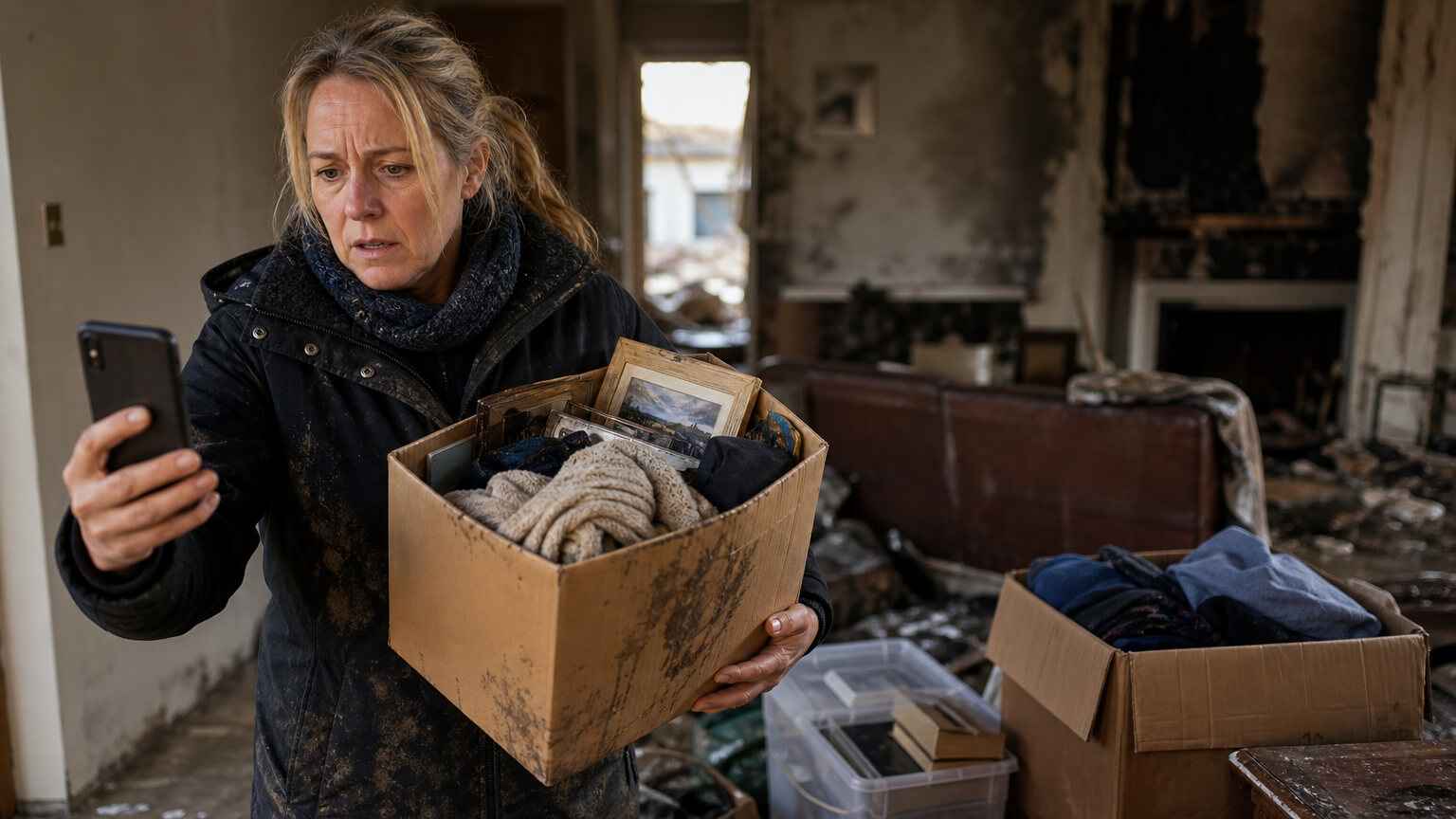
The hardest thing about storage after a flood or fire is that you rarely know how long you will need it. Repairs can take months, and dates slip. So the terms matter as much as the unit. Ours are built to flex around an unknown end date rather than punish you for it.
Why a flexible end date matters
Flood and fire repairs commonly run from a few months to the best part of a year, and timelines move. A contract that charges you for a fixed block, or penalises an early exit, is the wrong fit for this. With us you give 14 days’ notice when you know your repairs are finishing, and if you leave early, the unused days are refunded. You are not betting on a date you cannot control.
The two-week minimum, and no deposit
There is a two-week minimum stay, which suits a short decant and never forces a long commitment. There is no deposit either: you give 14 days’ notice, and once you have moved out and the account is settled, any unused days come back to you, less anything owed. The full detail is on our terms and conditions page.
Planning your move back
When the repairs are done, give your 14 days’ notice, plan your removal team in advance, and check your belongings as you load them out. A calm exit is the mirror of a calm decant, and by then the worst is behind you.
Need a unit now? Get a quote at quote.wigwamstorage.co.uk, or find your nearest site on our storage locations page. We can have a unit ready at short notice.
Contents protection: what is covered and what to declare
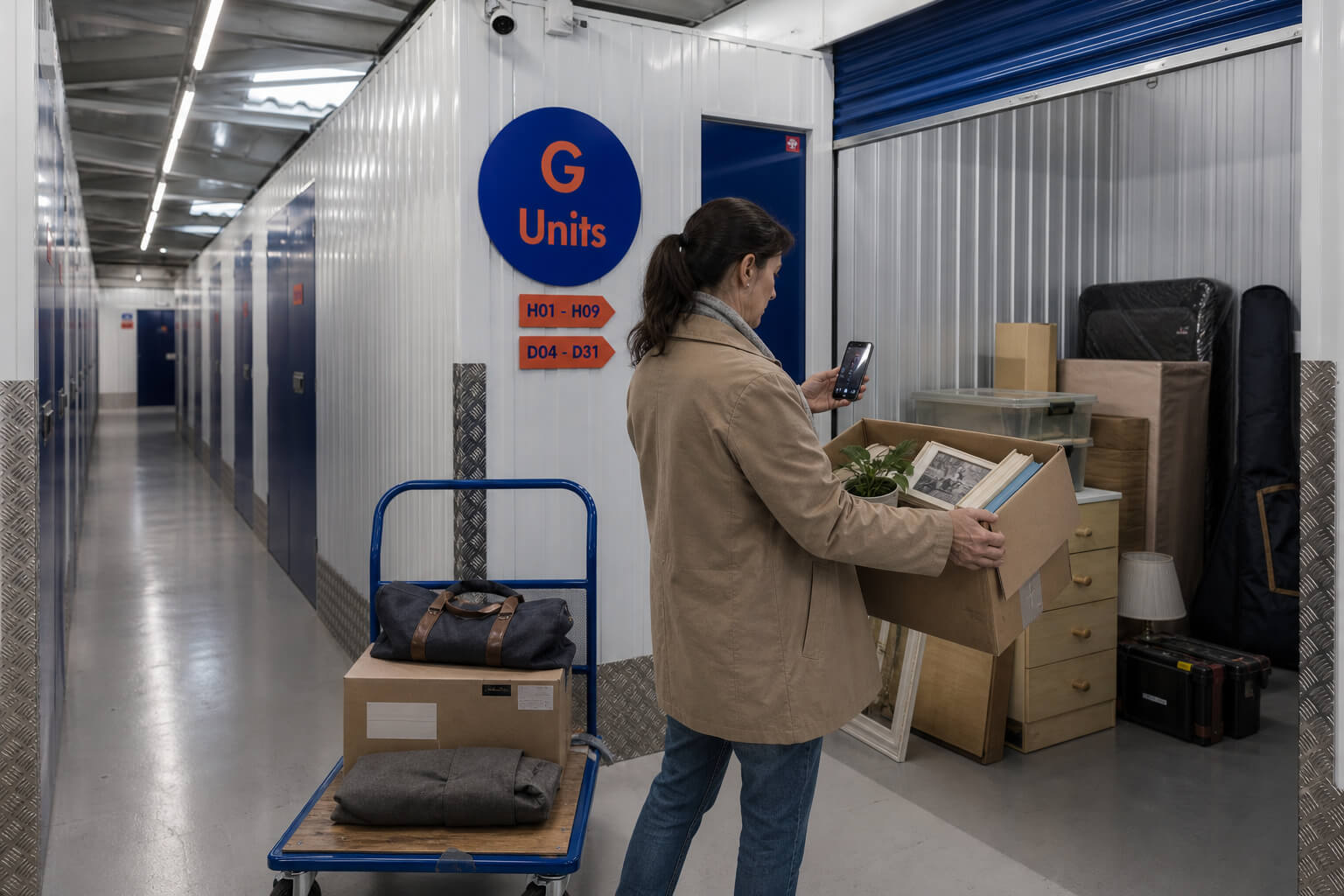
Your belongings should be covered the whole time they are with us, and cover is not optional. The facts here are simple, but the detail belongs to your policy, so we will set out the shape of it and point you to the right page rather than give you advice.
Wigwam’s contents protection
Cover is required while your goods are in store. You can take our own contents-protection policy or prove you have your own cover in place. Declare the full replacement value of what you are storing, because if you under-declare, any settlement is reduced in proportion. The detail is on our contents protection page.
Exclusions worth knowing
Standard contents-protection policies typically exclude mould and damp damage, and theft cover usually depends on forced entry. That is the practical reason, again, that only clean, dry items go into the unit. Check the policy wording for exactly what applies, because we cannot give insurance advice.
How storage costs may fit your home insurance claim
Some home insurance policies include cover for alternative accommodation or for contents while they are moved or stored, which may help with the cost of storage during a claim. Whether yours does is a question only your insurer can answer, so ask them directly. We can give you a clear invoice and documentation to support your claim, but we cannot promise that any cost will be recovered.
In England and Wales, the general position on home insurance claims, alternative accommodation, and recovering storage costs is broadly as described here. Scotland and Northern Ireland differ in detail, so for any legal question about your claim, speak to a solicitor qualified where you live, and confirm cover with your own insurer.
How a local team helps when everything feels uncertain

When your home is damaged and you are displaced, the last thing you need is a call centre and a postcode search. A local storage team is a person in a place you know, who has seen this before and will not make it harder.
Why local matters in an emergency
A unit near you is easier to reach when you are running between the house, the insurer, and wherever you are staying. And a local team can talk you through size and timing like a neighbour, not a script. In a week where little feels in your control, that steadiness is worth a great deal.
Our market-town locations
We run our sites in UK market towns. You can see them all on our storage locations page, and find the one nearest your home. If you are near Wigwam Self Storage Bath at /locations/bath-self-storage/ or Wigwam Self Storage Lincoln at /locations/lincoln-self-storage/, those are good places to start. Every unit is individually alarmed and kept clean, dry and secure.
A checklist for decanting your home after a flood or fire
Here is the whole sequence on one page, so you can work through it without scrolling back.
Before the removal team arrives
Photograph every room and item in place. Separate the dry, clean belongings from anything wet or contaminated. List the dry items for your claim. Confirm your removal team’s timing against smart-entry hours of 6am to 10pm, and remember someone from your side must be present for any delivery.
During the move
Label and list your boxes. Keep documents in sealed or waterproof boxes. Keep electronics separate and flagged as checked. Put nothing wet or contaminated in the unit. Keep a duplicate of your inventory.
Once it is in storage
Keep the invoice and your storage paperwork for the claim. Check the unit from time to time on smart entry if repairs run long. And when you are ready to move back, give 14 days’ notice; any unused days are refunded once you have vacated and settled the account. The full terms are on our terms and conditions page.
Ready to get things somewhere safe? Get a quote today at quote.wigwamstorage.co.uk. If you would rather talk through the size you need or your nearest location first, you will find us on our storage locations page.
Frequently Asked Questions
It needs to be genuinely dry all the way through, not just dry to the touch, because surface-dry items can still hold enough moisture inside to grow mould once they are sealed in a closed space. This is the single most important judgement after a flood, and it is worth being strict about. A wooden chair can feel dry on the outside while the joints and the underside are still damp. A washed and tumble-dried coat can carry moisture in the seams and the lining. Sealing either of those into a box and into a unit gives mould exactly the still, enclosed conditions it needs, and it can then spread to clean items stored nearby. When in doubt, leave it out and let it dry longer.
The practical test is patience plus airflow. Let salvaged items dry fully in a well-ventilated space, with air moving around them, for longer than feels necessary, and check the parts you cannot see, undersides, joints, linings, the inside of drawers. Textiles should be washed and completely dried before they go anywhere near the unit. Anything with soft padding or upholstery that has been wet is much harder to dry through and is better assessed by a restoration specialist before you decide to keep and store it. Hard, smooth items that have only been splashed and wiped down are the easiest to clear. The reason to be so careful is reinforced by the insurance position: the contents-protection policy, like most, excludes mould and damp damage, so if you store something not properly dried and it spoils, that loss falls on you. Take the extra day to dry things thoroughly. It protects both the item and everything stored beside it.
Yes, and a unit is a useful place to hold the salvageable, dry items while those decisions get made, provided you keep your insurer in the loop first. The order still matters: speak to your insurer before you move anything, photograph and list everything in place, and only then move the dry, clean items out. But once that documentation is done, you do not have to have made every keep-or-discard decision before you store. The clean, dry belongings can go into the unit and wait there, out of the damaged, damp or smoke-tainted house, while you work through the slower questions with the loss adjuster about what is being claimed, repaired or replaced.
What the unit must not become is a holding pen for things you have not decided about that are wet or contaminated. The dividing line does not move: anything damp, sewage-touched, chemically contaminated or smoke-soaked stays out until it has been cleaned, dried or assessed, because storing it spreads the damage rather than pausing it. So the decisions you can defer are the ones about dry, intact items, keep this, replace that, where does this go long term, not about whether to box up something that is still wet. Keep your inventory and photographs safe throughout, because they support the claim and they help you track what is where. The flexible terms mean there is no pressure to rush: the minimum stay is two weeks and the unit continues for as long as the claim and repairs take, with 14 days’ notice and a refund of unused days when you are done. That breathing room is exactly what lets you make sound decisions rather than panicked ones in the first chaotic week.
Yes, you can choose whichever location is most convenient for you, and if you are staying with family or in temporary accommodation some distance from the damaged home, a unit near where you are now may make more sense. Sites operate across UK market towns, and the right one is simply the one that is easiest for you to reach during a difficult period, whether that is close to the house, close to where you are sleeping, or close to whoever is helping you. You can find the nearest site on the storage locations page and pick accordingly.
There is a practical balance to weigh. A unit near the damaged house is handy while you are still salvaging and ferrying dry items out of the property. A unit near your temporary accommodation is handy for the weeks or months afterwards, when you want to get to your belongings without a long journey on top of everything else. If most of the salvage is already done and you are settling somewhere for the duration of the repairs, nearer to you is often the better choice. Either way, access is by smart entry from 6am to 10pm, seven days a week, so you are not tied to office hours wherever the unit is. One thing to plan for at whichever site you choose: the sites are unmanned, so if a removal firm or restoration team is bringing items in, someone from your side has to be present to receive them, because there is no staff on site to take in goods on your behalf. Beyond that, the choice of location is entirely about what reduces the running-around for you in a week when little else is in your control.
Yes, others can help with the physical work and can be given access to the unit, which is often a real relief when you are dealing with the house, the insurer and somewhere to stay all at once. After a flood or fire there is usually no shortage of willing hands, and there is nothing to stop a relative, friend or neighbour doing the lifting, the ferrying and the packing. The account stays in your name, so you remain in control of the arrangement, but you can arrange access for the people helping you so they can get to the unit by smart entry, between 6am and 10pm, seven days a week, without needing you there for every trip.
A few things keep it sensible. Because the sites are unmanned, if a removal firm, restoration team or courier is bringing goods to the unit, one of your helpers, or you, has to be physically present to receive them; there is no one on site to sign for or take in deliveries on your behalf. So coordinate the help around someone being there for any delivery. It is also worth keeping your inventory shared with whoever is helping, so the dry, clean items are the only ones going in and nothing wet or contaminated gets boxed up by mistake in the rush, since that would spread damage to clean goods. And keep the documentation, the photographs and the list, with you or backed up, because that is what supports your insurance claim regardless of who did the carrying. Accepting help is the right thing to do in this situation; the unit is set up so that the people around you can genuinely take some of the load, while you keep oversight of what matters.
When repairs finish you reverse the process calmly: plan your removal help in advance, give 14 days’ notice, and check your belongings as you load them out. There is no rush imposed from our side. Once you know roughly when the home will be ready, give the 14 days’ notice so the unit closes cleanly, and book whatever help or removal firm you need for the move back. If the repairs run long, you simply keep the unit on the same terms until you are ready; the flexible end date works in both directions, and you are never penalised for the timeline slipping.
As you load out, take the chance to check the condition of everything, partly for peace of mind and partly because it is the natural moment to confirm nothing has been affected during the stay. Lift lids on boxes, look over furniture, and make sure the items you dried and stored have come through well. Keep your storage invoice and paperwork even after you have moved back, because if any storage cost is being put towards your insurance claim, your insurer will want the documentation. Whether the cost is recoverable is a question only your insurer can answer, so confirm that with them directly; we can provide a clear invoice and records, but we cannot promise recovery. Once the unit is empty and the account is settled, any unused days come back to you, less anything owed. One last practical point that mirrors the move in: because the site is unmanned, you or your helper need to be present whenever a removal firm is collecting from the unit, as there is no staff on site to release goods on your behalf. A calm, planned exit is the right ending to what began as an emergency, and by that stage the hardest part is well behind you.