When the dust from the build reaches every room, where does the house go?
A loft conversion or a rear extension does not just take one room out of your house. The dust travels. The hall fills. By the end of the second week, you are stepping over boxes in the kitchen, the spare room is a furniture graveyard you cannot walk through, and the tradespeople are working around belongings that should not be there.
It settles eventually, of course. The build finishes, the dust settles, and your home comes back to itself. But getting there is a whole-house problem, not a spare-room problem. And that is what this article is about.
If you are planning a loft conversion, an extension, or a substantial knock-through, and you are wondering where everything goes in the meantime, the following should help you work it out calmly, practically, and without committing to more than you need.
Why a building site and a full house do not mix

The disruption always spreads further than the floor plan suggests. A loft conversion starts in the roof space, but it quickly pulls the bedrooms below into chaos too, as the dormer goes in and the staircase is rerouted. An extension that opens the back of a house sends dust through every room not sealed off, and sealing off rooms is easier said than done on a working building site.
Dust, paint and trade traffic, what really happens to your furniture
The risk to your belongings during a major build is real. Dry wall dust is fine and pervasive. It settles inside drawers, behind glass, and into upholstery. Paint overspray from internal finishing work reaches further than you would expect, especially with a spray gun. Trade foot traffic on a long job means heavy boots, tool bags, and materials moving through spaces where your dining table or your bookshelves are still sitting.
Most good tradespeople are careful. But a long build is a busy environment, and a scratch on a piece of furniture that has been in the family for thirty years is not something anyone can undo. The practical answer is to move the things that matter before the first wall comes down, not after the first thing gets damaged.
It is worth being clear about what clean, dry and secure units actually do for you here. They are not climate-controlled environments, and we do not claim otherwise. But they are dry, individually alarmed, and separate from the building site. Your furniture is not competing with a skip, a concrete mixer, or a succession of site deliveries. For most household goods in good condition, that is exactly the protection you need.
Why the garage or the spare room is not the answer
The garage is the obvious first thought. But most residential garages are damp, and most of the time they fill up faster than expected. By the time a major build is running at full pace, the garage has often become a second staging area for materials, and the car has been evicted anyway. What was meant to be temporary storage for the sofa has become a jumbled room you cannot navigate.
The spare room goes first. It fills in week one, before the build has properly started, and then it stays full for the duration because there is nowhere to cascade goods to. It is also not lockable against a whole team of tradespeople moving through the house.
A container on the driveway is sometimes the right answer, but it has its own complications: planning permission in some cases, driveway width and access, weather ingress through imperfect seals, and the difficulty of getting into it mid-build without pulling everything out. It is also a fixed size you choose on day one, when you know least about what you will actually need.
A self storage unit nearby removes all three of those problems. It is dry, separately secured, correctly sized for what you are actually moving, and you can access it whenever you need to.
What to store and what to leave behind
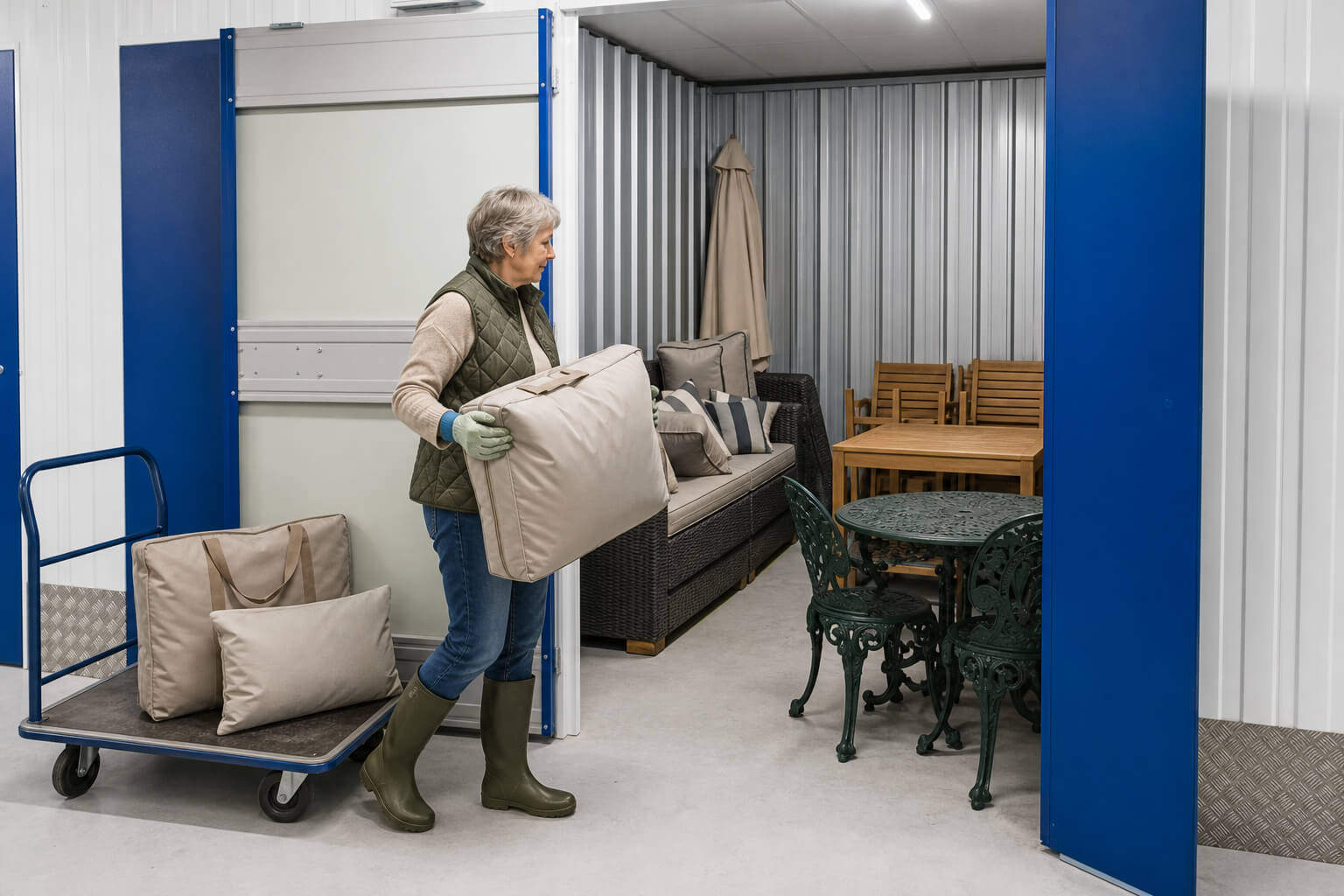
Not everything has to go. Deciding what moves into a unit and what stays behind is worth doing deliberately, before the first skip arrives. The right framework is to clear anything that is either at risk from the build environment or in the way of the tradespeople doing their best work.
Room by room, the loft conversion case
A loft conversion typically displaces goods in phases. The loft contents go first: stored items, old furniture, archived boxes. Then the bedrooms directly below become semi-accessible as the dormer goes in, the ceiling is opened, and scaffolding obstructs the windows. Landing furniture and anything on the upper staircase needs to move for the staircase works, and often for the safe movement of materials.
By the mid-point of a typical loft conversion, the entire upper floor is a site area. If there are children in the house, the displacement pressure pushes downstairs too, as temporary sleeping arrangements are made and rooms are reshuffled. The kitchen and ground floor hold out longest, but dust does not observe floor plans.
As a general guide: clear the loft entirely before work starts, plan to move the upper-floor bedrooms at the start of the dormer works, and review the landing and stairwell once the stair route is confirmed. Move more rather than less; the tradespeople will work faster in clear space, and the risk to your goods is lower.
Room by room, the extension or knock-through case
A rear extension attacks the kitchen, the utility, and often the ground-floor living area. The knock-through variant opens an interior wall, which takes out a room’s worth of floor space and spreads dust throughout the ground floor during the structural phase. These jobs do not displace a bedroom or a loft; they displace the parts of the house your family uses every day.
Kitchen contents are the first priority in an extension job. Crockery, appliances, and food storage are not compatible with a working building site. If the extension opens into a living area, the furniture and soft furnishings in that space need to go before the structural work starts. Dust sheets help at the margins, but they are not a substitute for the goods not being there at all.
The case for moving more is the same as above. A living room sitting empty gives tradespeople room to work without the stress of working around the armchairs. It also means your armchairs come back undamaged. The upfront effort is worth it.
The biggest item you are worried about, sizing from that piece out
Start with the item you are most worried about: the Victorian dresser, the dining table, the piano, the large wardrobe. Measure it. That measurement tells you a great deal about what size unit you need, because a unit that comfortably fits your largest piece will almost always fit everything else with sensible packing around it.
As a rough guide, a two-bedroom home clearing most of its upper floor into a unit typically fits in a 50 to 75 square foot space. A three-bedroom or four-bedroom period property clearing multiple floors will generally need 100 to 150 square feet or more, depending on how much furniture and how many stored items are involved. These are indicative ranges only; the sizing section below gives a project-by-project breakdown, and the most accurate estimate comes from getting a quote.
What size unit for a whole house

The sizing question sits at the heart of the planning conversation, and it is the one most people get wrong by underestimating early and overcommitting late. The principle is straightforward: size from your largest item out, add a working corridor inside the unit, and add a margin for the items you have forgotten about until you actually start loading.
Rough size guidance by project type and home size
These are guidance ranges, not quotes. Actual availability and pricing depend on location and unit configuration.
| Project type and home size | Indicative unit size |
|---|---|
| Loft contents only (any house size) | 25 to 50 sq ft |
| Upper floor of a 2-bed flat or terrace | 50 to 75 sq ft |
| Two or three rooms of a 3-bed semi | 75 to 100 sq ft |
| Whole upper floor of a 3 or 4-bed property | 100 to 150 sq ft |
| Whole-house clear for a 4 or 5-bed period home | 150 to 200 sq ft or larger |
These figures assume reasonable furniture volumes and do not account for unusual items like grand pianos, full-length wardrobes, or extensive workshop equipment. If you are in any doubt, size up by one bracket. You can always consolidate once you see what fits; you cannot create floor space that is not there.
Ready to get a size and price? Get a quote for storage near your home at quote.wigwamstorage.co.uk.
How to pack so a small unit holds more
Packing well is the difference between a unit that holds your whole upper floor and one that holds half of it. A few practical principles that make a genuine difference:
Flat-pack what can be flat-packed, and stand it vertically against the back wall. Bed frames, table leaves, and cabinet doors take a fraction of the floor space when stored upright. Stack horizontally only when the item has no vertical option.
Load the heaviest items first, at the base. Sofas and mattresses on their sides free up floor area considerably. Wardrobe boxes are worth using for hanging clothes and lightweight textiles; they keep garments in good condition without creasing or folding, and they stack.
Label every box on the side, not the top, so you can read the label when boxes are stacked. If you are likely to need access during the build to retrieve specific items, load those last so they are closest to the unit door.
Leave a central working corridor in the unit. You will go back more often than you expect during a long build, and a unit you cannot navigate costs you time and stress every visit.
How long will you need it, and what it costs

One of the honest advantages of self storage over most build-site alternatives is that the terms flex around the actual job, not the job as quoted.
Two-week minimum stay and the refund of unused days
There is a two-week minimum stay. That is the baseline commitment. After that, if the job finishes earlier than planned and you have vacated, unused days are refunded. This matters on a renovation because builds overrun more often than they finish early, but when they do finish early, you should not be paying for a unit you are no longer using.
This is stated plainly because it is a genuine difference from the way many storage companies operate. You pay for what you use, beyond the two-week minimum.
No deposit, and the 14-day notice explained plainly
There is no deposit. Nothing is held back when you book, so there is nothing to reclaim. Any days you have paid for but not used are refunded after you have given 14 days’ notice, vacated the unit and settled the account, less anything owed. The notice period is the industry standard and is there for straightforward operational reasons.
The full terms are on the Wigwam terms and conditions page. It is worth reading them before you book, as you would with any storage agreement.
Where to check current prices
Prices depend on location and unit size, and they change. We do not quote prices on this page because a number here may not reflect what is available at your nearest Wigwam location on the day you are looking. The pricing page gives current rates by location and unit size. Use that as your planning number.
Keeping your furniture clean, dry and secure

This section covers what you can rely on the unit to do, and what you need to do yourself to make sure your goods come back in the same condition they left.
How Wigwam units protect your goods
Wigwam units are clean, dry and secure. Each unit is individually alarmed. That means your belongings are in a controlled, dry environment, with a separate alarm on your specific unit, not just a shared perimeter alarm on the building.
What the units are not: climate-controlled. We do not offer temperature or humidity management, and we do not imply it. For the great majority of household furniture, clothes, books, and general belongings, clean, dry and secure is the correct level of protection during a renovation. A unit that is dry and alarmed is not a building site.
If you are storing items that are genuinely sensitive to temperature variation, such as certain musical instruments, specialist wine, or fine art on panel supports, those may need specialist conditions that go beyond what a standard self storage unit provides. Be honest with yourself about what you are storing, and discuss it with your insurer.
Protecting your goods, covers, lifting and declaring value for contents protection
The unit does its part; you do yours. Use furniture covers and good quality dust sheets on upholstered items and polished surfaces, even though the unit is clean. Wrap mirror glass and picture frames. If you are moving a piano or a large wardrobe, use professional removal assistance rather than relying on the build team. The cost is small relative to the value of the piece.
Contents protection is mandatory. You can take Wigwam’s RSA Self Storage Customers’ Goods policy, or you can prove your own cover. Either way, you must declare the full replacement value of everything in the unit. Under-insurance is settled in proportion under the RSA policy: if you declare half the value and make a claim, you receive half the claim value. Declare what the goods would actually cost to replace at today’s prices, not what you paid for them years ago.
The contents protection page explains the policy and the options. Read it before you move in.
A note on jurisdiction: The RSA Self Storage Customers’ Goods policy is governed by the law of England and Wales. If you are based in Scotland or Northern Ireland, insurance regulation and contract law differ in ways that may affect your position. Confirm your cover with your own insurer or broker before storing. This article does not constitute insurance advice.
Access, deliveries and your builders

The access arrangements are practical and worth understanding before the first load goes in, particularly if you are coordinating a removal team or expecting a builder to retrieve something on your behalf.
Smart entry 6am to 10pm, you access your own goods
Access to your unit is by smart entry, seven days a week, from 6am to 10pm. This covers the full working day comfortably: you can be there before the tradespeople arrive at your house, and you can make an evening run after they leave. It is not 24-hour access, and we do not claim it is. For most renovation projects, the 6am to 10pm window is more than sufficient.
You access your own goods. The unit is yours for the period you have booked it; the access system lets you in and out within the hours above.
Builders, couriers and deliveries, what you need to know
Wigwam sites are unmanned. That is important to understand clearly before you start coordinating with a building team.
Wigwam does not sign for deliveries. Wigwam does not receive items on your behalf. If a builder, a courier, or a delivery driver is going to drop something at your unit, someone from your household or your team must be present. You cannot arrange for a delivery to happen at the unit while you are not there and expect it to be handled.
This is not a limitation unique to Wigwam; it is how almost all self storage sites work. State it plainly to anyone involved in your build who might assume otherwise, and plan the access visits accordingly. If you know you need to retrieve a measurement or a specific piece mid-build, arrange to go yourself, or arrange for a trusted person from your side to be there with you.
Finding a Wigwam unit near your market town

One of the practical advantages of Wigwam over national chain storage is that the units are in market towns, not on ring-road industrial estates that are twenty minutes from your house by car.
Why a local unit makes the renovation easier
During a long build, you will go back to the unit more often than you expect. You need the specific lamp your electrician wants to see. You need the kettle and the cups because the kitchen is off. You need a measurement from the sideboard before the joiner cuts the alcove shelving. Proximity is not a minor convenience; it is a practical operational point.
A unit that is a ten-minute drive from your front door is one you will use well. A unit that is forty minutes away gets avoided, and avoidance costs you money and builds stress.
Wigwam Self Storage Bath serves Bath Somerset and the surrounding villages. Wigwam Self Storage Lincoln serves Lincoln Lincolnshire and the surrounding area. For the full list of our UK market-town locations, the locations hub shows every site with directions and contact details.
How to find and book your nearest location
Use the locations hub to find your nearest Wigwam site. Once you know which location suits, get a size and price at quote.wigwamstorage.co.uk. The quote tool covers availability and current pricing for the unit sizes at that location.
The two-week minimum stay applies from the day you move in. If you are co-ordinating with a removal company, fix the move-in date with them first, then book the unit. That way the unit is ready when the removal team arrives.
Full terms are at wigwamstorage.co.uk/terms-conditions.
Is self storage right for your renovation?
Most people reading this will already know the answer, but it is worth stating plainly.
When a unit is the right call, and when it might not be
Self storage during a major build is the right call when the house is genuinely full, the goods are worth protecting from a builder’s environment, and the build timeline is uncertain enough that you need flexibility. Loft conversions, rear and side extensions, full strip-backs, and substantial knock-throughs all meet that bar. You are displacing more than one room, the tradespeople need clear working space, and the alternative options (garage, spare room, container on the drive) all have material drawbacks for a job of this scale.
It is a less obvious call for a light redecorate or a single-room freshen-up. If you are painting the bedroom and your furniture fits neatly in the landing, you do not need a storage unit. If your garage is genuinely dry, genuinely secure, and is not going to become a second site area, it may serve you well for a small project. Be honest about which situation you are in.
The honest answer from our side: storage is a cost, and it should be a considered one. We would rather you know exactly what it does and does not give you than book in and feel it was the wrong choice.
Next steps when you are ready
Three plain steps:
- Use the locations hub to find the Wigwam site nearest to your home.
- Get a quote at quote.wigwamstorage.co.uk for the unit size that matches your project.
- Start the two-week minimum term when you are ready to move the first load in. The access hours are 6am to 10pm, seven days.
Ready to clear the house and give your builders room to work? Get a quote for storage near you at quote.wigwamstorage.co.uk.
Frequently Asked Questions
Yes, and it is the kind of thing worth doing before the work starts rather than after, though the specifics are a conversation for your insurer, not for me. Home insurance policies often carry conditions about major building work and about a property being left unoccupied or partly emptied for a stretch, and notifying your insurer of a significant renovation is generally the safe course. I am signposting here rather than advising: your insurer or broker is the right authority on what your particular policy requires.
What I can be clear about is the storage side. Once your goods are in a Wigwam unit, they need contents cover that is separate from your home policy. Contents cover is mandatory with us: you either take the RSA Self Storage Customers’ Goods policy or prove your own insurance covers goods held in self storage. So there are two cover questions running in parallel during a renovation, the house and the stored contents, and they are not the same policy. Sort both before the build begins.
The point that catches people out is assuming home contents insurance automatically follows their belongings into a storage unit. Sometimes it does, sometimes it does not, and the level may differ. That is exactly what to confirm with your insurer when you tell them about the renovation. Ask specifically whether goods in third-party self storage are covered and to what value, and if not, take the Wigwam policy for the stored items. The contents protection page sets out what the Wigwam option covers.
Yes, white goods store well in a clean, dry and secure unit for the length of a typical renovation, provided you prepare them properly before they go in. Drain the water from washing machines and dishwashers, defrost and dry out the fridge-freezer, and store everything upright. A washing machine on its side can damage the drum, so keep them all standing. Leaving fridge and freezer doors very slightly ajar in storage prevents the shut-up, musty smell that catches people out on reconnection.
The units are clean, dry and secure but not climate controlled, and that is fine for appliances over a normal build window. We do not claim temperature or humidity management, and white goods do not need it. What they need is to go in dry and empty and come out the same way. Pack any loose hoses, fittings and manuals into a labelled box with the appliance so reconnection is straightforward when the new kitchen is ready, rather than hunting for the right hose across a houseful of boxes.
Reconnection itself is a job for you or your fitter, not for the unit, but the storage end is simple. Because access runs 6am to 10pm, seven days a week, you can collect the appliances when the kitchen is at the stage of receiving them, rather than having to take everything back in one go. On a phased build that matters: you bring the white goods home when the plumbing and electrics are ready for them, and leave the rest of the contents in the unit until the room is finished.
Storing your belongings in a unit has nothing to do with whether your build needs permission, and it is worth separating the two clearly. Whether a loft conversion or extension requires planning permission, or falls under permitted development, and whether it needs building regulations approval, is a matter for your local authority’s planning department and your architect or builder. That is firmly outside what a storage provider can advise on, and you should confirm it with the right people before work starts.
Moving your furniture into a Wigwam unit is simply a household decision about where your things live during the disruption. It does not create any planning consideration of its own and does not change the status of your build either way. The confusion sometimes arises with containers placed on a driveway or the street, which can in some cases raise their own questions about siting and permissions. A drive-up unit at our site avoids that entirely, because the storage is at our location, not at your property.
So treat them as two separate tracks. Get the planning and building-regulations position confirmed for the work itself through your local authority and your builder. Handle the storage as a straightforward arrangement to keep your goods safe and out of the trades’ way while the approved work goes ahead. The support team can help with everything storage-related, sizing, availability, access, but planning permission for your renovation is not something they can speak to.
The same flexibility that let you clear the house in phases works in reverse, and a phased return is usually the calmer way to do it. As each room is finished and handed back, decorated, dried out, ready to live in, you bring its contents home and leave the rest in the unit. Smart entry runs 6am to 10pm, seven days a week, so you can do this in manageable trips that fit around work and family rather than blocking out a single chaotic day to empty the unit at once.
The labelling you did on the way in earns its keep here. If boxes are marked by destination room on the side, not the top, you can walk into the unit and pull just the kitchen boxes, or just the main bedroom, without disturbing everything else. Loading the things you would need first nearest the door, as the packing section suggests, means the order of retrieval roughly matches the order rooms come back to you. A unit with a clear central aisle is one you can work through in stages without it becoming a puzzle.
On the terms, a phased return does not complicate the exit. You keep the unit until the last load comes home, then give 14 days notice, clear it and settle the account. If you finish ahead of a paid period, unused days are refunded. There is no rush to empty the unit the moment the builders leave; take the time to bring things back as each room is genuinely ready to receive them.
Treat them the same way you treat the indoor furniture: get anything worth keeping out of the work zone and into the unit, and dispose properly of anything hazardous before it goes anywhere near storage. Extensions and groundworks often turn the garden, the side return and the patio into a materials yard and a route for diggers and barrows, so garden furniture, pots, tools and shed contents that you would normally leave outside are suddenly in the firing line. A clean, dry and secure unit keeps them safe and out of the way.
The important exception is anything flammable or hazardous, which must not go into a storage unit at all. Petrol for the mower, half-used cans of paint or wood treatment, gas bottles, weedkiller and similar garden chemicals are all prohibited, for safety reasons that apply across every operator. Groundworks are the natural moment to deal with these properly: use them up, or take them to the appropriate disposal point, rather than sweeping them into a box with the rest of the shed. The same goes for anything with fuel left in it.
One thing the unit cannot take is any vehicle or leisure item: no cars, motorbikes, caravans or boats. So if the groundworks mean the drive or garage is out of action and you need somewhere for a vehicle, that is a specialist service, not something a Wigwam unit covers. For the ordinary contents of a shed and garden, though, clean garden furniture and dry, non-hazardous tools store perfectly well alongside the household goods until the work is done and the outside space is yours again.