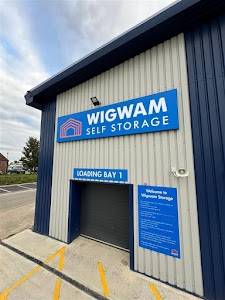
Posted abroad for a year or three — what happens to the whole flat?
Most storage advice is written for the person who is back next Saturday. Box a few things, find a unit nearby, done. That is not the decision you are facing.
You have a confirmed posting. One year, perhaps two, possibly three. You have a flat or a house full of belongings that cannot realistically come with you, that you cannot ask someone to hold for that long, and that you would rather not sell if you are coming back. You need to make this decision once, before you get on the plane, and then not think about it again until the posting ends.
That is what this piece is for. A plain plan, built around the unattended reality of a long overseas posting, with the honest details up front so there are no surprises from six time zones away.
What counts as long-term storage when you are working abroad

Long-term self storage has no formal industry definition, but for this use case it means one specific thing: you are not coming back next month. You are gone for a posting, and the unit needs to hold without you. That is a different category from someone storing a few chairs between flat moves. The planning that goes into it is different too.
One to three years is a plan, not an open-ended drift
The difference between a vague “I will sort it out eventually” storage arrangement and a proper one-to-three-year plan is structure. A plan has a clear start: you set it up before you go. It has a quiet middle: the unit runs without you, your nominated UK contact knows where everything is, and you are not fielding panicked calls from abroad. And it has a clean end: when the posting finishes, you give 14 days notice, clear the unit, and settle up.
That structure is what this piece walks you through. The two-week minimum rental is the floor; there is no ceiling. Your posting length sets the natural length of the plan.
Store, ship, or sell: the first fork in the road
Before you get to unit sizes and access codes, there is a decision that sits upstream of all of it: store, ship, or sell. Most people heading on a long posting work through some version of this conversation with themselves. The next section gives you the logic to settle it quickly so you can move on to the practical setup.
Store, ship, or sell: making the call before you go

Three options. Most people working abroad for a year or more land on one of them, often a combination of two, and it is worth thinking it through before the removal van arrives.
Why storing usually beats shipping for a fixed posting
Shipping a houseful of furniture and personal goods internationally is expensive, complicated, and in many cases pointless for a fixed posting. You would be shipping things to a furnished flat or temporary accommodation that has no room for them, paying insurance costs for goods in transit, navigating import paperwork in an unfamiliar jurisdiction, and then either shipping it all back or letting it go when the posting ends. For a two-year placement, none of that arithmetic tends to work.
Keeping goods in one secure, dry place at home removes all of that. The furniture is exactly where you left it. You have not sold anything you will need on your return. There are no customs complications. And the cost of monthly storage over a two-year posting is almost always considerably less than two international container moves.
We do not quote prices here because rates vary by town and unit size; the current prices page is the place to check what your town and size would run to. But the directional logic almost always favours storing for a fixed return date.
What is worth keeping and what is worth letting go
This is where it gets personal, and only you can settle it. But as a practical frame: furniture, sentimental items, books, kitchen equipment, things you will genuinely need when you walk back through the door. These are worth storing. Things that will be outdated, or have no sentimental weight, or that you would replace anyway on your return, are often easier to let go of now.
A few categories to keep out of the plan entirely. Storage units are for household goods; they are not for vehicles, caravans, motorhomes or boats. If you have a car or a campervan to deal with, that is a separate arrangement to make. Perishables and hazardous or flammable materials also stay out, as a matter of course.
The rest is a judgment call. A good guide is to ask yourself: if I came home to find this was gone, would I genuinely miss it, or would I quietly not care? Keep the first group. Let the second go.
Yes, you can store for one to three years – and here is exactly how the terms work

The answer is straightforwardly yes. There is no upper limit on how long you rent a Wigwam unit. The starting point is a two-week minimum stay, and from there the arrangement runs until you are ready to close it.
The two-week minimum, the 14-day notice, and why there is no deposit
Three things to understand before you sign up, because these are the mechanics that bookend the whole plan.
Two-week minimum. You commit to at least two weeks. For a one-to-three-year posting that is not a constraint at all; it is simply the floor.
No deposit. You pay no deposit when you set up the account, so nothing of yours sits with us for the length of the posting. When you return, give your 14-day notice to close, clear the unit and settle the account. Any days you paid for but did not use come back to you.
14-day notice to close. When you know the posting is ending and you are ready to clear the unit, you give 14 days written notice. That is your closing trigger. Clear the space, settle up, and the account closes cleanly.
One more thing worth knowing: if you return from the posting earlier than planned and close the unit ahead of schedule, unused days are refunded. An early homecoming does not cost you.
Full terms are set out at wigwamstorage.co.uk/terms-conditions.
Ready to sort the storage before you go? Get a quote for your town at quote.wigwamstorage.co.uk and we will take it from there.
Choosing a Wigwam town near your UK base
The question most people ask is: which town should I pick? The better question is: which town am I coming home to? Pick the Wigwam location nearest the address you are returning to, not necessarily the one nearest where you live right now. The unit is already waiting where you need it on the day you collect.
Pick the town you will come back to
If you are returning to Bath, Wigwam Self Storage Bath is the natural base. If you are coming home to Lincoln, Wigwam Self Storage Lincoln puts you close. For forces personnel on long postings, the Warminster Wiltshire area is worth noting as a location for the return journey.
For other market towns, the full list is at our UK market-town locations. We are not a city-centre chain. We sit in market towns, which is often exactly right for a customer coming home to a smaller town after a long posting.
The practical advice is to choose the location as part of your pre-departure planning rather than leaving it to work out remotely. Pick the town, get the quote, set up the account while you are still in the country. That way your nominated UK contact knows exactly where to go if they need to.
Right-sizing so you do not overpay for two or three years

The most common mistake is renting for what you have today. For a long posting, you need a size that holds for the full duration, including anything that might come out of a sublet flat, or items a family member drops off on your behalf partway through.
A unit that holds for the whole posting, not just month one
Think in room equivalents rather than box counts. A two-bed flat typically fills a medium unit. A one-bed flat plus the contents of a garage is a larger one. The specific guidance, with current sizes and what they typically hold, is on the current unit prices and sizes page.
The reason to get this right before you go is straightforward: changing the unit size from abroad is complicated. Over-renting slightly is usually the more comfortable option than cramming things in and creating problems you cannot deal with in person. Walk through everything you are storing, think about whether anything else might join it during the posting, and size to the whole plan rather than the first delivery.
What Wigwam does not store: a plain list
To save any confusion at setup: Wigwam stores household goods and personal effects. The following are outside what we offer.
- Vehicles of any kind, including cars, motorbikes, caravans, motorhomes and boats
- Perishable goods
- Hazardous, flammable or corrosive materials
- Anything prohibited under the terms of the rental agreement
If you are in any doubt, the terms and conditions cover what is and is not permitted. Most household contents fall well within the scope; it is mainly the vehicle and hazardous categories where people occasionally have questions.
Budgeting a one to three year stay

Cost over two or three years is a real question, and it deserves a straight answer. We do not quote prices on this page because unit rates vary by town and size. What we can do is give you the maths to work through once you have the current price.
How cost adds up over the months (and where to check current prices)
The model is simple: monthly rental, paid in advance. Take the current monthly rate for your town and size, multiply it by the number of months in your posting, and that is your running cost. There is no deposit to add at the start.
For a two-year posting at a typical mid-range unit size, the running cost is a meaningful but predictable sum. The key is that it is fixed in advance and transparent. There are no price escalations buried in the paperwork; the current prices by size and town page is where to check the current figure.
Unused days refunded: why an early return does not cost you
One thing worth knowing for anyone on a posting that might end earlier than planned: if you return ahead of schedule and close the unit before the end of a paid period, unused days are refunded. You are not locked into the month. That is a small but genuine relief for anyone whose posting end date is not entirely predictable.
Running it remotely: smart entry, nominated contacts, and what happens when something needs collecting

Most of your contact with the unit over a two-year posting will be none at all. It just sits there, and that is exactly the point. But when access is needed – by you briefly if you are in the country, by a nominated person, or by a removals firm collecting on your behalf – here is how it works.
Smart entry, 6am to 10pm, 7 days a week
Access is by smart entry, available from 6am to 10pm, seven days a week. That is not 24-hour access, and we are not going to dress it up as if it were. For a customer who will visit the unit rarely over the course of a two-year posting, or who will send someone in their place once or twice, 6am to 10pm is entirely workable.
The honest framing matters here. If you are going to hand a nominated person the details and ask them to deal with a collection while you are in another time zone, they need to know the real access window, not a rounded-up version of it.
Nominating a trusted UK contact
Before you fly, name a trusted person in the UK who can access the unit on your behalf. This might be a family member, a close friend, or a removal firm you have an ongoing relationship with. They will need to be authorised on your account.
There is one important thing to be clear about, and it is worth stating plainly. Our sites are unmanned. That means Wigwam does not sign for deliveries, accept goods on your behalf, or manage what goes in or out of your unit. If a removals firm is delivering to or collecting from your unit while you are away, someone from your own arrangement needs to be present. That could be your nominated UK contact. It cannot be a Wigwam staff member, because there is no Wigwam staff member on site.
For a long posting, the practical answer is to establish your nominated contact before you leave, walk them through the access process in person, and make sure they have everything they need. One conversation before departure is worth a dozen anxious messages from abroad.
Packing for two or three winters: protecting furniture and boxes for the long haul
A unit that is clean, dry and secure will protect well-packed goods for years. The packing is where the work happens, and doing it carefully before you go is significantly easier than unpacking a damp armchair on your return.
Clean, dry and secure: what the unit does (and does not) promise
Wigwam units are individually alarmed, clean, dry and secure. That is the genuine operational commitment. What the units do not offer is climate control; there is no temperature or humidity management, and we will not imply there is.
The consequence of that honesty is straightforward: good packing matters more than a climate-controlled promise would suggest. The insurance policy for goods in storage excludes atmospheric and climatic damage, which reinforces the same point from a different direction. The protection for your furniture and belongings over two or three British winters comes from how you pack, not from the unit managing the weather.
Two or three winters: the packing approach that matters
These are practical points, not a checklist of things to worry about.
Furniture: disassemble what you can before it goes in. Flat-pack where possible. Wrap upholstered pieces in breathable furniture covers rather than sealed plastic, which can trap moisture against fabric. Breathable is the word to remember.
Boxes: use sealed plastic boxes for anything in long-term storage rather than cardboard. Cardboard boxes can degrade over a couple of years; they also offer less protection if anything shifts in the unit. Label everything clearly with contents and a contact number.
Photographs: take a photographic record of the unit contents before you close it up. This is useful if you ever need to make an insurance claim, as a declared-value policy benefits from an accurate, evidenced record of what is stored.
Things to avoid: do not store damp or wet items. Do not store anything that cannot tolerate ambient temperature variation. Do not stack items in a way that puts significant weight on fragile things at the base.
None of this is complicated. It is the same common-sense packing advice that applies to any long-term storage, done a bit more thoroughly because the time horizon is two or three years rather than two or three months.
Insuring goods you will not see for years
Goods stored for two or three years need contents protection. This is not optional, and for a long posting it deserves proper attention before you go.
How the RSA policy works: New-for-Old, declared value, and the excess
Wigwam offers a Self Storage Customers’ Goods policy through RSA at sign-up. You can also use your own insurance if it extends to self-storage and you can provide proof. Either way, the unit needs to be covered from day one.
The key things to understand about the RSA policy:
New-for-Old: the policy replaces on a New-for-Old basis. That means full replacement cost, not current market value or what you paid for something years ago. Declare the value accordingly.
Declared value: you must declare the full replacement value of everything in the unit. If you insure for less than the actual replacement cost, any claim is settled proportionally. If the replacement value is GBP 20,000 and you declare GBP 10,000, a claim pays half. Under-insurance is not a technicality; it is a real financial exposure.
Excess: GBP 50 per claim.
Theft: theft claims require evidence of forcible entry. A missing item without evidence of forced access is not covered under this category.
Atmospheric and climatic damage: this is excluded. The packing guidance above is the practical response to that exclusion.
The full policy terms are at the Wigwam contents-protection page. Read the policy before you sign up; do not rely on this summary as insurance advice. If you have questions about whether a specific item is covered, or whether your existing home or travel policy extends to goods in self-storage, that is a conversation for your insurer or an independent adviser.
Jurisdiction note: insurance policy terms are governed by the RSA policy document. Readers in Scotland or Northern Ireland should confirm whether any referenced policy or legal framework applies to their jurisdiction. For legal or insurance questions specific to your situation, consult a solicitor or independent adviser.
Proving your own cover
If you have home insurance or another policy that covers goods in self-storage, you can provide proof of that cover rather than taking the RSA policy. If you cannot demonstrate adequate cover, Wigwam’s contents-protection option applies. Short and simple; the contents-protection page has the detail.
Planning the return: closing the unit cleanly
When the posting ends, closing the unit is the simplest part of the whole arrangement. You have already done the hard work. Now you just need to close it cleanly.
The 14-day notice, and what comes back
Give 14 days written notice that you are closing the account. Clear the unit. Settle the account. Any days you paid for but did not use are refunded, less anything owed. That is the complete sequence.
If you arrive home ahead of schedule and close the unit earlier than expected, unused days are refunded. The end of the arrangement is designed to be as plain as the start.
Full terms, including the notice procedure, are at wigwamstorage.co.uk/terms-conditions.
Coordinating the collection when you come home
The practical homecoming logistics mirror the departure. Access is still smart entry, 6am to 10pm, seven days a week. You or your removals firm collect from the unit. The sites are unmanned, so if the removals firm is collecting on your behalf, your nominated person or you yourself needs to be there. Nobody from Wigwam is signing off on a van full of your belongings; you or your representative does that.
The sensible sequence: give your notice, book your removals, make sure the person on the UK end has the access details, and collect on a day within the notice window. The unit is then empty, the account closes, and you pick up the thread of the life you left in storage.
If you are heading overseas and ready to sort this before you go, get a quote for your nearest town at quote.wigwamstorage.co.uk. Tell us what you are storing and how long the posting is, and we will take it from there.
Frequently Asked Questions
Sort the payment method before you fly, because that is the detail most likely to cause trouble from abroad. A UK direct debit from a UK bank account is the smoothest option, since it runs on its own each month and you never have to log in or remember a date. If you still have a UK account, set the direct debit going before departure and the payment side effectively looks after itself.
If you have closed your UK account, or you will be paying from an overseas card or account, raise this with the team at the point of booking rather than assuming it will work. Card payment arrangements vary, and it is far easier to confirm what is possible while you are still in the country than to discover a problem six time zones away. The team handles payment setup, billing and invoicing as part of normal storage administration, so this is squarely something they can help with.
Two practical safeguards. First, make sure we have an email address you will genuinely monitor while abroad, because if a payment ever fails, that is how you will be contacted, and a prompt response keeps a small issue small. Second, build the monthly rate into your posting budget from the start so nothing is a surprise. There is no deposit to budget for. What we cannot advise on is your personal banking or any tax implications of paying from overseas. For that, speak to your bank. We will keep the unit side simple.
It can, which is why getting the cover right from day one matters more than people expect. Contents cover at the unit is mandatory, and you have two routes: take the RSA Self Storage Customers’ Goods policy offered at sign-up, or prove your own policy extends to goods in self-storage. The mistake to avoid is assuming your existing home contents policy automatically covers things sitting in a storage unit for years. Many do not, or they apply different limits or conditions once goods are off your own premises.
So before you rely on your own cover, check the specific wording with your insurer. Ask plainly whether goods in commercial self-storage are covered, for how long, and up to what value. If the answer is unclear or no, take the RSA policy instead. Either way, declare the full replacement value, because under-declaring means any claim is settled proportionally.
A point that catches long-stay customers out: the RSA policy excludes atmospheric and climatic damage, which is exactly why the packing guidance in this article matters. Good packing is the practical defence against the one thing the policy will not pay for. We can set you up with cover and point you to the full terms at wigwamstorage.co.uk/contents-protection/. What we cannot do is give you insurance advice or tell you whether your own policy is adequate. That is a conversation for your insurer or a regulated broker, and over a two or three year posting it is worth having properly.
You can still close the unit, you just settle through the notice period rather than skipping it, so plan the timing as soon as you know your return date. The 14-day notice exists so both sides know when the unit is being given up. If your posting ends abruptly and you need out faster than that, the practical position is that the notice period still applies, but it is straightforward to manage, particularly if you have a nominated UK contact who can act for you.
Here is the calm way to handle a sudden end. The moment you know the posting is finishing, give your 14 days notice, even if you are still abroad. The clock starts then, not when you physically arrive home. Your nominated contact, or your removals firm with someone from your side present, can clear the unit within that window. By the time you land, the unit can already be empty and the account closing.
Remember too that unused days are refunded, so an early end does not mean losing money you have paid for. The combination of giving notice early and using a trusted UK contact is what turns a sudden recall into an afternoon’s admin rather than a crisis. The full notice procedure is set out at wigwamstorage.co.uk/terms-conditions/. The single best thing you can do before you fly is make sure one person in the UK is authorised and briefed, so that whatever the posting throws at you, someone can act locally.
It is your unit and your responsibility, so the honest answer is that sharing it with a family member is something to think through carefully rather than a casual cost-split. The account is in your name. You are responsible for the rental, for what is stored, and for the contents cover. If a family member adds their own belongings, those goods are still part of what sits under your account and your declared insurance value, which has real consequences.
Take the insurance point first. Contents cover is based on the full replacement value you declare. If someone else’s possessions go in and they are not reflected in your declared value, you risk under-insurance, which means any claim is settled proportionally and everyone loses out. So if you do share the space, the declared value has to cover everything inside, and you need to be comfortable carrying that responsibility.
On access, you can add a UK family member as a named, authorised contact, which is useful anyway for a long posting since it gives you a trusted person on the ground. That lets them get in by smart entry during the 6am to 10pm window. What the unit is not is a shared commercial arrangement we administer between two parties: there is one account holder, and that is you. If your family member needs significant separate storage, the cleaner answer is often a second unit in their own name. For a modest amount of shared family goods under one clearly declared value, sharing can work, as long as you both understand that it all rides on your account.
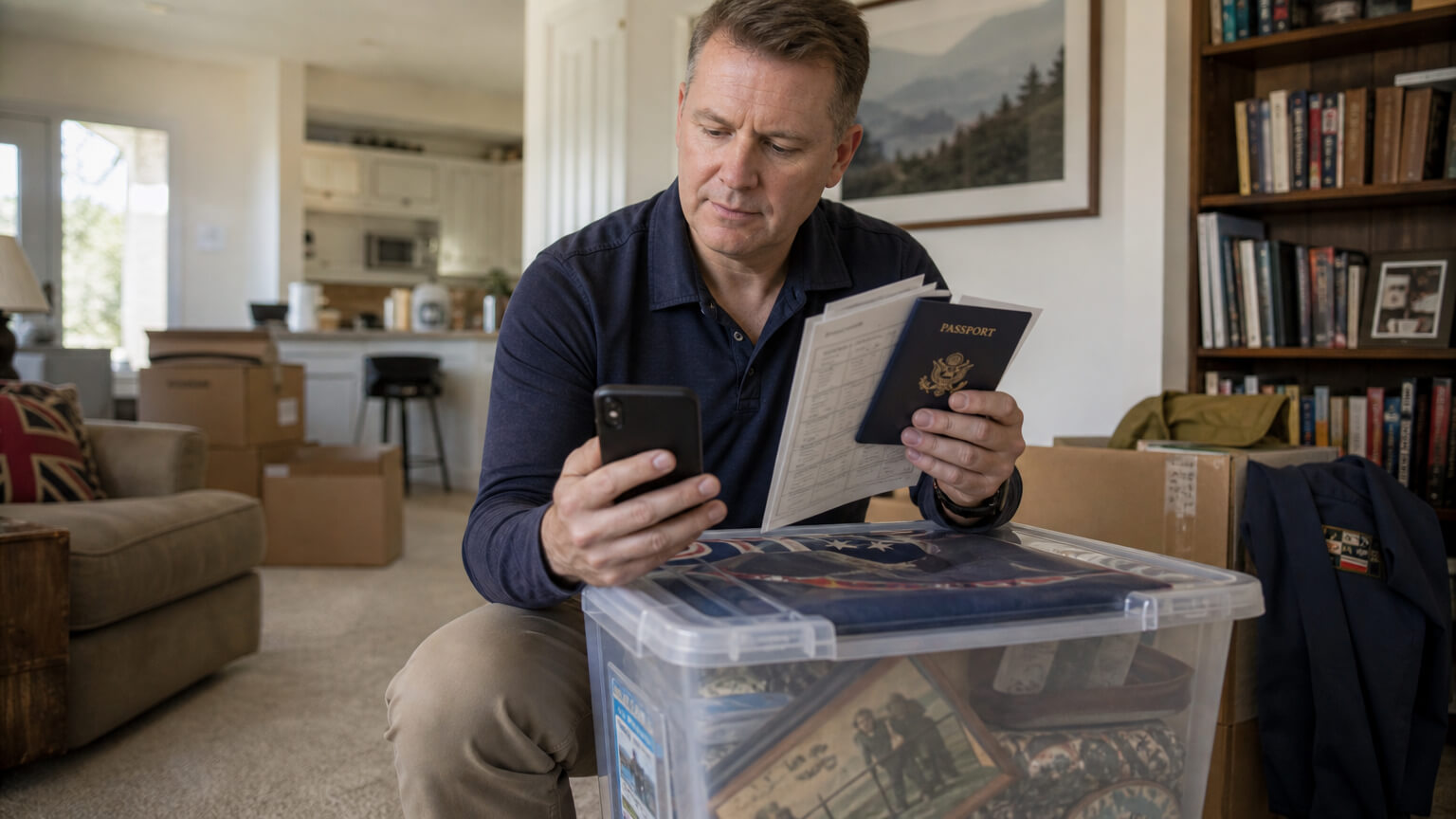
Yes, store the originals safely and keep digital copies you can reach from abroad, because the two solve different problems. Some documents genuinely should not be casually boxed and forgotten in a unit for years: passports you may need, anything required for the posting itself, and papers you might have to produce at short notice. Those travel with you or stay accessible. The unit is the right place for archive papers, records and originals you will not need to touch until you are home.
The smart habit, and it costs almost nothing, is to scan or photograph everything important before you pack it, and store those copies somewhere you can reach from any country: a secure cloud folder, plus a copy shared with your nominated UK contact. Then if a question comes up while you are abroad, “is the warranty in box nine or box fourteen”, you check the digital record instead of needing physical access to the unit.
This pairs neatly with the inventory advice elsewhere in this article: number your boxes, photograph the contents, and keep that list in two places. For the originals that do go into storage, archive boxes or folders keep them clean and dry, and a record of what is where means your UK contact can find a specific document and retrieve it during the 6am to 10pm access window if it is ever genuinely needed. Originals safe in the unit, copies in your pocket. That combination is what stops a stored document becoming a reason to fly home.