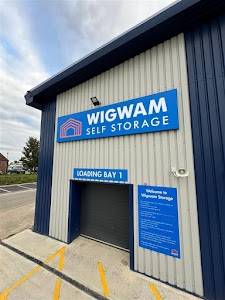
Everything you earn a living with, parked on a dark street all night?
Most tradespeople reach the same point eventually. The job wraps up, the van is packed, and somewhere on the drive home the thought surfaces: everything I need to earn a living is sitting in a box on wheels, on a street I do not own, in the dark. It is not a pleasant thought. Most people push it back down and get on with things.
This piece is for the moment you stop pushing.
Whether you have had a break-in, heard of one, or just costed up what a replaced kit would actually set you back, the question is the same: where else can the tools go? A self-storage unit near your patch is one answer, and it is worth understanding properly before you decide.
If your van was broken into last night, here is the immediate checklist:
- Photograph everything before you touch or move anything
- Report to police and get a crime reference number (your insurer will need it)
- Call your insurer before you clear up, move the van, or make any emergency purchases
When you are ready, here is how to make sure it does not happen again.
The garage most tradespeople do not have
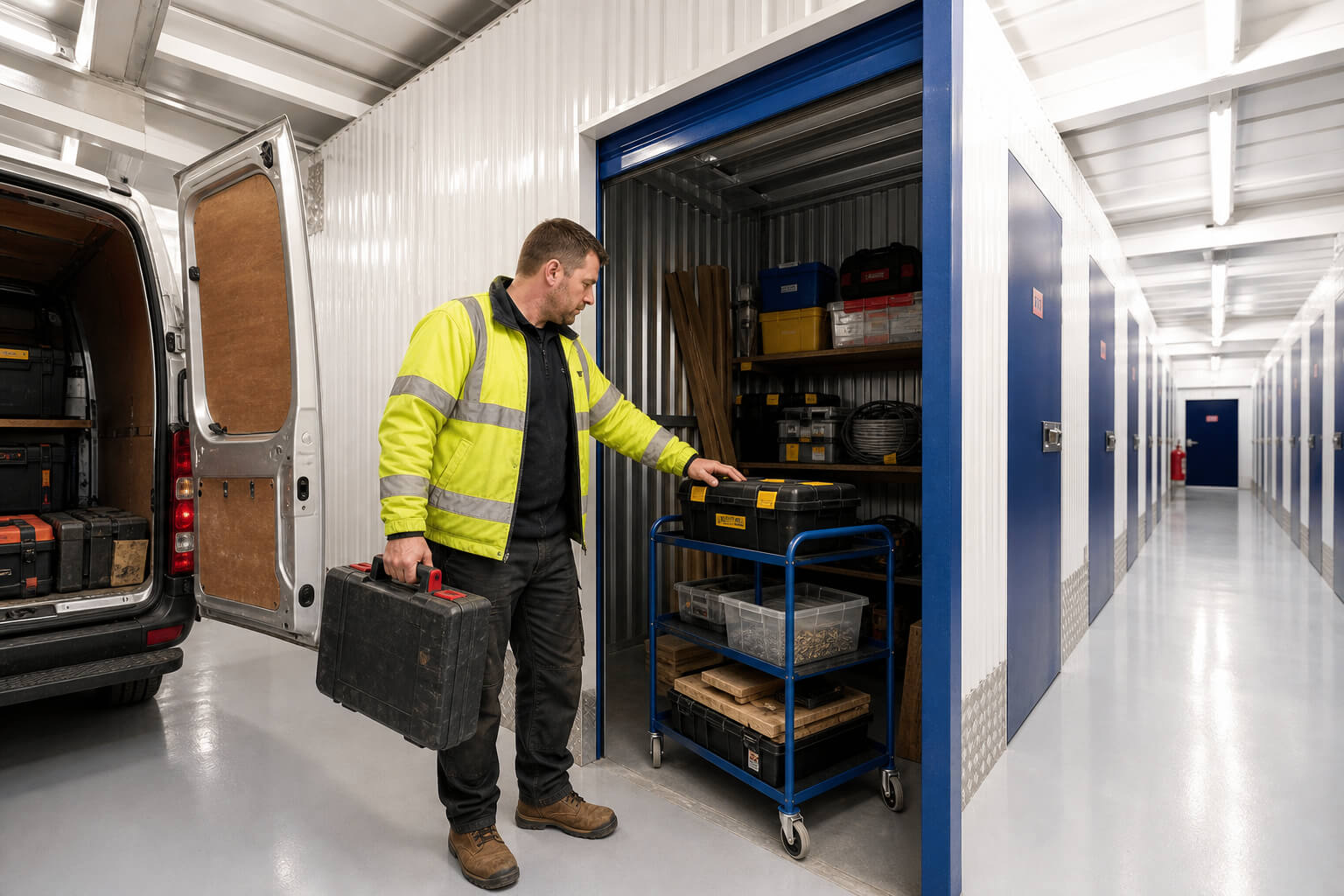
Most working tradespeople do not have a garage, a proper lock-up, or a workshop. That is not a personal failing; it is the practical reality for anyone renting, living in a terrace, or working from a market town where a commercial lock-up costs as much as a second van. The tools have to go somewhere, and that somewhere ends up being the van.
Why the van becomes the default overnight lock-up
The van is not a bad place for tools during the working day. You need them with you, the job sites change, and loading the van is part of the routine. The problem is that the van does not stop being a tool store at 5pm. It sits there overnight, fully loaded, and it is visible to anyone walking past. Tradesmen who rent rather than own, who live in flats, or who park on a shared street have no real alternative within their immediate setup. The van fills the gap by default, not by design.
That is the structural problem. It is not about carelessness. It is about the absence of a proper fixed base for the kit.
The risk that builds up quietly
Van tool theft is a consistent problem across the UK, and the financial exposure is larger than most people price in until it happens. A standard van lock can be defeated quietly and quickly. The tools are portable, sellable, and easy to move. What gets left behind is a broken window, a stripped van interior, and a morning where you cannot go to work.
The insurance position compounds the problem. Many van insurance policies restrict or exclude overnight tool cover, particularly if the tools are not in a locked steel security box or if the van is parked on a public road. The exact terms vary by insurer and policy (England and Wales law applies; policy terms in Scotland and Northern Ireland may differ; always read your own policy schedule and speak to your insurer or a solicitor if you are unsure). What tradespeople commonly report is discovering the exclusion at the point of a claim, not before. By then, the cost of that discovery is already running.
What van-tool insurance often does not cover
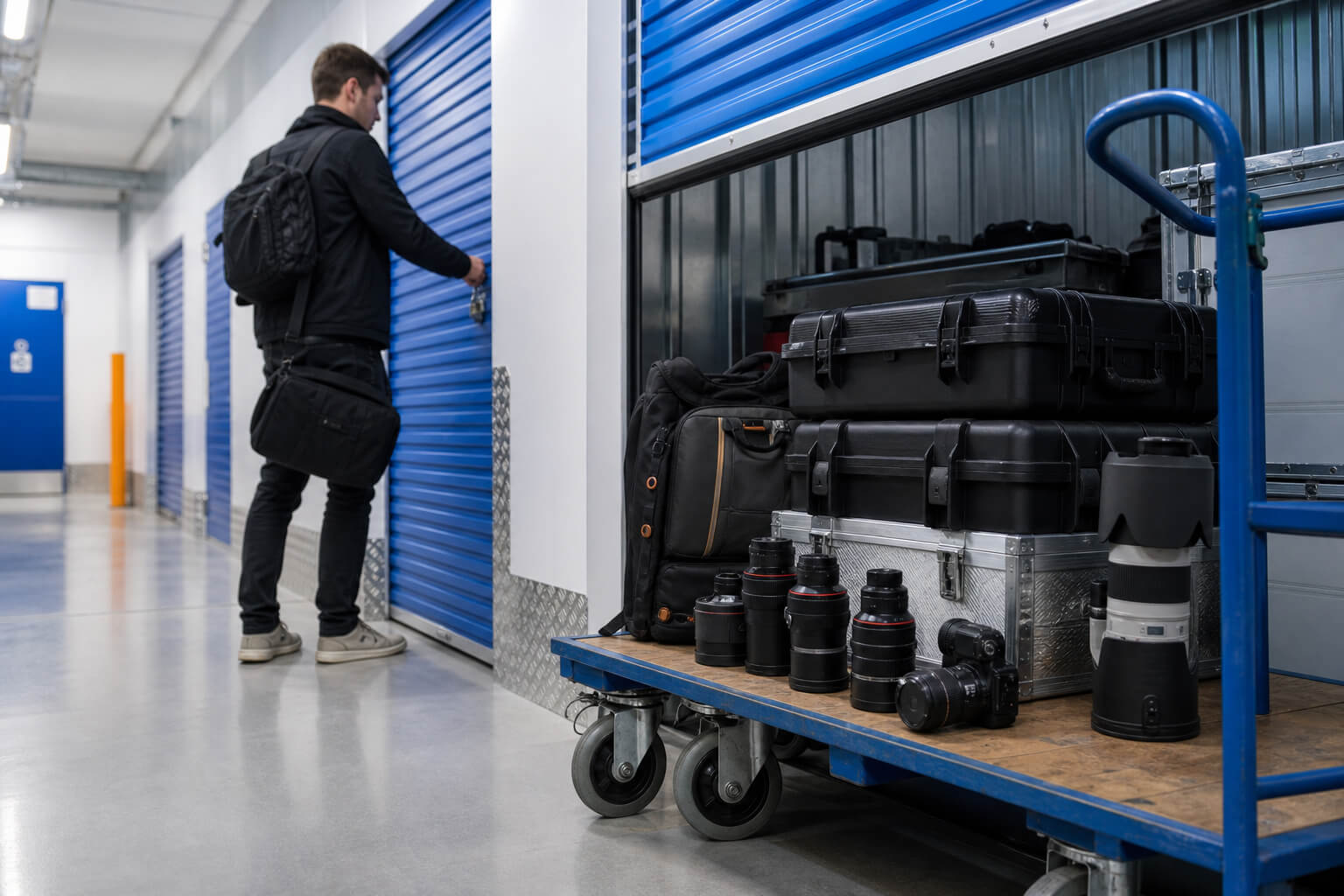
The short version is that van insurance and tool theft do not always work together as cleanly as the brochure suggests. Understanding the gap before a claim is the only way to do anything useful about it.
Locked-van exclusions and why they catch people out
A locked van is not a secure storage environment in most insurance definitions. Many van policies require tools to be in a locked, fixed security vault or a recognised steel security box, and some policies exclude theft from an unattended vehicle entirely after certain hours. The phrase “from the body of the vehicle” appears in more policy schedules than most policyholders realise, and it does not mean what it sounds like in plain English.
None of this is advice about your specific policy. Read it, call your insurer, ask the direct question: what happens if my tools are stolen from a locked van parked on a public street overnight? The answer will tell you your real exposure. Jurisdiction note: the above reflects common patterns under England and Wales law; policy terms in Scotland and Northern Ireland may differ; take your own advice.
How the contents protection position changes in a storage unit
A self-storage unit is a different proposition from a van. When you store tools with Wigwam, contents cover is mandatory: you either take Wigwam’s policy (arranged through RSA, covering customers’ goods on a New-for-Old basis) or you prove your own. The key practical points to know before you decide: theft cover under the policy requires forcible entry; atmospheric or climatic damage is excluded; you declare the full replacement value, and under-insurance is settled in proportion. We do not advise on which option is right for you. Our contents protection page has the detail.
The point is that the insurance question has a clear answer when the tools are in a unit. In the van, it often does not.
Why 6am access changes your morning
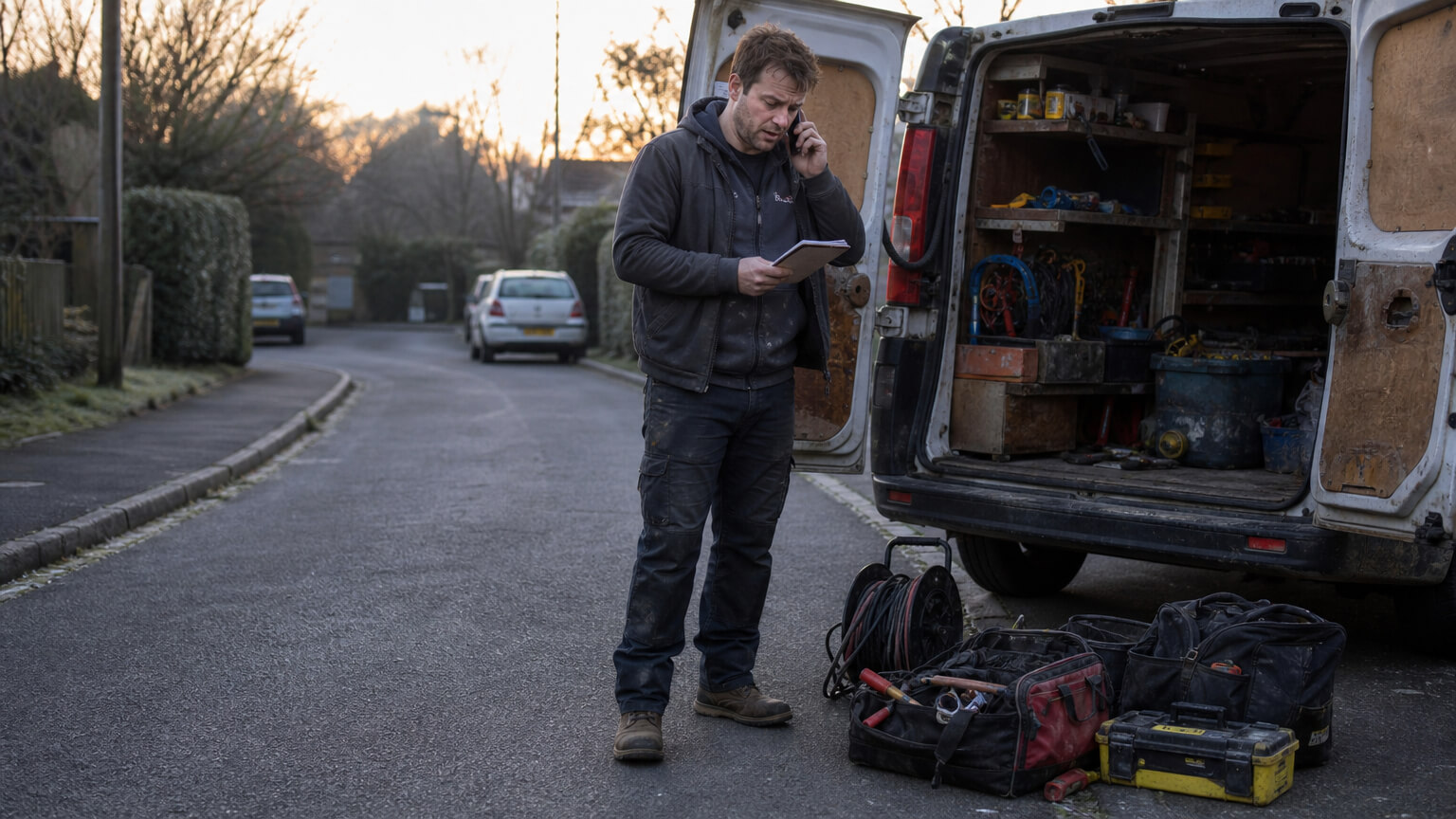
Smart entry opens at 6am, seven days a week. If your site start is 7am, you have time to drive to the unit, load what the day needs, and be on site before the first coffee is cold. That is the practical answer to the early-access question, and it does not require any caveats beyond the one that matters: access closes at 10pm.
Smart entry from 6am – how it works in practice
The sites are unmanned. There is no one to let you in and no gate you are waiting at when the security guard is running late. Smart entry means you access your unit directly, from 6am, without needing to call ahead or wait for anyone. Your unit has your own lock on it. No one from Wigwam can access it. No one from the site team can open it on your behalf. It is your space, your lock, your access.
That model suits tradespeople well because it is the same as having a private lock-up, not a shared facility. The unit is individually alarmed. If someone tries to get into it when you are not there, the alarm is on that unit specifically, not a building-wide bell that might or might not get noticed. When you are not there, nothing is happening. The unit is closed, alarmed, and sitting in a building in your market town.
The one delivery note to be aware of: because the sites are unmanned, Wigwam cannot sign for or receive deliveries. If a supplier is dropping materials at your unit, someone from your own business needs to be there to receive them. That is a straightforward operational fact, not a drawback; it just means deliveries need to be coordinated the same way they would at any unmanned premises.
The trade-off that is actually honest: not 24-hour, but enough
We do not offer 24-hour access. Several competitors claim it, and it sounds better than 6am to 10pm. But for most working tradespeople in most market towns, 6am to 10pm covers every realistic working day and then some. A 4am call-out is a different conversation; a 6am site start is the normal reality, and 6am access handles it.
The more useful question is not “is it 24-hour” but “does nothing of value sit in the van overnight.” If the tools are in the unit and the van is empty, the answer to that question is yes. Whatever someone does to the van at 2am, they find nothing worth taking. That is the actual trade-off, and it is a better one than the false comfort of a locked rear door.
Ready to get your kit off the van?
Get a quote at quote.wigwamstorage.co.uk
Van, lock-up or site container – which is right?
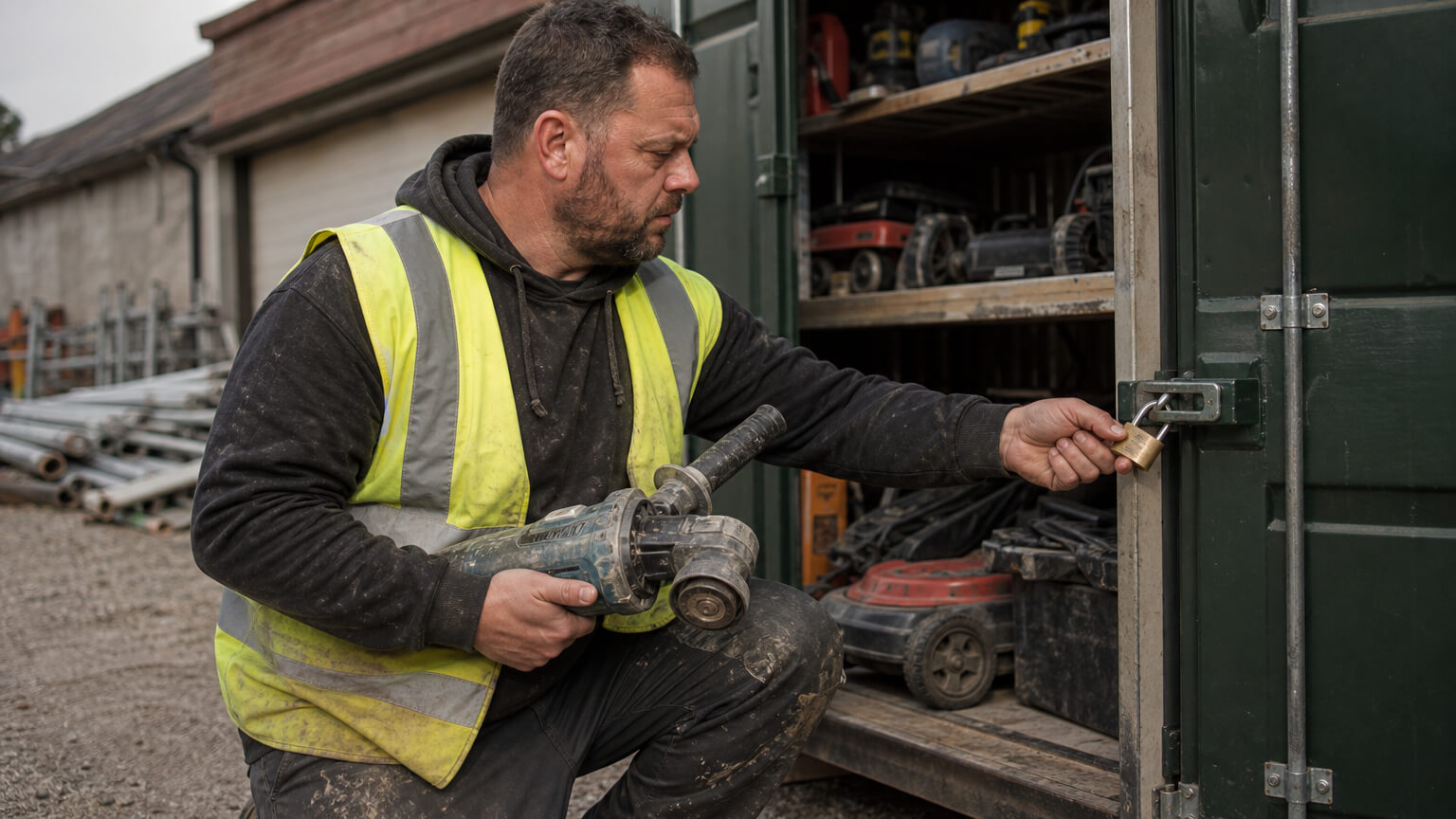
A fair comparison between the options is worth doing before committing to anything. Each has a genuine use case, and none of them is automatically wrong.
Van storage: the default and its limits
The van is convenient because it is always with you. The kit is loaded and ready, and on many jobs that matters. The problem is that convenience on your terms is also convenience on a thief’s terms. The van is a moving target that becomes a static one every night. Van-mounted security boxes add weight and cost, but they still travel with the van and they are still visible to anyone watching the vehicle. The security model for van storage is better than nothing; it is not the same as a fixed, alarmed, private unit.
Site containers: useful on site, useless between jobs
Anti-vandal site containers solve a real problem when you are on a long job with a fixed site. They are heavy, they stay put, and they are built to resist interference. The limitation is that they follow the job, not the tradesperson. Between contracts, or when you are running multiple smaller jobs across a week, the container is not where you need it to be. It does not follow you home, and you cannot collect from it at 6am on the way to a new site.
When a self-storage unit is the right call
A storage unit near your home patch earns its keep when you are doing varied work across a town or area, when the tools change by job, or when you simply do not have a fixed site to attach a container to. The unit is in your town, you control the access, and you take what you need for each day. If a job finishes early and you no longer need the space, the flexible terms at Wigwam mean you are not locked in: two-week minimum stay, refund of unused days, and no deposit at all.
The right choice depends on your work pattern. For a sole trader running varied jobs across a market town, the fixed local unit with early access tends to be the most practical answer. For a long-term site contract with a secure compound, a container might suit better. These are not in competition; many tradespeople use both at different points.
What you can and cannot store
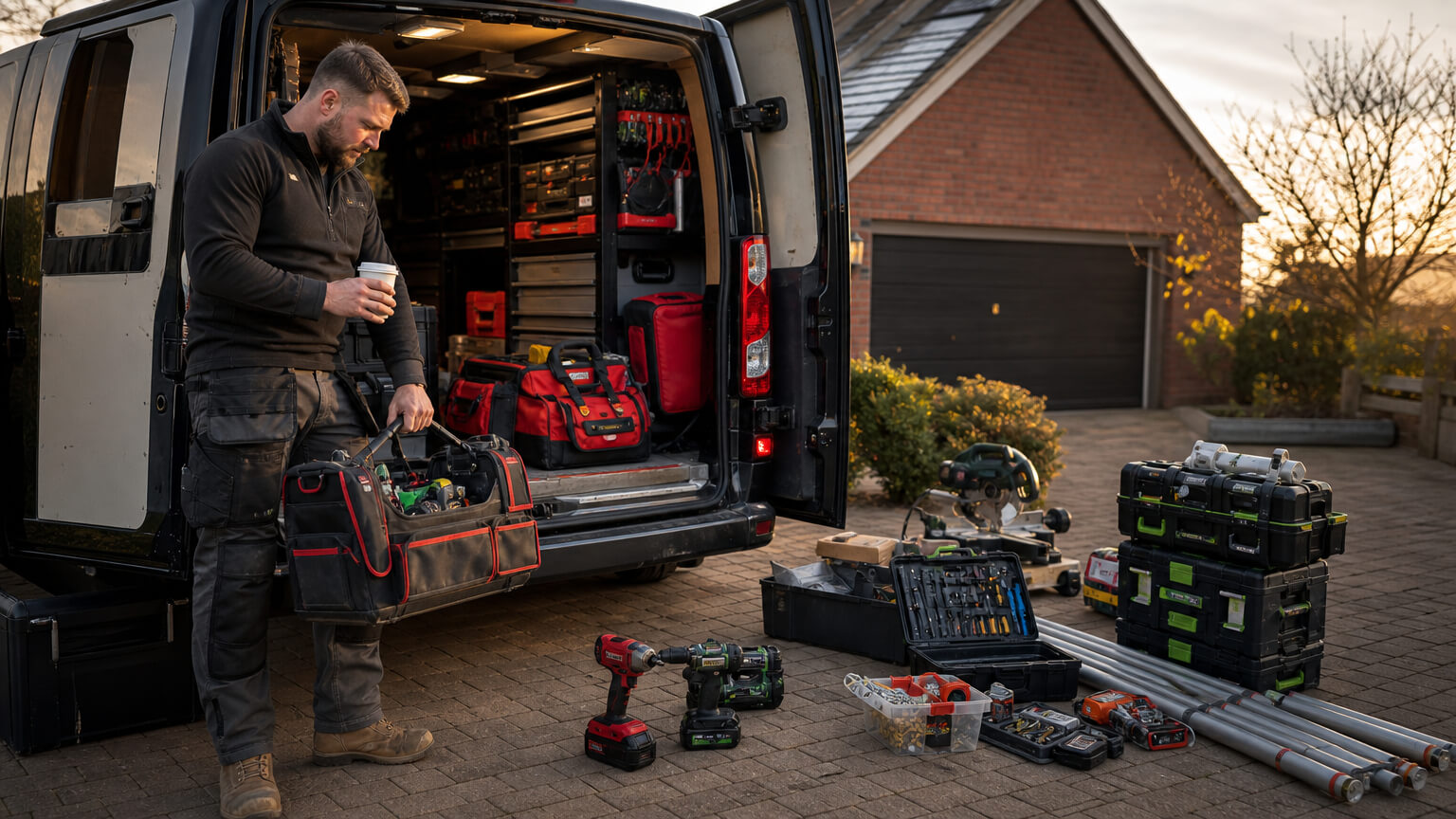
Most tools are completely straightforward to store. The short list of things that cannot go in is worth knowing upfront so there are no surprises.
Power tools, hand tools, materials – what fits and what stays dry
Hand tools, power tools, fixings, materials, site equipment, racking, storage bins: all of this is exactly what the units are designed for. The units are clean, dry and secure. They are not climate-controlled and they do not offer temperature or humidity management, so if any part of your kit has specific controlled-environment requirements, that is worth checking against before you book. For the vast majority of trades tools and materials, clean, dry and secure is precisely the standard required: nothing gets wet, nothing is accessible to anyone else, and nothing deteriorates from damp.
You can bring your own racking and organise the space exactly as it suits your workflow. The unit is your space. Nobody else has access, nobody else is using it, and nobody else’s stock is sharing your floor area.
Fuel, gas bottles, hazardous materials – the short no-list
Fuel, gas bottles, and hazardous materials cannot be stored in the units. That includes generators with fuel in the tank. This is a straightforward safety standard and applies across self-storage as a sector. If you regularly carry a fuelled generator or gas bottles, those stay in your vehicle or on site; they do not come into the unit. For most electricians, plumbers, carpenters and builders, this restriction does not affect day-to-day kit at all. It is worth naming clearly so there are no misunderstandings when you move in.
Units are for goods, not vehicles or plant on wheels. If you have questions about a specific piece of equipment, the team can confirm.
Sizing your unit and understanding the security spec
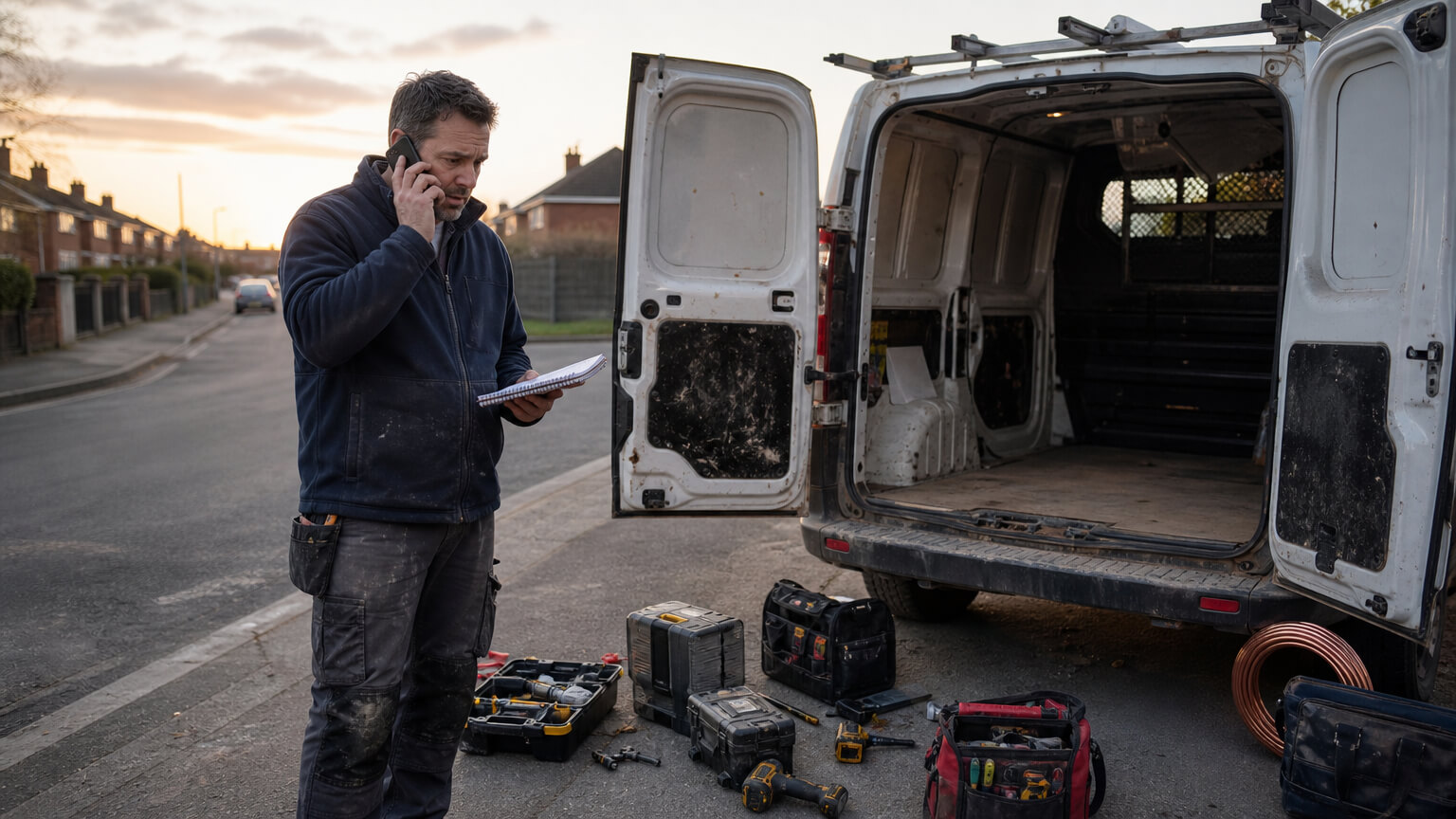
Getting the size right saves money and avoids the frustration of running out of space two weeks in. The security spec is worth understanding once, because it is the thing that makes the unit genuinely different from other options.
How much space tools actually take – a simple sizing guide
For a sole trader carrying hand tools, power tools, a set of drills, fixings, and day-to-day materials, a unit in the 20 to 35 square foot range is usually the starting point. If you are storing bulkier kit, materials for a current job, or equipment that does not fit in the back of a van, you are probably looking at 50 square feet or above. The right size depends on what you are putting in and how you organise it, and the best way to get a tailored answer is to use the quote tool: how much self storage costs gives you a sense of pricing by size, and the quote process at quote.wigwamstorage.co.uk walks through a size recommendation.
Individually alarmed units and your own lock
The security model matters enough to say clearly. Each unit has its own individual alarm. This is not a shared building alarm that covers the whole facility; it is an alarm specific to your unit. If someone interferes with your unit when you are not there, the alarm is on that unit. Combined with smart-entry access control and your own lock, the result is a security model that is closer to a private lock-up than to a public storage facility.
The Wigwam team cannot open your unit. No one from the site team, from the office, or from Wigwam generally has access to your space without your knowledge. That independence is the point. An independent tradesperson does not want a storage solution where someone else is handling the kit; they want a base they control.
Deliveries and couriers – the unmanned site rule
The sites are unmanned. That means Wigwam cannot sign for or receive deliveries on your behalf. If a supplier is delivering materials to your unit, someone from your own business must be there to accept them. This is the same arrangement you would have with any unmanned premises: it requires a bit of coordination, but it is entirely workable. The team at Wigwam are available to talk through how it works in practice. Selina and the local team members at individual locations can help with questions about access and operational setup.
What it costs – and the maths on a stolen kit
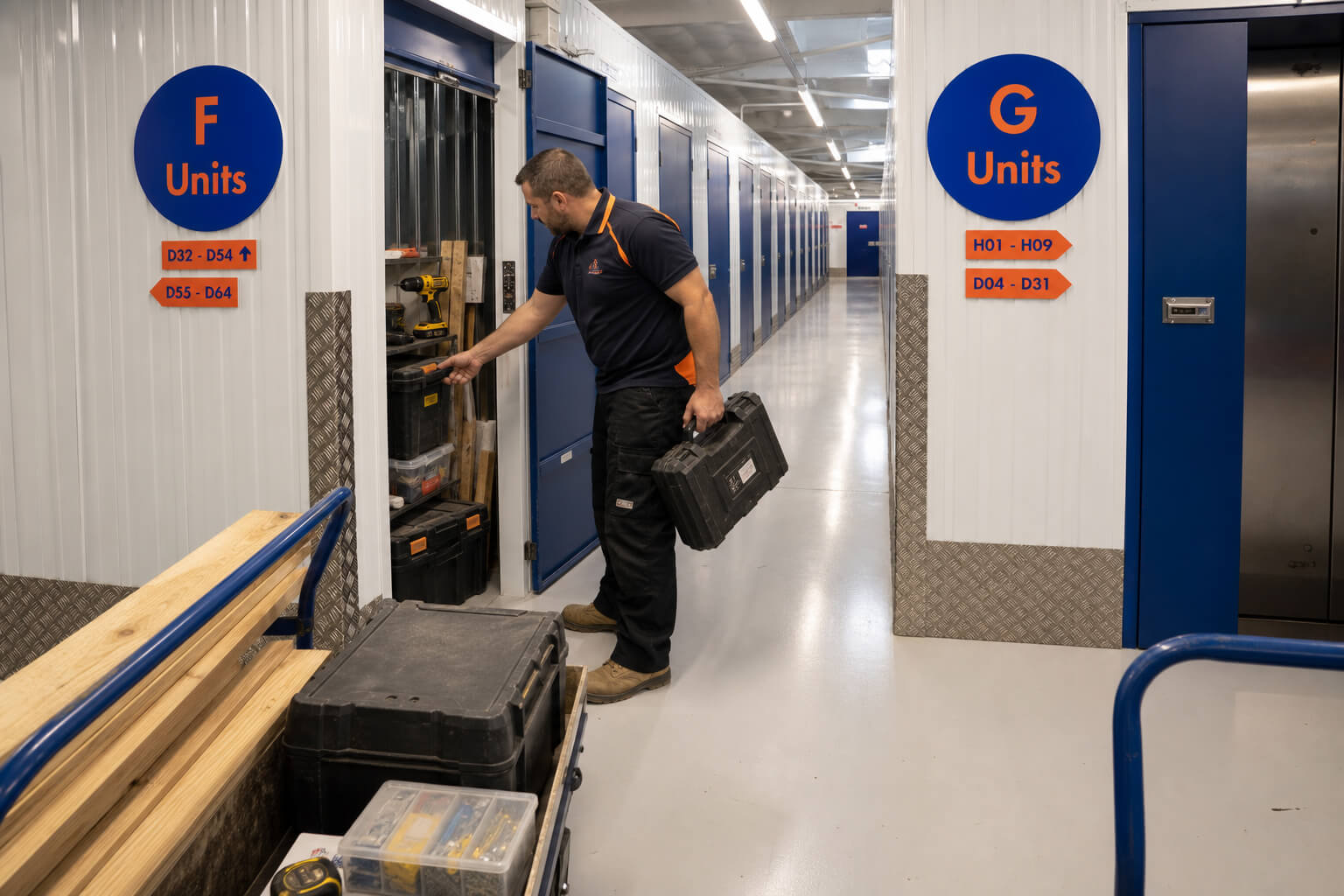
The cost question is a reasonable one to ask, and the honest answer is that it depends on the location and unit size. We do not publish prices in this article because they vary.
How self-storage is priced – where to check current rates
The how much self storage costs page is the right place to check current rates by size and location. Pricing varies across our UK market-town locations, and the quote process will give you a specific figure for the unit you need in the town where you work.
The comparison worth running alongside the pricing page is the cost of a replaced kit. A set of professional power tools, hand tools, fixings, and specialist equipment can run well into four figures for a sole trader. An insurance excess on a van-tool claim, if the claim is accepted at all, adds to that. The maths on a unit versus the maths on a stolen kit are worth putting side by side before deciding the unit is too expensive.
Terms that fit the work calendar – no deposit, minimum stay, and early exit
The terms at Wigwam are designed to fit the way trades work. The minimum stay is two weeks, which is long enough to be a useful storage arrangement and short enough to suit a project-based work calendar. If a job finishes early and you no longer need the unit, unused days are refunded. If you are leaving, the process is to give 14 days’ notice, vacate the unit, and settle any outstanding account. There is no deposit to return, because we don’t take one; the terms on this point are straightforward. The full terms are at wigwamstorage.co.uk/terms-conditions/.
For a small trades firm with two or three operatives, the flexibility on exit also means you are not committed to a fixed overheads line regardless of how the work calendar moves. The unit is there when the work is there, and the exit is clean when it is not.
Find your nearest Wigwam – market-town locations
The locations are in market towns, which is the point. Not an industrial estate on the ring road that adds half an hour to the morning routine; a unit in or near the town where the work happens.
Locations near working tradespeople – examples and the full list
Wigwam Self Storage Lincoln in Lincolnshire and Wigwam Self Storage Bath in Somerset are two examples of the market-town locations where local tradespeople store with us. The full list of our UK market-town locations is at wigwamstorage.co.uk/self-storage-locations/, where you can find the location closest to your work patch and check availability.
The locations include Cheltenham, Burton upon Trent, Warminster, Reading, and others. The sensible starting point is the locations hub, which lists every site with contact details.
What to expect when you visit – honest and unmanned
The sites are unmanned, so you will not arrive to find a sales team. What you will find is a clean, accessible site with smart entry, your individually alarmed unit, and your own lock on it. The local team members at each site, including Selina at one of our locations, are real people and reachable when you have a question; the site itself is yours to use without anyone overseeing you.
That is the experience that suits an independent tradesperson. Your kit is in a private, alarmed space in your own town. You access it on your schedule, from 6am, and you leave it secure when you drive away. Nothing travels with the van overnight that a thief would find worthwhile.
Ready to move your tools off the van tonight?
Get a quote at quote.wigwamstorage.co.uk
Frequently Asked Questions
It might, but that is a question for your insurer, not for me to promise. What I can tell you is the logic, because it is sound. Many van policies load the premium, or restrict cover, precisely because tools left in a vehicle overnight are a known theft risk. If your tools are no longer in the van overnight, that risk profile changes, and some insurers will reflect that. The practical move is to tell your insurer what you are actually doing: tools stored in a secure, individually alarmed unit overnight, van empty. Ask directly whether that changes your premium, your overnight tool exclusion, or your excess. Some policies care a great deal about where tools sleep; others price the whole vehicle and barely flinch. You will not know until you ask the specific question. Be honest about it, because the flip side matters: if your policy assumes tools travel in the van and you have moved them to a unit, you want the cover to follow the tools, not stay attached to an empty vehicle. The contents protection on the unit covers goods in the unit. Your van policy covers the van and, depending on its terms, tools in transit during the day. Make sure the two together leave no gap, and get any change confirmed in writing. This is signposting, not insurance advice. Speak to your insurer or broker, and note that policy terms differ in Scotland and Northern Ireland.
Yes, if you set them up with their own access, and for a small firm that is often the point. Access works through smart entry rather than a single key passed hand to hand, so an account holder can authorise more than one person to enter the site and the unit. That means your apprentice can swing by at 6am, pull what the day needs, and meet you on site, without you having to drive across town first. What does not happen is anyone outside your own arrangement getting in. The site team cannot let a labourer into your unit on your say-so over the phone, and Wigwam holds no key to your space. Access stays entirely inside what you have set up. So the model is: you decide who is authorised, you brief them, and they operate within the 6am to 10pm window like you do. The sensible discipline for a firm with staff is to keep your own note of who has access and to remove it when someone leaves, the same way you would collect a uniform or a fuel card. If you want to add or remove a person, that is a straightforward conversation with the team about your access setup. Selina and the local team can talk through how multi-user access works at your location.
You provide and fit your own lock, and no, Wigwam does not hold a spare or a master. That is deliberate, and it is the core of why the unit works like a private lock-up rather than a shared facility. Nobody from the site team, the office, or Wigwam generally can open your unit, because nobody holds a key to it but you. The practical upshot is that the quality of the lock is your call and your responsibility. For tools, a decent closed-shackle padlock is the sensible choice, because it leaves little of the shackle exposed for bolt croppers, which are the usual tool of a quick storage break-in. A cheap open-shackle padlock from a corner shop undermines a good unit. Spend sensibly here; it is the cheapest part of the whole arrangement and the one most worth getting right. The trade-off of the sole-keyholder model is the one worth naming plainly: if you lose your only key, there is no spare to fall back on, because the whole point is that nobody else has one. So keep a spare key somewhere secure off-site, the way you would for your home or van. If you genuinely lock yourself out, the team can talk you through the process, but it is far better avoided. Your lock, your key, your access, with no back door: that independence is exactly what an independent tradesperson wants, and the small responsibility that comes with it is fitting a proper lock and not losing the key.
The tools can sit there as long as you keep the unit, and for a trade with a seasonal lull that is often the smart play. There is no requirement to visit, no maximum idle period, and no penalty for a unit that simply holds your kit untouched through a quiet January. You pay for the space, the space is yours, and whether you are in it daily or not at all for six weeks makes no difference to the arrangement. The unit stays individually alarmed and secure the entire time, which is exactly the reassurance you want when the kit is not earning and you are not keeping an eye on it. A few practical notes for kit left long-term. Store everything clean and dry, because tools left damp will corrode whether anyone is watching or not, and the unit is clean and dry but not climate-controlled, so it will not pull moisture out of something you stored wet. Batteries are worth a thought: lithium tool batteries sit better part-charged than flat or full, so top them to a middling charge before a long layoff. Beyond that, the maths is simple. If keeping the unit through a quiet winter costs less than the hassle and risk of moving a full kit home and back, and for most tradespeople it does, leave it where it is. If the lull is genuinely long and the cost stops making sense, the flexible terms let you give 14 days’ notice and clear out, with any unused days refunded. The choice is yours and the terms do not punish either decision.
First, the immediate steps, because they shape the claim. Report the theft to the police and get a crime reference number, take photographs before you move anything, and contact the insurer holding the cover, whether that is Wigwam’s RSA policy or your own. Then the specifics. Under the RSA “Self Storage Customers’ Goods” policy, theft cover requires evidence of forced entry to the unit. That is a standard condition, and it is why the lock you fit matters: a unit broken into with visible forced entry supports a claim, whereas a unit found open with no sign of a break-in is a much harder conversation. The individually alarmed unit works in your favour here, because interference with your specific unit triggers an alarm on that unit, not a vague building-wide bell. Settlement is on a New-for-Old basis with a fifty pound excess, which is good for a tradesperson because it means replacement cost, not depreciated second-hand value. The catch most people trip on is the declaration: you must have declared the full replacement value of your kit, because under-insurance is settled in proportion. Declare half the value of your tools and a claim pays out at roughly half. So the honest groundwork is to declare accurately when you take the unit and to keep a tool list with serial numbers and rough values, which makes any claim faster and cleaner. I cannot advise on your specific claim or interpret the policy for you; the policy document and your insurer are the authority on that. The detail is on the contents protection page, and policy terms may differ in Scotland and Northern Ireland.