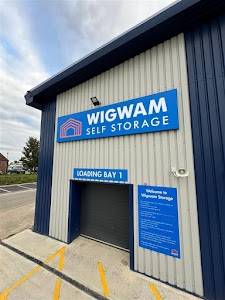
Closed files stacking up faster than the retention clock runs down?
A practice manager we know in Lincoln told us she could not see the far wall of the back room. Not because anything had gone wrong. The files were exactly where they should be, properly boxed and labelled, waiting for the legal clock to run down on each one. The room was simply full, and the firm was still taking on new work.
That is the problem this page addresses. Not a compliance failure. Not poor records management. Just the structural reality of running a regulated practice in the UK: closed matters do not disappear when you finish them. They join a queue. The queue is measured in years, and it grows.
There is a straightforward answer for most firms, and this guide sets it out plainly. We will cover how long UK solicitors and accountants are required to keep records, whether a self storage unit is a legitimate home for those boxes, how to pack and index them sensibly, and where Wigwam fits into that picture. We will also tell you where a self storage unit is not the right tool, because that honesty is worth more than a sales pitch.
Why professional firms run out of file space
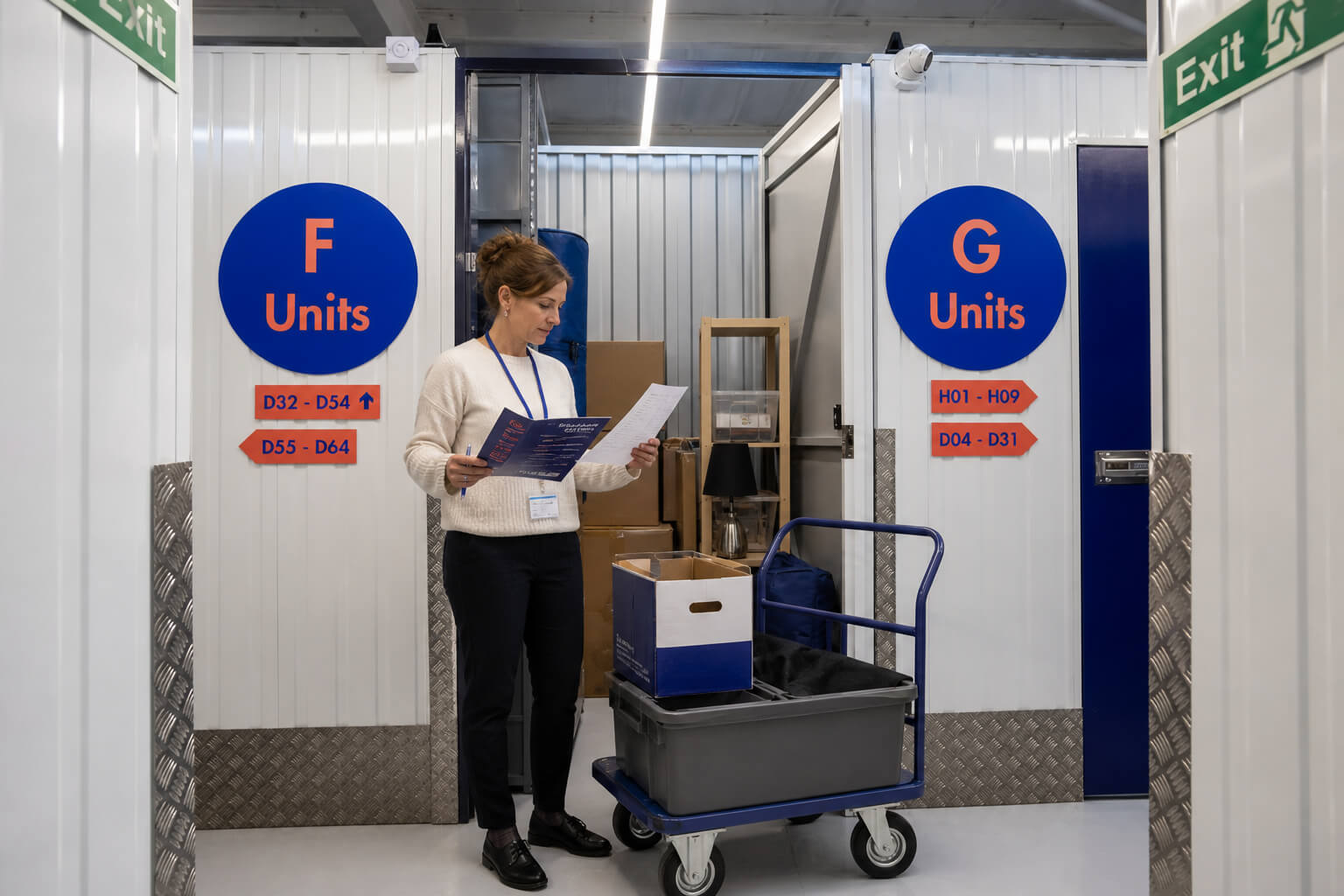
Most law and accountancy firms have the same problem. Closed matters do not go away. They join a queue measured in years, not weeks, and the queue grows every year the firm takes on new clients.
The closed-file problem
The cycle is the same across most regulated practices. A matter closes. The file is boxed and labelled. It sits in a queue for the retention period, whether that is five years, six years, fifteen years, or longer depending on matter type. Then, and only then, can it be reviewed for destruction. Until that date arrives, the box stays. You cannot bin it, you cannot delete it, and your regulator may ask for it at any point.
This is not a sign of poor organisation. It is a structural feature of running a practice under legal and regulatory obligations. A growing firm with a healthy caseload will accumulate closed-matter boxes faster than it destroys them, year on year, for as long as it operates. The back room fills up because the firm is doing its job properly.
Why the office cannot solve it
Office space is expensive. The back room, the storage cupboard, the spare desk stacked with boxes: all of that is rented at your office rate per square foot, which is almost certainly the most expensive filing cabinet you will ever own. At a certain point, the cost and the inconvenience of retrieving a file from a wall of boxes tips the balance. Off-site storage becomes the practical answer, not a last resort.
For current unit sizes and pricing across our UK market-town locations, the pricing reference page gives a useful starting point. Most practices make the move within the first few years, once the volume of closed matters reaches a certain mass.
The mixed-format problem
Most firms still hold a mix. Scanned PDFs live on the practice management system. But the original signed documents, physical title deeds, wills held on behalf of clients, and correspondence that predates the digital transition: these are physical and they need physical space for the retention period. Scanning does not make the originals disappear, and many originals carry legal weight that a digital copy cannot replace.
A self storage unit is a straightforward answer for the physical layer while the digital records stay on your system. The two solutions do not compete; they complement each other.
How long must UK solicitors and accountants keep records?
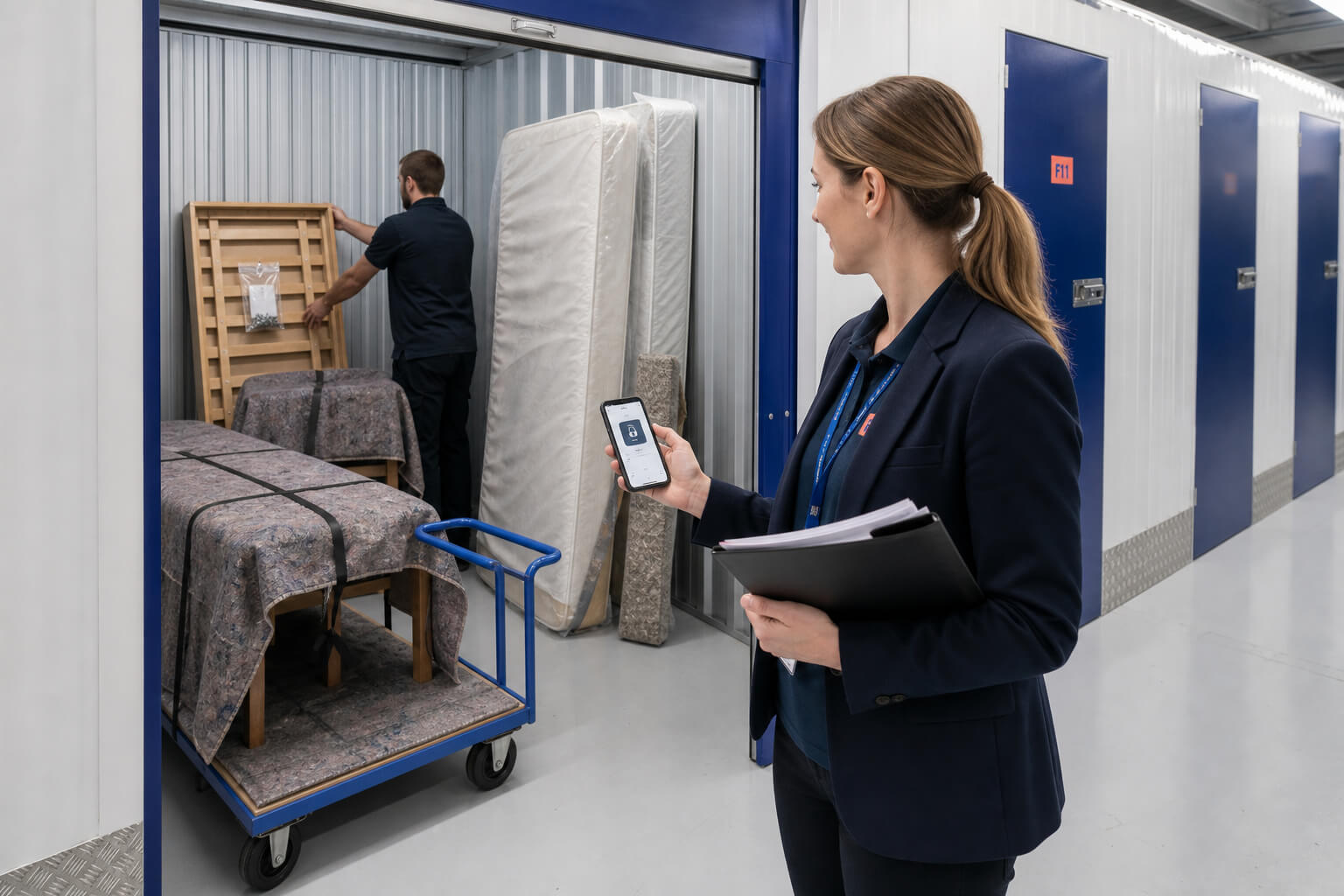
The rules differ by professional category, matter type and which regulator applies. The table below is a starting point, not professional advice. Always confirm the period with your own regulator and your firm’s retention policy.
Jurisdiction caveat: The retention periods set out in this section apply in England and Wales. Scotland and Northern Ireland operate under different rules in some areas. If your practice is based in Scotland or Northern Ireland, check with your own regulator and, if needed, your solicitor.
Accountant and tax records
The period depends on how the business is structured.
Limited companies are required to keep accounting records for six years from the end of the accounting period, under the Companies Act 2006 and HMRC rules. Sole traders and partnerships must keep records for five years after the 31 January self-assessment deadline for the relevant tax year, under HMRC self-assessment rules. VAT records carry a six-year minimum requirement from HMRC.
These are the standard minimums. If HMRC opens an investigation, the practical position is that records should be retained until the investigation closes, regardless of what the standard period says. Your own accountant or tax adviser can confirm what applies to your specific situation; Wigwam signposts the rules but does not give tax advice.
Solicitor and legal files
The baseline across most matter types is a minimum of six years, derived from the Limitation Act 1980, which sets the general limitation period for most civil claims. Beyond that, the period depends on matter type.
Conveyancing and title deeds carry a longer retention period. The Council for Licensed Conveyancers (CLC) file-storage code references a 15-year longstop under section 14B of the Limitation Act 1980. If you work in conveyancing, assume the longer period applies and check the current CLC guidance directly.
Litigation and personal injury files typically require retention for seven years or more, or until the end of any proceedings, whichever is later. Wills and probate matters are more variable; best practice is to retain until the estate is fully administered and, where there is any prospect of dispute, longer still. The SRA and CLC both issue guidance on matter-specific periods. That guidance, not this article, is your authoritative reference.
When a complaint, claim or investigation extends the clock
The periods above are minimums. They can be extended by circumstances the firm cannot always anticipate. A pending SRA complaint, an open ICO inquiry, live litigation, or an HMRC investigation all override the standard periods. The file cannot be destroyed while any of these are open, and your professional indemnity insurer may also specify retention minimums that exceed the statutory floor.
For files in either of these situations, a self storage unit is a clean holding solution. The boxes sit in the unit until the matter is resolved and the regulatory position is clear. For definitive guidance on your own position, check your PI policy and speak to your regulator. Do not rely on this article alone.
Is a self storage unit the right home for your records?

For the bulk of a professional firm’s closed files, a self storage unit you control is a practical, compliant solution. It is not the right tool for everything, and it is worth being clear about where the boundary sits before you go any further.
A unit you control versus a managed records service
A managed records service, the kind offered by large archive operators, gives you indexed retrieval. You call them, identify the specific file you need, and they pull it and courier it to you. You never visit the facility yourself. The trade-off is cost, and for most closed-matter files, it is a trade-off that does not make sense.
A self storage unit works differently. You hold access. You visit the unit yourself, between 6am and 10pm, seven days a week, with no need to book in advance. You retrieve what you need, usually a box at a time. The unit is the right tool when your retrieval pattern is occasional and bulk rather than frequent and single-file. For a firm reviewing closed-matter boxes for destruction once a year, or retrieving a box because a former client has made contact, that pattern fits a self storage unit well.
There are honest limits to state. Our sites are unmanned. You access your own goods; there is no member of staff present to assist. If a document-shredding firm visits the unit to collect boxes for destruction, someone from your own practice must be present. Wigwam does not manage, index, retrieve or sign for documents. The key, in every sense, stays with you.
Confidentiality, GDPR and the “is self storage risky?” question
Some managed-archive providers argue that self storage is risky for confidential records. It is worth meeting that argument directly rather than sidestepping it.
The “risky” argument assumes a shared or poorly secured space is handling your files. Wigwam units are individually alarmed. The unit is accessed only by the firm, or by whoever the firm authorises. No third-party handler touches the files between visits. The key does not leave your pocket.
Under the UK GDPR and the Data Protection Act 2018, your firm remains the data controller. The storage unit is infrastructure, not a data processor with independent access to your clients’ information. Your firm’s own access controls, packing standards and destruction procedure form the compliance layer. A well-managed unit with a clear retention log and a sensible access policy can sit within a compliant records management approach. For guidance specific to your firm’s circumstances, the ICO’s records management guidance for professional organisations is the appropriate starting point.
Two things are worth being clear about. Units are clean, dry and secure. That is the honest standard we operate to. There is no managed temperature or humidity control, and the contents protection policy excludes climatic damage. For paper records, good packing practice matters: sealed archive-standard boxes, off the floor where possible, and a consistent stacking arrangement. If you are storing original documents of particular significance, it is worth discussing appropriate storage conditions with a records management professional rather than relying on general self storage standards.
Ready to get your closed files off the office floor?
Get a quote at quote.wigwamstorage.co.uk. Tell us your approximate box count and your nearest Wigwam town, and we will suggest the right unit size.
How to pack and index your records for storage

Good packing does more for your compliance position than the unit specification alone. Here is a simple starting approach that most practices follow.
Boxing, labelling and a basic retention log
Use standard archive boxes. Uniform size means they stack reliably, take up predictable space, and give you a rough sense of how many will fit in a given unit. On each box, record at minimum:
- The matter reference or ledger year
- The date the matter was last active
- The earliest date destruction is permitted
- The category of contents (tax, conveyancing, litigation, wills, or similar)
Keep a simple retention log, even a spreadsheet, in the office. The log maps each box to its location in the unit and its permitted destruction date. This log is your audit trail if a regulator or insurer asks how you manage your off-site records. Keep the log in the office; do not store it solely in the unit.
What goes in and what stays out
The unit is the right home for: closed-matter box files, old ledgers and accounts files, historic client correspondence, and original signed documents whose retention period has not yet expired.
What stays in the office: active matter files, the retention log, the firm’s own insurance and regulatory documents, and any original documents held on behalf of a current client. If your firm holds original wills or title deeds on behalf of clients, consider whether moving those to an off-site unit changes anything in your client care letter or the SRA’s expectations. That is a question for your compliance officer, not for Wigwam.
Destruction review and secure disposal
Review the unit contents annually. Check the retention log against each box. When a box has passed its destruction date and no extending circumstances apply, the next step is secure shredding.
Several document-shredding firms offer collect-and-shred or on-site services. If a shredding firm visits the unit, remember that the site is unmanned: someone from your practice must be present. Wigwam cannot receive, supervise or sign for contractors on your behalf. After destruction, update the retention log to reflect what has left the unit. Over time, as the clock runs down on older matters, the unit should get smaller, not larger.
What a Wigwam unit gives a professional firm

The short answer is a private, individually alarmed room a few miles from your office, open 6am to 10pm, seven days a week, that only your firm can enter.
Security and access
Each Wigwam unit is individually alarmed. Access is by smart entry, available from 6am to 10pm every day of the year. The authorised account holder enters using their own access code. No third party handles your files between visits. Sites are unmanned, which means the space is entirely yours, without staff walking past the unit door.
The physical standard is clean, dry and secure. That is what we deliver and what we claim. We do not offer or market climate-controlled storage, and no temperature or humidity promises are made or implied.
Contents protection is mandatory. You can take Wigwam’s RSA Self Storage Customers’ Goods policy, or you can bring evidence of your own equivalent cover. Either way, cover is required. If you take Wigwam’s policy, declare the full replacement value of what you are storing; any under-insurance claim is settled in proportion to the value declared. Note that the policy excludes climatic damage. Full details are on the contents protection page.
Flexibility and commitment
The minimum stay is two weeks. If you leave early, unused days beyond the minimum are refunded. No deposit is taken when you start. There is no long-term contract and no managed-service lock-in.
For a practice that expects its archive volume to change over time, as boxes come in and destruction reviews take boxes out, these terms give flexibility to scale up or down without financial penalty. For current unit pricing, see the pricing reference page. We do not quote prices within this guide because they vary by size, location and availability.
Choosing a unit near your office

Wigwam’s market-town locations mean that most practices in the areas we serve are within a short drive of a unit, rather than a city-centre journey. That matters when you are retrieving a box before a court hearing or dropping off six months of closed matters on a Saturday morning.
Unit sizes for professional file storage
A standard archive box takes up roughly 0.05 cubic metres. As a rough starting guide:
- A small unit (around 25 sq ft) holds approximately 40 to 50 standard archive boxes
- A medium unit (around 50 sq ft) holds approximately 80 to 100
For a starting estimate, count the boxes already waiting in the back room, add two years of projected closed-matter volume, and use that as the floor size. If the volume grows, transferring to a larger unit is straightforward. For current sizes and an up-to-date size guide, check the pricing and locations pages; specifications can change and we want you to have the current figures.
Finding your nearest location
Wigwam Self Storage Lincoln in Lincolnshire and Wigwam Self Storage Bath in Somerset are two of our market-town locations. For practices in Reading (Berkshire), Cheltenham (Gloucestershire) and elsewhere across our network, the locations hub lists our full range of UK market-town locations. We do not use city-centre vaults; our sites are in the towns where the practices are.
Cost and getting a quote

We do not publish prices in this guide because they vary by unit size, location and availability. The pricing reference page gives you current starting points. The terms and conditions page sets out the notice period and refund rules in full.
What affects the cost
The main variables are unit size and location. The two-week minimum stay means the initial outlay is modest, and there is no deposit on top of it. If you leave earlier than expected, any unused days beyond the minimum are refunded.
For most practices, a small or medium unit covers the initial requirement. As the destruction review process reduces the box count over time, you can downsize or close the account with the standard notice.
Getting a quote
If you know roughly how many boxes you have and which of our locations suits, a quote takes about two minutes.
Get a quote at quote.wigwamstorage.co.uk
Tell us your approximate box count and your nearest Wigwam town, and we will suggest the right unit size. No pressure, no obligation, and no hidden fees to unpick.
When the retention period ends: secure disposal
A self storage unit for professional records is not a permanent arrangement. Most boxes have a destruction date. The unit should get smaller over time, not larger.
Reviewing and destroying records correctly
An annual review against the retention log is the simplest system. Work through the log, identify every box whose destruction date has passed, and confirm that no extending circumstances apply: no open complaint, no live investigation, no pending litigation, no PI insurer requirement that overrides the standard period.
When a box is cleared for destruction, arrange secure shredding. As boxes leave, you can downsize to a smaller unit or close the account when the last box goes. Closing the account requires the 14-day notice, full vacation of the unit and settlement of the account. The terms and conditions cover the process in full.
Regulatory confirmation before destruction
Before destroying any professional file, confirm the retention period with your firm’s own regulator (SRA, CLC, HMRC as appropriate) and with your professional indemnity insurer. Do not rely solely on the table in this article; it is general guidance, not a regulatory ruling on your firm’s specific position.
A brief file note recording that destruction was authorised by the compliance officer, with the date and the basis for the decision, is good practice. It creates a record if the decision is ever queried. Wigwam does not issue destruction certificates; that responsibility stays with the firm and its contracted shredding provider.
If your back room is looking full and the boxes are not going anywhere for a few years yet, we have units near you. A plain quote takes two minutes. Get one at quote.wigwamstorage.co.uk and we will suggest the right size.
Frequently Asked Questions
That is entirely in your hands, which is both the advantage and the responsibility of a self storage unit over a managed archive. There is no retrieval service to call and no turnaround time to wait on: access runs 6am to 10pm, seven days a week, by smart entry, with no need to book in advance. If a subject access request lands and the file is in your unit, an authorised member of the practice can drive over, pull the box, and have the documents back at the office the same day. For the statutory timescales that apply to a subject access request under data protection law, that immediacy is genuinely useful, because the clock on responding is yours to manage, not a third party’s. The catch, and it is the whole reason indexing matters, is that fast retrieval depends entirely on knowing which box holds the file. A unit you can reach in twenty minutes is no help if you then spend two hours opening boxes to find the right one. This is where the retention log earns its keep. A log that maps each box to its position in the unit and its contents turns retrieval into a quick, targeted trip. Keep that log at the office, not in the unit, so you can identify the box before you set off. The managed-archive trade-off is the mirror image: they do the finding for you but on their timescale and at their cost. For a practice that indexes its own boxes properly, self storage gives faster, cheaper, same-day retrieval under your own control. The data protection obligations of responding to the request itself remain your firm’s, and the ICO’s guidance is the authority on those, not this article.
Start from the legal reality: your firm remains the data controller and the custodian of those records regardless of where they are physically stored. The storage unit is infrastructure, not a party that takes over responsibility for your clients’ files. That distinction shapes the whole answer. Wigwam provides a secure, individually alarmed room that only your firm accesses, and no third party handles the files between your visits, which is precisely the point of the self-access model for confidential records. But the duty to manage, account for, and protect those records sits with the practice. Two layers of protection back this up, and they are different things. The physical layer is the unit: clean, dry and secure, individually alarmed, sole access by your firm. The financial layer is contents protection, which is mandatory; you either take Wigwam’s RSA “Self Storage Customers’ Goods” policy or prove your own equivalent cover. That policy stands behind the replacement value of what you store, subject to its terms, with theft claims requiring evidence of forced entry and climatic damage excluded. What contents protection does not do is indemnify the regulatory or professional consequences of losing client records, which is a matter for your professional indemnity insurer and your regulator. So the honest, layered answer is: the unit keeps the files physically secure, the contents policy addresses the value of the goods, and the professional and data-protection responsibility stays with your firm throughout. For the cover detail see the contents protection page, and for your firm’s specific liability position, your PI insurer and compliance officer are the right authorities. We signpost; we do not advise.
Sometimes, but not always, and the line is a legal and regulatory one rather than a storage question, so the useful answer is where to draw it and who to ask. For a great deal of routine material, a properly made and indexed scan can satisfy the retention obligation, and many firms run a scan-and-shred policy for correspondence and standard file content to reduce physical volume. But originals are not all equal. Some documents carry legal weight that a copy cannot replace: original signed deeds, wills held on behalf of clients, certain title documents, and instruments where the original itself has standing. Shredding those because you hold a scan can be a serious mistake. The safe approach is to separate your file content into what can be digitised and destroyed versus what must be retained in original form, and to take that classification from your regulator’s guidance and your firm’s own retention policy, not from a general rule of thumb. The SRA, the CLC, and HMRC all have positions relevant to different parts of this, and your professional indemnity insurer may have a view too. Where a scan-and-shred policy is appropriate, the secure destruction of the originals still has to be done correctly through a certificated shredding provider, with the destruction recorded against your retention log. Where originals must be kept, that physical layer is exactly where a self storage unit earns its place: the digitised records live on your system, the originals that genuinely must survive sit in a secure, indexed unit for their retention period, and the two complement rather than compete. Wigwam stores the physical layer; it does not advise on which documents you may digitise and destroy. That classification belongs with your compliance officer and your regulator.
Quite possibly, and it is worth checking your policy before you move a single box, because PI insurers sometimes specify conditions about the retention and security of client records that go beyond the statutory minimums. Some policies set minimum retention periods that exceed the regulatory floor. Some take an interest in how and where confidential records are kept, particularly for matter types with a long tail of potential claims, such as conveyancing or probate. The honest position is that I cannot tell you what your specific policy requires, because PI wordings vary considerably between insurers and between firms; that is a question for your policy document and your broker. What I can tell you is what a Wigwam unit offers so you can check it against whatever your insurer asks for. Each unit is individually alarmed and accessed only by your firm through smart entry, with no third-party handling of the files between visits and no site staff with access to your unit. The physical standard is clean, dry and secure. Contents protection is mandatory, through the RSA policy or your own equivalent cover. Those are concrete, verifiable controls you can point to if your insurer wants to know how off-site records are secured, and a clear retention log kept at the office demonstrates the management layer on top. The sensible sequence is: read your PI policy’s requirements on records, confirm whether off-site self storage is acceptable and on what conditions, and then check those conditions against what the unit provides. If there is any doubt, raise it with your broker before committing. Wigwam does not advise on insurance; the policy and your broker are the authority.
Keep them separate. The instinct to split a unit and halve the cost is understandable, but for two distinct regulated practices it creates problems that outweigh the saving. The core issues are access control and accountability, both of which matter far more for confidential client files than for ordinary goods. A unit is rented under one account with access controlled by that account holder through smart entry. If two separate firms share a single unit, you have two firms’ confidential client records behind one point of access, one account, and one contents protection declaration, which muddies the data-controller responsibilities, the confidentiality position, and any later claim. Each firm is its own data controller with its own duty over its own clients’ files, and that responsibility is cleaner to demonstrate when each firm controls its own locked, alarmed space. There is also the practical confidentiality point that one firm’s authorised person would, in a shared unit, have physical access to the other firm’s client files, which is exactly the kind of arrangement a regulator or a PI insurer would question. The cleaner and barely-more-expensive answer is a unit each, sized to each firm’s volume, at the same site. Both firms get the proximity and the flexible terms, both control their own access, and both keep their own contents declaration and retention log clean and separate. The cost difference between two smaller units and one shared one is usually modest, and it buys you a defensible records management position rather than a tangled one. If cost is the driver, talk to the team about right-sizing each unit to the actual box count; that is where the real saving sits, not in sharing a space that should not be shared.