How big a unit do you actually need for a houseful of furniture?
The trades are booked for Monday. The kitchen is coming out. Every room in the house has furniture stacked against the wall and no obvious place to go. You know you need to clear the space before anyone can start work properly, but right now you are looking at a houseful of belongings and a blank calendar, and the two are not obviously talking to each other.
Most people in this position book the biggest unit they can find, just to be safe. Then they pay for half-empty space for four months and wish they had asked a different question first.
The question worth asking is this: what does each phase of the build actually need, and how long does it need it for? That is what this piece is for. We are going to work through the sizing, the duration, and the practical details, so your storage fits the job, not the other way round.
Why you need the house clear before the trades arrive
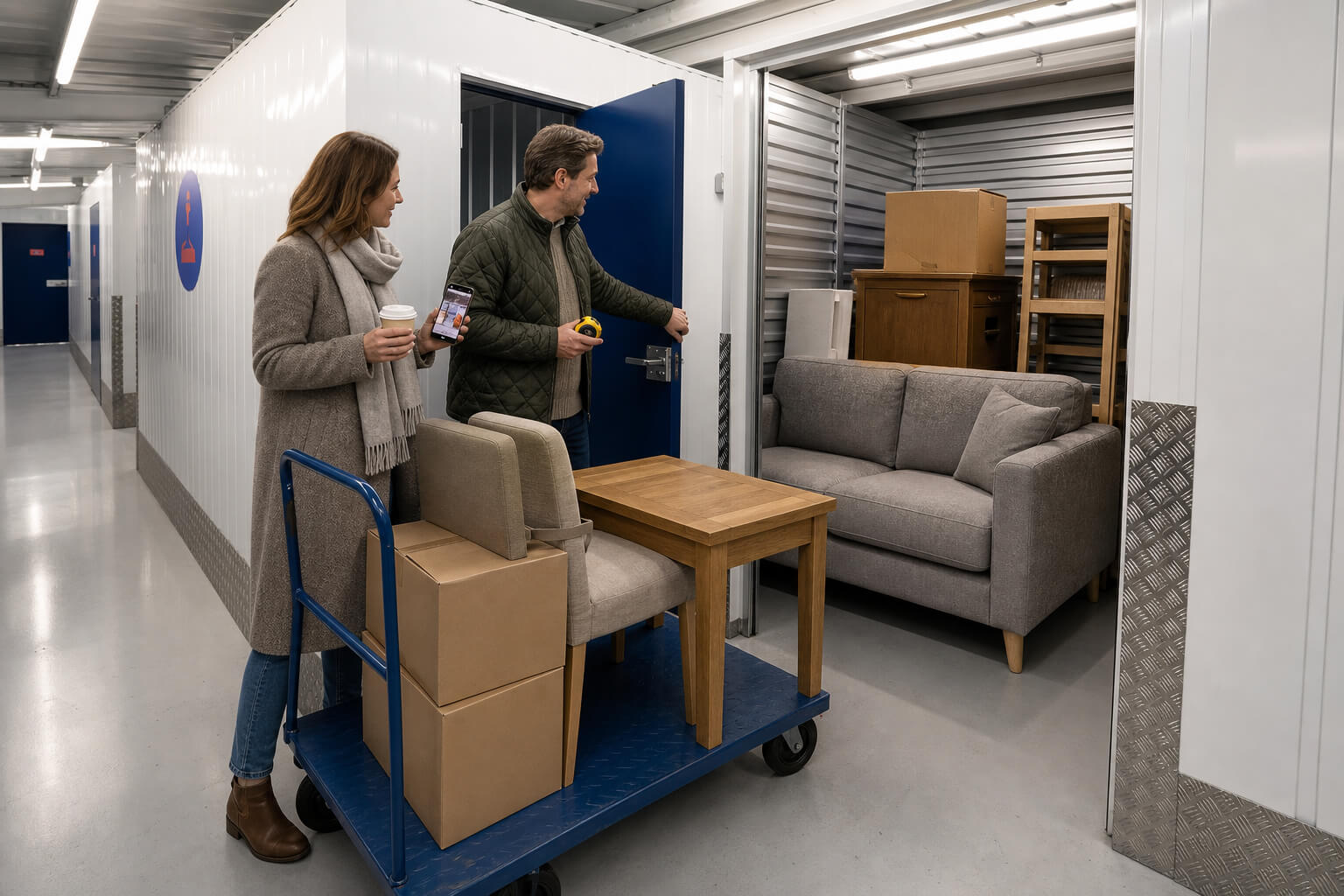
Trades move fast. When a kitchen fitter or plasterer arrives on site, they need to work, not navigate a room full of furniture they cannot touch. Getting your belongings properly out of the way is not just tidiness; it is how the job gets done safely and on time.
Dust, knocks and the liability gap
Renovation dust travels further than you expect. A kitchen refit three rooms away will coat an unprotected dining table in fine plaster dust within a day. Trades cannot protect your contents and do the job at the same time, and that is not a criticism of them. It is just the reality of how a build works. A wardrobe left in a room being replastered is a liability for everyone. Furniture that is moved out of the building entirely is furniture that does not get marked, scratched or coated in debris. That simple fact drives the decision more than anything else.
When a spare room or garage is enough, and when it is not
For a genuinely small job, a well-organised spare room or garage can work. A bathroom refit with three pieces of furniture and a collection of towels and toiletries is manageable without renting external storage. But if you are hitting multiple rooms, or the job runs longer than a few weeks, the calculus changes. A garage that fills up early in the job becomes a retrieval problem by week three. A spare room used as overflow means the trades have to step around it or work in it. More importantly, a damp garage is a risk to wood, fabric and leather in a way that an indoor, individually alarmed self-storage unit is not. The threshold is roughly this: small footprint, short job, sturdy belongings, use your own space. Anything bigger, longer, or more valuable than that, and the cost of a proper unit pays for itself in peace of mind alone.
The three routes: off-site unit, driveway container, removals storage
Before you choose, it is worth understanding what you are actually comparing. Three options come up consistently in renovation planning, and they are not the same thing at all.
How a clean, dry, secure unit differs from a metal box on the drive
A self-storage unit is a dry, individually alarmed indoor space. Your belongings are inside a building, off the ground, away from the damp, and behind a door that only you can open. A driveway container is a metal box. It sits on your property, often on concrete, and it is exposed to everything the British weather does between January and March. Condensation forms inside metal boxes. Heat builds up in summer. There is no alarm. If the renovation overruns and the container sits on the drive into November, you will likely find your furniture in a worse state than if you had done nothing. Clean, dry and secure is not marketing language. It is a meaningful practical distinction when you are storing a sofa for ten weeks.
Full-service removals storage: when it makes sense and when it does not
Full-service removals storage means a company packs your goods, loads them, and holds them in a warehouse you may or may not be able to access easily. It is a legitimate option if you are also moving house or if you are physically unable to run the transport yourself. For a renovation where you are staying in the property, it usually costs more and gives you less control. When you want something back mid-build, you have to go through the company’s process. For most renovation jobs, a self-access unit gives you both lower cost and direct access to your own goods.
Unmanned sites: what that means for access and deliveries
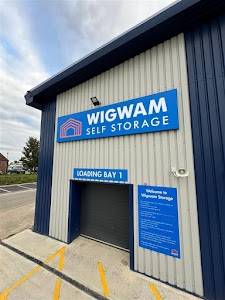
Wigwam sites are unmanned. That is a fact worth knowing before you arrive. You access your unit yourself, using smart entry. Nobody is on site to let you in, show you round, or receive goods on your behalf. If a delivery is being made to the site while you are storing, someone from your own side needs to be present. Wigwam does not sign for couriers and cannot accept deliveries on your behalf. For a renovation, this is rarely a problem. You are not expecting deliveries to the storage site; you are expecting deliveries to the build. But it is worth knowing, so there are no surprises.
Sizing the unit to the build (the bit nobody explains)

Here is the logic most renovation storage guides miss entirely. They tell you what to pack. They do not tell you how big a unit to take, or why that question changes completely depending on which rooms you are hitting and in which order.
One room or a kitchen refit: small to medium
A kitchen refit clears one room in functional terms, though it usually displaces a fair amount of overflow into adjacent spaces. A single room or a kitchen refit typically generates the volume of a small to medium unit: kitchen appliances, table and chairs, a few boxes of crockery and cupboard contents, possibly a sofa if the living area is being used as a work route. A small unit handles this comfortably if you pack well. A medium unit gives you breathing room if you are adding the contents of an adjacent hallway or utility room.
Two or three rooms: moving up to medium
A ground-floor open-plan refurb, or a project hitting two or three rooms in sequence, is the medium-unit territory. You are clearing a bedroom suite, a living room, possibly a study. The key here is how you pack. A bed frame disassembled takes far less space than a bed frame standing upright. A sofa on its end, wrapped in furniture blankets, takes less floor space than a sofa on its feet. The packing discipline that saves money on unit size is the same discipline that protects the furniture. Do both at once.
Whole-house strip-out: large, or phase it
A whole-house strip-out is different in kind, not just degree. You are clearing every room in the building before any room goes back in, and the build may run twelve to sixteen weeks or longer. A large unit covers the volume. But a phased approach is often cheaper. Take a large unit for the first eight weeks when you need maximum capacity. As rooms go back in and furniture returns, reduce to a medium unit for the final clearance phase. Two rental periods, sized to what the build actually needs at each stage, frequently cost less than one large unit held for the full duration.
A simple size guide by project scope
This is a rough guide only. Every renovation is different, and packing quality affects the space needed as much as volume does.
| Project scope | Starting point |
|---|---|
| Single room or kitchen refit | Small to medium unit |
| Two to three rooms | Medium unit |
| Whole house | Large unit, or phase it |
For a quote sized to your specific town and the rooms you are clearing, use the quote tool at quote.wigwamstorage.co.uk. Current rates by location are at the pricing reference page. If you are not sure whether your project falls into “medium” or “large,” talking it through with the team at your nearest location is a better use of five minutes than guessing.
Not sure which unit fits your project? Tell us your town and roughly what you are clearing, and we will size it with you. Get a quote at quote.wigwamstorage.co.uk.
Matching the rental length to your schedule

Duration is where most renovation storage plans go wrong. People either book for too long, paying for a unit that is sitting empty while a finished room waits for its furniture, or they book too short and face an unnecessary scramble to extend. Getting this right is simpler than it sounds.
The two-week minimum stay and what it means for short jobs
The minimum stay at Wigwam is two weeks. That is the baseline. If your kitchen refit runs nine days and you are done, you have still paid for fourteen. That is the floor, and it is worth knowing when you are sizing the budget. For most renovation jobs, two weeks is a sensible starting point in any case: fit-outs rarely run to a precise deadline, and having a fortnight of storage from the start gives the trades the room they need without you rushing the pack-out. For a longer job, you simply extend from there. Full terms are at wigwamstorage.co.uk/terms-conditions.
The 14-day notice and refund of unused days: built-in slack for a slipping schedule
Renovation schedules slip. Anyone who tells you otherwise has not done many renovations. The practical protection here is the 14-day notice period. When you are ready to vacate the unit, you give notice, and unused days beyond that notice period are refunded once the unit is cleared and the account is settled, less anything owed. This is not a technicality in the small print; it is a feature worth planning around. Book to your best-guess finish date. When you are confident the rooms are going back in, give notice. The unused days come back to you. If the build runs longer than expected, extend the rental. The two-week notice period means you are never trapped.
Phasing: pay for what the build needs, when it needs it
A well-planned renovation storage budget follows the build programme, not a round number of months. If you are doing a whole-house strip-out with a sixteen-week programme, consider booking a large unit for the first eight to ten weeks when you need maximum capacity, then assess. If rooms are going back in, you may be able to drop to a medium unit for the final clearance phase. Two shorter, right-sized rental periods can cost less than one large unit held “to be safe” for the full duration. The only discipline this requires is planning the rental from the build programme itself, not from a rough guess at the end date.
Packing and protecting furniture for a build

A unit that is packed well stores more, costs less, and gives you your furniture back in the same condition it left the house.
Disassemble, wrap and label by origin room
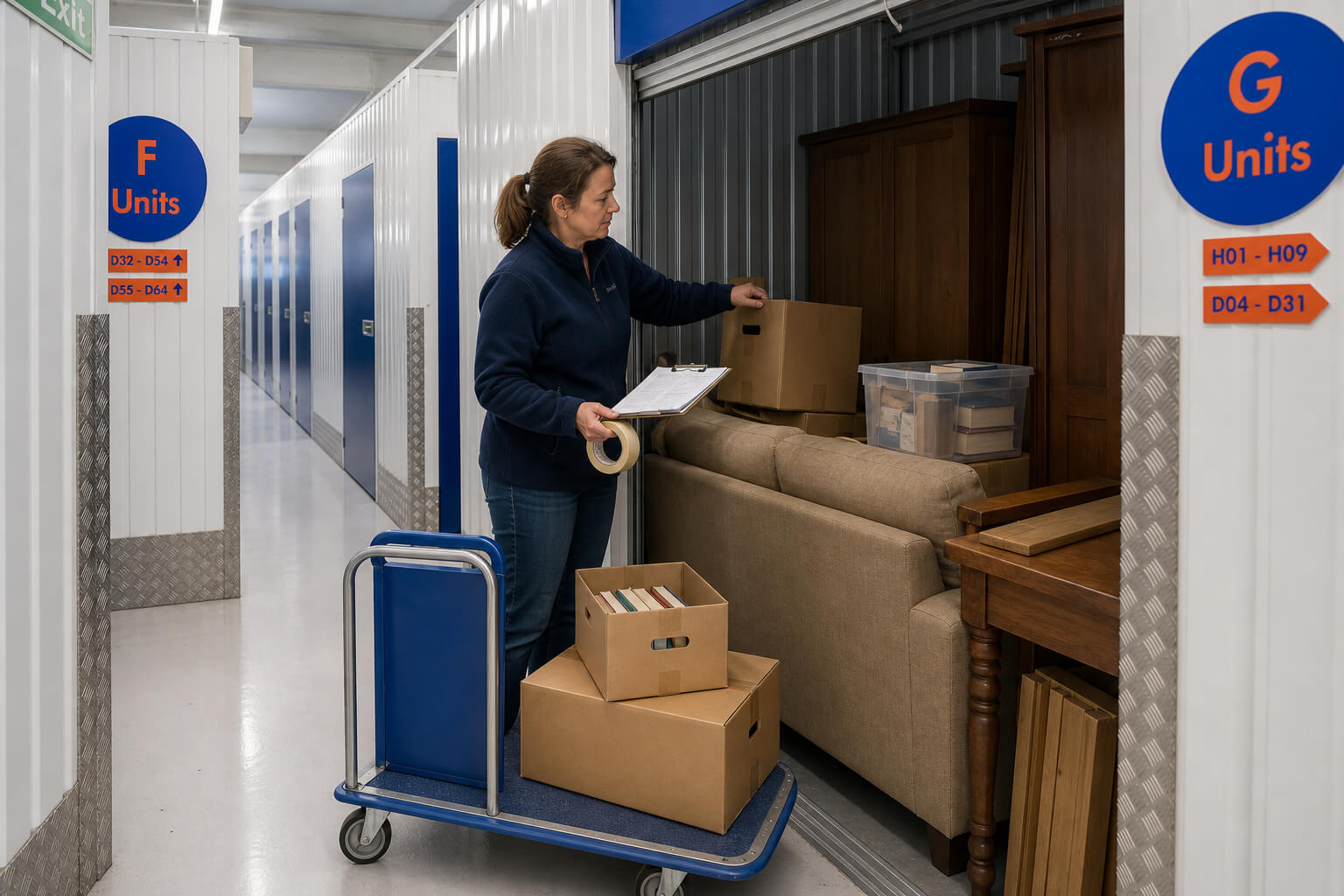
Take beds and tables apart before they go in. A bed frame on its side, labelled with the room it came from, takes a fraction of the space of a fully assembled bed. Wrap upholstered items in furniture blankets or dedicated covers. Label everything by origin room, not just by content. When the build finishes and you are moving furniture back in, you do not want to be reading box labels in an unlit unit trying to remember where the bedroom bookcase came from. Heavy items go at the back of the unit. Items you are likely to need mid-build go near the door. This matters more than it sounds.
The honest line on sensitive items: what clean, dry and secure actually covers
The standard renovation storage advice across the internet recommends climate-controlled storage for antiques, artwork, instruments and electronics. We do not offer climate control, and we will not pretend otherwise. What Wigwam offers is clean, dry and secure: indoor units, individually alarmed, off the ground, away from damp. That is a meaningful level of protection for the bulk of household contents. For good furniture, kitchen appliances, books, clothing and general household goods, a clean, dry, individually alarmed unit is appropriate and honest.
For genuinely specialist items, high-value antiques, fine art, instruments that need precise temperature and humidity stability, our honest advice is to consult a specialist storage or conservation service. That is not a referral; it is a limit we are clear about. Wigwam’s offer is general household storage, done properly. It is a strong offer for what it is, and we will not inflate it to cover things it does not cover.
Access during the build: getting to your things

One of the quiet anxieties of renovation storage is the feeling of having surrendered access to your own belongings. You have not.
6am to 10pm smart entry, seven days
Smart entry is available seven days a week, from 6am to 10pm. On any day the trades are on site, you can get to the unit before they arrive and after they leave. If you realise mid-project that you need a specific tool, a set of bedding for a room that has just gone back in, or winter clothes in October when the heating is still disconnected, you can go and get them. Plan a mid-build access trip around week four or five of a longer project; it is often the right moment to return furniture to rooms that are finished and reduce the unit size accordingly.
Packing for access: a practical note on deliveries
Pack with mid-build access in mind from the start. Items you are likely to need before the job is done go near the door of the unit, not behind the sofa. A simple inventory list kept at home tells you exactly where everything is before you make the trip.
One practical point on deliveries: if you are expecting a delivery to the storage site rather than to the build, you need someone from your own side to be present to receive it. The sites are unmanned. Wigwam cannot sign for couriers or receive goods on your behalf. For most renovation storage arrangements this never comes up, because your deliveries go to the house. But if it might apply to your project, factor it into your logistics.
Cost: how to think about it without surprises

Cost is usually the first question and the hardest to answer simply, because it depends on your location, your unit size, and how long you need it.
Where to check current pricing
We do not quote prices in the article because rates vary by location and unit size and are updated regularly. The right place for a current figure is the pricing reference page, or the quote tool at quote.wigwamstorage.co.uk which gives you a live figure for your nearest location. Our UK market-town locations each have their own rates, and the quote tool reflects those. Wigwam Self Storage Bath and Wigwam Self Storage Lincoln are examples you can explore directly; for other locations, the locations hub lists them all.
Contents cover and declaring full replacement value
There is no deposit to reclaim when you leave. Any unused days are refunded after you give your 14-day notice, once the unit is vacated and the account is settled, less anything owed.
Contents cover is mandatory when you store with Wigwam. You can take the Wigwam policy (RSA Self Storage Customers’ Goods cover, New-for-Old basis) or prove your own. Either way, you must declare the full replacement value of everything you are storing. Under-insurance is settled in proportion: if you declare half the value and make a claim, you receive half the payout. The excess is £50. Theft cover applies after forcible entry; climatic damage is excluded. These are the terms of the policy. We are pointing you to them, not advising you on them. Full details are at the contents protection page. If you have any doubt about whether your own home or contents policy extends to a storage unit, check with your insurer before you store.
Renovation storage mistakes to avoid
The most common mistake is booking a unit that is too large and too long before the build has properly started. You do not know exactly how long the job will run, so you book for six months “just to be safe,” and you end up paying for three months of half-empty space because you did not want to be caught short. The two-week minimum and 14-day notice are designed precisely to protect you from this. Book for your realistic estimate, not your worst-case one.
The others worth knowing:
Under-declaring replacement value on the contents form. If your furniture cost £8,000 to furnish a bedroom and you declare £3,000 because you did not want to think about it, a claim pays out at a fraction of the real loss. Take the time to add it up properly.
Not planning a mid-build access trip. If you are running a twelve-week project and you never visit the unit, you will move furniture back in at the end without having thought about it since the day it went in. A visit around the halfway point, to return anything the trades have now finished around, often reduces the final weeks of rental and the size of unit you need to finish the job.
Ignoring the notice period. If you stop needing the unit on a particular date and forget to give your 14 days notice on time, you will pay for an additional fortnight you did not need. The notice period is not a penalty; it is part of the planning. Put it in the calendar when you take the unit.
Packing without labelling. A unit full of unlabelled boxes is a significant problem at move-in when you are trying to set up a house that has been gutted for three months. Every box, every wrapped piece of furniture: label it by room and by rough content. Future you will be grateful.
Ready to size your unit to the build?
The right unit is the one that matches the rooms you are clearing and the weeks you are working, not the largest one available. Start with the quote tool and tell us your town and roughly what you are moving out.
Get a quote at quote.wigwamstorage.co.uk.
Not sure which location is closest to you? Find your nearest Wigwam site at the locations page.
Frequently Asked Questions
You move up to a larger unit, subject to what is available at your site, so the main thing is to flag it early rather than at the last minute. Underestimating happens, usually because furniture takes up more room than it looks once it is wrapped and stacked, or because the build scope grew and another room had to come out. The fix is straightforward in principle: you take a larger unit and move your goods across. The honest caveat is availability. Sites do not always have a bigger unit free on the day you need it, and the popular sizes can be taken, so the sooner you raise it with the team the better the chance of a smooth move. A few practical points help. If you suspect at the planning stage that you are on the line between two sizes, it is usually cheaper and less hassle to start one size up than to move twice. If you do need to upsize mid-build, it means a moving session to shift everything from the small unit to the larger one, so pick a quiet day and do it in one go. And remember the two-week minimum applies per unit, so very short overlaps are worth planning around. The terms themselves do not penalise you for changing, you give notice on the unit you are leaving and unused days are refunded, but the practical constraint is simply whether the size you want is free, which is why an early conversation beats a last-minute scramble.
Yes, and on a longer build that is often the cheapest way to run your storage, but it means a physical move from one unit to another rather than the same unit shrinking. The logic is sound: on a whole-house strip-out you need maximum capacity at the start, then as finished rooms take their furniture back, the unit empties and you are paying for space you no longer use. Moving down to a smaller unit at that point trims the cost for the final clearance phase. The practical reality is that you cannot make a unit smaller, so downsizing means transferring what is left into a smaller unit and giving notice on the larger one. That is worth timing well: do it when there is a clear, substantial drop in volume, not after every single box leaves, so you are not moving things twice. Speak to the team about availability of the smaller size before you commit to the plan, since the move only works if the smaller unit is free when you need it. On the terms side, you give your 14-day notice on the larger unit, clear it, and unused days are refunded, while the smaller unit starts on its own two-week minimum. For many sixteen-week projects, two right-sized rental periods genuinely cost less than one large unit held to be safe for the full duration, which is the whole point of sizing to the build programme rather than to a round number of months.
No. The sites are unmanned and your smart-entry access is yours, so someone from your own side has to be present, you cannot simply send a removals crew or a tradesperson to let themselves in. This catches people out, so it is worth planning around. Wigwam holds no keys, has no staff on site to open up, and does not receive or release goods on a customer’s behalf. Access to your unit runs through your own smart-entry credential, between 6am and 10pm, seven days a week. So if a removals firm is collecting furniture to bring back to a finished room, you or someone you trust from your household needs to be there with the access to let them in and supervise. The same applies to any delivery to the site: a courier or supplier dropping goods needs someone from your side present to receive them, because Wigwam will not sign for or accept deliveries. In practice this is rarely a real obstacle for a renovation, because your build deliveries go to the house, not the unit, and you are usually present for furniture runs anyway. The thing to avoid is booking a removals slot or a courier on the assumption that the site will handle access for you. Build your access around being there, or having a trusted person there with the credential, and the unmanned model causes no difficulty at all.
Your storage simply continues at the same rate, because the arrangement is rolling with no fixed end date, so a stalled build does not create a storage problem. Renovations pause for all sorts of reasons: a delay waiting on a key trade, a planning or building-control hold-up, funds being rephased, or a structural surprise that needs a fresh quote. Whatever the cause, your unit is unaffected. There is no fixed term to breach and no penalty for the build taking longer than planned. You keep the unit for as long as you need it, paying the same rate, and when the project finally resumes and finishes, you give your 14-day notice, clear the unit, and any unused days beyond that are refunded. Two things are worth doing during a pause. First, if you can see that finished rooms are ready to take some furniture back even while the rest of the build is on hold, returning those items lets you consider moving down to a smaller, cheaper unit for the duration of the pause, using the 6am to 10pm access to do it at your own pace. Second, keep your contents protection in mind: cover is mandatory throughout the stay, so make sure the declared replacement value still reflects what is in the unit if the contents have changed. Beyond that, a paused build needs no special action on the storage side. The flexibility that protects you against an overrun protects you against a stall in exactly the same way.
If you are storing heavy items like a cast-iron bath, a range cooker, large wardrobes or a full set of white goods, a ground-floor unit with level or near-level access makes the move far easier, so it is worth raising when you book. Sites vary in layout, so the right move is to tell the team what you are storing and ask what the access is like at your nearest location: whether the unit is at ground level, whether there are steps or a lift, and how close you can get a van or trolley to the unit door. Heavy renovation furniture is awkward to manoeuvre at the best of times, and the difference between a level wheel-in and carrying a wardrobe up a flight is significant on moving day, especially if you are doing it yourself rather than using a removals crew. A few practical tips regardless of unit location: use a sack truck or furniture dolly for the heavy pieces, disassemble what you can (bed frames, table legs, shelving) so individual loads are lighter and easier to handle, and put the heaviest items in first and at the back so lighter boxes can stack in front of them. If you are bringing a removals firm, remember they will need you or a trusted person present with the smart-entry access, as the site is unmanned. Raise the heavy-items question at quote stage and the team can point you to the most suitable unit for what you are moving.