How do you protect original veneer from a passing plasterer’s elbow?
A renovation is mostly small events. A plasterer’s elbow catching the corner of a wardrobe. An open window during a rain shower. A paint roller left too close to a chair. None of those things would matter much to flat-pack furniture. To a Georgian chest with its original veneer, or a Victorian dining table whose finish took someone decades to develop, each one is the kind of damage that cannot be undone.
The good news is that none of those risks follow the furniture once it leaves the house. A well-run, clean, dry and secure unit is simply a different environment, one where the pieces sit quietly while the trades do their work, and come back out in the same condition they went in.
This is what we have watched happen for families across our UK market-town locations. The anxiety beforehand, the relief on collection day. Getting the pieces there in good order is the work. What follows is the honest guide to doing that properly.
Why antiques and building work do not mix
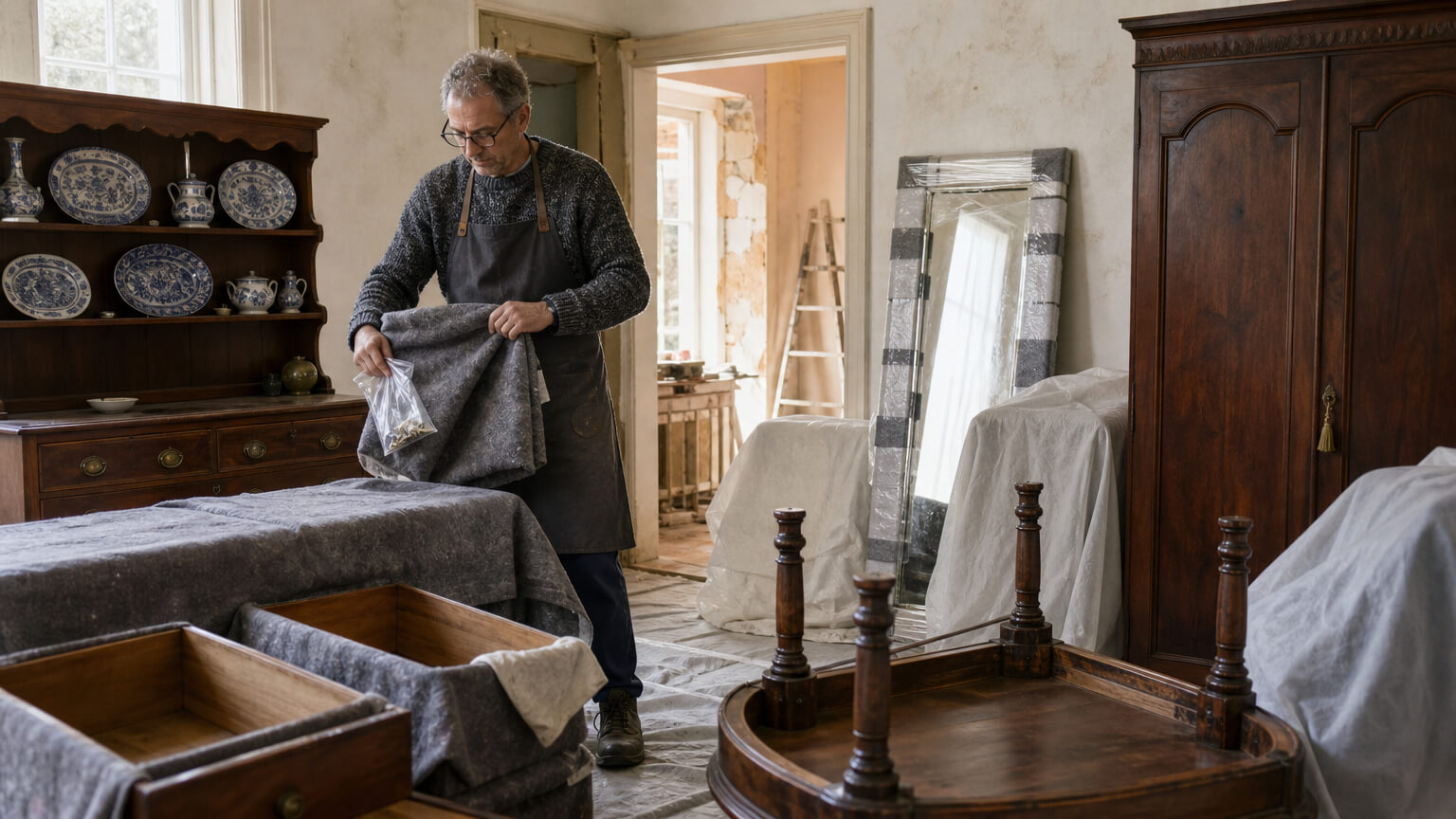
Period furniture and an active building site occupy the same space uneasily. Even a modest project, a single bathroom refurbishment or a kitchen extension, generates a daily accumulation of small hazards that standard furniture shrugs off and period pieces do not.
Dust, damp plaster, paint and the daily reshuffle
Plaster dust is the first problem, and it is relentless. It settles on every horizontal surface within two or three rooms of the work, and it is abrasive. Rubbing it off a waxed surface takes some of the wax with it. On a painted finish, particularly the kind of milk-paint or distemper found on Georgian country pieces, it bonds and marks. A full-floor renovation involving several trades at once means the dust is being generated in waves for weeks.
The daily reshuffle compounds this. Furniture that seemed safe in the dining room gets moved to make space for a scaffold tower. The piece that was near the wall is now near the door. Things that get moved repeatedly on a building site get knocked. And damp plaster, in the weeks while it is curing, raises the ambient humidity in the immediate rooms, which is exactly what you do not want near joinery with an age-old moisture balance.
Why period pieces face different risks than flat-pack furniture
The differences are material, not sentimental. Modern furniture is built with materials that absorb and release moisture gradually and without much consequence. Old furniture is different in three ways that matter.
First, veneer and marquetry are glued with hide glue, a traditional adhesive that softens under heat and humidity. Plaster dust settling into the grain of a marquetry surface is hard to remove without risking the inlay beneath. Second, original paint finishes, wax patinas and French polish are surface coatings built up over decades of use. They are not protective lacquers; they are the record of the piece’s life. Third, horsehair and linen stuffing in upholstered Victorian pieces absorbs dust and moisture in ways that modern foam does not, and once it is in, it is difficult and expensive to remedy.
None of this is insurmountable. It just means the right approach is to remove the pieces rather than protect them in situ, and then store them properly.
Self-storage versus the alternatives
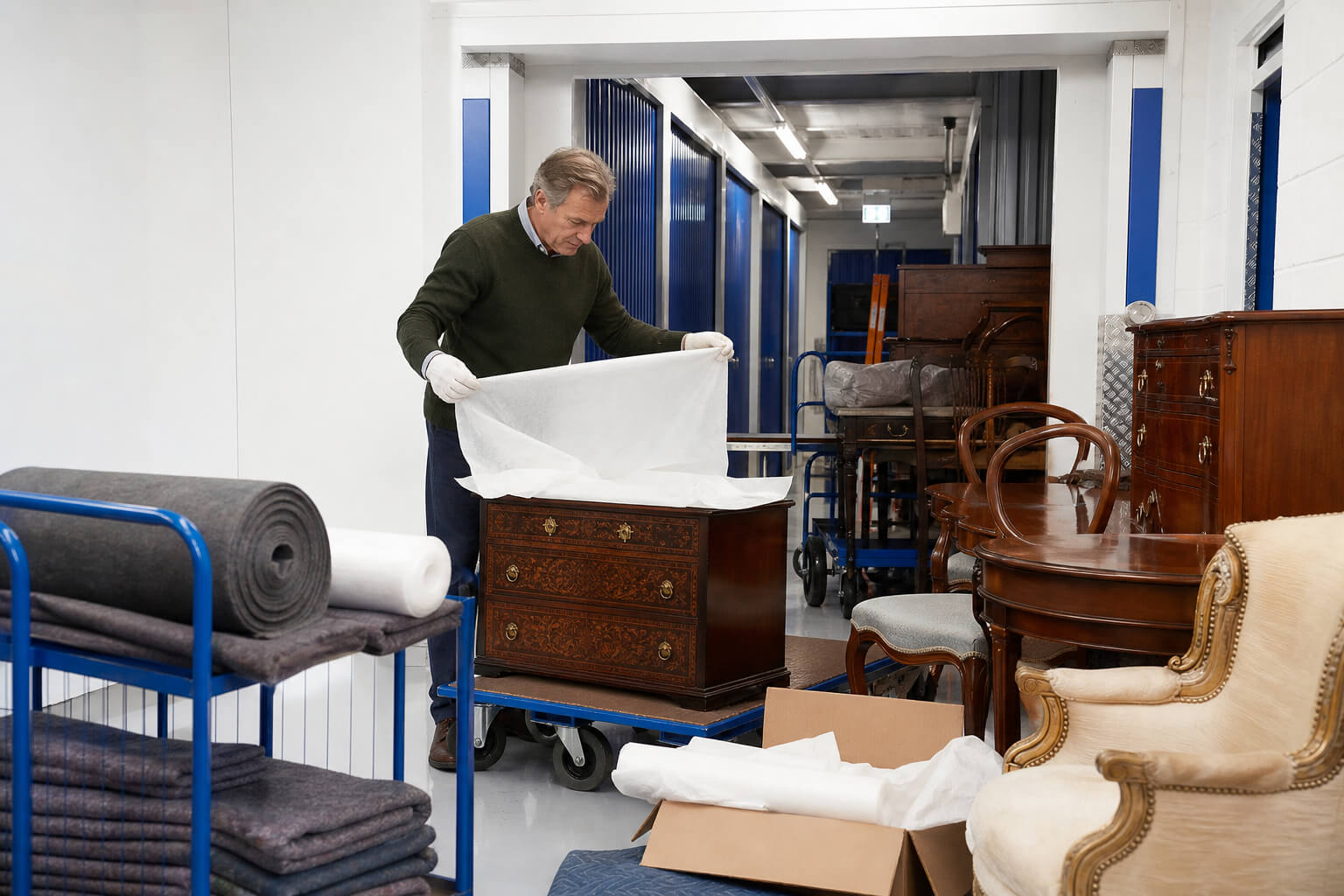
Once you have accepted that the furniture needs to leave, the question is where it goes. There are three realistic options besides a self-storage unit, and each has a characteristic failure mode when antiques are involved.
A skip-side container and builder’s storage
The builder’s storage container at the side of the house is convenient for the trades, which is precisely the problem. It sits in the same environment as the build. Damp gets in. The container is accessed by people other than you. Vibration from machinery travels through the ground. And the site access means your furniture is handled whenever someone needs to get past it for something else. It solves the problem of where to put things without solving the problem of what happens to them there.
A spare room or garage, and why it usually fails for valuables
The spare room feels like the free option, and it often is, right up until week four. Renovations migrate. The safe room in week one becomes the overflow route for scaffolding boards in week three, or the place where the plumber runs a pipe through the ceiling while you are at work. Garages are typically damp environments with temperature swings that are worse than a heated house, not better. If the piece genuinely cannot be replaced, a space you cannot fully control is not the right space.
A removals firm’s warehouse, or a national chain
Both of these are legitimate options for many situations. The distinction worth understanding is this: a removals firm’s warehouse or a national chain’s container store typically means your furniture is held by someone else, accessed on their schedule, and in a space you cannot enter without arranging it in advance. For a renovation where you might want to retrieve a specific piece, or check the condition of something after a long wet stretch, that limitation matters. A self-storage unit you can walk into directly is a different arrangement.
The climate-control question: what we offer and what we do not
This is the section most renovation guides avoid. Every competitor who writes about storing antiques or period furniture reaches for climate control as the answer. We are not going to do that, because it is not what we offer, and because for most UK renovations it is not what you actually need.
Why a renovation rarely needs climate-controlled storage
Climate-controlled storage exists for a specific purpose: long-term preservation of sensitive materials in environments where the surrounding climate is genuinely variable over years. A collection stored in an unheated barn for a decade. Instruments in a building that freezes and thaws through multiple winters. For that use case, steady temperature and humidity matter.
A renovation that runs for eight weeks, or sixteen weeks, is a short window. The risk to period furniture during that window is not the slow atmospheric drift that damages things over years. It is dust, impact, moisture ingress during transit, and wrong packing materials. Correct packing technique, which we cover in the next section, addresses all of those risks more directly than the ambient temperature band of the unit.
We do not offer climate control. We will not imply that we do. What we offer instead is a clean, dry and secure unit that you control, combined with the packing knowledge that actually determines whether the pieces come out of storage in good order.
What clean, dry and secure means at Wigwam
Our units are individually alarmed. The site is clean and dry. Nobody else has access to your unit. When you lock the door, the only person who can open it is you, or someone you have explicitly brought with you.
That matters for period furniture in a specific way. One of the genuine anxieties about storing irreplaceable pieces is the thought of strangers handling them. At an unmanned site, there are no strangers in your unit. The pieces sit exactly where you put them.
Packing period pieces properly
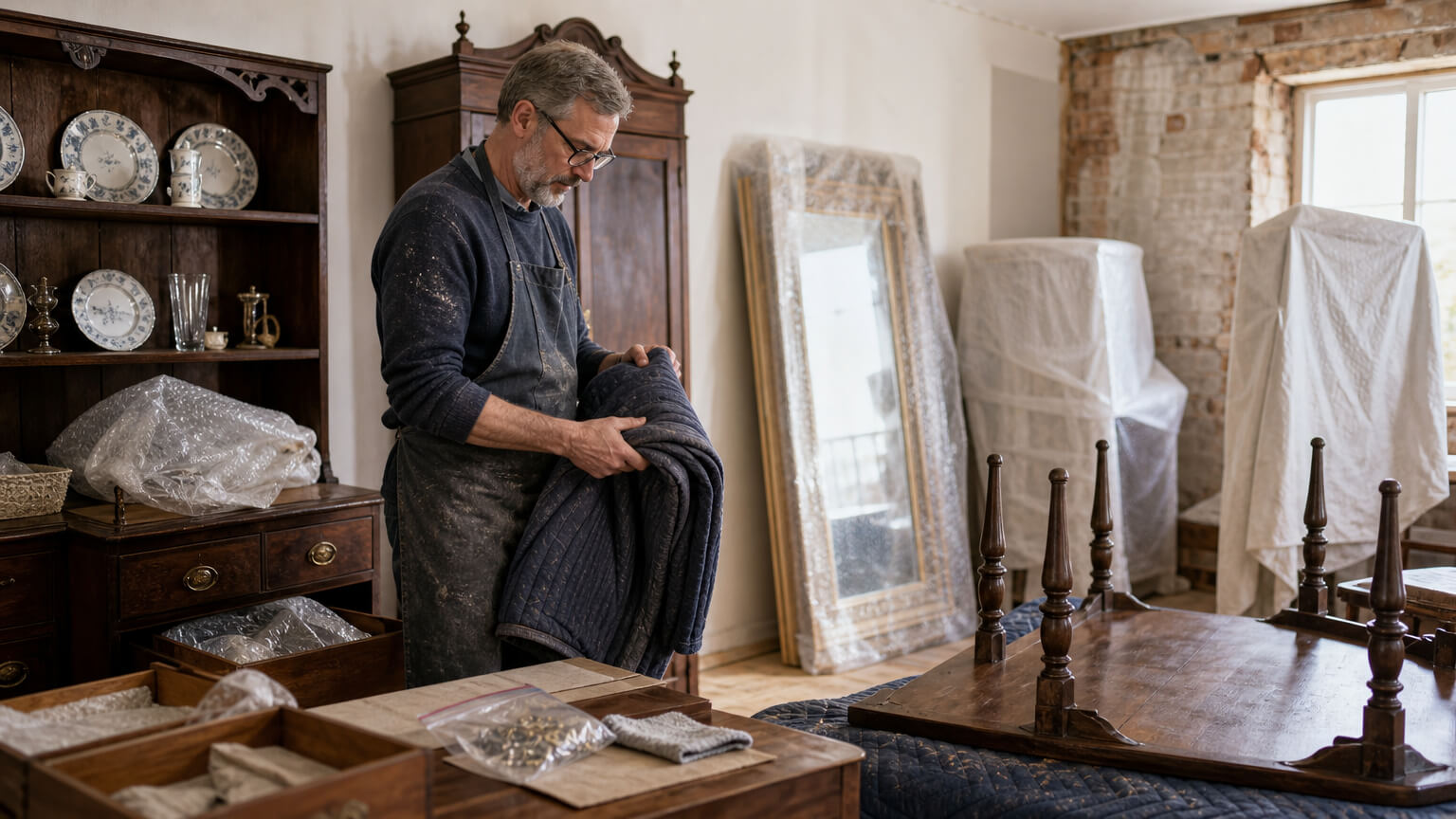
This is the section where the article earns its keep regardless of where you end up storing. Packing period furniture correctly for even a short move is knowledge worth having. The wrong materials cause more damage than the average renovation site.
Breathable covers and why plastic is the enemy of veneer
The instinct when wrapping anything valuable is to reach for plastic. For period furniture, that instinct is wrong. Plastic sheeting, bubble wrap and shrink film trap moisture against old finishes. In a warm unit, plastic against veneer or French polish will cause off-gassing, condensation and adhesion that lifts the surface. Once a veneer starts to lift, it does not reliably go back down.
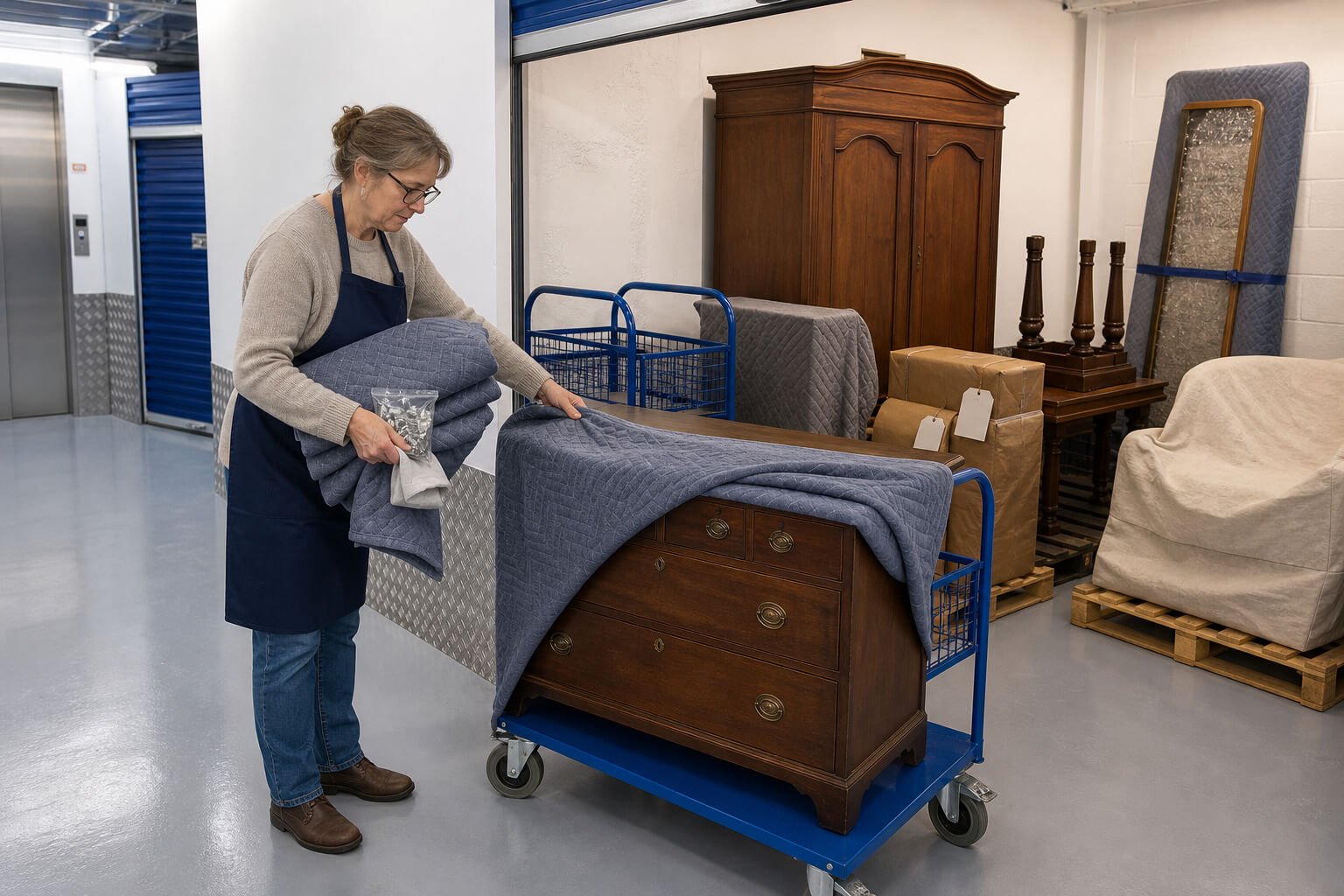
The right materials are breathable. Cotton furniture blankets or furniture pads are the workhorses of careful furniture removal, and they are right for storage too. Cotton dust sheets over the top. For marquetry surfaces or inlay, acid-free tissue placed directly against the surface before any other covering goes on. This allows the wood to breathe without exposing it to abrasion.
Empty and wedge drawers, protect feet and corners, lift off the floor
Drawers left in a piece during movement and storage become levers under any kind of stress. Empty them fully. Then wedge them lightly so they cannot rattle but are not forced. A drawer that is free to shift during movement will transfer that force to the joints of the carcass, and hide-glued joints from the eighteenth and nineteenth centuries are not infinitely forgiving.
Carved feet and decorative corners are the most vulnerable points on most period pieces. Wrap them individually with furniture padding before the main blanket goes on. This is worth the extra ten minutes. For the floor of the unit, lay boards or a pallet so the piece sits off the concrete. Unit floors are dry, but timber feet sit better on timber, and the small air gap matters over weeks.
Do not stack heavy items on top of upholstered surfaces. A buttoned Victorian chair will bear the weight of a box for a morning and show the marks for years.
Disassembly: what was made to come apart, and only that
Modern flat-pack and factory furniture is designed to be disassembled. Georgian and Victorian furniture generally is not, or at least, its joinery was not conceived with repeated disassembly in mind. The hide glue that holds traditional mortice-and-tenon joints softens under heat and stress but does not necessarily reglue cleanly once broken. Forcing a period piece apart to make it easier to move is the single fastest way to damage something that a careful move would have kept intact.
If a piece has been apart before and the joints are clearly designed for it, take it apart with care. If you are not certain, leave it whole and ensure the removal is done by people who handle period furniture regularly.
Before any piece is moved, photograph it from multiple angles. Note any pre-existing damage: a crack in the veneer, a replaced foot, a repaired corner. This protects you at the insurance stage and ensures you know what you brought to the unit if anything looks different when you collect.
Sizing the unit for a period property
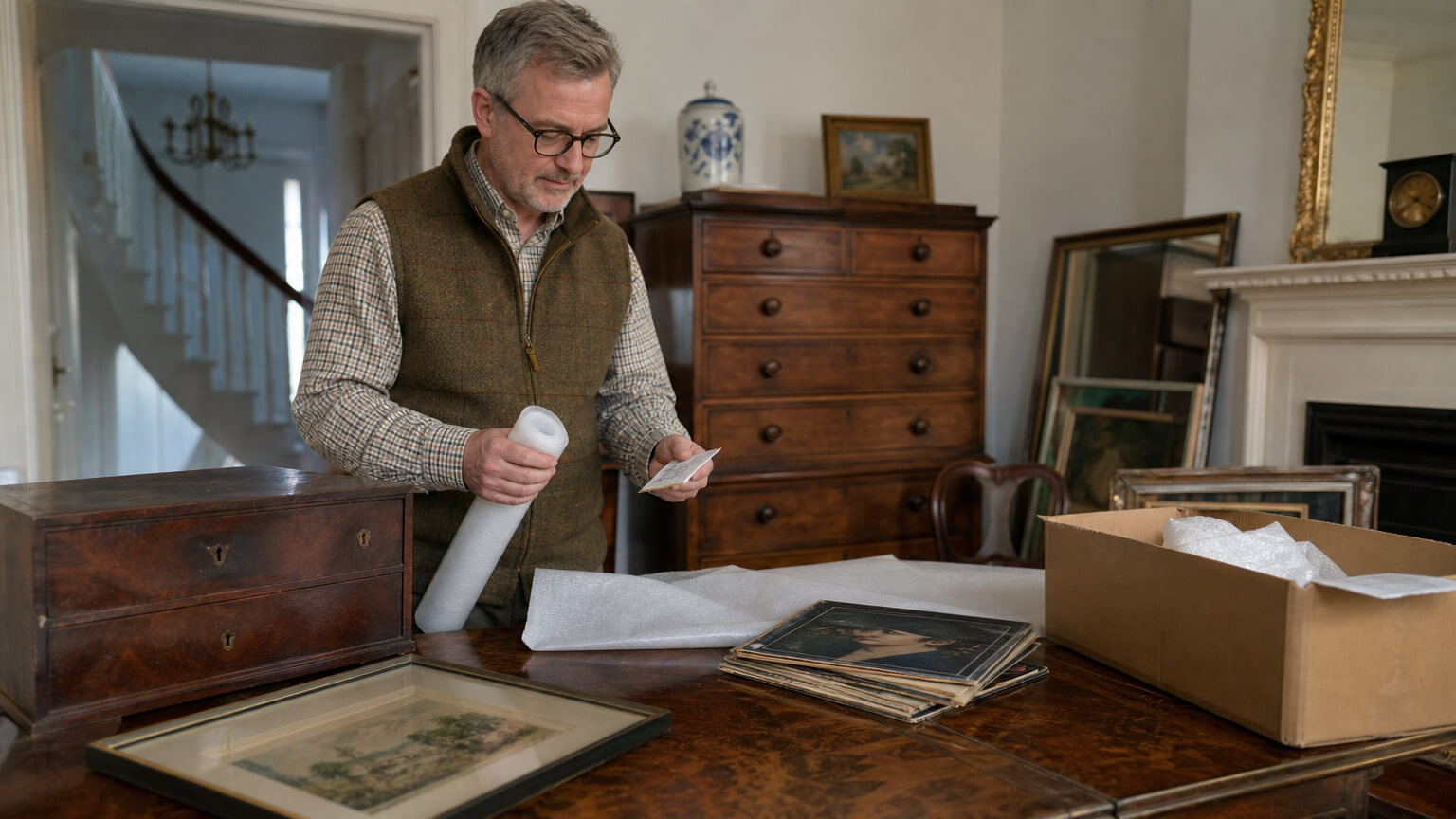
The furniture of a Georgian or Victorian house tends to take up more space than its modern equivalent because the pieces are larger and because there are more of them per room. A Victorian dining room routinely contained a table, six to eight chairs, a sideboard, a chiffonier and a linen press. All of that needs to go somewhere, and sizing the unit correctly on the first call saves you from paying for two units or from packing so tightly that pieces are at risk.
Room-by-room sizing for a typical period property
The industry standard size bands give a useful starting point. A 25 square foot unit holds roughly the contents of a large wardrobe. A 50 square foot unit holds a single furnished room if the pieces are not large. For the contents of a Georgian dining room or a Victorian front parlour, a 100 square foot unit is a more realistic starting point, and a full ground-floor clearance for a period town house will typically need 150 square feet or more.
These are orientations, not guarantees. A set of seven Victorian balloon-back chairs takes up more floor space than an equivalent number of modern dining chairs. A chiffonier with a large mirror back needs to stand, not lie down. Leave yourself more room than you think you need, and use the remainder for access.
For current pricing, the Wigwam guide at wigwamstorage.co.uk/how-much-is-self-storage-in-the-uk gives you an honest cost picture without requiring a call.
Leaving room to walk in and check on the pieces
Pack the unit so the most important pieces are nearest the door. If you want to open the door on a Tuesday afternoon and confirm that the walnut bureau is unmarked, you should be able to do that in thirty seconds without moving anything. This is partly peace of mind and partly practical: a renovation with an uncertain end date means you may want to retrieve specific items or add more things as different rooms are cleared.
Do not fill a unit to capacity. A unit that is packed to the ceiling is one where the piece at the back can only be reached by moving the piece at the front. For a renovation context, accessible storage is worth the cost of the extra square footage.
Not sure what size you need? Get an instant quote at quote.wigwamstorage.co.uk and we can help you work it out. No obligation, and the quote takes a few minutes.
Flexible terms for a build that runs to its own schedule
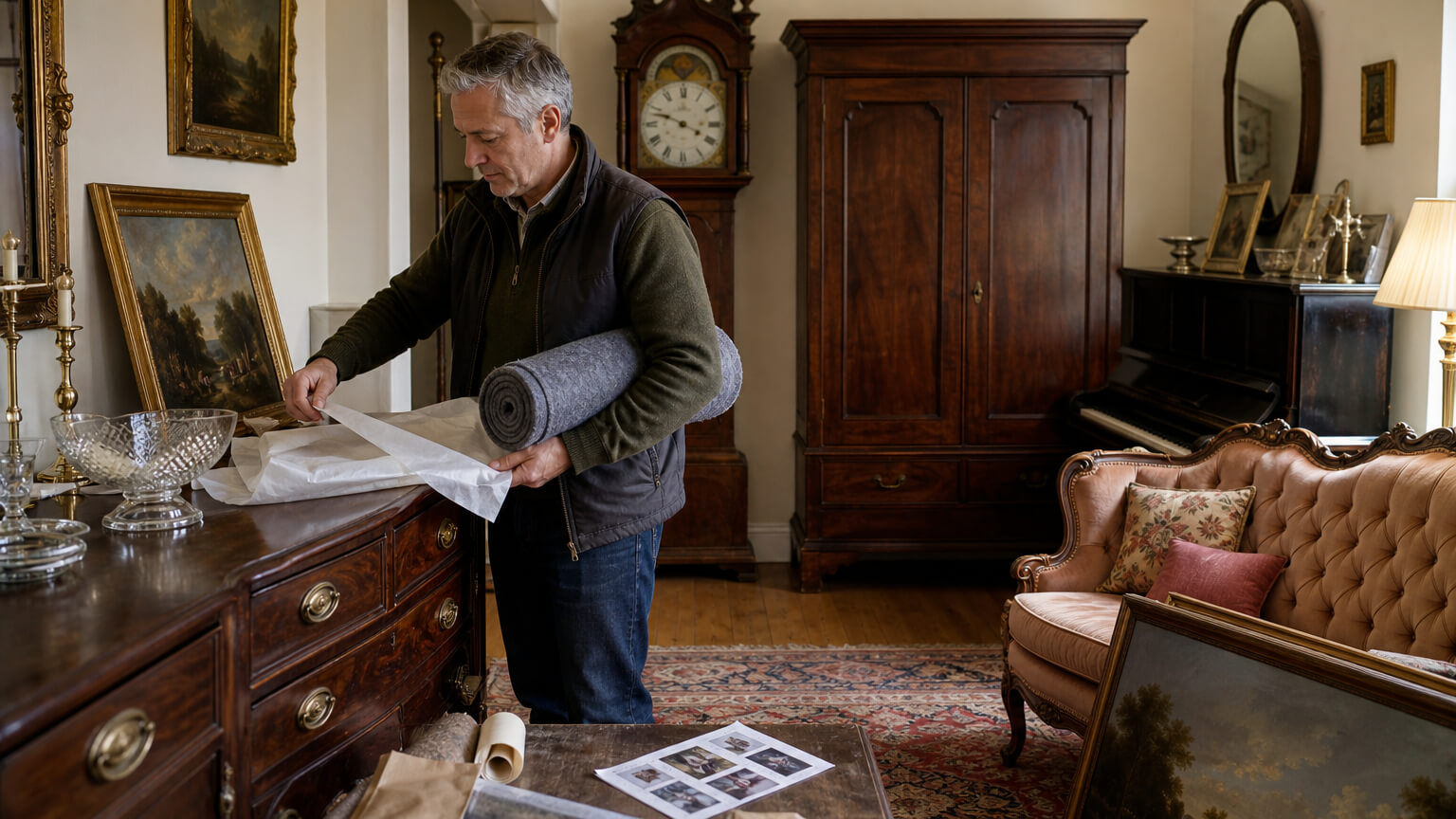
The anxiety of storing during a renovation is rarely about whether the unit is safe. It is about the build’s end date. Trades overrun. Materials arrive late. A job that was quoted as six weeks is in its tenth week and the kitchen is still half finished. You do not want a storage contract that punishes you for the builder’s schedule.
Two-week minimum stay and refund of unused days
The minimum stay at Wigwam is two weeks. If the build finishes early, unused days are refunded. In practice, this means the unit follows the build rather than the other way round. You are not paying a monthly minimum and hoping the renovation fits within it. If the plasterer finishes a fortnight ahead of the carpenter, you can move the furniture back when the plastering is done and only pay for the time you actually used.
No deposit, and the 14-day notice
When you are ready to vacate, give 14 days’ notice, clear the unit and settle the account. There is no deposit to come back, because we don’t take one, and nothing is retained as a penalty for leaving. Full details are at the terms and conditions page.
Insuring irreplaceable furniture properly
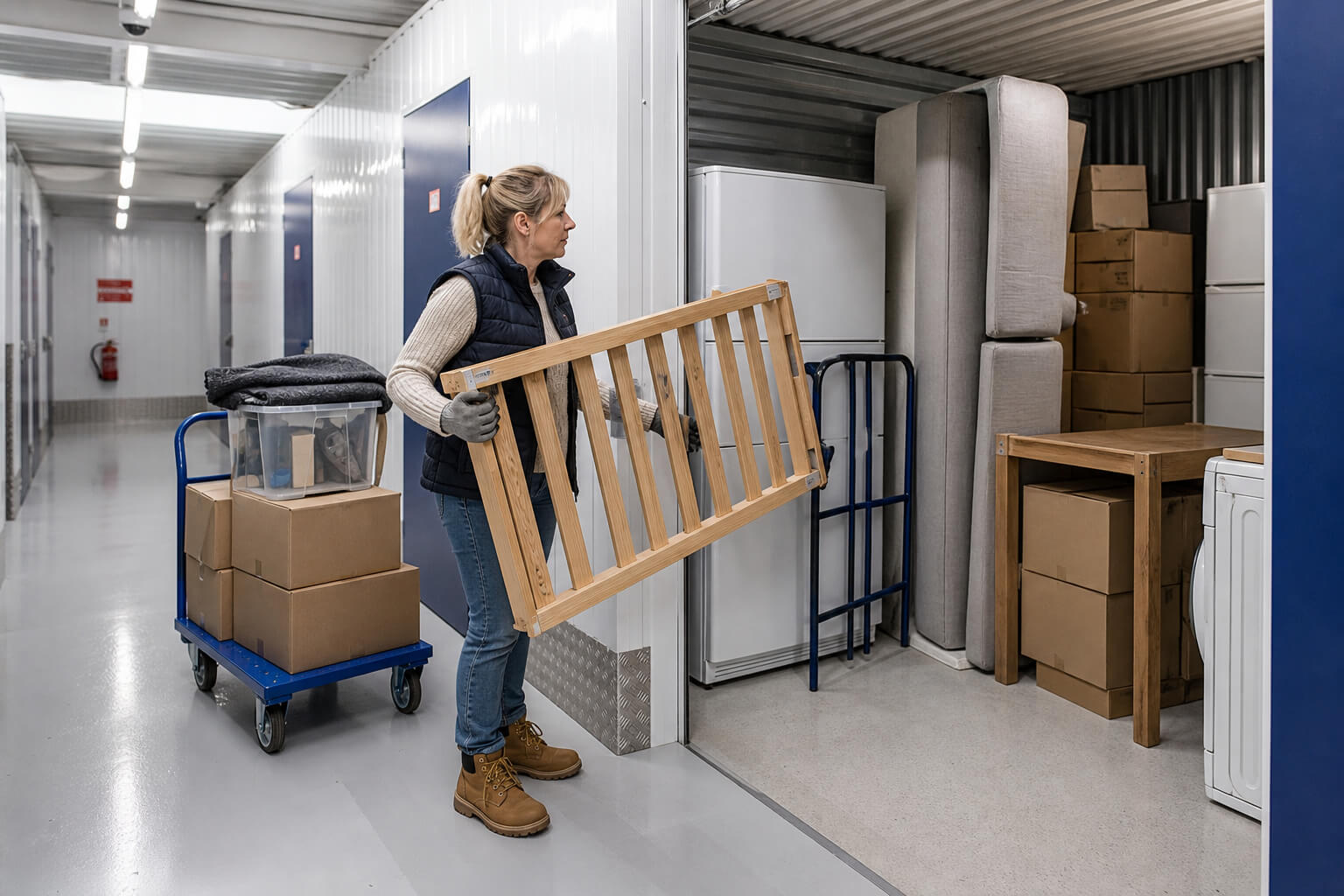
Contents protection is mandatory at Wigwam. You either take the policy offered, backed by RSA’s Self Storage Customers’ Goods cover, or you bring proof of equivalent cover from your own insurer. This is not a bureaucratic requirement; for irreplaceable antiques, it is the most important decision you make before the furniture goes into the unit.
How the RSA contents-protection policy works
The policy is new-for-old with a GBP 50 excess. Theft is covered following forcible entry. Climatic and atmospheric damage is excluded. The details, including the full policy schedule, are at the contents protection page.
The signposting here is intentional. Wigwam can tell you the structure of the cover. Your insurer is the right person to advise on whether it suits your specific situation, and your insurance broker or the RSA policy document is the definitive source on the terms.
Declaring the right value and what under-declaring costs you
This is the section that matters most for an antiques owner, and it is the one most likely to go wrong without thought.
Under-insurance in self-storage is settled proportionally. If you declare a piece at half its replacement value and make a claim for its full value, the settlement will reflect the proportion you declared. For furniture with a known market value, that is a straightforward mistake to avoid: get a specialist valuation or check recent auction results for comparable pieces, and declare accordingly.
For antiques, the replacement cost is rarely the original purchase price. A piece bought at a country auction fifteen years ago for a few hundred pounds may now have a replacement value of several times that, particularly if it has been professionally restored. Declare the figure it would cost you to replace it today, not what you paid for it.
We cannot advise on value; that is the job of a specialist valuer or your insurer. What we can say is that for pieces that cannot be replaced at any price, the right insurance answer is the one that would actually make you whole, and under-declaring to save a few pounds on the premium is the wrong calculation.
Access and security during the works
One of the consistent things we hear from people who have stored antiques during a renovation is how much it matters to be able to check on the pieces. Not because anything usually goes wrong. Because knowing you can open the door and see that everything is fine is what lets you focus on the build instead of worrying about what is in the unit.
Smart entry, 6am to 10pm, individually alarmed units
Access is by smart entry from 6am to 10pm, seven days a week. That covers the working day, the evening when you have finally got home and want to collect something, and the weekend when the builder is off and you have a moment to bring a piece back or take more out. We do not offer round-the-clock access, and we will not imply we do. The 6am to 10pm window covers every realistic need during a working renovation.
Each unit is individually alarmed. If yours is opened, that alarm is specific to your unit, not a site-wide system that covers everything loosely. That specificity matters.
Your unit, your access: nobody else handles the pieces
The site is unmanned. That means there is no staff presence entering units, checking on goods, or moving things to accommodate other customers. Your unit is the space you put the pieces in, and the only people who open it are the ones you bring with you.
For furniture that cannot be replaced, the knowledge that no one else handles it is worth more than any feature list. The Victorian wardrobe sits where you put it. If you come back a week later, it is still there, still wrapped, still in exactly the position you left it.
Deliveries and collections: someone from your side must be present
If a removals firm is collecting pieces on your behalf, or a furniture restorer is coming to pick up a specific item for work, someone from your own side needs to be present. The site is unmanned, which means Wigwam cannot sign for deliveries, receive items, or supervise third-party collections. You, or someone you nominate and trust with the access, needs to be there when the pieces are handled.
This is framed correctly as control, not as an inconvenience. The person who handles your furniture during the renovation storage period is the person you choose and who is present with your authority. That is the right arrangement for irreplaceable things.
Finding your nearest Wigwam and getting a quote
Our locations sit in the market towns where period-property owners tend to be: across the south-west, the Midlands and further north. Wigwam Self Storage Bath serves Bath Somerset and the surrounding Georgian housing stock. For Cheltenham Gloucestershire, Tewkesbury Gloucestershire, Warminster Wiltshire and all other towns, the full list of locations is at the locations hub.
When you are ready to move the pieces somewhere safe, the next step is straightforward. Get a quote at quote.wigwamstorage.co.uk. It takes a few minutes, there is no obligation, and the quote will tell you what size unit fits your situation and what the term costs. The furniture can go in once the terms suit you, and it comes back out when the build is done.
The renovation is temporary. The pieces are not.
Frequently Asked Questions
Before, and ideally before they are moved at all. A current valuation does two jobs that matter for a renovation. First, it sets the figure you declare for contents cover, and with antiques that number is rarely the price you paid. A piece bought at a country sale years ago can be worth several times that today, particularly after restoration. Declaring the right replacement value is the whole point, because under-declared cover is settled proportionally. Second, a dated valuation alongside your photographs gives you a clean record of condition and worth at the moment the pieces left the house. That protects you if anything is questioned later.
The practical sequence is straightforward. Get a specialist valuation or check recent auction results for comparable pieces. Photograph each item from several angles and note any existing marks, a crack in the veneer, a replaced foot, an old repair. Then wrap and move. Wigwam cannot value your furniture and cannot advise on what figure to declare. That is the job of a specialist valuer or your insurer. What we can say is that the renovation, with its dust and daily reshuffle, is exactly the kind of window where a recent valuation earns its keep. If the worst happens during the works, you want a number that reflects what the piece would actually cost to replace, not a guess made under pressure. Do the valuation while the house is still calm, not in the scramble of moving week.
That is the normal case, not the exception, and the terms are built for it. There is no fixed end date on a Wigwam unit. You give 14 days notice when you are ready to leave, and until then the unit simply runs. A job quoted at six weeks that drifts into its twelfth does not create a problem at the storage end. The unit follows the build rather than the other way round.
The mechanics are worth being clear about. The minimum stay is two weeks. After that there is no upper limit and no penalty for an open timeline. You are not on a rolling monthly contract that punishes an overrun, and the two-week minimum does not compound with the 14-day notice. They are two separate things: the minimum is the shortest you can stay, the notice is the warning you give before you go. If the plasterer finishes ahead of the carpenter, you can take some pieces back early and leave the rest. When the build is finally done, you give your fortnight’s notice, clear the unit, and settle the account. If you happen to leave partway through a paid period, the unused days are refunded, so you are only ever paying for the time the furniture was actually with us. For a renovation with a moving target of an end date, that is the arrangement that takes the storage worry off the list entirely.
Only if someone from your side is there to let them in and hand the piece over. Our sites are unmanned. There is no reception, no staff on site, and we do not hold spare keys or open units for third parties. We cannot sign for a collection, supervise a restorer, or release a piece on your behalf. So a restorer turning up alone at a site they have no access to will not be able to get in.
The way to make it work is simple. You, or someone you trust and have arranged access for, meets them at the unit during access hours, which run 6am to 10pm, seven days a week. You open the unit, the piece is handed over or collected, and you lock up again. For a one-off collection that is usually a quick job to coordinate. If a restorer is doing several pickups across a long project, agree the dates in advance and put them in the diary alongside the build schedule. This is worth framing as control rather than inconvenience. The only people who ever handle your period furniture are the ones you have chosen and who are present with your authority. For pieces that cannot be replaced, that is exactly the arrangement you want. Nobody you have not vetted is moving a Georgian bureau while your back is turned.
It can, and it is worth thinking through before you load up. The risk is not the unit, it is what shares the space. Building materials carry the very things you moved the furniture to escape: bags of plaster and bare timber raise dust, paint tins and solvents off-gas, and anything with a sharp edge or hard corner becomes a hazard the first time something shifts. A tin that tips or a length of skirting that slides can mark a waxed surface or chip a carved foot in a way that is slow and costly to put right.
If you do need to keep some renovation kit in the same unit, separate it properly. Keep the period pieces wrapped in breathable cotton blankets, lifted off the floor on boards or a pallet, and positioned away from anything that could leak, shed dust or topple. Put the building materials at the opposite end, sealed where possible, and do not stack anything heavy on or against the furniture. A buttoned chair will hold a box for a morning and show the dent for years. The cleaner answer, if the budget allows, is to keep the antiques in their own space and the building clutter somewhere it cannot reach them. The unit is clean, dry and secure, but it cannot protect a French-polished tabletop from a paint tin you stored two inches away. The protection comes from how you pack and what you choose to put together.
Deal with it first, before the piece goes anywhere near storage or your other furniture. Active woodworm is a live infestation, and the warm, quiet conditions of a packed unit are not where you want to find out whether it spreads. The honest position is that a self storage unit is for sound household goods, not a treatment facility, and putting an actively infested piece next to clean furniture risks the problem moving across.
The signs of active woodworm are fresh, pale bore dust, called frass, beneath the piece, and clean, sharp-edged exit holes rather than old grey ones. If you see those, get the piece assessed and treated by a specialist before it joins anything else. Treatment is a job for someone who handles period furniture, because the wrong chemical or method can damage a finish that is itself part of the value. Once a piece has been treated and is confirmed inactive, it stores perfectly well in a clean, dry unit alongside everything else. Wigwam cannot inspect or treat furniture, and we cannot advise on infestation. What we can say plainly is that the time to handle it is before the move, not after, when the furniture is wrapped and stacked and you have lost the chance to catch it early. A short delay to treat a single piece protects the whole collection.