Twenty desks and a comms rack to shift before the refit — to where?
Every office refurbishment starts the same way. Someone pins a contractor start date to the calendar, and then someone else works backwards and realises the floor has to be completely clear before that date arrives. Twenty desks. A stack of monitors. Three filing cabinets. A comms rack. Somewhere to put all of it for six weeks, without leaving town, without spending a fortune, and without signing something you cannot get out of cleanly.
Most people in that position have not arranged commercial storage before. They search around, get quoted minimum three-month contracts by the national operators, and wonder whether it is actually cheaper just to sheet everything up in a corner and hope the plasterers work carefully. It is a reasonable question. But the answer, once you have thought it through, is almost always no.
A unit near the office, one your own team controls, loaded and retrieved on your schedule, is the cleaner solution. And if the fit-out finishes a week early, you should not be paying for storage you are no longer using.
Why Move the Office Out Before the Contractors Arrive
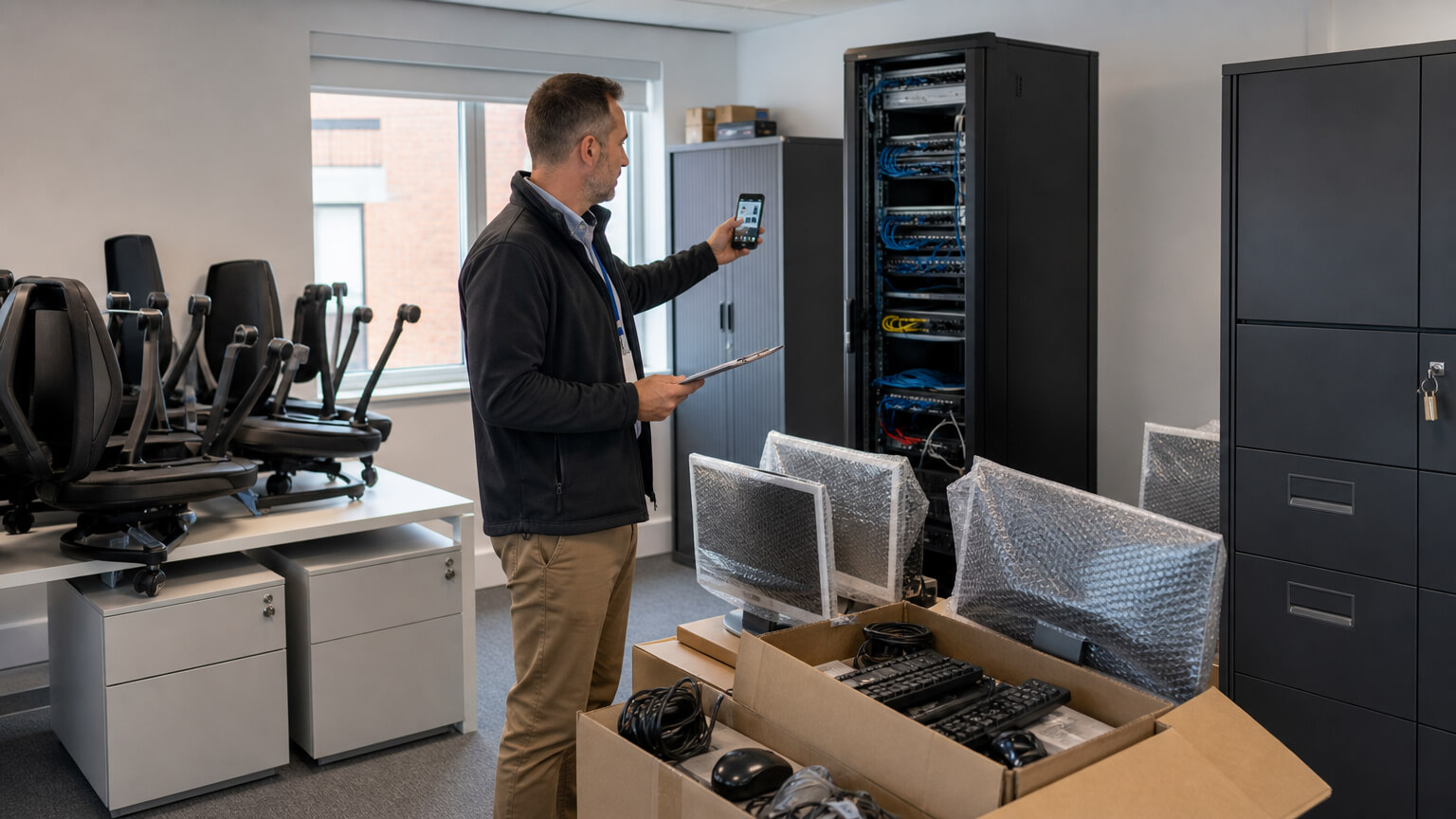
The honest reason is simple: a cleared floor lets the work happen properly, faster, and without risk to your kit.
Dust, Paint and Trade Traffic Damage Furniture and Electronics
Refurbishment work generates more airborne material than most people expect. Sanding, cutting, painting and plastering all produce fine dust that settles everywhere, including into ventilation slots on monitors, keyboards and network switches. A desk that looks clean the day the trades leave can have a quarter-inch of fine particulate worked into every surface.
Paint splashes are the other risk. Floor coverings can be protected. A board table that takes a drip of emulsion is a different problem. Electronics that get wet from ceiling work above them can fail entirely, and the damage is not always covered by standard office insurance because it happened during works the business chose to undertake.
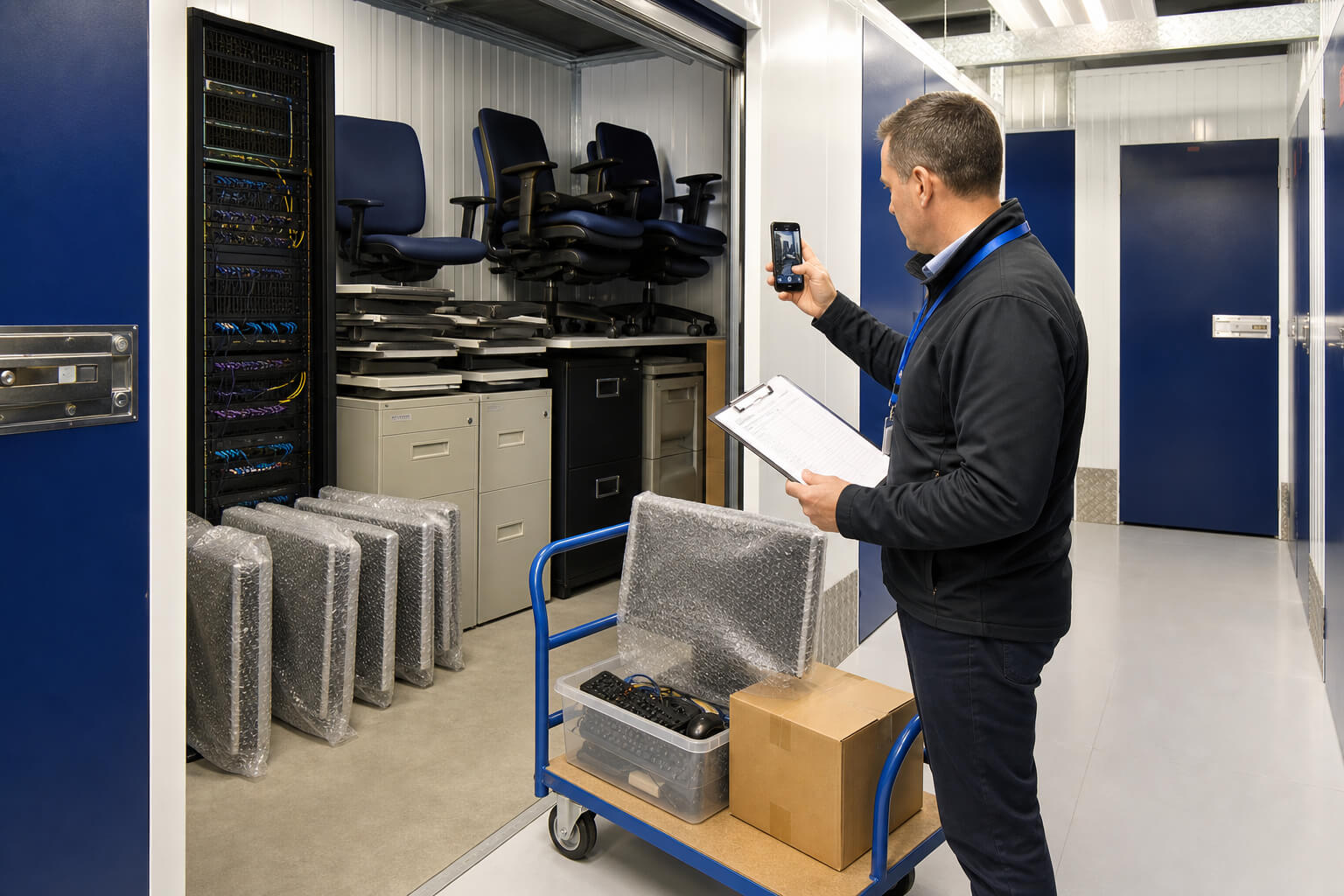
The honest advice here is practical: if you are storing IT equipment, wrap monitors in their original packaging where you still have it, or in bubble wrap, and bag keyboards and peripherals before they go into the unit. A clean, dry, secure unit protects against ambient dust and incidental moisture. It does not offer temperature or humidity control, and we do not claim otherwise. What it does offer is a sealed, individually alarmed space that no trade operative can walk through by accident.
A Cleared Floor Lets Contractors Finish Faster (and Keeps Them on Budget)
A contractor working around furniture is a contractor adding days to the programme. Trades cannot lay flooring under desks that are still in place. They cannot paint walls behind filing cabinets that have not moved. Every workaround costs time, and time in a refurbishment costs money at day rates.
Frank, the person running the logistical side of a fit-out, is also the person who gets called when the programme slips. A cleared floor on the agreed start date is the single most effective thing he can do to keep the contractors on schedule and the final invoice close to the original quote. Storage is not a cost here. It is insurance against a programme overrun that would cost considerably more.
Why a Sealed Unit Beats Sheeting It Up in a Corner
Sheeting furniture up on site keeps it in the building. That sounds like the simpler option until you work through what it means in practice. The trades are now working around a large sheeted mass in the corner. The corner itself cannot be refurbished. The sheets are not airtight and dust will get in regardless. And if anything goes wrong with the materials stored underneath, it is in the middle of an active building site with limited access and no separation from the work.
A self-storage unit removes the furniture from the risk entirely. Your team loaded it, your team has the access code, and the unit is individually alarmed. Nothing goes in or out without someone from your business being there. That level of control is simply not available from a sheeted corner, and it does not require a full-service removals contract either.
What to Store and How to Pack It for a Refurbishment
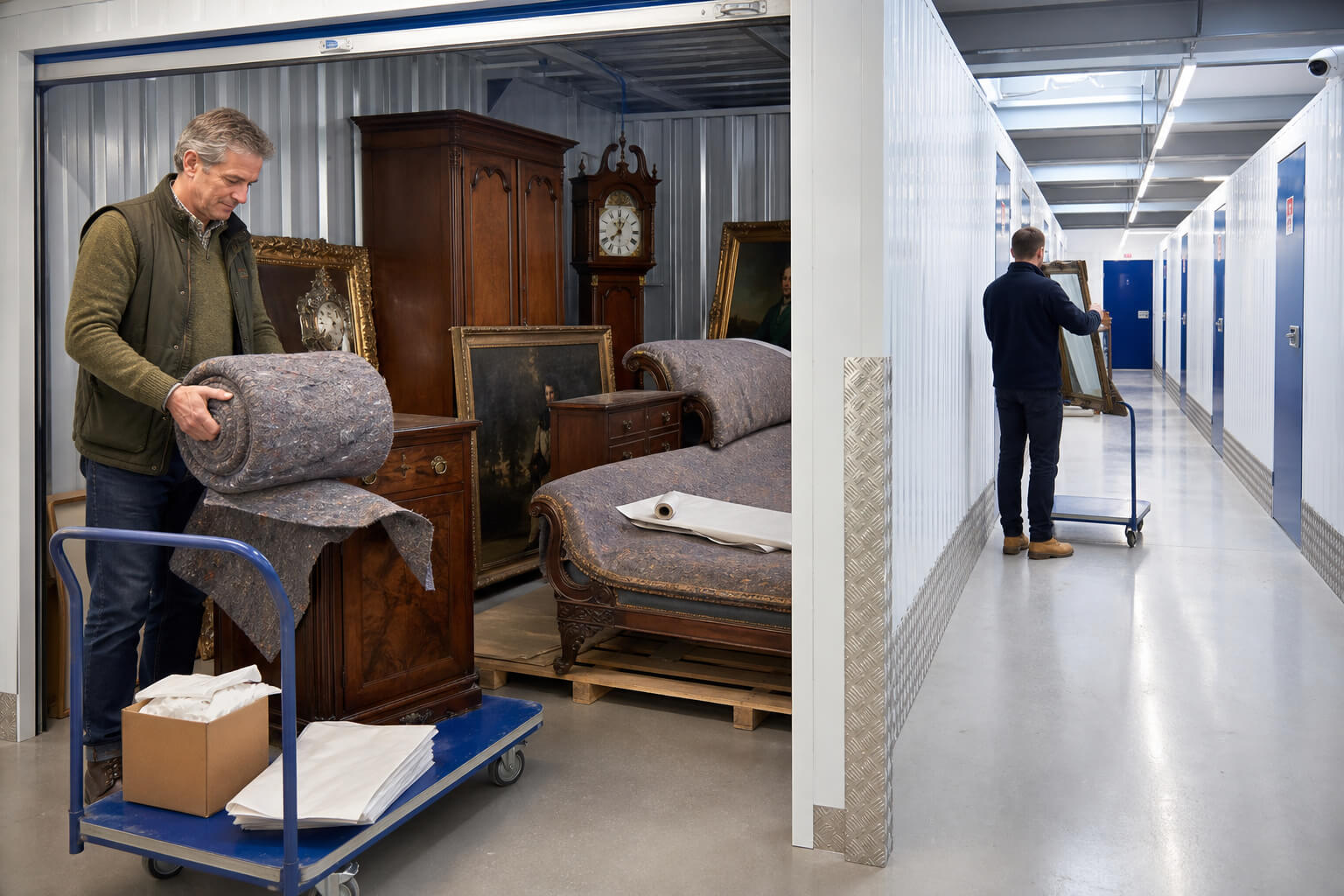
Most offices move more than they expect and pack it better than they think they will. The practical answer is: move everything that is in the direct path of the works, pack fragile and electronic items carefully, and label everything systematically before it leaves the building.
Desks, Chairs and Partitions
Flat-pack desks that disassemble are straightforward. Frame-and-panel partitioning stacks efficiently in a mid-range unit. The items that take up the most space are usually solid desks that cannot be broken down, pedestal units, and operator chairs stacked three high. A ten-desk office with associated chairs and a couple of storage pedestals typically needs less space than people expect, but the quote tool will give you a more accurate figure than any rule of thumb.
Stand furniture upright where possible. Chairs stack seat-down to reduce height. Wrap chair bases and desk edges with moving blankets or offcuts of cardboard to prevent surface contact damage. Label everything with the room or zone it came from, so the move-back-in happens in one organised pass rather than a sorting exercise.
IT Kit, Monitors and the Comms Rack
IT kit needs the most attention before it goes into storage. Monitors should be wrapped individually in bubble wrap and stood upright, not flat. If you have the original packaging, use it. Desktop towers and small form-factor machines should be bagged against dust before being packed into boxes. Keyboards, mice and cables should be coiled and bagged by workstation so re-connection is straightforward.
The comms rack is usually the last thing out and the first thing back in. Before it goes into the unit, photograph the back-of-rack cabling layout. Patch cables that are removed without documentation take time to reconnect that the programme does not have. Some businesses prefer to move the rack with cabling partially intact and reconnect only the trunk cables at the storage end. Either approach works; the photograph is the safeguard.
Keep a written inventory of everything that goes into the unit. Serial numbers for high-value items. This feeds directly into the contents protection requirement covered in the safety section below.
Filing Cabinets and Paper Records
Filing cabinets go into storage as they are, locked. If the cabinets are unlocked, box the files or transfer them to archive boxes before loading, so nothing falls or spills during transit. Label each cabinet or box with the contents at department level, not document level.
If your records are held for regulatory or legal purposes, which will be the case for most businesses, check your obligations before deciding what to store and for how long. HMRC document retention requirements, Companies House filing obligations, and professional regulatory requirements all set minimum periods for different record types. These rules apply in England and Wales; Scotland and Northern Ireland have differences in some areas. Your accountant or solicitor is the right person to advise on retention obligations. This article signposts the storage option; it does not give records-management advice.
What Size Storage Unit Do You Need for an Office Refurbishment
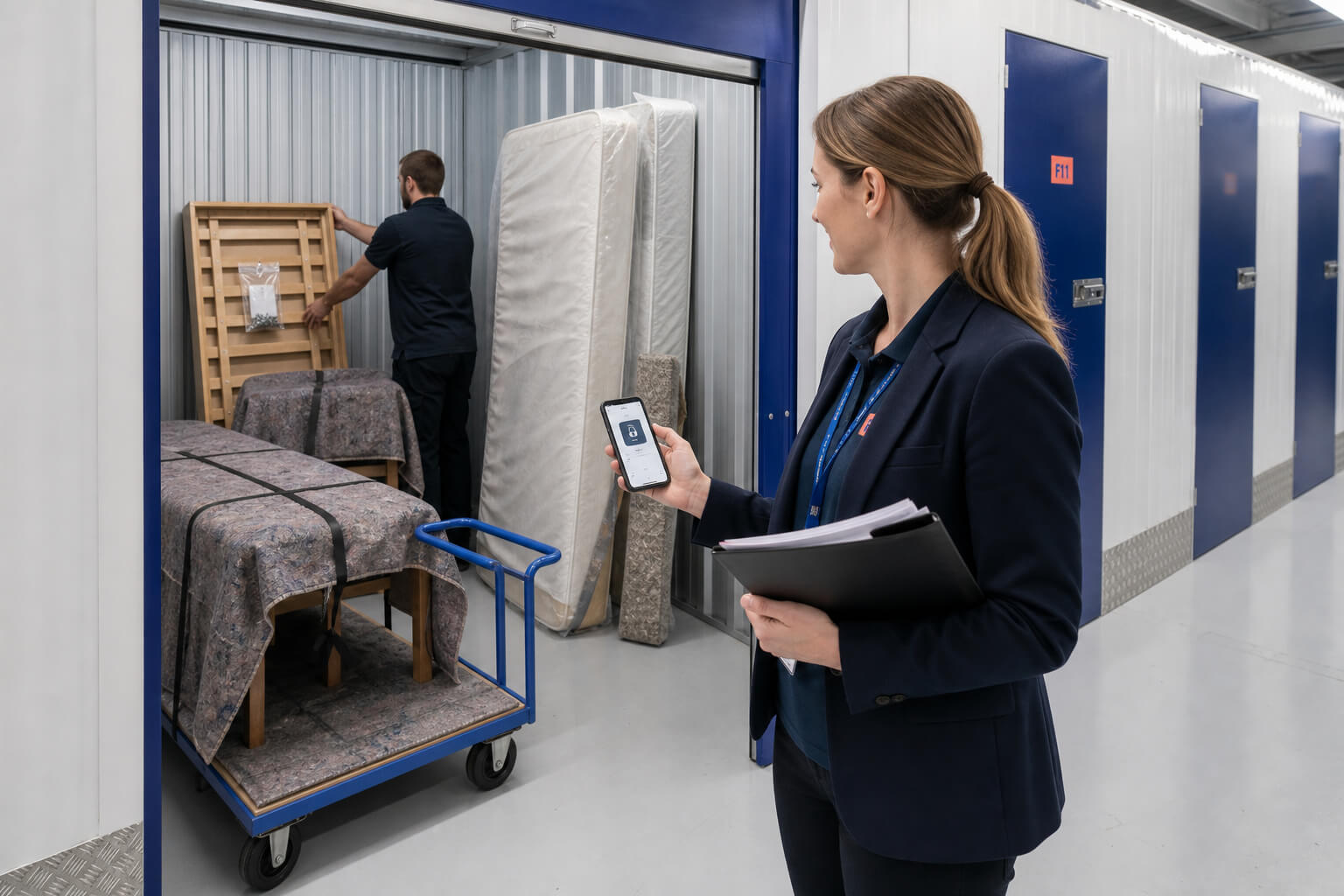
The size depends less on headcount than on what you are actually moving. Furniture density, the number of filing cabinets and whether the comms rack stays racked or comes apart all affect the unit requirement more than the number of desks.
Rough Sizing by Team Count and Furniture Volume
A small office of eight to ten people with standard desks, operator chairs, a few pedestals and two or three filing cabinets typically fits comfortably in a mid-range unit. A larger open-plan floor of fifteen to twenty-five desks with full pedestal sets, meeting tables, collaborative furniture and a server rack will need a larger space, and the exact requirement depends on how the furniture is loaded.
The cleanest way to size the unit accurately is to use the quote tool at quote.wigwamstorage.co.uk and describe what you are moving. We can advise on the right unit before you commit. That conversation also lets you flag any phased requirements, which matters if the refurbishment is happening in sections.
Swapping Contents in Stages as the Works Progress
Phased fit-outs are more common than people expect. The works might run floor by floor, or wing by wing, or in contractor sequences where one trade hands over before the next arrives. In that case, Frank may be clearing half the office into storage, then swapping contents as each phase completes.
A single flexible unit handles this well. Smart entry from 6am to 10pm, seven days a week, means your team can make a retrieval on a Tuesday afternoon when the first wing hands back, without needing to book access in advance or wait for a staffed office to open. The unit is yours to use as the programme dictates.
Ready to size your unit? If the contractor start date is in sight, getting a quote now means the unit is ready when you need it. Get a quote at quote.wigwamstorage.co.uk
How Long Can You Store For, and What If the Schedule Slips

The terms here are simpler than most national operators will tell you. The short answer is that you are not locked into a long contract, and if the job finishes early, you do not pay for the days you are not using.
The Two-Week Minimum Stay and What Happens If the Works Overrun
The minimum stay is two weeks. Beyond that, storage continues on a rolling basis. If the refurbishment takes longer than planned, which most do, you simply carry on. There is no penalty for overrunning the original estimate. You give 14 days’ notice when you are ready to vacate, clear the unit, and settle the account.
For a finance manager reviewing the projected cost, this structure is straightforward to budget. The terms are on the terms and conditions page if you need to put them in front of a finance director before signing.
When the Fit-Out Finishes Early: the Unused-Days Refund
This is the point that most business storage arrangements get wrong. A fixed three-month minimum contract on a refurbishment that completes in six weeks costs the business six weeks of unnecessary storage. That is a meaningful sum for a mid-sized office, and it is money the project manager has no good answer for when the finance team queries it.
At Wigwam, unused days are refunded. If you move back in and vacate the unit after week four of a planned six-week contract, you give your 14-day notice, clear the unit and return the key, and the days you did not use come back to you once the account is settled. There are no exit fees and no penalty for finishing on time.
That is the difference between a storage contract designed around flexibility and one designed around the operator’s revenue. For Frank, it is the number that lets him tell the finance director the storage cost exactly what it should have.
What It Costs and How Notice Works

Two things matter before you can present a storage budget to your finance team: the notice period and the unit rate. There is no deposit to account for.
No Deposit, and the 14-Day Notice, in Plain Terms
No deposit is required when you take a unit. Once you are ready to leave, you give 14 days’ notice, clear the unit and settle any outstanding balance. That is the full sequence. There are no hidden retention clauses, no administrative fees, and no sum of yours held back.
Having no deposit at all is worth stating clearly because some national operators are vague on this point in ways that matter to a finance team signing off on a commercial contract. The terms and conditions set out the full detail.
Where to Check Current Pricing
Unit rates vary by size and location. We do not list prices on this page because they can move with demand and availability. The right place to check current rates is the how much self storage costs page, which covers sizing and pricing across our locations. For an accurate figure on the specific unit size you need, the quote tool at quote.wigwamstorage.co.uk gives you a current, location-specific number.
Keeping Your IT and Records Safe While the Works Are On

The worry most office managers carry into this decision is whether the IT will come back in the same condition it left. A board table is replaceable, at a cost. A server that fails because it sat in plaster dust for six weeks, or a monitor that was stored incorrectly, is both a cost and a delay. That concern is reasonable, and it is worth addressing directly.
Individually Alarmed, Clean, Dry and Secure Units
Every unit at Wigwam is individually alarmed. The alarm is unit-level, not perimeter-level, which means that access to the building does not create access to your storage. Your unit opens with your code, and any movement inside it triggers the alarm independently of everything around it.
The units are clean and dry. We do not offer climate control, and we do not pretend otherwise. What you get is a dry, weatherproofed, individually secured space that keeps your furniture and IT away from building-site conditions. Combined with proper packing (bubble wrap for screens, bags for keyboards, original packaging where you have it), that is a genuine level of protection for the duration of a standard office refurbishment.
Contents Protection for Business Goods
Contents cover is a requirement, not an option. You can take the policy Wigwam offers, underwritten by RSA (“Self Storage Customers’ Goods”), or you can demonstrate that your existing business insurance extends to goods held in self storage. Either is acceptable. What is not acceptable is leaving high-value IT and furniture in a unit uninsured.
When you declare your goods, declare the full replacement value. If you under-insure and a claim arises, the settlement is proportional to the declared amount against the actual replacement cost. For a rack of IT equipment, that gap can be significant. The contents protection page has the full detail on the policy. This article points you there; it does not give insurance advice. Policy terms, coverage scope and excess should be confirmed directly with the provider. Insurance regulation is broadly UK-wide, but policy terms should be read carefully and queries directed to your insurer.
Access, Deliveries and Who Needs to Be Present
Smart entry runs from 6am to 10pm, seven days a week. There is no staffed reception and no need to book an access slot. You turn up within those hours, enter your code, and your unit is available.
The sites are unmanned. That is worth understanding clearly before the refurbishment starts, because it affects how you plan deliveries and contractor collections. If a courier or contractor needs to bring something to or collect something from your unit, someone from your own business must be there to receive or hand over the goods. Wigwam does not sign for deliveries and cannot receive goods on your behalf. If that is part of the plan for the fit-out, build the team schedule around it from the start.
Finding a Wigwam Near Your Office
The reason most office managers end up storing with national operators is geography: they search and the nearest option listed is twenty miles out on a city ring road. Wigwam sits in UK market towns, which means the unit is near the office, not a long drive away.
Our UK Market-Town Locations
Our locations are in market towns across the UK. That matters for an office refurbishment because the loading and retrieval schedule ties directly to the working day. If a team member needs to pick up a monitor for a remote worker on a Wednesday afternoon, a nearby unit means it happens. A unit twenty miles away on a dual carriageway is a half-day logistics exercise.
Wigwam Self Storage Bath and Wigwam Self Storage Lincoln are two examples. The full list of our UK market-town locations is on the self storage locations page. The quote tool will also match you to the nearest branch when you enter your postcode.
If you want to know which location is closest to your office before you start the quoting process, Selina and the team at your nearest branch can help you think through the unit size and access logistics. First names and contact details are on the individual location pages.
Getting a Quote for Your Nearest Branch
The quickest way to confirm availability and size is the quote form at quote.wigwamstorage.co.uk. Put in your postcode, a rough description of what you are moving, and the start date the contractors need the floor clear by. You will get a location-specific unit recommendation and current rate.
After the Refurbishment: Keeping a Unit for Archive and Overflow
Most people who use storage during an office refurbishment come back into the building and move everything back exactly as it was. But some of them, once they have lived through a fit-out, notice something useful: the new office layout does not actually need all of what they brought back.
The four filing cabinets that went into storage because they had to may only need to return as two. The rest can stay in the unit, on a rolling basis, as an off-site archive. The training materials and branded event kit that went in may work better staying out, accessible from 6am to 10pm rather than buried in a cupboard that now does not exist in the new floor plan.
This is the moment Branch-Overflow Ben appears. He is the office manager who took the unit for the refurbishment and kept it on afterwards, because it turned out to solve a second problem he had always had. Archive space. Seasonal overflow. Equipment that the business needs a few times a year but not every day.
There is no new contract to negotiate. The terms that served the refurbishment serve the ongoing overflow arrangement on exactly the same basis. The unit continues, the access continues, and the 14-day notice period applies whenever the arrangement is no longer needed. For a business already familiar with the unit and the access routine, that continuation is essentially frictionless.
A dedicated business storage article on the Wigwam site covers the ongoing business storage use case in more detail, if the archive and overflow question becomes the main question after the fit-out completes.
Your office floor is about to belong to the builders for a while. Let us hold everything safely until it is yours again. Get a quote at quote.wigwamstorage.co.uk
Frequently Asked Questions
The relationship that governs damage during a move sits between you and whoever is doing the moving, not between you and the storage site. Wigwam staff do not handle, load or move your goods; the unit is unmanned and you, or the contractor and removals crew you engage, do the loading and retrieval. So damage caused in transit or in handling is a matter for the terms you have with that firm, and it is worth checking their liability and insurance before they touch anything valuable.
This is one of the strongest reasons to document the kit before it goes in. Keep a written inventory with serial numbers for high-value items, and photograph monitors, the comms rack cabling and any furniture with existing marks before the move. If something turns up damaged, you can show its condition going in. For IT especially, that record is also what underpins a contents-protection claim and what an external insurer or the moving firm will ask to see.
Once the goods are inside the unit, the picture changes: there they are protected by the individually alarmed, clean, dry and secure space and, crucially, by the contents cover that is mandatory at Wigwam. But the handling itself, the lifting, the carrying, the loading of the van, is the moving party’s responsibility. Choose a firm that carries goods-in-transit cover, get their liability position in writing, and keep your inventory and photographs. For how the storage cover works once the goods are in the unit, the contents protection page sets out the detail.
Yes, entirely. The security of the data held on any device you store is your responsibility, not the storage operator’s, and it should be handled as part of your decommissioning before the kit ever reaches the unit. Wigwam provides a secure physical space, individually alarmed and accessed only by your business, but it does not access, manage, image or wipe your equipment, and physical security of a unit is a different thing from data security on a drive inside it.
The practical approach most IT teams take during a fit-out is to treat the storage window as part of the chain of custody. If servers or workstations are simply being held and reinstalled afterwards, keep them powered down, bagged against dust and logged on your inventory with serial numbers, so you can account for every device in and out. If any drives are genuinely being retired rather than reused, the decommissioning, secure wiping or destruction is a job to complete before storage under your own data-handling process.
There are obligations here that sit well outside what a storage page or a storage support team can advise on. Data protection duties, including how personal data on stored devices is handled, are governed by law and by your own policies, and your data protection officer, IT lead or a specialist is the right source of guidance. Wigwam’s support team handles storage matters only, sizing, access, pricing, booking, and cannot advise on data security or compliance. Build the data-handling step into the decommissioning plan, and use the unit for what it is: a secure place to hold the hardware.
It handles it well, but only if you declare honestly, because the policy settles against the full replacement value you declare, and under-insurance is settled in proportion. For an office move, the trap is that the furniture is bulky and visible while the IT is compact and easy to undervalue. A single comms rack, a stack of workstations and a set of monitors can be worth far more than the desks and chairs around them, and if your declaration is anchored to the volume of furniture rather than the value of the kit, you will be under-declared on the thing that matters most.
Work it the other way: total the replacement cost of the IT first, at what it would cost to buy equivalent equipment new, then add the furniture, and declare the full figure. This is where the inventory with serial numbers earns its place, because it gives you an itemised basis for the declaration and the evidence to support a claim. Contents cover is mandatory regardless: you either take the Wigwam policy underwritten by RSA or demonstrate that your own business insurance extends to goods in self storage.
A few terms to read before you rely on the cover. The policy is New-for-Old, theft claims require evidence of forced entry to the unit, and atmospheric or climatic damage is excluded, which is one reason the packing guidance for screens and hardware matters. The full policy detail is on the contents protection page. This article signposts the cover; it does not give insurance advice. For a high-value IT estate, confirm the scope, the excess and the declared-value basis directly with the provider or your own insurer before the kit goes in.
Yes, a single unit works well for a phased fit-out, because smart-entry access runs from 6am to 10pm, seven days a week, with no need to book a slot or wait for a staffed office to open. As each floor or wing hands back, your team can retrieve what belongs there on the day it is ready, then return it as the next phase clears. The unit is yours to use as the programme dictates, and you are not paying a separate charge each time you open the door.
The thing that makes staged retrieval painless is how you load on the way in. Pack and label by floor, zone or phase, and put the contents of the area that comes back first nearest the door, with a clear path to it. A phased programme that loads everything in one undifferentiated mass turns every retrieval into an excavation; one that loads in reverse order of the works turns it into a five-minute pickup. Keep the inventory ordered the same way so a team member sent to collect a specific item knows roughly where it sits.
Plan the access around the unmanned-site rule, too. Because there is no reception and no one to receive goods, any contractor collecting from or delivering to the unit during a phase needs someone from your business present with access. For a fit-out running in sequence, the simplest setup is to have one or two named team members hold the access for the whole programme and coordinate the staged moves. If you flag the phasing when you get a quote at quote.wigwamstorage.co.uk, the team can help you pick a size that gives you room to work in and out rather than one packed solid.
It will, and nothing in the terms changes when the use shifts from refurbishment to archive. Plenty of businesses that take a unit for a fit-out keep it on afterwards, because the move-back-in reveals that the new layout does not need everything that came out. The surplus filing cabinets, the seasonal or event kit, the equipment used a few times a year, all of it can stay in the unit on exactly the same basis rather than being crammed back into a floor plan that no longer has room for it.
There is no new contract to negotiate and no renegotiated rate for changing what you use the unit for. The arrangement that served the refurbishment simply continues: the same rolling monthly terms after the two-week minimum, the same 6am to 10pm smart entry, the same 14-day notice whenever the overflow is no longer needed, and no deposit either way when you eventually vacate and settle the account. The only practical change is yours, not ours: you reorganise the unit for long-term holding rather than short-term swap-in, swap-out.
A couple of things are worth carrying over. Keep the contents cover current, declaring the full replacement value of whatever stays in the unit long term, since the mix of goods may change once the bulky furniture goes back. And keep your inventory updated so the archive does not drift into a forgotten pile of boxes. Wigwam’s site also covers the ongoing business storage use case in more detail if the archive question becomes the main one after the fit-out. For the rolling terms and notice arrangements, the terms and conditions page has the full detail.