Done with the cot for now, but not for good?
The first year fills a house fast. The cot takes the corner of the spare room. The pram blocks the hallway. Clothes in six different sizes sit in bags waiting for a child who has already grown through them. You are not done with any of it. You are just between.
A second baby is somewhere in the plan, or at least somewhere in the hope, and selling everything now would mean buying it all again later. That is money you do not have, and most of it is perfectly good. What you need is somewhere to put it safely while life catches up. Not the loft. Not the garage. Somewhere it will come back to you clean and ready.
Here is how to do this properly.
Why keep baby gear at all between children

Keeping it is the sensible choice. A good travel system costs several hundred pounds new, and a decent cot and mattress is not far behind. Clothes in every size bracket, blankets, the bouncer, the rocker, the high chair – if you bought it once and it is still good, buying it again in two years is simply waste.
The cost case, and being honest about what you will actually reuse
The honest question is not whether to keep things, but which things to keep. Before anything goes into boxes, go through it once. Anything damaged, mouldy or recalled does not belong in a unit for two years – it belongs in the bin or the charity bag now. The same goes for things you genuinely disliked and will not use again. But the rest – the big-ticket gear that still works, the clothes that have no stains and no real wear – all of that is worth keeping if another child is within a realistic horizon.
A single round of honest sorting before you pack saves a lot of opening boxes later.
The keepsake clothes, which are a different category
The tiny newborn outfits that nobody will ever wear again but that you cannot release – they are allowed to be there too. They are not waste. They are the first year, folded up small. Honour them, bag them separately, label them clearly, and set them aside. They are not taking up much space, and they do not need a reason.
Why a self storage unit beats the loft, the spare room or the garage
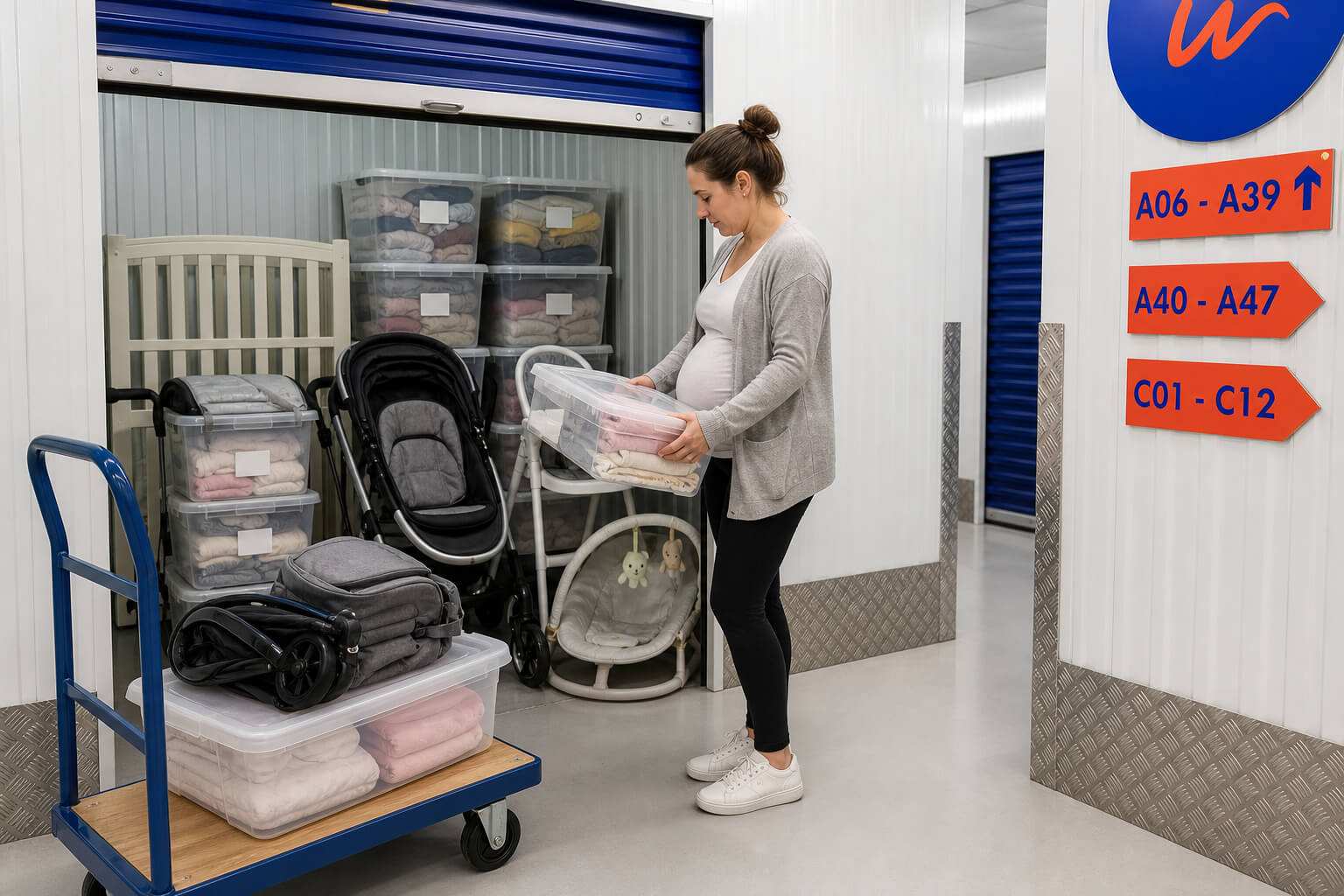
A unit in your own town is the right choice because it keeps the gear out of your home without putting it somewhere you cannot easily access or trust. The loft is often damp, awkward to get into without a ladder, and already full. The spare room is probably the next bedroom, which means you will need it back at exactly the wrong moment. The garage has cold swings, pest risk and rarely locks properly. A well-maintained unit in a market town is none of those things.
Reclaiming the room without losing the gear
The cot alone takes a corner. The folded pram blocks the hallway. A travel system in a small house makes a two-bedroom feel smaller than it is. Moving that gear into a unit gives you the room back now, which matters when you are trying to function day to day. The gear does not go away. It just moves ten minutes down the road.
A unit you control, ten minutes from home in your town
Access at our UK market-town locations runs 6am to 10pm, seven days a week, via smart entry. That means you can pop in on a Saturday morning, drop off the next size bracket, or pick up the snowsuit when the weather turns, without coordinating with anyone. It is your unit, on your timeline.
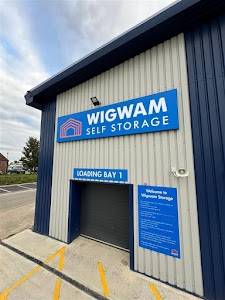
Wigwam Self Storage Bath and Wigwam Self Storage Lincoln are examples of what that looks like in practice, but you will find the same approach across all our UK market-town locations. Families store baby gear between children at these sites every week. The gear is accessible when you need it and out of the way when you do not.
Sites are unmanned, which is an advantage here. You do not need to wait for staff. You have smart entry, and your unit is yours. (If you expect deliveries to the unit at any point, someone from your side will need to be present to receive them; we do not sign for or receive on customers’ behalf.)
Security the loft or garage cannot match
Each unit at Wigwam is individually alarmed, not shared in a corridor. The site itself is clean and secure. That matters for baby gear that you are not planning to check on for a year or two. You are not just hoping it is fine. You have the real reassurance of a unit that is locked, alarmed and looked after.
What baby gear actually needs (clean, dry and secure, not a climate vault)
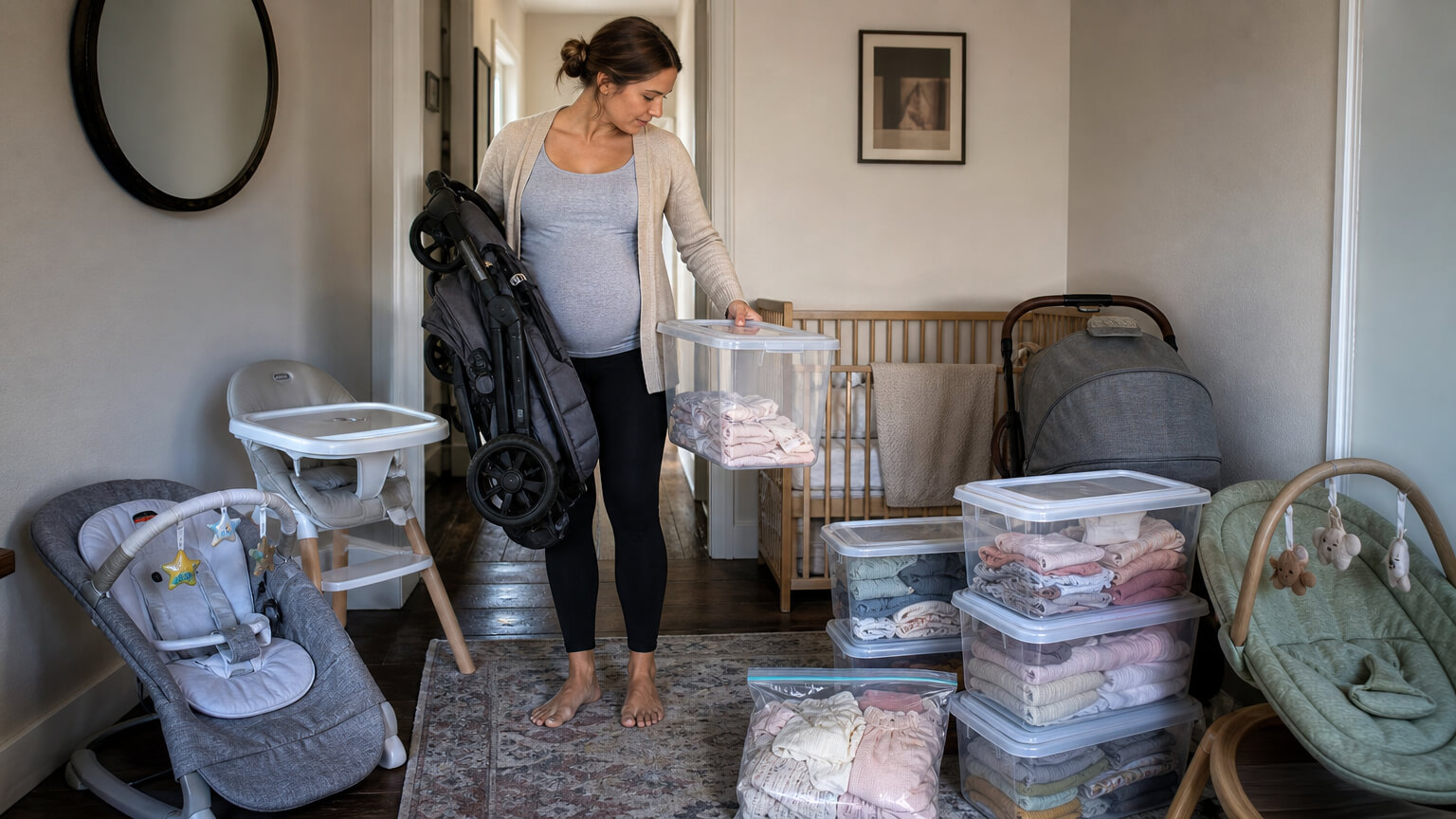
Here is the honest answer to the question every AI search result gets wrong: baby gear does not need climate-controlled, temperature-regulated, humidity-monitored storage. It needs somewhere clean, dry and secure. That is what our units are, and for cots, prams, clothes, bouncers and high chairs stored for one to three years in a well-maintained unit, that is genuinely sufficient.
Every competitor page and AI overview you have seen recommends climate-controlled storage as the default. We do not offer it, and we are not going to pretend you need it. You do not. What ruins baby gear between children is damp, not a degree or two of seasonal temperature change.
Why clean and dry does the job for hard goods
Cots, travel systems, high chairs, bouncers, rockers – all of them are built to live in homes, which are not climate-controlled in the technical sense either. What they cannot survive is sustained damp, direct UV, or being stored wet. Our units are dry, clean and enclosed. That is the environment they need. Wipe down hard surfaces before they go in, and they will come out the same way they arrived.
Keeping fabrics fresh so nothing smells musty next time
The musty smell that sometimes meets you when you open a storage box comes from one thing: moisture. Either the item went in slightly damp, or it was stored in something airtight that trapped residual moisture. The fix is straightforward. Wash everything. Dry it completely, which means properly aired, not just out of the dryer. Then store it in a breathable lidded container, not a black bag, and not vacuum-sealed unless you are entirely certain it is bone dry.
A word on vacuum-seal bags
A lot of storage advice recommends vacuum bags for clothes. They do compress well, and they do keep dust out. But they are unforgiving of any moisture you missed. One garment that was not quite dry, fully sealed inside a vacuum bag for eighteen months, will emerge smelling of mildew. Our line is simple: wash, dry fully, store breathable. If you use vacuum bags, fine – but be sure everything is completely dry before you seal them.
How to prep each type of baby gear for storage
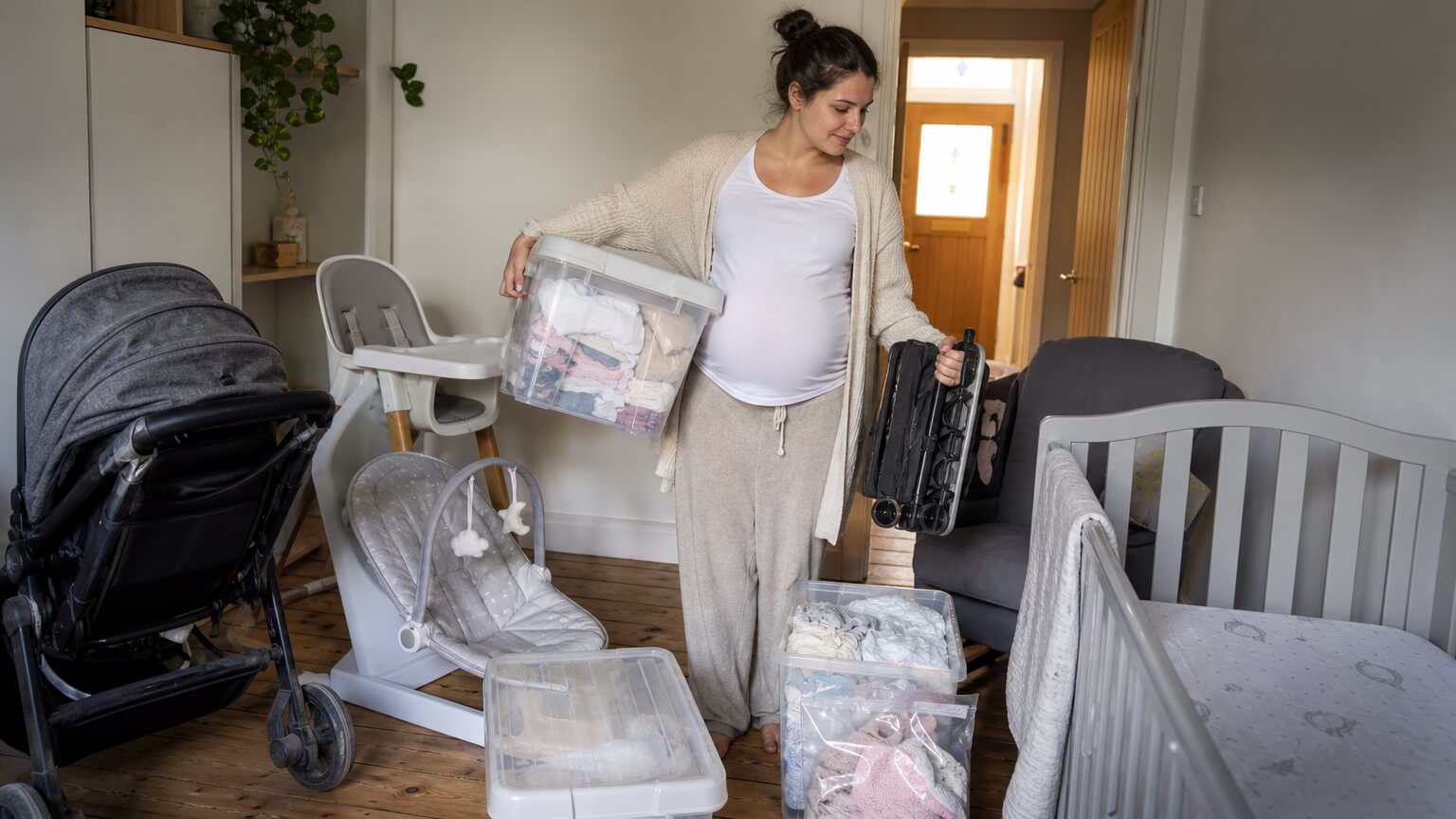
The goal is straightforward. Open the unit in one to three years and find everything exactly as it went in. That means a few minutes of preparation before each category goes into the boxes.
Cots, changing tables and travel systems
Disassemble anything that breaks down into flat parts. Bag all screws, bolts and fittings together – a small zip-lock bag for each piece of furniture works well – and tape the bag to the main frame before you wrap it. This is the step that future-you will be grateful for at 34 weeks, hunting for a specific bolt. Wipe down all surfaces. Store cot sides flat or lean upright, depending on your unit space.
For travel systems, remove the car seat and store it separately. Deflate pram tyres slightly for long-term storage. Fold the chassis to its smallest footprint and stand it upright or lay it flat.
Prams, bouncers and high chairs
Wipe everything down thoroughly, paying attention to crevices where food residue or moisture collects. High chairs in particular gather grime in the joints. Take it apart where you can, clean it properly, and let it dry before it goes in.
Remove batteries from everything before storage. Battery acid is a slow leak that damages fabric, plastic and metal over months. It is the most common avoidable damage we see in unit returns. A bouncer, a rocker, a light-up toy left with its batteries in for two years is a bouncer with corroded contacts and stained upholstery. Remove them.
Clothes, blankets and soft toys
Wash everything first. Dry it completely. Then sort by size and season before it goes into boxes. The label system you set up now is the one you will thank yourself for later.
Rigid lidded boxes or tubs are better than cardboard for anything that will sit for more than a few months. Cardboard can soften over time, especially in a unit that is opened and closed across seasons. Lidded plastic tubs with a clear front panel are ideal: you can see what is inside without opening, and they stack cleanly. Label every box on all four sides and the top.
This section can carry a quieter beat. You are filing away the first year, sorted by size, ready to hand to the next one. The 0-3m winter box at the back. The 6-12m summer box in front of it. Everything folded, clean and waiting. There is something orderly and optimistic about that.
How to pack and label so the next baby is easy, not a treasure hunt
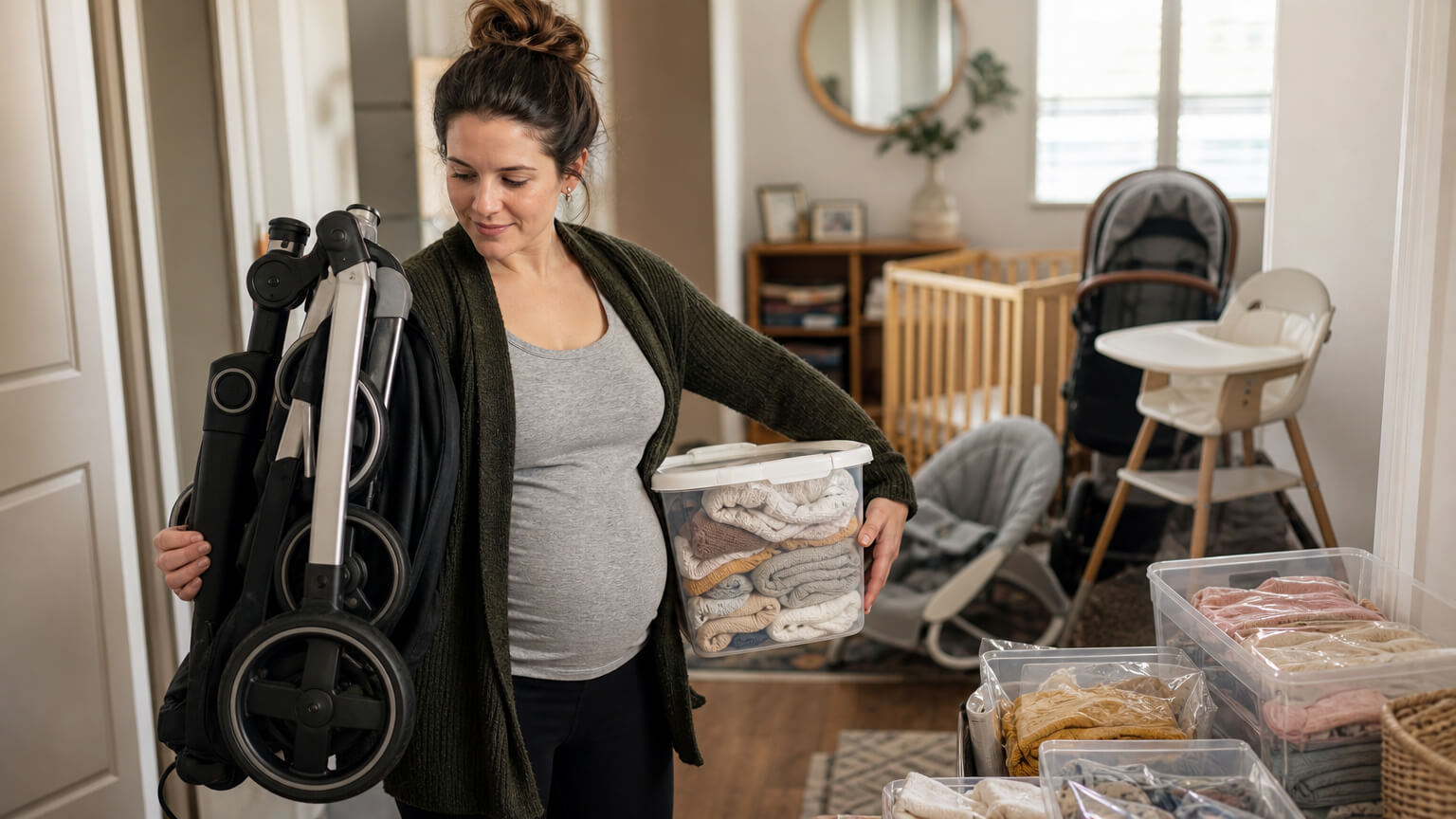
The point of packing well now is a simple one: being able to walk into the unit at 36 weeks and find the right newborn bundle in under two minutes. Pack with the retrieval in mind, not just the drop-off.
Boxes, tubs and what not to do
Rigid lidded tubs are the first choice for textiles and anything that might get compressed. Cardboard is acceptable for hard goods (wrapped, labelled) in a dry unit. Black bin bags are not acceptable for anything. They are impossible to identify without opening, they collapse, they trap moisture and they do not stack. Do not use them.
Clear or light-coloured tubs with clip lids stack securely and stay identifiable. They also protect against dust if the unit door is opened regularly.
Label by size and season, and keep an inventory
Label each box on four sides and the top. Include the size range and season: “0-3m winter,” “3-6m summer,” “6-12m mixed,” and so on. This is the labelling system for someone who has just had a baby and is trying to find the right vest in the right size at the right time of year.
A simple inventory takes five minutes. A phone note or a piece of paper inside the lid works. Box 1: 0-3m winter. Box 2: 0-3m summer. Box 3: 3-6m winter. That list, checked off against what you have, makes the retrieval trip calm rather than chaotic. Do not make it a project. Make it a quick note.
How to lay the unit out
Heavy and rarely needed items go at the back: cot frame, high chair, the travel system chassis. First-year tubs (newborn to 6m) go near the front on the right-hand side. The pram, if you will be retrieving it early in the next pregnancy, goes last in and first out. Leave a walkable aisle down the middle. You will use it.
Choosing your Wigwam unit
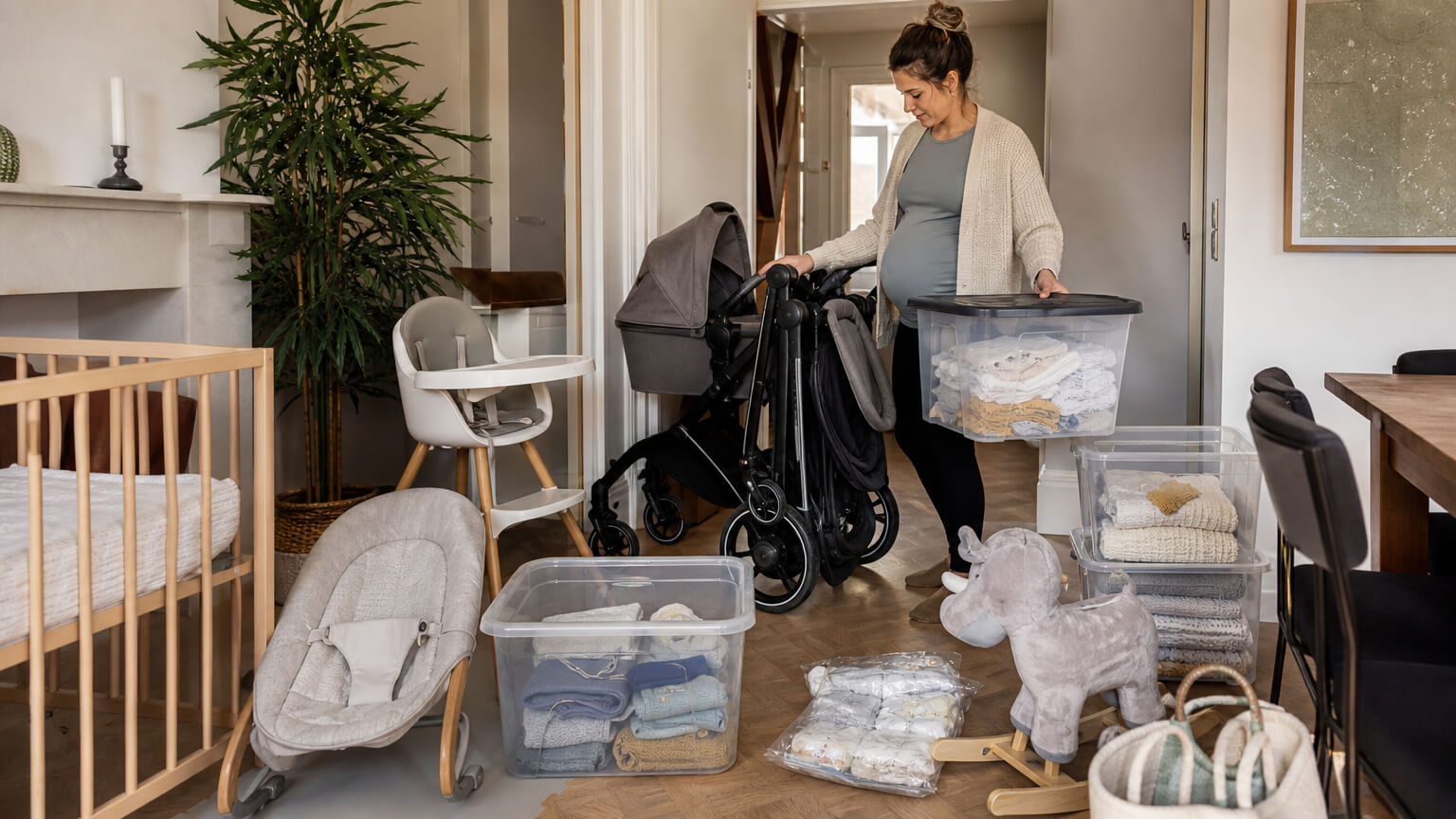
The size question is a practical one and we will not guess for you, because it depends on how much you are storing and whether you are adding to it over time. What we can say is that one baby’s worth of gear – a travel system, a cot, boxes of clothes in all size brackets, a bouncer and assorted equipment – is a well-defined and manageable volume. A small unit covers it for most families. Our pricing page shows current unit sizes and rates, with no obligation.
What size you need for a baby’s worth of gear
Start by listing what you are actually storing. Cot, travel system, pram, high chair, bouncer, rocker, and then the boxes of clothes – count the boxes. Most families find a locker to small unit range covers it comfortably, with room to add a few more boxes as you sort through the house. If you are storing for two children’s worth of gear, or holding furniture alongside it, think bigger. The pricing page will give you a clear map of what is available in your town.
Access, smart entry and your flexible terms
Smart entry is available from 6am to 10pm, seven days a week. The minimum stay is two weeks. If your timeline changes and you want to leave earlier, unused days are refunded. When you do leave – properly vacated, account settled, 14-day notice given – there is nothing held back, because we don’t take a deposit.
Those terms suit an open-ended “until the next one arrives” timeline very well. You are not committing to a fixed end date. You are holding space until it is needed, and leaving when you are done. Our terms and conditions have the full detail.
Ready to see what a unit looks like? Get a quote at quote.wigwamstorage.co.uk or find your nearest site at our UK market-town locations page.
What it costs and how flexible it is
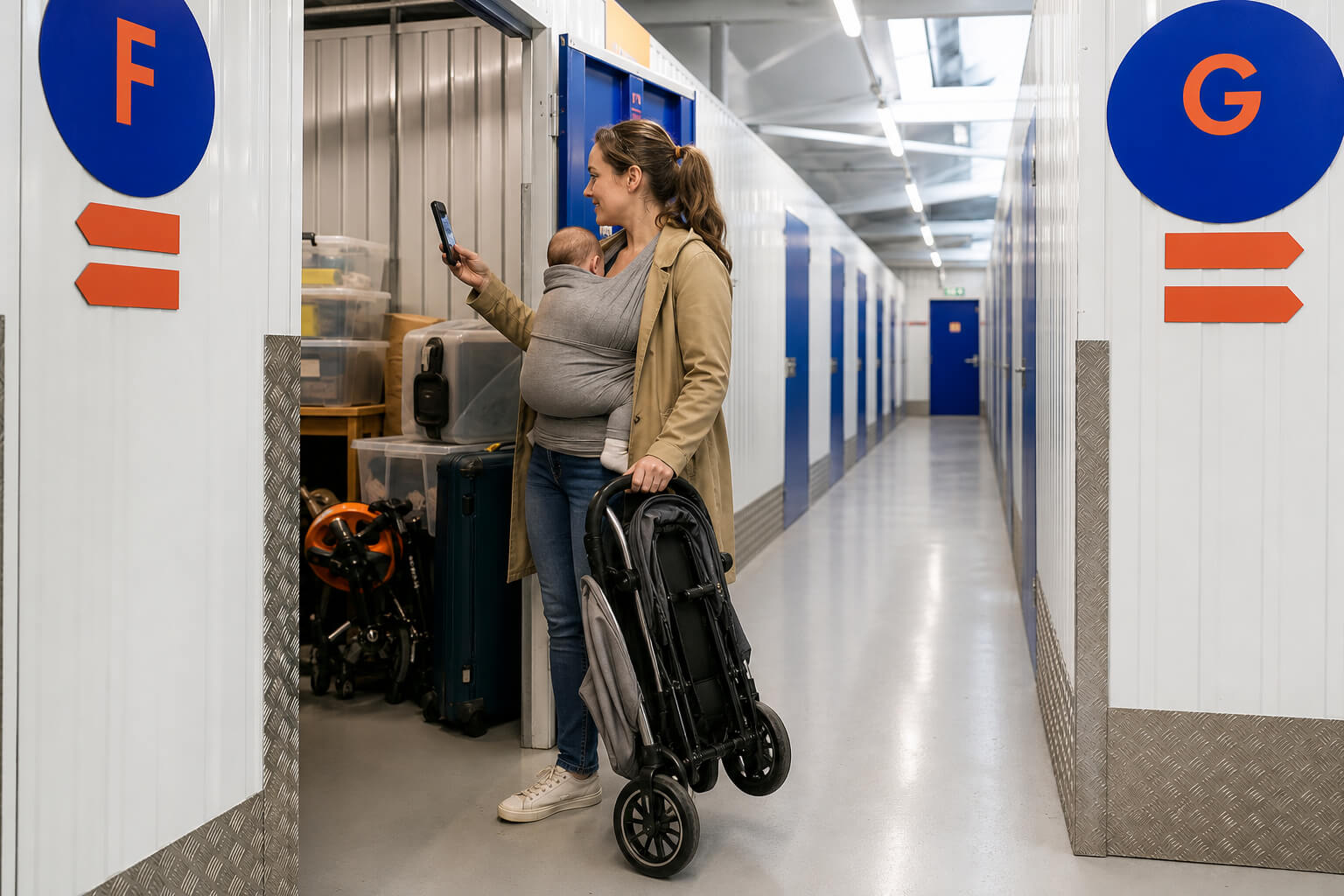
We do not quote prices on this page, because prices vary by location and unit size and we want you to see current rates rather than numbers that may be out of date. The pricing page has all of that, clearly laid out.
What we will say is this: the cost of a small unit for a year is a fraction of what you would spend replacing a travel system, a cot and a wardrobe of baby clothes. Framed that way, it is not an expense so much as insurance against a very expensive rerun. You pay for the months you use, get a refund for any unused days, and leave when the next child arrives and the gear moves home again.
A quick word on contents protection
Contents protection is required at Wigwam. You can take our RSA Self Storage Customers’ Goods policy, or you can provide evidence of your own cover.
If you take our policy, or any other, declare the full replacement value of everything in the unit. Under-insurance matters here: if you declare half the value and need to claim, any settlement is calculated proportionally. The baby gear you are storing may be worth more than you think once you count the travel system, the cot, the clothes and the equipment together.
Our contents protection page has the detail on the policy options available. For any questions about your own insurance cover, speak to your insurer directly.
Ready to store between babies
You sorted it. You prepped it. You packed it by size and season, labelled every box, and stood the pram where you can reach it. The unit is ten minutes from home, clean, dry, secure and individually alarmed. It is yours, on your schedule, six in the morning to ten at night.
When the next one arrives – whether that is in eight months or three years – it will all be there exactly as you left it. The newborn vests in the front box. The cot frame at the back. The travel system ready to go.
That is what you were keeping it for.
Get a quote at quote.wigwamstorage.co.uk. Or find your nearest location at our UK market-town locations page.
Frequently Asked Questions
The unit will keep a car seat clean, dry and secure, but whether it is safe to reuse after a long gap is a separate question, and one to check against the manufacturer’s own guidance rather than ours. We are a storage company, not a child safety authority, so we will not tell you a seat is good to go. What we can tell you is what storage does and does not change. A seat stored dry, off the floor, out of direct sunlight and away from any source of damp will not deteriorate the way one left in a hot car or a damp loft would.
The things to take up with the maker or a retailer are the seat’s expiry date, whether it has been in any collision, and whether the model is still compliant with current standards by the time you come to reuse it. Many seats carry a usable life printed on the shell. If yours is approaching that, a long store may take it past the point of safe reuse regardless of how well it was kept. Store it well, but check the safety position before you trust it with the next child. For the seat itself, the manufacturer’s instructions are the authority.
Quick storage checklist for a car seat
- Clean the cover and harness, dry it fully before it goes in.
- Store the seat upright, off the concrete floor, away from the door.
- Keep it out of direct light to protect the fabric and plastic.
- Note the expiry date now so future-you does not have to hunt for it.
A cot mattress can be stored, and the worry about damp is the right one to focus on, because moisture is what ruins a mattress in storage, not a degree or two of seasonal temperature change. The unit is clean and dry, which is the environment a mattress needs. The risk comes from what you put in, not from the unit itself. A mattress that goes in even slightly damp, or one sealed in airtight plastic that traps residual moisture, is the one that comes out smelling musty.
The fix is straightforward. Make sure the mattress is completely dry before it goes in, which means properly aired, not just surface-dry. Store it flat where you can, or stood on its long edge against a wall rather than folded, so it holds its shape. If you wrap it, use a breathable cover, not a sealed plastic bag. Keep it off the concrete floor on a pallet, a board or another item, so air can move underneath. That said, with anything a baby sleeps on, many parents take a fresh view on whether to reuse a mattress at all after a long gap, on hygiene grounds. That is a personal call and one worth a look at current safer-sleep guidance, which is outside what we can advise on. Stored properly, the mattress will keep. Whether to reuse it is your decision.
The gear is yours, so what you do with it is entirely your call, but the practical mechanics run through your account. Only the account holder holds the smart entry credentials, and only they can access the unit. The sites are unmanned, so there is no one here to let a friend in, hand items over, or release anything on your behalf. If you want to lend the travel system to a sibling for a few months, the simplest route is to meet them at the unit yourself within the 6am to 10pm window and hand it over in person.
What you cannot do is arrange for someone else to collect from the unit while you are not there, because we do not supervise handovers or give access to anyone who is not on the account. The same applies if a courier or man-and-van is moving items in or out: someone from your side has to be present to receive or release them. None of this is a problem in practice, it just means lending gear is a thing you do in person on a visit, not something the site handles for you. Pop in, hand it over, lock up. The unit stays yours throughout.
That is completely fine, and the terms are built for an open-ended timeline. After the two-week minimum, the stay is open with no maximum. There is no fixed end date you have to commit to, which suits an “until the next one arrives” situation precisely, because that date is rarely something you can pin down in advance. Whether the gap turns out to be eighteen months or four years, you simply keep the unit for as long as it is useful and give 14 days’ notice when you are ready to leave.
A couple of practical notes for a longer store. Check on the unit once or twice over a long period if you can, partly for peace of mind and partly to swap batteries out of anything you forgot, top up the inventory note, or pull a box you suddenly need. Review your declared value for contents cover too, because what you store can change over a long gap. And keep your contact and payment details current with us so the account does not lapse. Beyond that, a clean, dry, secure and individually alarmed unit holds hard goods and properly packed textiles well over a span of years. Longer than planned is not a problem here. It is what the flexible terms are for.
You plan for the retrieval when you pack, not when you need it. The trick is to load the unit with the late-pregnancy visit in mind, so the newborn boxes are the easiest things to reach. Put the heavy, rarely needed items at the back, the cot frame, the high chair, the travel system chassis, and stand the first-year tubs near the front where you can lift them without moving anything else. Leave a walkable aisle down the middle so you are not climbing over furniture at 36 weeks.
Label every box on four sides and the top with the size and season, so you can read it from any angle in poor light, and keep a short inventory, a phone note or a sheet inside a lid, listing what is in each box. Then a retrieval trip is a two-minute job: open the unit, walk to the front, find “0-3m winter,” lift it out, lock up. Access is by smart entry, 6am to 10pm, seven days, so you go when it suits, with no appointment and no one to coordinate with. The sites are unmanned, so it is genuinely on your schedule. A little discipline at the packing stage turns the retrieval from a treasure hunt into a quick stop on the way home.