Halls end in June, the house-share starts in September — what about the summer?
The halls licence ends in June. The house-share tenancy starts in September. Somewhere in between sits a whole room of belongings with nowhere to live for eight to ten weeks.
It happens to almost every student at some point. The two contracts simply do not line up, and nobody warns you in advance. One minute you are packing up your room at the end of term. The next you are staring at a bedframe, a small fridge, two dozen boxes and a bike, wondering what on earth you do with all of it for the summer.
There is a third option, and it is quieter than it sounds. A small, clean, alarmed unit in the same market town as your new house. Booked for the summer. Sorted.
The gap between contracts, and why it catches students out

This is not a planning failure. It is just how student accommodation works in the UK. Halls licences typically run to mid-June. House-share tenancies typically start in late September or early October. The eight to ten weeks in between are structural, not unusual, and they catch students out every year at every university town we operate in.
When halls end and a tenancy starts (the summer hole)
The gap exists because halls providers clear rooms for summer maintenance, and landlords set September start dates to catch the incoming year’s intake. The student in the middle is not doing anything wrong. They are caught in a calendar that was never designed with their belongings in mind.
Most students discover this gap about two weeks before halls clearance day, when the stress of deadlines and exams finally clears and they look up from their desk to realise nobody has sorted the move. If that is where you are right now, that is fine. Two weeks is enough time.
Why dragging it all home is the expensive option
The maths on taking everything home looks different once you write it down. A hire van for a day runs to a hundred pounds or more. Petrol for a 150-mile round trip, twice, at current pump prices adds up quickly. Then there is the time: a full weekend in the car, helping to carry boxes up narrow stairs, and doing it again in September when the tenancy starts.
For a parent driving from more than an hour away, two round trips over a summer can easily cost more than two months of local self storage. And that is before you account for the items that will not fit in the family home in the first place: the desk, the fridge, the boxes of textbooks nobody needs until October.
The local unit option is not just easier. For many families it is simply cheaper.
How much space one room of student kit really needs

A typical student room fills a unit in the 16 to 25 square foot range. That is a useful working estimate, not a guarantee, and the right size for you depends on what you actually have.
A rough sizing guide for one room of student belongings
Think through what you are storing. Clothes, bedding and pillows pack down well. Books take up more space than students expect. A small desk or chair, a dorm fridge, a bike (pedal bikes are fine inside a unit), a television, some kitchen kit: stacked carefully, most students find a compact unit handles it all without wasted space.
The honest answer is that sizing is personal, and a quote will give you a more accurate picture than any guide. Head to our pricing page to check current rates and unit sizes. If you are not sure, book a quote and ask: our team have seen this move hundreds of times and can steer you right.
What we do not offer is climate control. Our units are clean, dry and secure, which is the honest claim. That is enough for clothes, books, bedding, furniture and the everyday contents of a student room. It is not a wine cellar or a document archive. Just your stuff, safe and dry until September.
Sharing a unit with a housemate to split the cost
If you and a housemate are both moving out of halls and into the same new house, sharing a unit between two of you is worth considering. One unit handles both rooms, and you split a single monthly cost down the middle.
The practical question is whose name the contract sits under. One person holds the agreement, and they are responsible for the account. Both of you access the unit. How you divide the cost between yourselves is up to you. For the full terms of who can access a unit and how the contract works, see our terms and conditions. We are not in a position to give contractual advice, so if there are questions about responsibility between the two of you, read the terms and satisfy yourselves before booking.
How long you store for, and the terms that matter

The minimum stay is two weeks. For a student storing over the summer, that minimum is easy to exceed. Eight weeks between a June clearance and a September tenancy is four times the minimum. The terms here are designed for flexibility, not to catch you out.
The two-week minimum stay and storing across the summer
Two weeks is the shortest you can book. For most students, the summer gap is eight to twelve weeks, so the minimum is reassuring rather than restrictive: you are not paying for a full quarter if your move-in date falls earlier. And you are not being asked to commit to months in advance.
If you know your dates, book around them. If you are not quite sure when the house share starts, the notice period gives you the exit route you need.
No deposit, and the 14-day notice period, in plain English
There is no deposit when you book. We want to be straight about that, because a deposit of around two weeks’ rent is still common elsewhere in the trade. Nothing of yours is held as security, so there is nothing to be returned.
That means when you are ready to move into the house share, you give your 14 days’ notice, you clear the unit and you settle any outstanding balance. There are no clever deductions and no admin fees buried in the small print. Any days you paid for but did not use come back to you.
For full details on how the notice period works in practice, see our terms and conditions.
Refund of unused days when you move out early
House shares sometimes start ahead of schedule. A landlord brings the start date forward. A room becomes available early. Whatever the reason, if your tenancy starts earlier than you planned and you clear your unit before your paid period ends, the unused days are refunded.
That means you are not penalised for things going right. If the new house is ready in mid-August and you wanted to move in right away, you can. Sort your unit, give your notice, and the days you did not use come back to you.
Ready to sort your summer storage?
Once you know your halls clearance date, locking in a unit takes a few minutes.
Get a quote at quote.wigwamstorage.co.uk
What it costs (and the truth about student discounts)

Pricing is not something we publish on this page, and that is deliberate. Rates vary by unit size, location and time of year, and quoting a number here would mislead more people than it helps.
How storage is priced and where to check rates
The fastest way to get an accurate figure is to check our pricing page, which shows current rates for each location. From there, you can move to a quote in a couple of steps.
On student discounts: we do not run time-limited discount gimmicks. What we offer instead is straightforward pricing, a two-week minimum stay, and a refund of unused days if you leave early. For most students those practical flexibilities are worth more than a “50% off for eight weeks” headline that turns out to have conditions attached. If you have questions about pricing for your specific situation, a quote is the right place to start.
Getting your belongings there without a van
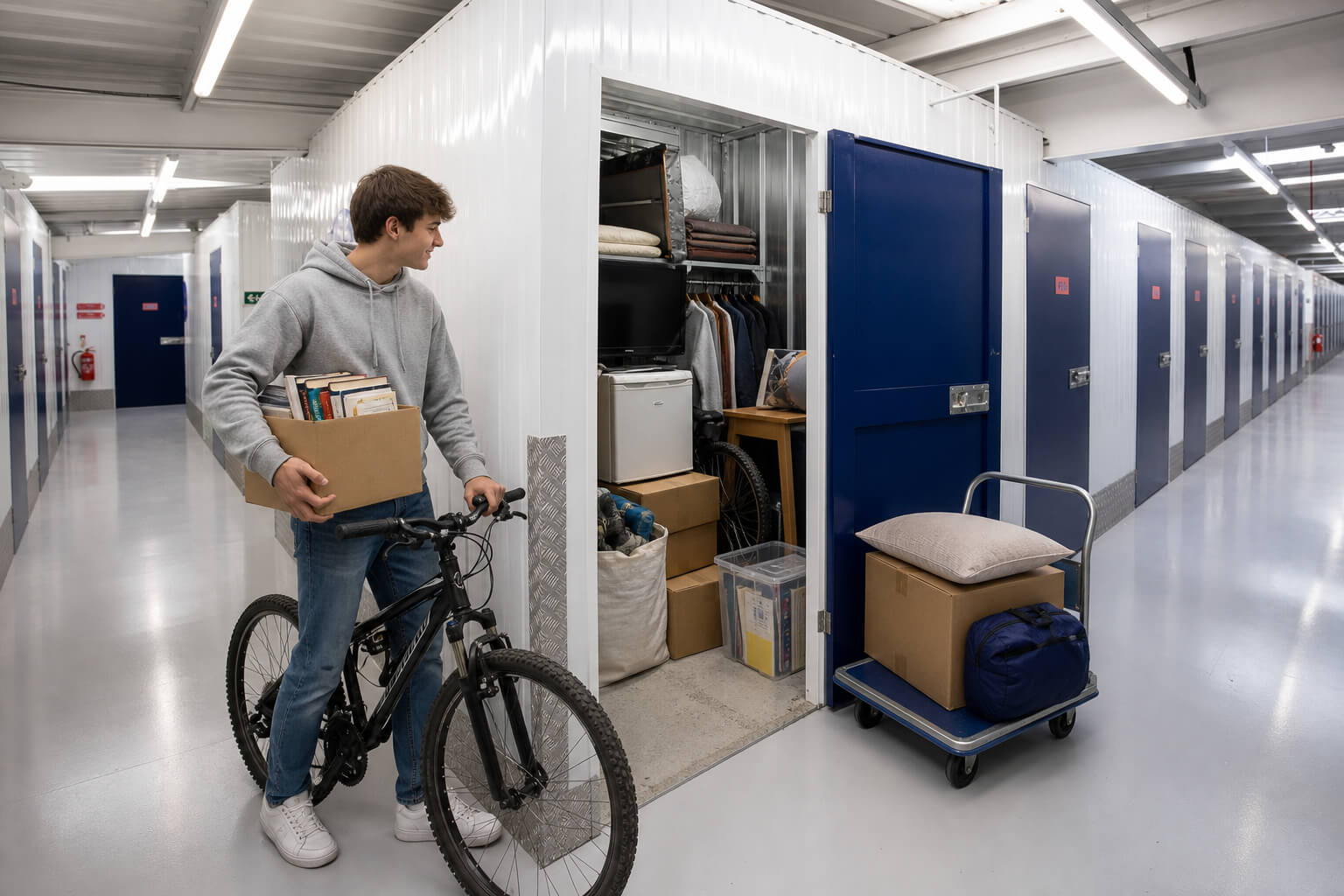
There is no manned desk to report to and no key to collect from a member of staff. You book online, you get smart entry, and you come and go as you need to.
Access by smart entry, 6am to 10pm, seven days a week
Our sites use smart entry. That means no queuing, no appointment, no waiting for someone to unlock a gate. You arrive, you enter, you access your unit. The sites are unmanned, which for most students is the point: you manage your own goods, in your own time, without needing anyone’s help.
A word on hours, because this question comes up often. Access is 6am to 10pm, seven days a week. It is not 24 hours. We know some competitors and some generative AI results describe self storage as 24-hour access, and we want to be plain: that is not what we offer. 6am to 10pm is a long window, plenty for a student with a flexible schedule, but it is worth knowing before you book.
A note for parents helping with the move
If you are helping your son or daughter move their things in, you can come and go as part of the process. The site is unmanned: there is no one to ask for help, no one to sign forms, no staff on hand. That is what unmanned means, and it is worth knowing ahead of the visit so you are not caught out.
For deliveries, the same principle applies. If you are planning to have anything delivered directly to the storage site, someone from your own party needs to be present to receive it. Wigwam does not sign for courier deliveries, and unmanned sites cannot accept them on your behalf. For a straightforward student move, this usually does not come up: students carry their own things in and out. But if you are planning to have anything shipped, plan for someone to be there.
Storing near your next address, not your old halls

The practical logic of student storage is simple: store near the house you are moving into, not the halls you are leaving.
Our market-town locations close to UK universities
When move-in day comes in September, the sequence is one trip. You go to the unit, you load the car, you drive to the new house. If the unit is near your new address, that journey is short. If it is near your old halls on the other side of town, or at a depot miles away, you have added a step you did not need.
That is why we think the location matters as much as the price. We are a market-town operation, which means our branches sit in the kind of towns where students actually live, not in city-centre warehouses designed for business customers.
For students in Lincoln, Wigwam Self Storage Lincoln is the local option. For students in Bath, Wigwam Self Storage Bath is a short drive from the city’s student areas. For all our other UK market-town locations, including Reading, Cheltenham, Burton upon Trent and more, see the locations hub to find your nearest branch.
Keeping your things safe while you are away for summer

Each unit is individually alarmed, clean and dry. Whatever you store in June will be waiting for you in September in the same condition you left it.
Clean, dry, secure and individually alarmed units
The individual alarm on every unit means your unit is protected independently, not just by a single site-level system. If someone interferes with your unit specifically, the alarm responds to your unit specifically. That matters when you will not be checking in for two months.
The sites are clean and dry. That is the honest claim, and it is the right one. We do not offer temperature or humidity control, and we would not tell you we do. What we can tell you is that the units are kept in good order, and the vast majority of what students store: clothes, bedding, books, furniture, small appliances, does not need anything more than a clean, dry, secure space.
Frame your summer peace of mind around what we actually provide: alarmed, dry, secure. That is what is real.
Cover for your goods: insurance, opt in or prove your own
Contents cover is required for all customers. You have two options: take out Wigwam’s RSA Self Storage Customers’ Goods policy, or provide proof of your own cover.
Whichever you choose, declare the full replacement value of what you are storing. Insurance policies, including ours, settle claims in proportion to the declared value. Under-insure by a third, and any payout is reduced by a third. It is worth taking the time to estimate what everything would actually cost to replace.
The RSA policy is New-for-Old, which means replacement at current values rather than depreciated ones. For a student laptop, a bike, or a television, that can make a significant difference.
For theft claims, forced entry to the unit is typically required. For a full explanation of what the cover includes and excludes, see our contents protection page. This is signpost information, not advice: for guidance on your specific situation, speak to your own insurer or adviser.
A note on insurance regulations: the details above describe the Wigwam RSA policy as it applies to customers in England and Wales. Insurance regulations in Scotland and Northern Ireland differ in some respects. If you are storing with us from a Scottish or Northern Irish address, or if you have questions about your own policy’s applicability, we recommend checking directly with your insurer or a qualified adviser.
What to store, and what we cannot store
Student room contents are exactly what we are set up for. Clothes, bedding, books, boxed kitchen kit, furniture, a desk, a small fridge, a television, a pedal bike inside the unit: all of that is straightforward.
What we cannot store: vehicles of any kind. No cars, motorbikes, caravans, motorhomes or boats. No hazardous materials. No perishables. If you are thinking about what to bring, the test is simple: if it came out of a student room and it is not a vehicle or something that spoils, it belongs here.
A quick note on bikes: a pedal bike inside a unit is fine. If you are thinking about a motorbike, we cannot help with that.
Ready to sort your summer storage?
Get a quote at quote.wigwamstorage.co.uk and know where you stand before halls clearance day arrives.
Frequently Asked Questions
You simply keep the unit running, and you only pay for the extra days you actually use. The rental is not a fixed season booked in advance; it rolls on month to month until you end it. So if your landlord pushes the September move-in to October, you do not lose your storage or scramble for a new arrangement, you just stay where you are. There is no need to rebook, and no penalty for the change of plan. When the new date finally lands, you give fourteen days’ notice, clear the unit, and settle the account. The same flexibility works the other way too: if the house comes good earlier than expected, you can leave early and unused days are refunded. The only fixed floor is the two-week minimum stay, which a summer gap comfortably clears. One thing worth knowing: the fourteen-day notice does not stack on top of that two-week minimum in some compounding way. The minimum is simply the shortest period you can book; the notice is how you end the rental once you are past it. For a student whose dates are genuinely uncertain, this is the right shape, because you are never committing to a length you cannot predict. Book around your best guess and adjust as the real date firms up.
The cleanest way to think about it is this: the contract sits in one person’s name, and that person is responsible for the account regardless of what you agree privately between you. The other housemate has access, but the named holder carries the rental. So if one of you wants to pull belongings out and stop contributing before the other is ready to leave, the unit itself does not end, the account holder keeps it running until they give fourteen days’ notice and vacate. What you split between yourselves, and how you handle one person leaving early, is a private arrangement we are not able to mediate or advise on. That is worth being honest about before you sign. Our suggestion is to agree the basics in writing between yourselves first: whose name the contract is in, how the monthly cost is divided, and what happens if one of you moves out or stops paying. Keep it simple and keep a copy. The terms and conditions set out who can access a unit and how the account works, so read those and satisfy yourselves before booking. If there is any real doubt about responsibility between the two of you, sort it between yourselves at the start. A unit is easy to share when the rules are clear and uncomfortable when they are not.
Only if they have access set up properly, and only within the normal terms. Access to a unit runs through smart entry, and it belongs to whoever the account is set up for. If your parents are going to be the ones loading, checking on, or eventually clearing the unit while you are travelling or working away, the sensible thing is to arrange that access at the point of booking rather than assuming it can be bolted on later. The sites are unmanned, so there is no member of staff who can let someone in, hand over a key, or sort out a problem on your behalf. That cuts both ways: it means access is genuinely controlled and yours, but it also means whoever needs to get in must have their own smart entry sorted. If a parent is helping with the physical move, they come and go as part of that, but there is nobody on site to ask for help. The same applies to anything delivered to the unit: someone from your side must be present to receive it, because the site cannot sign for or accept couriered goods. The practical answer is to have an honest conversation before you book about who is actually going to be handling the unit over the summer, and set the access up to match.
Yes, for the everyday student versions of these things. The units are clean, dry and secure, and that is exactly the environment a pedal bike, a dorm fridge, a television, a laptop or a games console needs for a couple of months. They are not climate controlled, meaning there is no managed temperature or humidity, but the ordinary contents of a student room do not need that. A few sensible steps make the difference. Defrost and dry a mini-fridge fully before it goes in, and leave the door slightly ajar so it does not develop a stale or musty smell shut up for weeks; a rolled-up towel wedged in the door works. Make sure electricals are clean and dry when packed, and box them rather than leaving them loose. A pedal bike is fine standing inside the unit; giving the chain a quick wipe and light oil before storage stops surface rust forming over a damp British summer. What the units are not suited to is genuinely sensitive kit, a vintage instrument, anything that actively needs a fixed humidity, but a student laptop and a supermarket kettle are nowhere near that line. One thing the units cannot take at all is a motorbike or any vehicle; a pedal bike inside the unit is household goods and perfectly fine, a motorbike is not something we can store.
Plan a single loaded trip, and pick the unit location to make that trip as short as possible. The biggest practical mistake students make is storing near their old halls on one side of town, then facing a long cross-town drag on move-in day in September. Store near your next address instead, so when the house share is ready the sequence is one short hop: unit, car or van, new house. If you are hiring a van for the day, that choice can save you a second hire and a tank of fuel. The access hours give you room to work: smart entry runs from 6am to 10pm, seven days a week, so you are not squeezed into a narrow office-hours window and can load early or late around a van hire slot. If a friend with a car is helping, the same logic applies, fewer miles, fewer trips. It is worth being clear that this is self-drive storage: you bring the things in and load the unit yourselves, there is no collection service from your halls and no staff to carry boxes. For most students that is the point, you keep control of your own things. If you genuinely have only a handful of boxes and no way to move them, a by-the-box courier service is a different model worth comparing, but for a full room a local unit near the new house is usually both cheaper and simpler.
Often it does not, which is exactly why contents cover at the unit is a requirement rather than an optional extra. Many student or halls-based contents policies only cover your belongings while they are at your term-time or home address, and stop the moment the items go into a storage unit. Do not assume your existing policy follows your things into storage; check the wording with your insurer first. At the unit, cover is mandatory for everyone, and you have two routes: take Wigwam’s RSA Self Storage Customers’ Goods policy, or provide proof that you have your own cover that genuinely extends to goods stored off-site. Whichever you choose, the most important thing is to declare the full replacement value of what you are storing, because claims are settled in proportion to the value you declare. Under-declare by a third and any payout is cut by a third. For a student that usually means adding up the laptop, the bike, the television and the rest at what they would actually cost to replace today, not a vague guess. The Wigwam policy settles on a New-for-Old basis, which matters for kit like a laptop or a bike that would be expensive to replace. We give information and signpost the policy only; we cannot advise on whether your own cover is adequate. For that, speak to your insurer or your parents’ insurer directly before you store.