Afraid of paying for empty space — or of the unit being too small?
There are two things that keep people awake the night before a move. The first is paying every month for a unit that is half empty. The second is the van pulling up on moving day and the unit being too small. Both fears are understandable. Both are more avoidable than you might think.
Most people choose too large because they size by instinct rather than by the job. And the most common reason for that is not knowing one practical fact: UK storage units are not just a floor area. They go up. A unit that is 25 square feet on the floor is a full column of space you can stack to 8ft or 10ft high. That changes everything about which size you actually need.
Here is a plain, room-by-room guide to working it out before you book.
Start with Rooms, Not Square Feet

The most useful thing you can do at the start is stop thinking about dimensions and start thinking about rooms. Count the rooms you are clearing, not the square footage of your house.
Why Thinking in Rooms Is Easier Than Guessing Dimensions
Two families clearing a two-bed flat have roughly the same storage job, whether that flat is 600 square feet or 900 square feet. What matters is how many beds they own, how many wardrobes, how many sofas and boxes. The dimensions of the rooms are almost irrelevant. The contents are what you are storing, and rooms are how most people mentally organise their contents.
This is a far more natural way to size the job. You do not need a tape measure. You need a clear-headed count.
The One Question That Sizes Most Jobs: How Many Rooms Are You Clearing?
The answer to almost every sizing question starts the same way: how many rooms are you clearing, and do you have any very large items that will not flat-pack?
Run through the quick fork before anything else. One room or a collection of boxes and loose items: you are likely looking at a small unit. Two or three rooms: a medium unit is the starting point. Four or more rooms, or a full house clearance: think large. After that, check the outsize items. The sections below will walk you through both steps.
UK Storage Sizes at a Glance
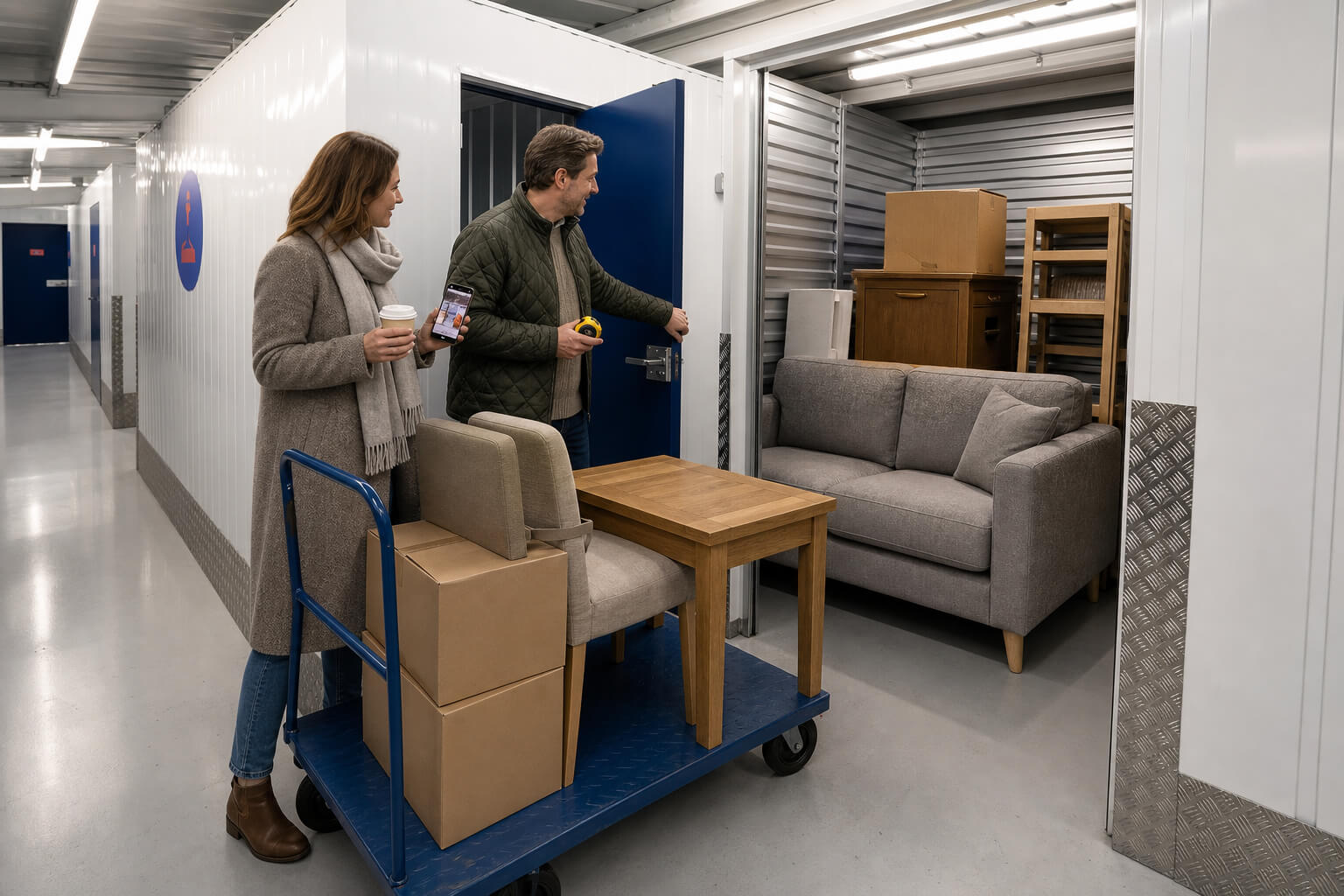
Before going room by room, it helps to have the reference figures in front of you. Here is a plain guide in square feet, the way UK storage is measured, with no US 5×5 notation in sight.
A Plain Square-Feet Reference Table
| Approximate size | Colloquial name | About the size of | Typical use |
|---|---|---|---|
| 25 sq ft | Small | A large wardrobe | Spare room contents, a few boxes, seasonal kit |
| 50 sq ft | Medium-small | A single garage bay | One-bed flat contents or a studio clearance |
| 75 sq ft | Medium | Two garage bays | Two-bed flat or a two-room clearance |
| 100 sq ft | Large | A single garage | Two or three-bed house contents |
| 150 sq ft | Extra large | A double garage | Four-bed house clearance or a full contents move |
All sizes are approximate and assume good stacking to ceiling height. Mixed loads (furniture plus boxes) will vary from this guide.
Familiar Anchors: a Wardrobe, a Shed, a Single Garage, a Double Garage
If the table still feels abstract, think in objects you know. A large garden shed runs to about 50 to 60 square feet. A single garage is about 100 square feet. A large wardrobe is around 15 to 20 square feet on the floor. A double garage is somewhere between 150 and 200 square feet.
These are UK reference points, not American warehouse units. When you see a sizing chart using 5×5 or 10×10, you are looking at American dimensions. Ignore them and work in the square feet above.
Room by Room: What Fits Where
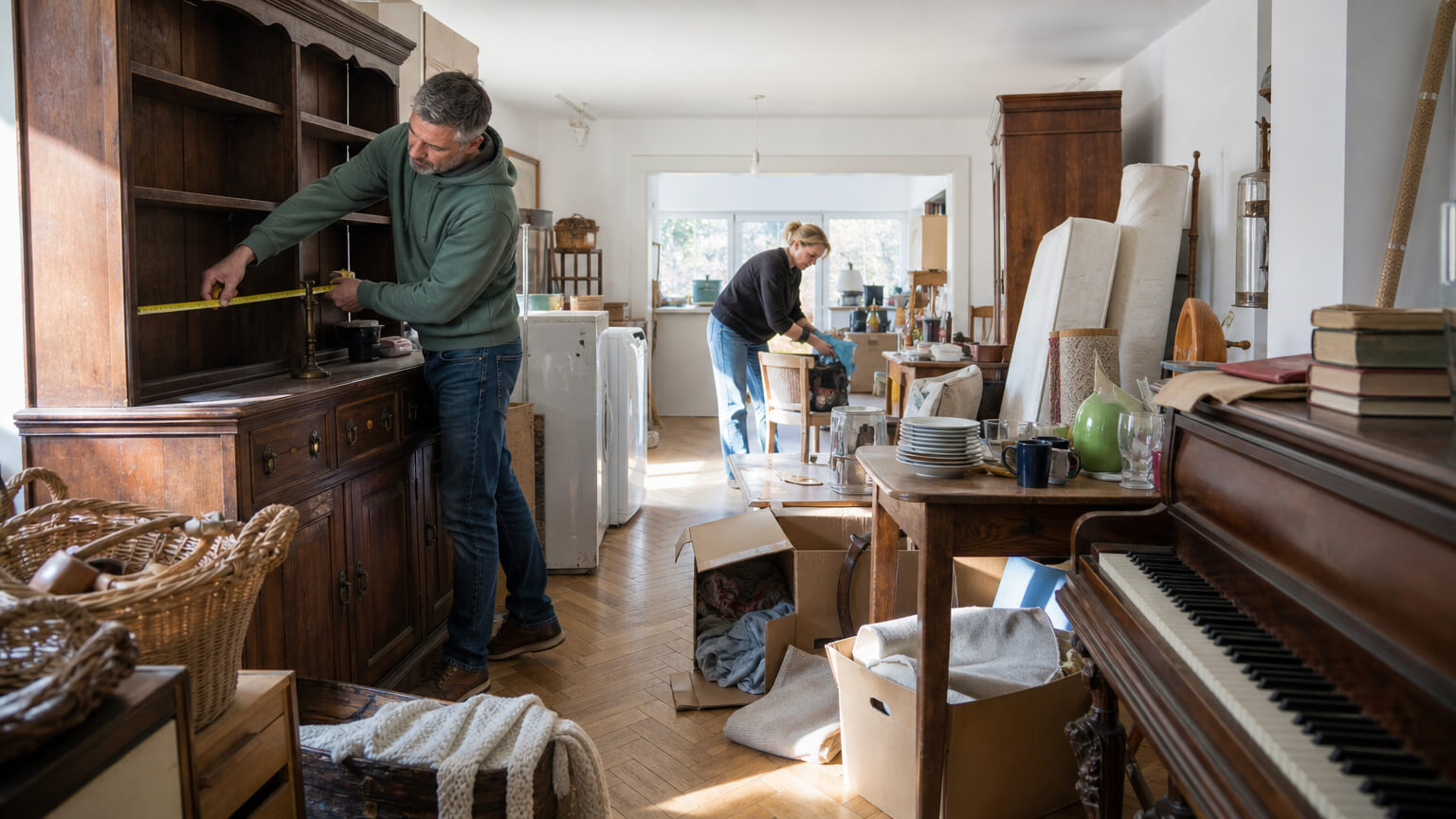
Now for the practical run-through. Match your job to the closest description, then check the outsize items section before you commit.
A Spare Room, a Few Boxes or Seasonal Kit
A small unit of around 25 square feet covers the contents of a single spare room: a single bed frame, a chest of drawers, 10 to 15 standard removal boxes and a collection of seasonal items. Think of it as a large wardrobe’s worth of space, but one you can stack to the ceiling.
This size works well for students clearing a rented room, for seasonal kit that will not fit in the loft, and for anyone who needs somewhere for a handful of things while they bridge between properties. It does not comfortably hold a sofa or white goods. If those are in the job, read the next section.
A One-Bed Flat or a Single-Room Move
A medium-small unit of around 50 square feet is the right starting point for a one-bed flat or a studio clearance. At this size you can fit a sofa, a double bed frame and mattress, a wardrobe, a chest of drawers, small appliances and 20 to 30 boxes, provided you stack well and stand the mattress on its edge.
Think of a single garage bay. That is roughly the floor area, but the ceiling adds a full working height on top of it. The key at this size is working vertically from the start.
A Two or Three-Bed Family Move
This is the most common job, and the one where the stacking rule pays off most clearly. A medium unit of around 75 square feet, or a large unit of around 100 square feet, covers a two or three-bed family move.
At 75 square feet you can fit two or three beds, sofas, a dining table and chairs, white goods and 30 to 50 boxes. The reason many families overestimate and book the 100 square foot unit is that they picture laying everything out flat. You do not lay it flat. You stack it. A 75 square foot unit stacked carefully to 8ft holds more than most people expect to fit. The honest starting point for a two-bed is 75 square feet. Size up to 100 only if you have multiple outsize items that cannot stack (see below).
A Full House Clearance or Four-Bed Move
A large unit of around 100 to 150 square feet is what a four-bed move or a full house clearance typically needs. At this scale you are looking at four beds, multiple sofas, wardrobes, dining furniture, white goods and 50 or more boxes.
This is also the range that probate and estate clearances tend to fall into. If you are an executor moving the contents of a full house and you are not certain of the inventory, a professional removals estimate before booking is worth getting. A unit that is slightly too small on a probate clearance, where you have no flexibility on the day, is a stressful situation to be in.
The stacking rule still applies here. A 100 square foot unit stacked to ceiling height is a substantial column of space. Do not be put off by the floor number alone.
Got a rough size in mind? Check it against a real price.
See what a unit costs at your nearest Wigwam siteReady to go? Get a quick quote at quote.wigwamstorage.co.uk
The Outsize Items That Change the Answer
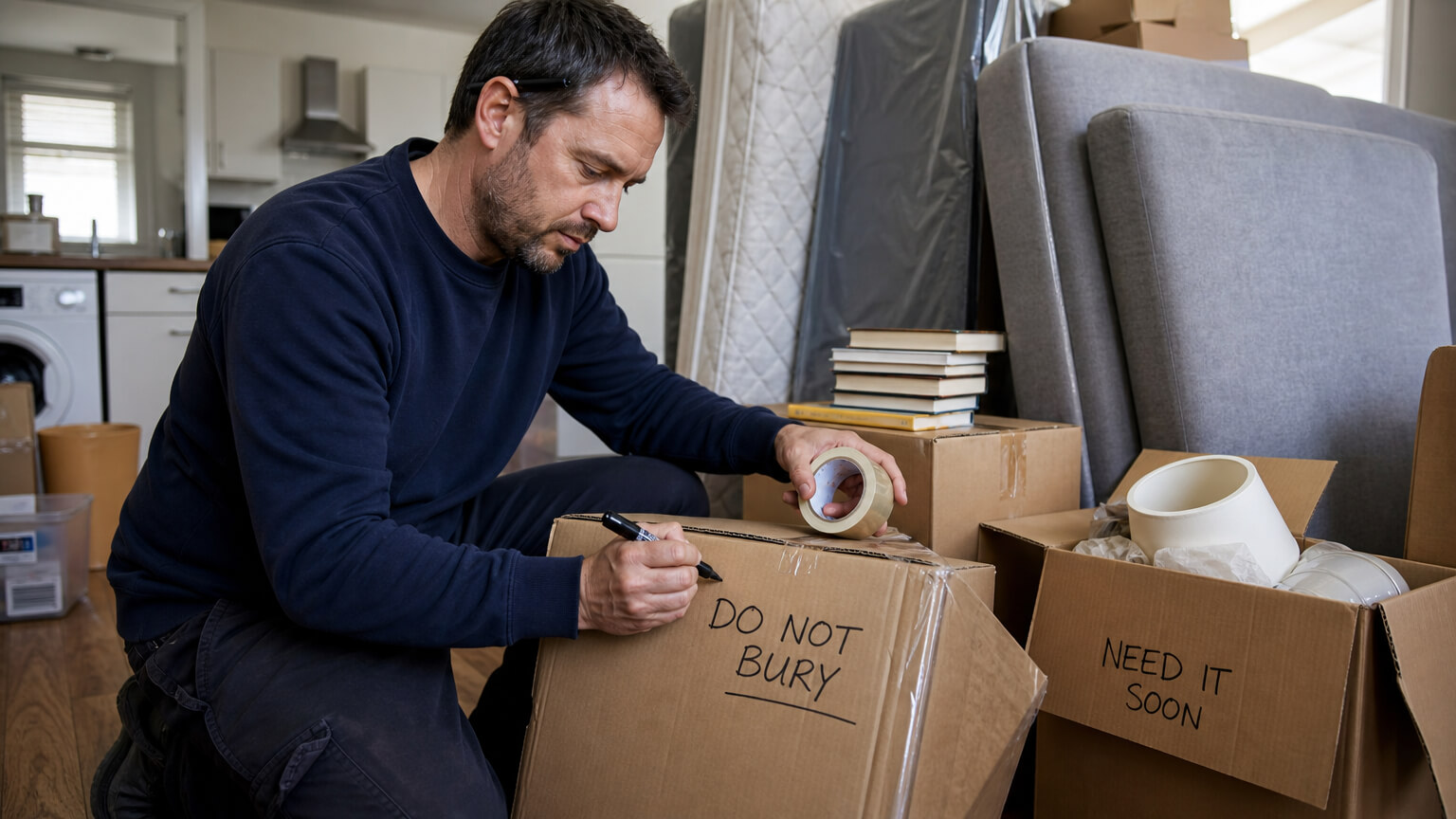
A single large item can shift you up a whole unit size before you have added a single box. This is the most common reason people book the wrong unit: they count rooms but forget the items that will not fold, stack or flat-pack.
Sofas, Beds, Wardrobes and White Goods
A three-seat sofa takes approximately 20 to 25 square feet of floor space on its own. A king-size bed base plus mattress is about 30 square feet when flat. Each wardrobe is 10 to 15 square feet of floor. White goods (a fridge-freezer, a washing machine) each take 5 to 10 square feet, and nothing else can be stacked on top of them.
That means a three-seat sofa, a king-size bed and a wardrobe already account for 55 to 70 square feet of floor before a single box goes in. You can stack boxes on top of solid furniture where it is safe to do so, and you can stand a mattress on its edge against a wall. But the floor plan of non-stackable items sets the floor you are working from, not the ceiling.
Work this out before you book: list the large items first, estimate their floor footprint, then add boxes on top.
Pianos, Dining Tables and Anything That Will Not Flat-Pack
Upright pianos take about 15 square feet of floor and cannot be stacked on. A large dining table needs its own footprint plus roughly 2ft of clearance on each side if you want to get past it to reach the back of the unit. Anything that will not disassemble must be measured before you book.
If you have a grand piano, a large dresser or another outsize piece and you are not sure how it affects the sizing, contact your nearest Wigwam site before booking and we will help you work it through. You can find your nearest location at wigwamstorage.co.uk/self-storage-locations.
Stack It Right: the Height Most People Forget

The floor plan is not the whole story. This is the fact that most size guides built on American charts miss, and it is the one most worth understanding before you book.
Units Are 8ft to 10ft Tall, So Size for Floor, Store for Height
UK self storage units are typically 8ft to 10ft tall. That is not a minor detail: a 50 square foot unit at 9ft of usable height is 450 cubic feet of space. A floor plan of 50 square feet sounds modest. 450 cubic feet is a meaningful amount of storage.
The practical implication is this. Most people size for the floor and then discover on loading day that they have room above. The smarter move is to plan the vertical stack from the start, knowing you have 8 to 10 feet to work with. This is the single change in thinking that lets most movers buy one size smaller than their instinct says and still fit everything in.
Stack heavy items on the floor. Put lighter boxes above. Beds and mattresses stand on edge against the wall. Furniture that is solid and stable can take boxes on top of it.
How to Stack Safely and Reach the Back
A few practical rules that make loading quicker and access easier:
- Heavy items and furniture on the floor, largest pieces going in first against the back wall.
- Boxes stacked with labels facing out so you can read them without moving anything.
- Leave a narrow walkway down the centre if you will need to access the unit regularly.
- Fragile items near the top where they will not bear any weight.
You will not get a shelving unit from Wigwam. Bring your own if you want to freestand anything, and make sure it is stable before you stack boxes on it.
Boxes, Not Maths: a Quick Box-Count Method

If the room-by-room method still feels too abstract, count boxes instead. It is a rougher guide, but a useful cross-check.
A Rough Boxes-per-Size Guide
These figures assume a standard 18x12x12 removal box, good packing and stacking to ceiling height. A mixed load of furniture and boxes will reduce the box count.
| Unit size | Approximate box capacity |
|---|---|
| Small (approx. 25 sq ft) | 10 to 20 boxes, plus a few standalone items |
| Medium-small (approx. 50 sq ft) | 25 to 40 boxes, plus furniture |
| Medium (approx. 75 sq ft) | 40 to 60 boxes |
| Large (approx. 100 sq ft) | 60 to 80 boxes |
These are indicative figures, not guarantees. Every load is different. Use this table as a sense-check against your room-by-room estimate, not as a replacement for it.
How to Estimate Without a Tape Measure
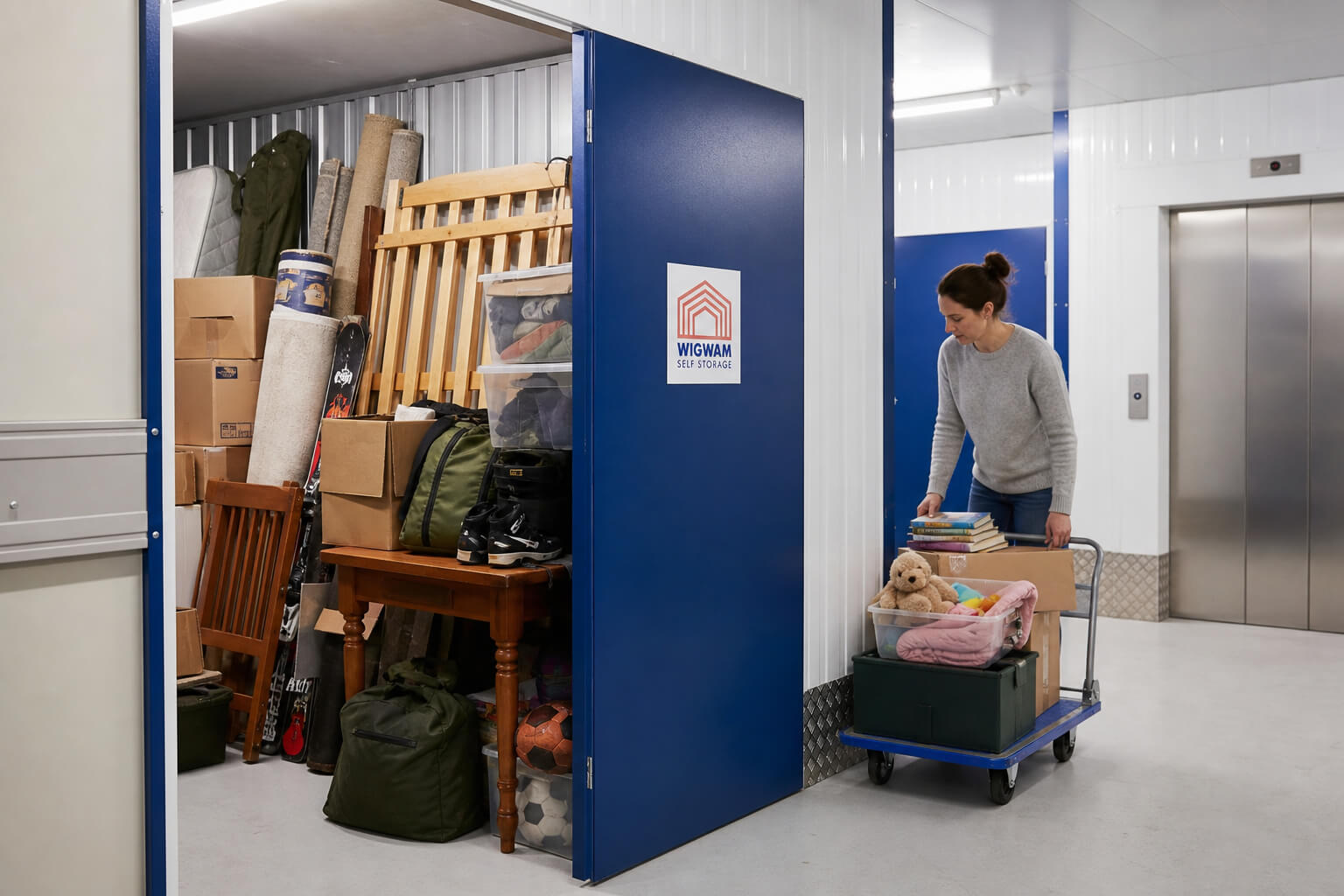
You do not need a tape measure to get a working estimate. A 15-minute walk around the house gives you enough.
The Walk-the-House Method
Go through each room you are clearing and note four things: number of beds, number of sofas, number of wardrobes, and an approximate box count. You do not need precision. You need a rough total.
Then match that list to the reference table in the “UK storage sizes at a glance” section. If your list sits comfortably in one row of the table, that is your size. If it feels close to the boundary between two rows, apply the rule below.
When to Round Up, and by How Little
The rule is simple. Round up by one size only if at least one of these applies: you have two or more outsize items that will not flat-pack (a large sofa plus a dining table, for example), or you are moving a three-bed house or larger with full white goods included.
Otherwise, trust the room count and remember the ceiling height. You almost certainly have more room in the unit than you expect.
The other thing worth knowing is that if you do misjudge it, you are not trapped. Wigwam’s two-week minimum stay and the absence of a deposit mean you are not committed to a year’s worth of the wrong size. If you need to move to a different size unit, that is a conversation, not a penalty.
Storing with Wigwam: the Practical Bits a Chart Leaves Out
Every size chart tells you how many square feet you need. Almost none of them tell you what it is actually like to use the unit once you have booked it. Here are the practical facts.
Smart Entry from 6am to 10pm, Individually Alarmed Units, Clean, Dry and Secure
Access at Wigwam is by smart entry, available from 6am to 10pm, seven days a week. That is not 24-hour access. It is a long day, and for most movers it is more than enough: you can load early on a weekday morning before work, or in the early evening after the van returns. But if you are planning to access the unit at midnight, you will need to know that beforehand.
Each unit is individually alarmed. The units are clean, dry and secure. There is no climate control and no temperature or humidity management. If you have items that need a controlled environment, the honest answer is that Wigwam units are not that. What they are is clean, dry, secure and individually alarmed. For household furniture, boxes, appliances and most personal belongings, that is exactly what you need.
Two-Week Minimum, No Deposit, and Moving Up or Down a Size
The minimum stay at Wigwam is two weeks. If you leave earlier than planned, unused days are refunded. There is no deposit, so nothing is held back and nothing has to be reclaimed when you go.
You can change unit size if you need to. If you arrive and the unit is too small, or you realise mid-stay that you have space you are not using, that is a practical conversation with the team, not an impossible situation.
Contents protection is mandatory. You can take Wigwam’s own policy (see wigwamstorage.co.uk/contents-protection) or provide proof of your own. Declare the full replacement value of your goods: under-insurance is settled in proportion to what you declared. See the full terms and conditions for the detail.
Unmanned Sites: What to Know Before You Book Deliveries
Wigwam sites are unmanned. Customers access their own units directly. If you are expecting deliveries to your unit (for example, business stock or furniture arriving from a supplier), someone from your side must be present to receive them. Wigwam does not sign for couriers and cannot receive deliveries on your behalf. Plan for that before you book if deliveries are part of your storage plan.
Check Your Size Against a Real Price
You have worked out the room count, noted the outsize items, and picked a size. The next step is straightforward.
Check what a unit of that size costs near you. No prices are quoted on this page because they vary by location and unit availability, but the pricing page gives a clear guide.
When you are ready to book, get a quick quote at quote.wigwamstorage.co.uk. It takes a few minutes and you will have a confirmed size and a price in front of you before you commit to anything.
If you want to see the site in person first, find your nearest location at wigwamstorage.co.uk/self-storage-locations. We have units across our UK market-town locations, including Wigwam Self Storage Bath in Somerset and Wigwam Self Storage Lincoln in Lincolnshire. For all other locations, the hub will show you what is nearest to you.
Frequently Asked Questions
Changing size is a conversation, not a penalty. The whole point of working out the size carefully is to avoid the shuffle, but if you misjudge it, you are not stuck with the wrong unit for the duration. Tell the team what is happening and they will look at moving you to a size that fits, subject to what is available at your site at the time.
This matters because the two most common sizing errors pull in opposite directions. The first is booking too big out of caution, then realising a fortnight in that half the unit is empty air you are paying for. The second is the rarer one: you packed by floor area, forgot the ceiling height, and discover you actually fit in a smaller unit than you booked. Either way, a move to a different size is a practical step, helped by the fact that the minimum stay is two weeks and there is no deposit, so you are never locked into a long run of the wrong size.
The honest steer is to get it close at the start. Availability is the one constraint: in busy spring and autumn periods the size you want to switch into may be taken, so ask sooner rather than later if you sense you have the wrong unit. But the model is built to flex. If your needs change, that is a phone call to sort out, not a problem to live with.
Stand them up. A wardrobe, a bookcase or a tall chest takes far less floor area upright than laid flat, and it doubles as structure you can stack boxes against. This is exactly the height advantage the guide above is built around, and tall furniture is where it pays off most clearly.
Here is the practical logic. A unit is 8 to 10 feet tall. A wardrobe is typically 6 to 7 feet. Stand it against the back wall and it occupies roughly its own footprint of floor, maybe 10 to 15 square feet, while using the vertical space you have already paid for. Lay that same wardrobe flat and it eats far more floor and wastes everything above it. The only time you lay a tall item down is if it is unstable upright, if the unit ceiling is lower than the item, or if the piece is fragile and safer flat under a blanket.
A few cautions. Make sure anything you stand up is genuinely stable before you stack against it, empty wardrobes can tip. Do not lean tall items on a single point; sit them flush to a wall. And if you are stacking boxes on top of or against upright furniture, put the heavy ones low. Used well, tall furniture is your friend in a small unit. It turns dead vertical space into working storage and often lets you take one size smaller than you feared.
Yes, and it is mostly about moisture, which matters more here precisely because there is no climate control to dry things out for you. A fridge or freezer must be fully defrosted and, crucially, completely dry inside before it goes in, with the door left slightly ajar in storage if you can manage it. A washing machine and dishwasher need draining of residual water from the pump and hoses. Trapped water is the enemy. In a clean, dry unit, the protection comes from what you put in, not from any conditioning we do.
The reason is straightforward. A sealed, switched-off fridge with a damp interior becomes a small humid box, and that breeds mould and a smell that is hard to shift. The same goes for a washing machine with a litre of water sitting in the bowels of it. Defrost fully, wipe out, drain down, and let everything air for a day before it goes near the unit. Leave appliance doors propped open inside the unit where space allows, so air can move.
On stacking: white goods stay upright, and as a rule nothing heavy goes on top of them, because their tops are not built to bear a load and you can dent the casing. They take 5 to 10 square feet of floor each and that floor is theirs. Treat them as fixed points you load around. Get the moisture out first and a clean, dry unit holds appliances perfectly well for months.
You size by volume and by how you will use it, which is a slightly different job from a house move. A house move is a one-off load that sits still. A business unit is often a working space you visit regularly, so you size not just for the stock but for the room to move, pick and stack around it. The room-by-room method above does not map neatly, so think instead in terms of pallets, shelving runs and box counts.
A useful starting frame: a small 25 square foot unit suits a modest stock holding or a document archive. A 50 to 75 square foot unit handles a growing e-commerce stock with shelving and a small packing area. Beyond that you are into larger units or multiple units as you scale. The key difference from a house move is that you should leave working aisles rather than packing wall to wall, because you need to get to things repeatedly, not just once at the end.
Two practical points specific to business use. First, our sites are unmanned, so if stock is being delivered to the unit by a courier or supplier, someone from your business has to be there with the smart entry code to receive it; we do not sign for or accept deliveries on your behalf. Second, the support team can help size the storage but not plan the business: they will tell you what fits in 75 square feet, not how fast you will outgrow it. Describe your stock and your visit pattern when you ask for a quote and they will steer the size.
Possibly not, and it is worth thinking ahead rather than just sizing for the day you move in. For a static load, a house cleared and sealed away, the right size today stays the right size, because nothing changes. But if the contents are likely to grow or shrink during the stay, size for where you expect to be partway through, not just the first day.
This comes up in a few situations. A renovation where you keep adding rooms of furniture as the work moves through the house: size for the fullest point. A business whose stock builds toward a seasonal peak: size for the peak, or plan to take a second unit when you need it. An estate or downsizing situation where things gradually leave the unit as the family sorts them: you may be able to move down a size later. In each case the question is not just “what fits now” but “what is the biggest this gets”.
The good news is the terms are built for change. The two-week minimum and the refund of unused days mean a long stay is not a long lock-in, and you can move size or, for business use, add an adjacent unit as things shift, subject to availability. For a six-month-plus stay I would book for your realistic peak, keep the team’s number handy, and adjust as the actual need reveals itself rather than guessing the whole arc upfront.