How do you actually paint a room that’s still full of furniture?
You have been planning the decoration for months. You know the colour, you have the brushes, and you have a fortnight set aside. The only problem is that the room is full of furniture, boxes, the lamp your mother gave you, and a sideboard that weighs as much as a small car. There is no clear floor, no clear wall, and no obvious way to start.
Most people manage this badly. They shove things into the hallway, balance a bookcase in the bathroom, and try to paint around a sofa they have dragged to the centre of the room. The job takes twice as long, nothing is protected, and the house feels like a building site for weeks rather than days.
There is a simpler way. Clear the room properly, put its contents somewhere safe and close, do the work, and move everything back before you touch the next room. It sounds obvious. The reason more people do not do it is that they cannot see where “somewhere safe and close” is. That is what this guide is for.
Why renovating room by room works – and what gets in the way

The room-by-room method is the right way to redecorate a home. Done properly, it means you always have somewhere liveable, the job is focused rather than sprawling, and the mess stays contained. The problem is not the method. The problem is finding somewhere for the furniture and breakables while the paint dries.
Dust, paint and the real risk of accidental damage
Paint splashes further than you think. Fine sanding dust settles on every surface in a room, and often in the room next door. If your furniture is still in the space while you work, it will need cleaning, covering and protecting at every stage. More practically, a crowded room is a room where things get knocked, scratched and broken. The sideboard you have been careful with for fifteen years is at real risk the moment a decorator starts moving past it three times an hour with a roller on a pole. Getting it out is not fussiness. It is the sensible precaution that lets you work without anxiety.
Why the cramped-room problem slows the job down
There is a version of decoration that takes twice as long because everything is still in the room. You paint up to the sofa, move it six inches, paint the strip behind it, and carry on. The skirting boards get done in three sessions rather than one. The corners are awkward. At the end of each day you tidy around obstacles instead of seeing a clean, finished room. A clear room is faster to paint and easier to assess. You can see what you are doing. The job you thought would take four days can sometimes be done in two.
The difference between clearing one room and clearing the whole house
Here is what this article is not about. It is not about emptying your house before a full renovation, shifting to a rental for six months, or planning a building-works decant. The room-by-room approach is gentler than that. You clear the dining room while the lounge stays intact. You paint the bedroom while the study is still tidy. You only ever need storage for the contents of one room at a time, and that is a much smaller amount than people assume. A standard bedroom or living room almost always fits in a small or medium self storage unit. You do not need a warehouse. You need a safe, accessible overflow shelf that you can turn around in two to four weeks.
A room-by-room decant plan

Working through a house methodically is something you can plan before you start. The sequence matters: begin with the least-used room so the house stays liveable throughout, and move on to the next only once the previous room is finished and back in use. The method is simple to describe. The relief when you are actually doing it – because the house always has a functioning room – is considerable.
Clear, store, work, move back, repeat – the cycle
The basic cycle has four steps, and each one follows from the last. First, clear the room entirely: furniture, pictures, curtain rails, anything that is either at risk or in the way. Second, move what has come out into your storage unit while the room is being prepared, primed and painted. Third, do the work properly, without obstacles, in a clear space. Fourth, bring everything back once the room is fully dry, and live in it again before you start on the next. This four-step loop is what keeps a phased renovation calm rather than chaotic. The house never feels fully upended because one room is always finished.
What goes to storage versus what stays in the house
Not everything needs to go. Light furniture that can be stacked in a corridor without causing a trip hazard, spare bedding, books that can go in boxes in a wardrobe – these do not need a storage unit. What does need to go is anything fragile, anything with a finished surface that dust or paint will damage, anything large enough to make the working space awkward, and anything you care about. A useful test: if you would be upset to find it scratched or painted over at the end of the job, it goes out. If you would not miss it for three weeks, it can probably stay somewhere in the house.
Labelling and staging so retrieval is easy
The single thing that makes the process more stressful than it needs to be is losing track of where things are mid-project. Label every box with the room it came from and a brief description of what is inside. Do this before the box goes into the unit, not after it arrives. Flat-pack or disassemble large furniture where you can, tape all the fixings, bolts and screws into a labelled bag and attach the bag directly to the piece they belong to. When you bring things back, the room goes together without a scavenger hunt. Load the unit so that the things you might need to access during the project – spare paint, a specific piece of furniture you need back early – sit near the front. Everything else can stack behind.
Where your things can go (options compared honestly)
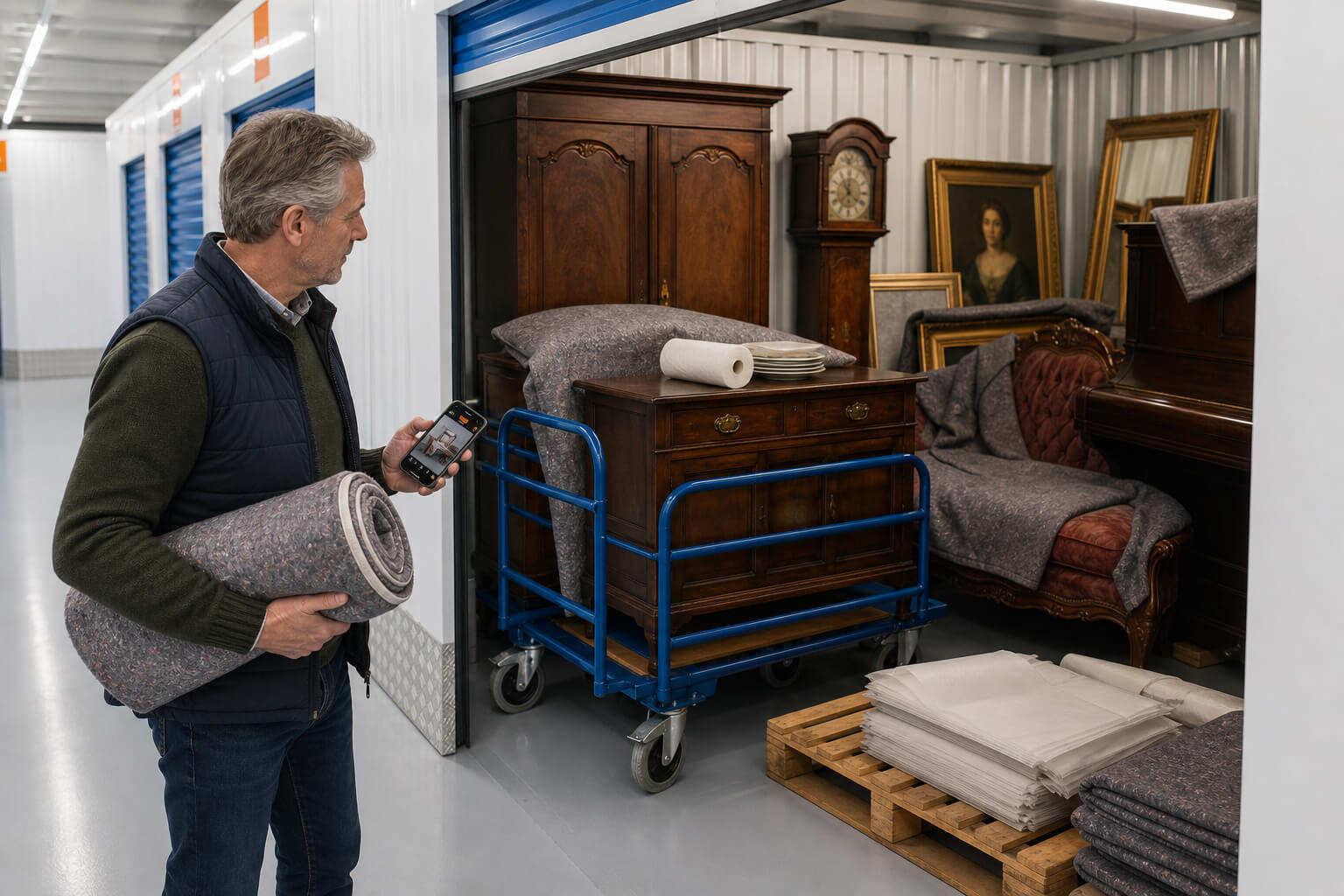
The obvious alternatives to self storage are a container in the driveway, the garage, or the spare room. For many UK homeowners, all three fall short in predictable ways. Understanding why is useful, because it helps you see the self storage option clearly rather than treating it as a last resort.
Self storage versus a container in the driveway
Portable containers and pods work well in some settings. The setting they work worst in is the one that applies to most UK market-town homes: a terrace or semi-detached house on a street where there is no drive, or a narrow drive that the container will block entirely for weeks. Even where space exists, a pod in front of the house for a month is not most people’s preference if there is a tidier option nearby. Self storage also gives you something a container cannot: the ability to go back and retrieve a single item without unpacking everything in front of the house on the pavement.
The garage and spare room – why they often do not work
The garage is full. This is almost universally true. The spare room is often the room that gets used as temporary overflow for everything else in the house, and by the time a renovation starts it can already be at capacity. Even when it is not, spreading a whole room’s worth of furniture through two or three other rooms creates a version of the half-finished house problem you were trying to avoid: the house is disorganised, nothing has a proper place, and the renovation feels more chaotic rather than more manageable.
Why a unit close to a UK market town suits this kind of project
The relevant factor is not square footage. It is distance. When a unit is within a few minutes of your home, you can drop things off in the morning and retrieve a single item in the evening without it becoming a journey. For a project that runs room by room over several weeks, you will go back to the unit multiple times. Smart entry from 6am to 10pm, seven days a week, means you can fit a visit around the working day without rearranging your schedule. Access is by smart entry, and the sites are unmanned. You access your own goods when it suits you, without needing to arrange access with anyone.
How short-term self storage works: the two-week minimum
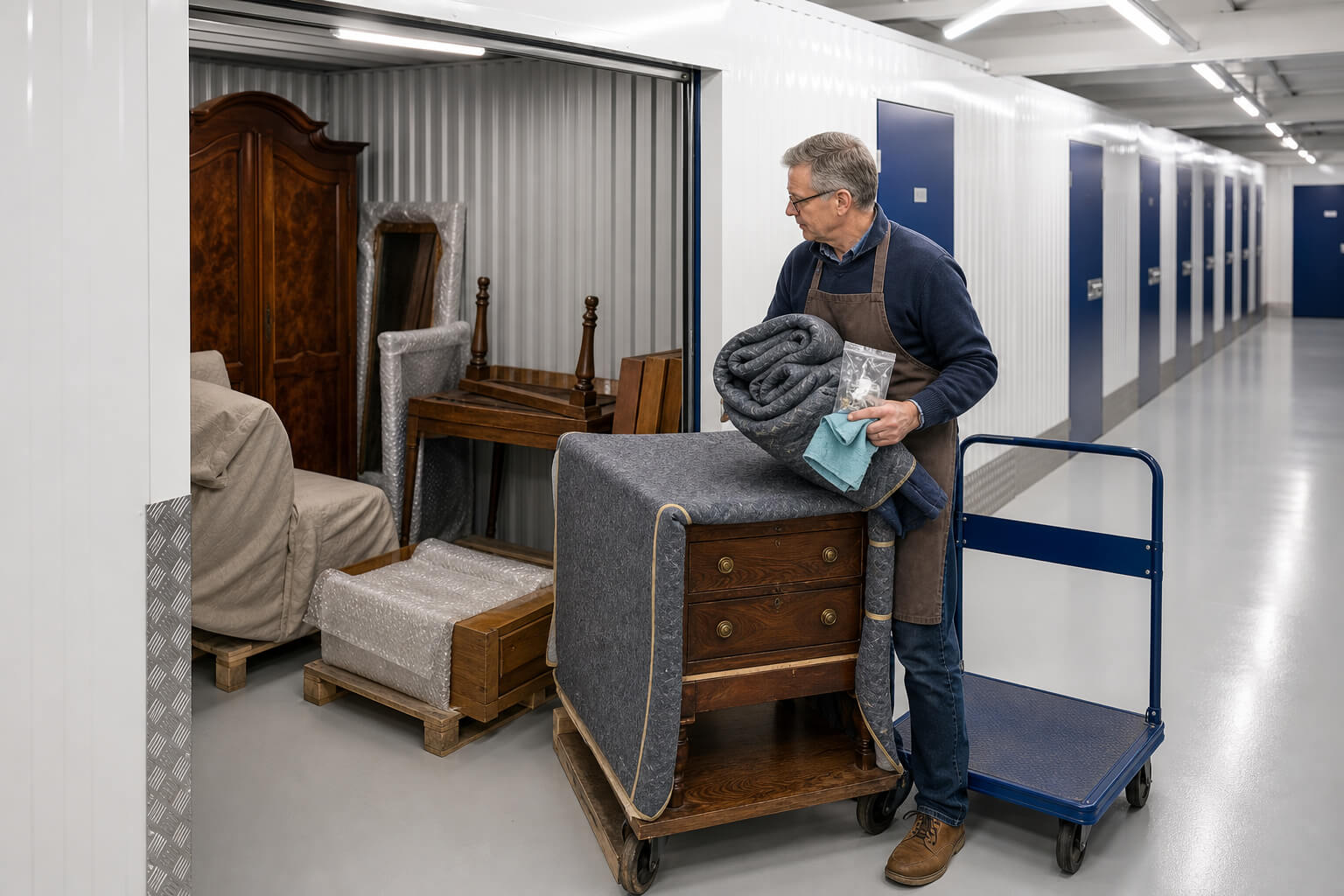
The question people most often have at this stage is whether it is realistic to take a unit for just a few weeks. The answer is yes. Wigwam’s minimum stay is two weeks, which is the right length for most decorating projects. If you finish early, any unused days are refunded. You are not paying for time you did not use.
Two-week minimum stay and refund of unused days
Two weeks covers most room-by-room decorating jobs with room to spare. It is long enough that you can take the time to do the work properly without feeling rushed, and short enough that you are not committed to months of storage for a project measured in weekends. The refund for unused days removes the incentive to stretch a three-week project to six weeks just to feel you are getting value from the unit. If the job is done, you leave. You get the unused days back.
No deposit, and the 14-day notice, explained plainly
When you take a unit, you pay no deposit. When you are ready to leave, you give 14 days’ notice, vacate the unit and settle the account, and any unused days are refunded. There are no hidden charges in that process. The terms and conditions set out the detail in full, and it is worth reading them before you book if you have questions about notice periods or account settlement.
Smart entry 6am to 10pm – you control your own goods
Access to your unit is by smart entry, available from 6am to 10pm, seven days a week. The sites are unmanned, which means you come and go as you need to without coordinating with anyone. You access your goods directly. If you are expecting a delivery to the unit, be aware that you or someone from your side will need to be present to receive it. Wigwam’s sites do not have staff on hand to sign for deliveries or manage incoming goods on your behalf.
Ready to get started? Get a quote at quote.wigwamstorage.co.uk and find out what a unit near you would cost for a two-week stay.
Packing and protecting furniture room by room
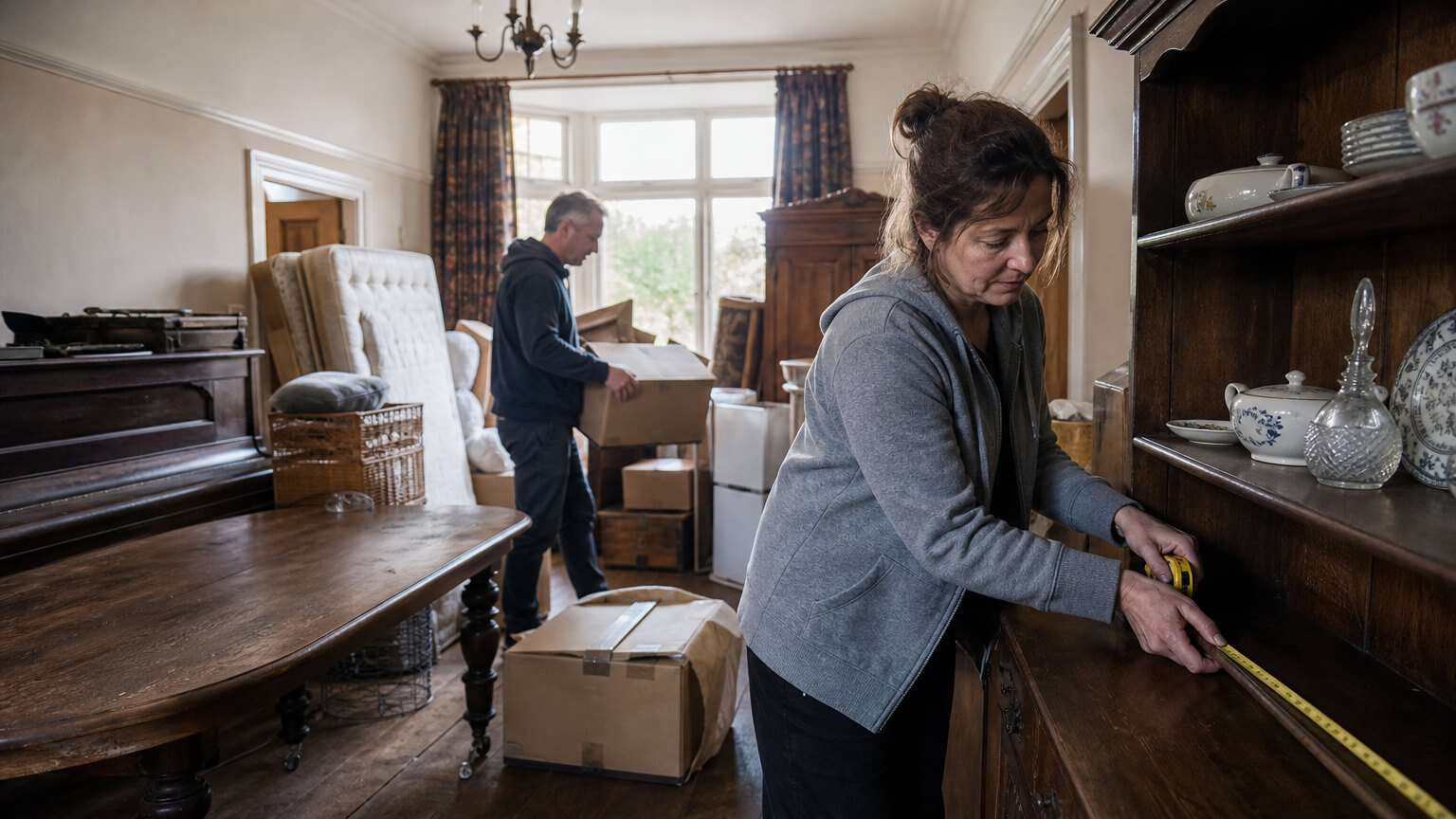
Good packing at the start of the process saves time and frustration at the end. It is not about wrapping everything in acres of bubble wrap. It is about being systematic enough that when you bring things back, the room goes together without guesswork.
Disassemble, label by room, tape hardware in labelled bags
Flat-pack furniture and bed frames should be disassembled if they will take up less space that way. Wardrobes, bed frames and dining tables all pack down considerably. When you remove bolts, screws or fixings, put them in a small labelled bag and tape or tie it directly to the piece it belongs to. Do this immediately. The bolt that goes into a pocket “just for now” is the bolt that takes an hour to find three weeks later. Label every box and every wrapped item with the room of origin and a short description. “Dining room – framed pictures x4, small” tells you what is in a stack without unwrapping it.
Boxing breakables, wrapping and stacking to use the unit efficiently
Breakables go in boxes, not bags. Bags give no structural protection and stack badly. Use box sizes that you can reasonably carry: large boxes filled with light items, small boxes for heavy ones like books. Wrap individual breakables in plain paper or bubble wrap before boxing them. When you load the unit, put heavy items on the floor and lighter or more fragile items on top. Leave a clear path to the front of the unit so you can reach items stored further back without unstacking everything. A unit used well holds considerably more than one packed without a plan.
Keeping sensitive items safe without climate control
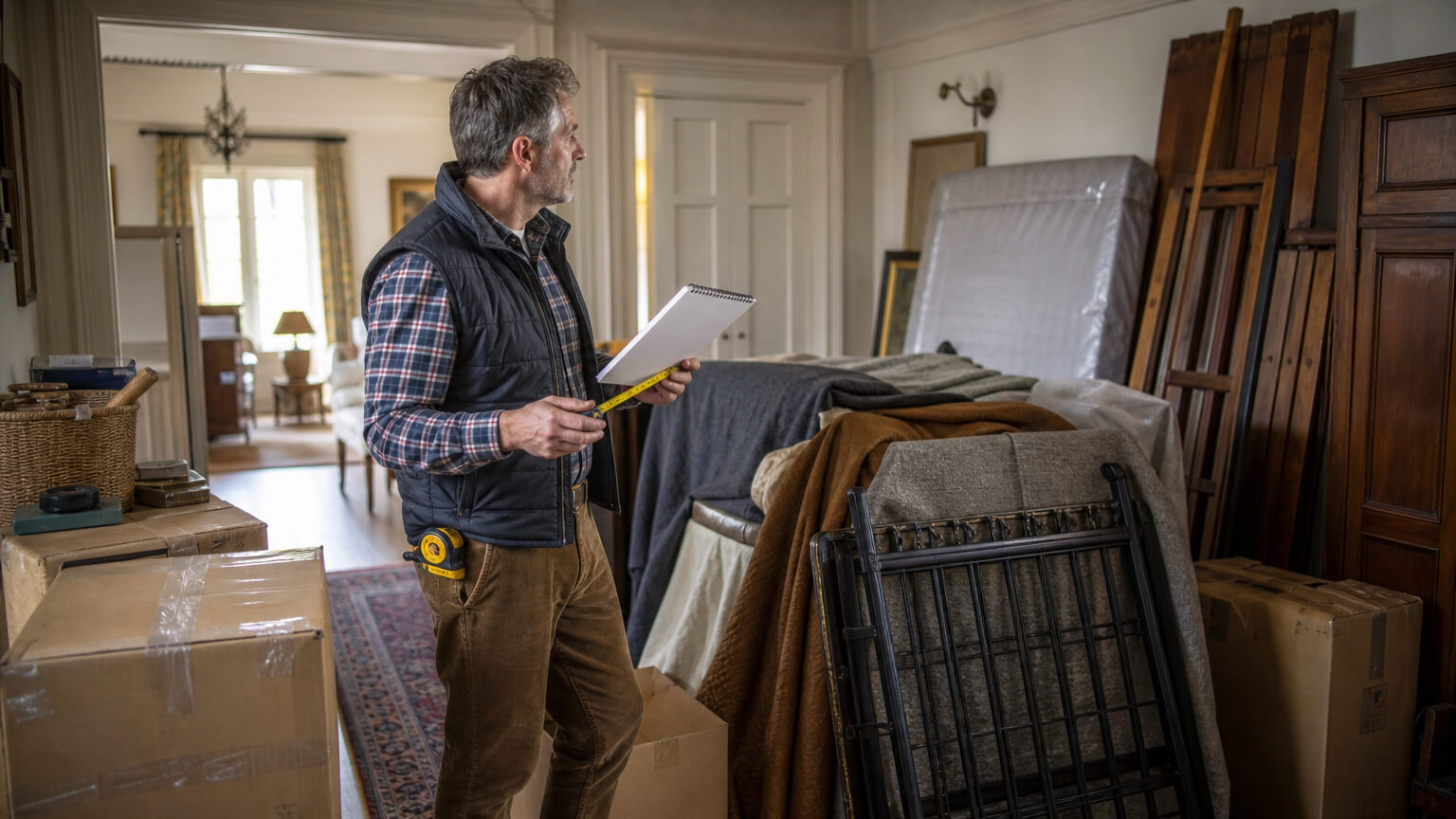
This comes up often, particularly for people who have seen advice online suggesting climate-controlled storage for electronics or artwork. Wigwam’s units are not climate-controlled, and we do not describe them as such. What they are is clean, dry and secure, with individually alarmed units. For the contents of a typical residential room – furniture, boxed items, soft furnishings, general household goods – that is the right environment.
What “clean, dry and secure” means in practice
Individually alarmed units means each unit has its own alarm. It is not a building-level alarm that covers many units together. Your unit is monitored individually. Clean and dry means the units are maintained to a standard that is appropriate for household goods. They are not damp, they are not dirty, and they are not shared with other customers’ belongings. For the items that typically come out of a room during a redecoration – furniture, boxes of everyday goods, soft furnishings, framed pictures, kitchen items – this is the right level of protection. If you are storing items that you believe require a controlled environment, that is a conversation to have before you book, and a factor to consider when reviewing your contents protection options.
Contents cover for your goods while they are stored
Contents cover is required for goods stored at Wigwam. You can take Wigwam’s own policy or provide evidence of your own. The key thing is to declare the full replacement value of what you are storing. If you declare less than the full value and need to claim, any settlement will be proportional to what you declared – you will not receive the full replacement cost of an underdeclared item. For detail on what the policy covers, what it excludes, and how to set it up, the contents protection page has everything you need. For questions about your specific items or your own existing home contents policy, your insurer is the right person to speak to.
What it costs and how to keep the unit small

The cost of a storage unit during a renovation is one of the first questions people ask, and one of the harder ones to answer in general terms. Prices vary by location, unit size and availability. The right approach is to check what is available near you rather than planning around a figure that may not apply.
Picking the right unit size for a single room’s contents
The most common mistake is overestimating how much space you need. A single bedroom’s contents – bed frame, mattress, wardrobe, chest of drawers, bedside tables, boxes of clothes and personal items – will typically fit in a small unit if you disassemble the larger furniture and stack boxes properly. A larger room with bulkier furniture may need a step up in size. Most storage providers, including Wigwam, can guide you through sizing when you get a quote. It is worth asking rather than guessing: taking a unit that is larger than you need costs you more than necessary, and taking one that is too small creates a practical problem mid-project.
Where to check current pricing for your nearest location
Prices are on the Wigwam pricing page, where you can see what different unit sizes cost. Because pricing varies by location, the most accurate figure comes from the quote tool. No prices are listed on this page because the figure that matters is the one for your nearest unit, at the size you need, for the dates you have in mind.
Mistakes that cost you space and money
Most renovation storage problems come from the same handful of errors. They are all avoidable with a small amount of planning at the start.
Clearing the whole house before you are ready
The single most common mistake is trying to clear everything at once. It creates an immediate problem: you now need a very large unit, you are paying for more space than the first room requires, and the house is in complete disarray before you have done a single coat of paint. The room-by-room approach avoids this. Clear only what you need to clear for the room you are working on now. Take the unit you need for that room. Move back in. Then think about the next room.
Underestimating the unit size – or booking too large
Underestimating is more common, but both errors cost you. Booking too small means you cannot fit everything in, and the excess stays in the house creating exactly the problem you were trying to solve. Booking too large means you are paying for empty air. The way around this is to make a list of what is in the room before you book, note the dimensions of the large pieces, and use that list when you are getting a quote. The sizing guidance on the quote tool is there to help, and a quick conversation with the team is often quicker than trying to calculate it yourself.
Not labelling – and the time it costs you mid-project
A unit with no labels is a unit you have to unpack to find anything. Mid-project, when you realise you need a specific item – the screws for the wardrobe, the lampshade that goes with the bedroom, the box of picture hooks – unlabelled storage means unpacking in front of the unit until you find it. Label everything before it goes in. It takes ten minutes at the start and saves an hour in the middle of the job.
Renovating near one of our UK market-town locations
Wigwam has self storage across our UK market-town locations, so there is likely a unit within a short drive of your home. For homeowners in the west of England, Wigwam Self Storage Bath is a useful starting point, whether you are in Bath itself or in the towns nearby. For those in the east Midlands, Wigwam Self Storage Lincoln covers that part of the country. For all our other locations, including those serving Reading, Cheltenham, Dorking and beyond, the self storage locations hub shows what is closest to you.
The process is the same wherever you are. Get a quote, choose a unit size, take the minimum two-week stay, and use the smart entry access from 6am to 10pm, seven days a week. If the project finishes early, you leave and the unused days come back to you.
A room-by-room renovation is a satisfying thing to do properly. Clear one room, do the work, live in it again before you move on. The house stays manageable throughout, and the finished rooms give you momentum rather than the chaos of a whole-house clearance.
Get a quote today at quote.wigwamstorage.co.uk. Find your nearest location, choose a size, and have your unit ready when the decorating starts.
Frequently Asked Questions
Yes, and the wait is longer than most people expect. Paint is touch-dry within hours, but curing, the point at which the surface is genuinely hard and resistant to marking, takes considerably longer. As a rough guide, emulsion on walls is usually safe to live with after a few days, but a freshly painted or varnished floor, skirting or woodwork can stay soft enough to mark or stick for two to four weeks. Bring a heavy wardrobe back onto a floor that has not cured and you can lift the finish straight off when you next move it.
This is one of the quieter arguments for using a storage unit rather than shuffling everything into the next room. The unit holds your furniture safely while the room finishes curing properly, so you are not tempted to rush things back to reclaim your hallway. A practical sequence works well here: do the messy work, let the room ventilate and cure, bring furniture back in stages starting with the lighter pieces, and save the heaviest items for last once you are confident the floor is hard. If you have used a slow-curing oil-based product or a specialist floor finish, check the manufacturer’s stated curing time rather than guessing, because it varies a lot between products. The two-week minimum stay on a unit lines up neatly with a typical single-room job plus a sensible curing window, and if you finish and clear out early, the unused days are refunded, so there is no cost penalty for being patient.
You can store goods at the unit, but you need to understand how deliveries work at an unmanned site before you arrange one. Our sites have no reception and no staff on site during access hours. That means we cannot take in a delivery, sign for it, or let a courier into your unit on your behalf. If a retailer is delivering a new sofa, bed or appliance to the unit, someone from your side has to be physically present, with smart entry access, to receive it and put it away. In practice that is easy to arrange: you simply book the delivery for a time you can be there, between 6am and 10pm, seven days a week.
For most decorating projects, though, the simpler approach is to take delivery of new items at home once the room is finished, rather than routing them through storage at all. The unit is best thought of as a holding space for the things that came out of the room, not as a parcel depot. If you are timing a new purchase to arrive as the project finishes, the cleanest plan is: clear the old furniture into the unit, complete the work, retrieve what you are keeping, then have the new piece delivered straight to the finished room. That avoids double-handling a heavy item and avoids the risk of a courier turning up at a site where there is no one to receive them. If you genuinely need the unit to be the delivery point, just make sure you, or someone you trust, are there in person to take it in.
Nothing dramatic, because the terms are designed to flex. There is no fixed-length contract that expires and locks you out. The minimum stay is two weeks, and after that the unit simply continues for as long as you need it. DIY projects famously run over, a fortnight becomes three weeks once you find the plaster needs patching or the second coat needs a third, and the arrangement allows for that without penalty. You are not forced to clear the unit on a particular date or to re-book.
When the work is genuinely finished and you are ready to move everything back, you give 14 days’ notice, vacate the unit and settle the account. Any unused days you have paid for are refunded once the unit is empty and the account is clear. So if you booked expecting a month and finished in three weeks, you are not paying for the extra week you did not use. The two practical things to remember are that the two-week minimum and the 14-day notice are separate from each other and do not stack into some longer combined commitment, and that you should give your notice when you are confident the room has fully cured and the furniture is genuinely staying out. There is no advantage in rushing the notice and then discovering you needed another few days. The flexibility is there precisely so a project that drifts does not become a storage problem on top of a decorating one.
For most general decorating and DIY trade kit, yes, with a couple of clear limits. A clean, dry, individually alarmed unit is a sensible home for hand tools, power tools, dust sheets, ladders, spare materials, tiling and flooring stock, and the general overflow that fills a van or a garage. Access from 6am to 10pm, seven days a week, suits an early start, and because each unit has its own alarm rather than sharing one across a block, your kit is individually protected. A unit can work well as a small base for a sole trader or a decorator who does not want a van loaded up overnight.
There are two things to be clear about. First, the units are for goods, not vehicles: there is no provision to store a works van, trailer or any motorised vehicle, so this is somewhere to keep what comes out of the van, not the van itself. Second, hazardous and flammable materials cannot go into storage. That matters in the trades, because solvents, certain paints, thinners, gas canisters and similar products are exactly the things you might want to stash, and they are precisely the things that are not allowed. Keep those handled and stored according to their own safety requirements, not in a unit. For everything else, declare the full replacement value of the tools and stock for contents cover, because trade tools add up quickly and under-declaring means a claim is settled in proportion. If you are unsure whether a particular item is acceptable, ask before you book rather than assuming.
You can work around furniture, but it almost always costs you more in time and risk than clearing the room properly. Covering everything sounds simpler, and for a quick freshen-up it can be fine. For a proper job, though, dust sheets and plastic only go so far. Fine sanding dust finds its way under coverings and settles on surfaces you thought were protected. A roller on a pole flicks paint further than you would believe. And every piece left in the room is something you have to paint around, move, and paint behind, which is how a job that should take two days stretches to four.
The honest test is the value and the vulnerability of what is in the room. Light, robust items that can be stacked safely in a corner or a corridor do not need a unit. But anything fragile, anything with a finished surface that dust or paint will spoil, and anything large enough to make you work awkwardly around it is better out of the way entirely. There is also a quieter benefit that is hard to put a price on: working in a genuinely empty room is calmer. You can see what you are doing, you can cut in cleanly along the skirting, and you are not anxious every time you reach past the sideboard you have looked after for years. For a single room, the contents usually fit a small or medium unit, the stay can be as short as the two-week minimum, and the difference between a relaxed job and a stressful one is often just whether the room was truly clear. If you would be upset to find something scratched or speckled at the end, take it out.