Will you be able to find the toaster six weeks after you pack the unit?
The move-out day is usually fine. You have the van, you have the people, and the adrenalin carries you through. It is the moment six weeks later, when the chain has slipped and you need the toaster, that tells you whether you packed well or just packed fast. That is when you find out if the unit is something you can walk back into, or something you dread opening.
Running self-storage sites across UK market towns, we have watched a lot of moves. Most people are brilliant at getting things out of the house. The loading plan for what comes next, not so much. This guide is the method we wish every mover used before they started.
It is straightforward enough. Heavy things to the back, lighter things in the middle, the things you will need soonest near the door, and a clear path down the middle so you can actually reach them. Everything else follows from that.
Plan the unit before you load it
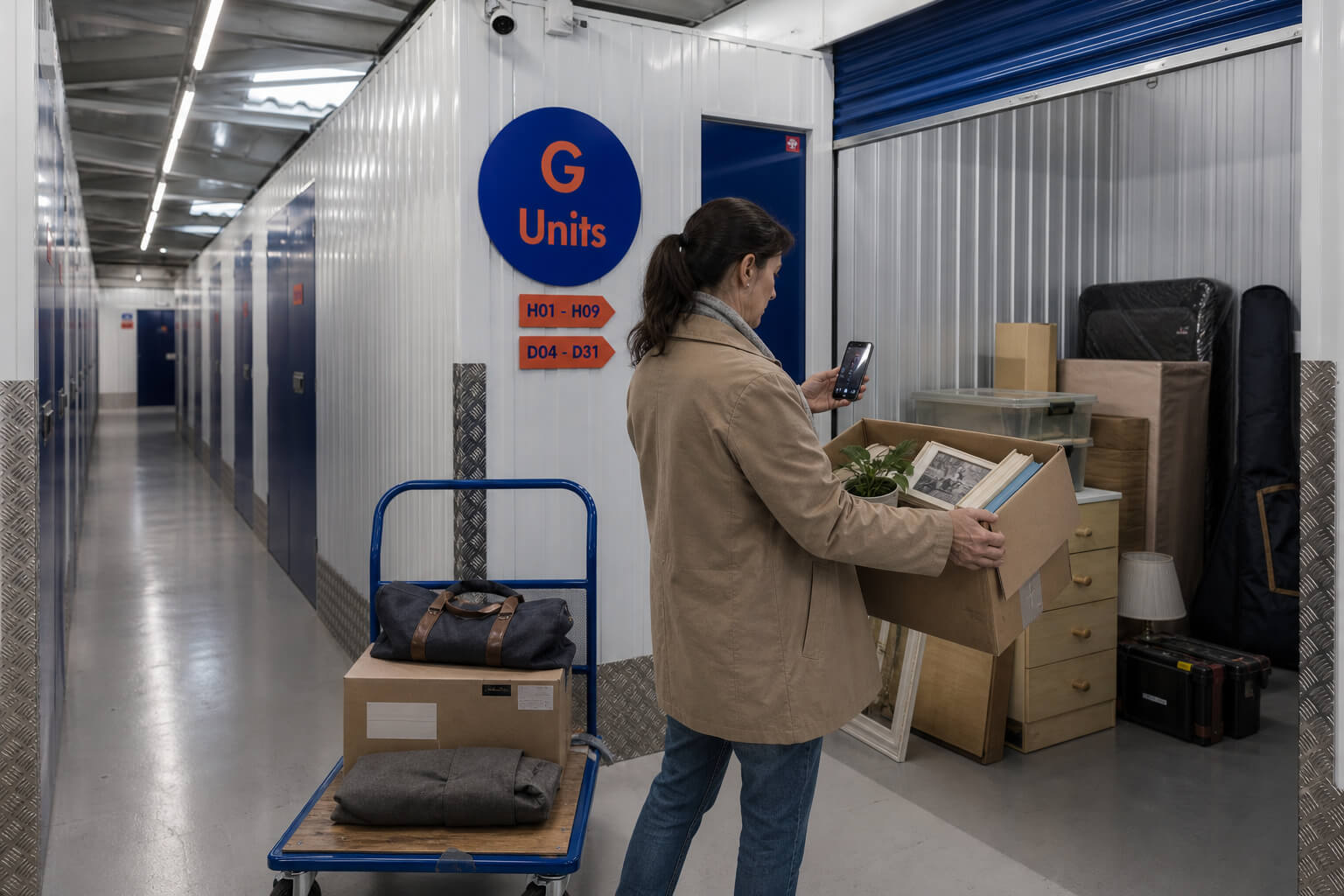
Think of the unit as a room before you start shifting boxes. The layout you choose on day one decides how usable the unit is every time you come back, especially if the move runs longer than planned.
The three-zone map: back, middle, front
The simplest way to picture a storage unit is three zones. The back zone is for heavy, bulky items you are unlikely to need for months: white goods, large furniture, boxes of books. The middle zone is for furniture pieces and sealed boxes that you know you will not want during the move period. The front zone is for anything you might need soon: the kettle, the school uniforms, the important documents folder. Each zone has a job. Once you know what goes where, loading becomes a series of decisions rather than a panic.
Why you always leave a walkway down the middle
Leave sixty to eighty centimetres of clear passage down the centre of the unit. Not because it is tidy, but because it is the difference between a unit you can use and one that defeats you on a cold Tuesday morning when you need one thing from the back. That walkway is not wasted space, and it is not wasted money. If your completion date slips and three weeks becomes eight, the walkway is what keeps you sane. It is proof you packed with the future in mind, not just the move-out day.
Labelling as a system, not an afterthought
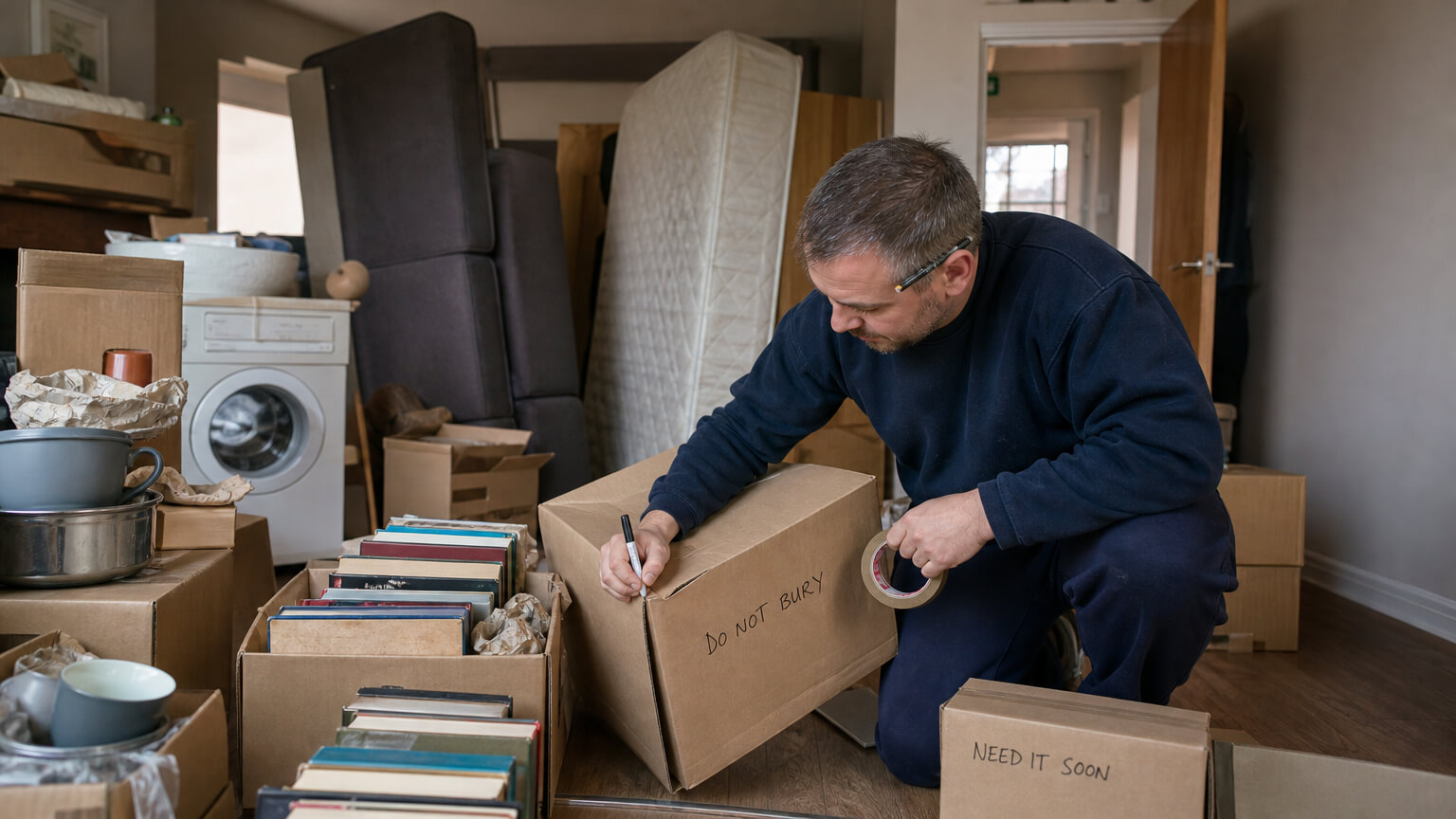
Write on the side of the box, not the top. When boxes are stacked, you will never see the top label. Write the zone (front, middle, back) and the room the contents came from: “FRONT / Kitchen.” Pack one box with everything you are most likely to need in the first two to three weeks, tape it closed with a distinctive colour of tape, and write “DO NOT BURY” on every visible face. This box goes in last so it sits right behind the door.
How big a unit, banded by home size
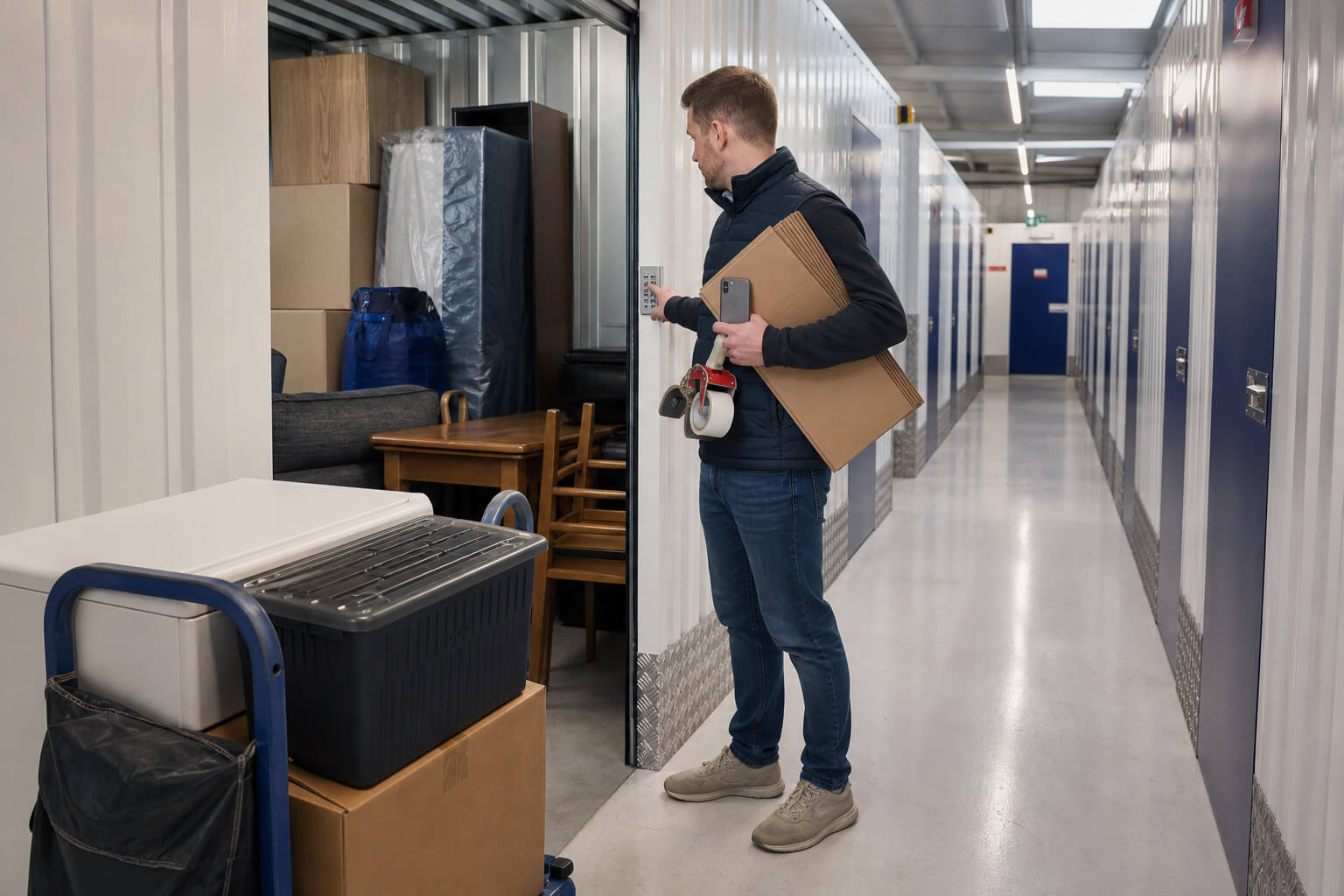
Getting the size right first time saves money and stress. Here is a plain guide, though the honest caveat is that contents vary, and these are starting points rather than guarantees.
One-bed flat to two-bed flat
A one-bedroom flat typically fits into a unit between 25 and 50 square feet. That is enough for the main furniture pieces, a modest number of boxes, and the soft goods. Two bedrooms often pushes you toward the 50 to 75 square foot range, depending on how much furniture you are keeping and whether there are bicycles, a chest freezer, or a sofa bed in the mix. If you are storing a loft that you never quite cleared, allow more.
Three-bed to four-bed house: when to size up
A three-bedroom house generally needs 75 to 100 square feet; a four-bedroom may need 100 to 150 square feet or more. The thing that catches people out is furniture. A three-piece suite, a dining table and six chairs, and a wardrobe take up more floor space than the equivalent volume in boxes. If your move is going to run longer than four weeks, it is worth sizing up by one band. A slightly larger unit that you can walk around is more useful than a tighter unit packed to the ceiling.
Where to check costs
No prices appear on this page because storage costs vary by location, unit size and availability. You can see what a unit costs on the Wigwam pricing page, which covers all our UK market-town locations.
Ready to book the right size? Get a quote for your move at quote.wigwamstorage.co.uk.
The loading order that protects everything (back to front)
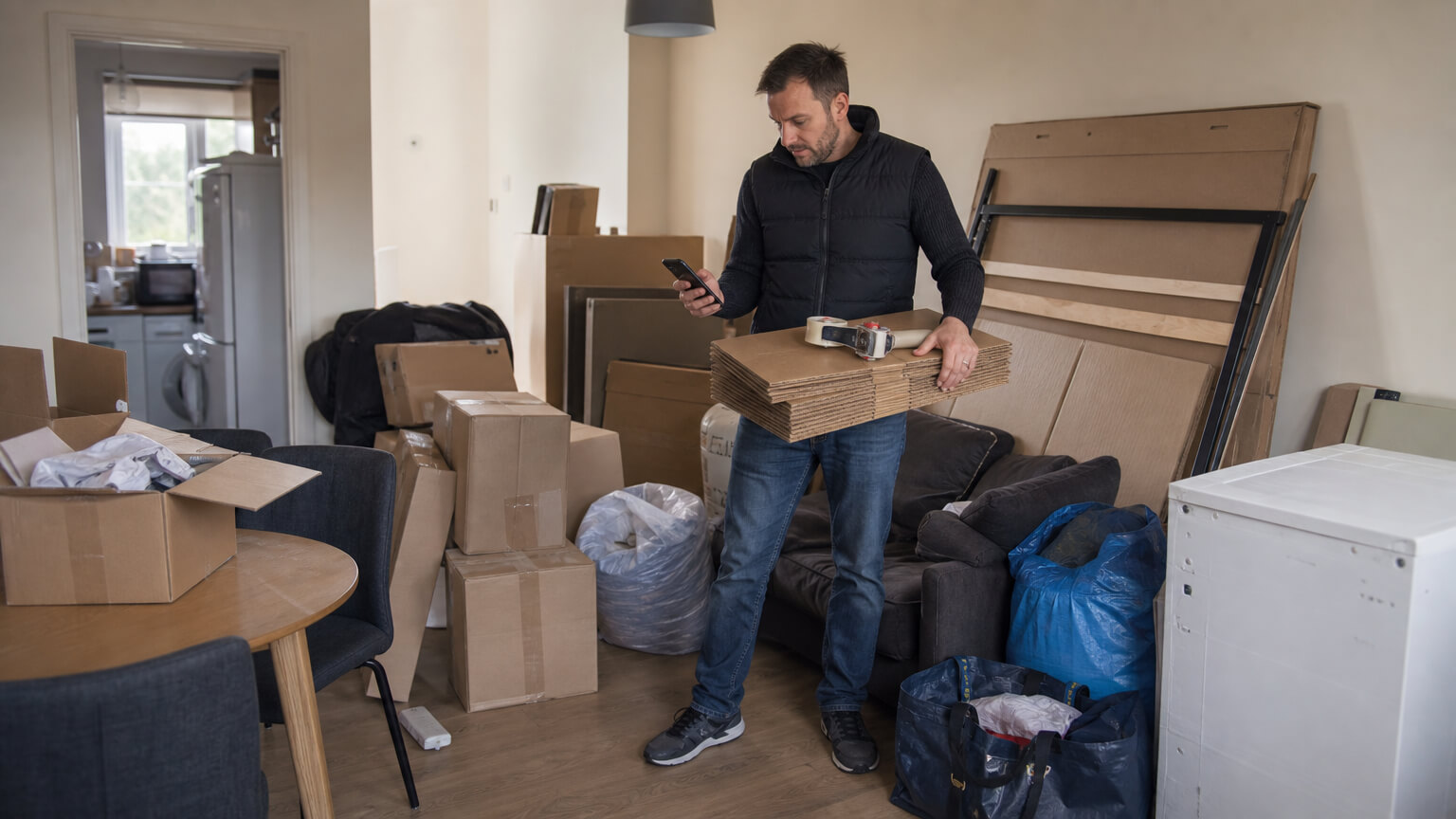
Load from the back wall forward. Everything that goes in early should be something you can live without for the duration of the move. Everything that goes in last should be the first thing you reach for.
Heavy and bulky items to the back, against the walls
White goods, large bookcases, heavy boxes of tools and books go to the back wall. Stand flat-packed furniture against the walls rather than leaving it flat on the floor. Tall items like wardrobes go upright; never lay them on their side unless the manufacturer specifically allows it. Chest freezers and washing machines should be stored upright; a washing machine on its side can damage the drum. Stack heavier boxes on the bottom, lighter boxes on top, and keep stacks stable at no more than five boxes high unless the bottom boxes are specifically rated for it. Gaps between stacks catch belongings and waste space; aim for neat rows.
Fragile and “need it soon” boxes near the door
Fragile items go on top of stable stacks and near the front where you can reach them without climbing. Label every fragile box on at least two sides. The “DO NOT BURY” box is the last thing that goes in, positioned right at the door. Coming back to the unit a month after moving day and finding the kettle immediately is a small thing, but after a stressful few weeks, it matters.
Furniture as structure, not just contents
Sofas can be stood on one end to save floor space; check that the frame can bear this before you do it. Drawers can stay in chests of drawers and be packed with soft items: folded clothing, bedding, towels. This saves box space and keeps the drawers from rattling loose. Mattresses go against the wall, standing upright, not flat on the floor. A mattress stored flat and used as a shelf underneath other furniture will take on weight damage.
Boxes or plastic totes for a UK move into storage
Both work. The choice comes down to how long you are storing, what you are storing, and how much you want to spend on containers.
When totes earn their keep
Plastic totes stack perfectly, close securely, and are waterproof to a point. For a longer stay, or for soft furnishings, clothing, and bedding where moisture is a concern, totes are worth the outlay. They also re-use well, which matters if you are moving across two or three house moves in close succession. The consistent height and footprint makes stacking easier and stacks more stable.
When good double-walled boxes are fine
Double-walled boxes, well taped and filled to the top before sealing, are entirely adequate for a shorter stay or for items that are already in protective packaging. The key words are double-walled and filled. A half-filled box compresses under weight; the box above it sinks, the stack becomes unstable, and things break. Seal every box before it goes in. Uniform box size helps stacking; mixing small, medium and large boxes leads to unstable piles. Avoid single-walled or grocery store boxes for anything fragile or heavy.
Packing the hardest rooms

Some rooms are harder to pack than others, and the hardest one is almost always left too late.
The kitchen: the room everyone leaves too late
Kitchens have the widest variety of shapes and the highest concentration of fragile items. Pack in layers: a layer of bubble wrap or paper, then the item, then more wrapping, then the next item. Nothing should rattle. Appliances go in their original boxes if you have kept them; if not, wrap them well, pack them upright where the instructions say to, and label the box with the orientation. The kettle is the last thing packed in the kitchen and the first thing to go into the “DO NOT BURY” box. Label every kitchen box “FRAGILE / THIS WAY UP” on the side.
The loft: the room that grows
Loft items are consistently larger and less uniform than people expect. Old vinyl records, picture frames, flat-pack furniture in original boxes, unused decorations: all of these are fragile in ways that are not obvious. Put them into labelled totes where possible. Garden tools, stepladders, and irregularly shaped items go to the back zone even if they are not particularly heavy, because their shape makes them awkward to build around. Clear the loft early; people who leave it to the day before the move end up putting loft items in front of everything else, which means they block the walkway.
Wardrobes, bedding and soft items as gap-fillers
Clothing bags and vacuum-pack bags for bedding keep volume down and keep dust out. Soft items are the best gap-fillers in the unit: they go around rigid furniture and into the spaces between boxes where nothing else fits. The important rule is that nothing damp goes in. Bedding and clothing must be completely dry before sealing. Moisture sealed into a unit, even a clean and dry one, leads to mildew. Seal before storing.
Heavy, awkward and fragile items, and what Wigwam does not store

Knowing what fits and what we cannot take is the honest starting point. We will tell you both, plainly.
Sofas, mattresses, white goods and artwork
All of these are straightforward in a Wigwam unit of the right size. Sofas upright to save floor space. Mattresses standing against the wall. White goods upright; drain the water from washing machines and dishwashers before moving day. Artwork padded, upright, near the front of the unit where it is easier to handle. Mirrors the same.
Pianos are a different matter. A standard upright piano will fit in a larger unit, but a grand piano is unlikely to fit in the kind of unit available in most of our UK market-town locations. If you have a piano or any other large or unusual item, contact us before you book so we can give you an honest answer about the space available.
What Wigwam does not store
Wigwam stores household goods. We do not store vehicles, cars, caravans, motorhomes or boats. We do not store garden machinery or leisure equipment that has fuel remaining in it. We do not offer climate control: the honest claim is clean, dry and secure, and that is what the units deliver. If the item you are considering falls outside household goods, please ask before booking.
Keeping everything clean, dry and secure
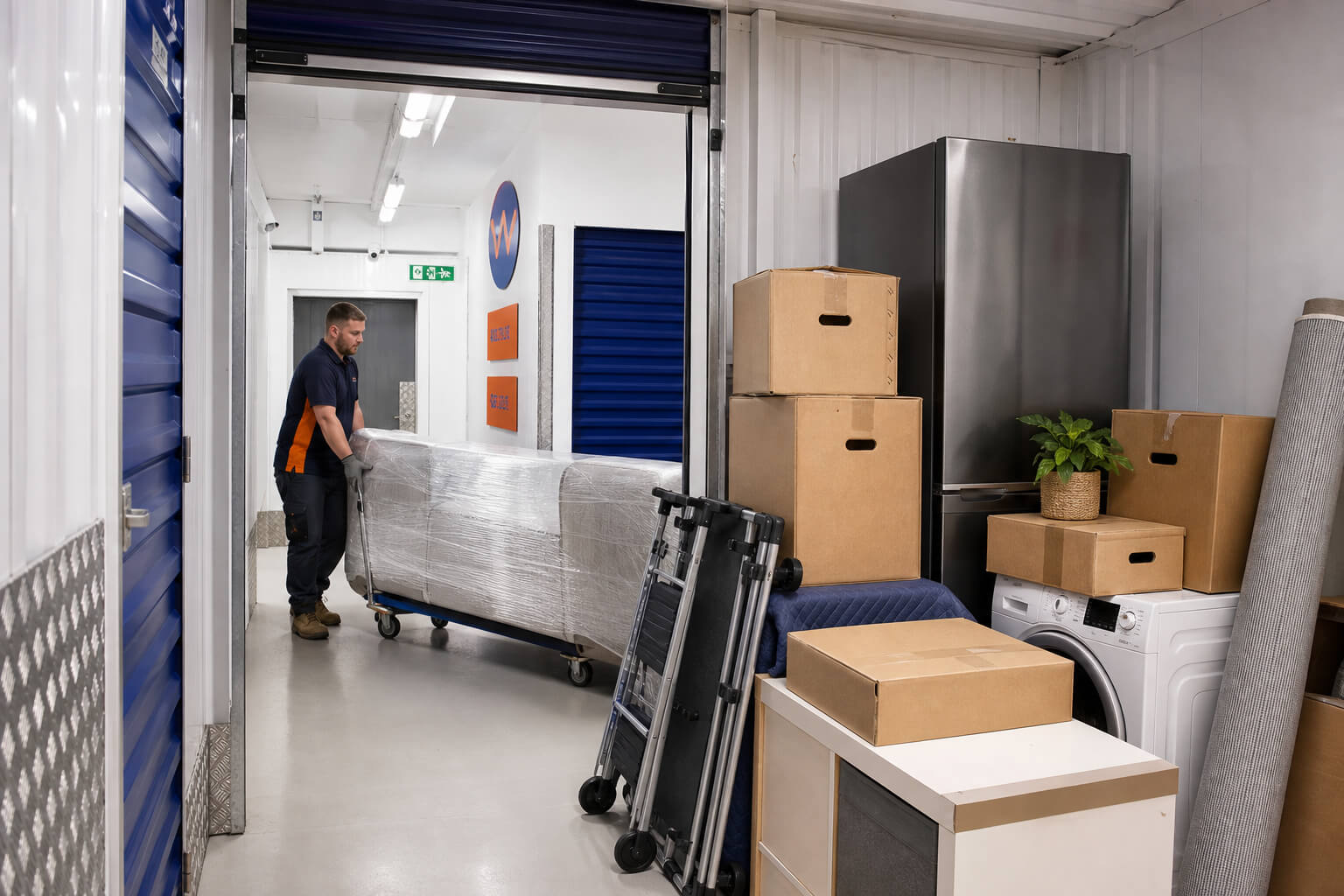
Wigwam units are individually alarmed, clean, dry and secure. There is no climate control and no humidity management, which is why what you do before loading matters.
Dry-packing, sealed boxes, and nothing damp going in
Every item going into the unit should be dry when it goes in. This is especially important for soft furnishings, bedding, and clothing. Seal boxes properly; tape the seams, not just the top flap. If you are storing soft items for more than a few weeks, cedar blocks or sachets inside the sealed bags or totes help with freshness without introducing moisture. Do not use chemical sprays inside sealed storage. No food, no perishables, no liquids that can leak. Even sealed tins of paint can leak under temperature variation.
Individually alarmed and what security means in practice
Each Wigwam unit is individually alarmed. Smart entry is available from 6am to 10pm, seven days a week, and only the account holder can access their unit within those hours. Our sites are unmanned. Wigwam does not sign for couriers or accept deliveries. If a delivery is being made to a storage unit, someone from the customer’s own side must be present to receive it; this is a straightforward rule, and it means your goods stay in your control. For the full terms, see our terms and conditions.
Contents cover is a requirement, not an option. You can take Wigwam’s contents-protection policy or demonstrate that your own insurance covers goods in self-storage. Either way, declare the full replacement value of what you are storing. Under-insurance means any claim is settled in proportion, not in full. We signpost and cannot advise, but the contents-protection page covers the options clearly.
Timing your pack and your stay
Moves slip. That is not a warning, it is a fact. Completion dates move, chains wobble, and the booking you made for three weeks sometimes needs to become six. The honest thing is to plan for that from the start.
When to start packing for storage
Four to six weeks before moving day is a sensible point to begin clearing the non-daily-use items into the unit. Anything you have not touched in a year can go in early. Books, seasonal clothing, spare bedding, loft items, garage contents: none of these need to wait for moving week. The earlier these go in, the more calmly you can load the rest when the pressure is highest.
The minimum stay at Wigwam is two weeks. If your situation resolves faster than expected and you want to leave early, unused days are refunded. There is no deposit to pay. The flexibility is genuine: you pay for the time you use. See our terms for the detail.
Access hours and what smart entry means in practice
Smart entry is available from 6am to 10pm, seven days a week. That is wide enough for a before-work visit on a Tuesday morning or an after-work run on a Friday evening. You do not need to call ahead or wait for someone to let you in. The unit is your space, and you access it on your schedule within those hours.
Booking the right unit for your move
If you have read this far, you have the method. You know the zone plan, you know the loading order, you know what fits and what we cannot take, and you know the terms are flexible enough to absorb a slipping chain.
Wigwam Self Storage Bath in Somerset and Wigwam Self Storage Lincoln in Lincolnshire are two of our UK market-town locations, and you can find the full list at our self-storage locations hub. If you are in a market town and want to know whether there is a Wigwam nearby, the hub is the place to start.
The next step is simple. Get a quote, pick the size that matches your home, and book the dates. If something changes, we work with you.
Get a quote for your move at quote.wigwamstorage.co.uk.
Frequently Asked Questions
Stack to a height you can reach and undo safely, and stop well short of the point where a top box is a hassle to lift down. As a working rule, keep box stacks to no more than five high unless the bottom boxes are rated for heavier loads, and never build a stack you cannot dismantle without standing on something unstable. The aim is a unit you can use on a cold morning, not a wall of cardboard you are nervous to touch.
There are two reasons to hold back from filling every inch of height. The first is stability. A tall stack of mixed box sizes leans, and a lean becomes a collapse the moment you pull one box out. The second is retrieval. The whole point of packing well is being able to walk back in weeks later and get to what you need; a stack you have to disassemble from the top down defeats that.
Put the weight low and the light, soft items high. Use uniform box sizes so the faces line up and the stack carries load evenly. Keep heavier furniture and white goods on the floor, not perched. If you genuinely have more than the floor footprint can hold at a sensible height, that is usually a sign the unit is a size too small, and it is worth checking the sizing guidance again before you cram it.
Yes, and a lot of movers do exactly this. There is nothing that requires you to fill the unit in a single day. Smart entry runs 6am to 10pm, seven days a week, so you can bring loads in as you clear the house, do an evening run after work, or add the last few boxes the weekend after the main move. The unit is yours for the period you have booked, and you come and go within those hours as you please.
This staggered approach is often the calmer way to pack. The non-daily items, the loft, the seasonal clothes, the books, can go in early when there is no pressure. That leaves moving day itself for the furniture and the things you used right up to the end. It also means you load the unit with more thought, because you are not racing a removal crew on the clock.
The practical tip is to keep your zone plan in mind from the first load, not the last. If you know the back zone is for things you will not touch for months, fill it first while the unit is empty and easy to walk into. Save the front zone and the do-not-bury box for the final run. Adding over several visits works well as long as you keep that structure rather than just stacking each load wherever there is space that day.
In a clean, dry and secure unit, yes, provided you pack them dry and sealed. The single biggest risk to bedding, clothing and upholstery in storage is moisture that you seal in yourself. A duvet that felt only slightly damp when you bagged it can develop a musty smell or mildew over weeks, even in a dry unit, because the moisture has nowhere to go. So the rule is simple: everything goes in bone dry.
Wigwam units are clean, dry and secure, but they are not climate controlled, and that is the honest position. There is no temperature or humidity management. What protects your soft goods is the combination of a dry unit and good preparation on your side. Vacuum-pack bags keep volume and dust down. Cedar blocks or moisture-absorbing sachets inside sealed totes help with freshness. Avoid cardboard for long-stay soft items where a sealed tote does the job better.
On pests, the defence is housekeeping rather than chemistry. Do not store food, crumbs or anything perishable, because that is what draws insects and rodents in the first place. Seal soft items in totes or bags rather than open boxes. Do not use chemical sprays inside sealed containers, as they can mark fabric. Pack clean, pack dry, pack sealed, keep food out entirely, and a few months of storage will leave your textiles in the condition they went in.
This is exactly the kind of question to put to the policy and your insurer rather than to me, because cover depends on the specific terms and the cause. What I can tell you plainly is how the cover is set up. Contents protection is mandatory at Wigwam: you either take the Wigwam policy, which is the RSA Self Storage Customers’ Goods policy, or you prove your own insurance covers goods in self storage. Whichever you choose, you declare the full replacement value of what you store.
The reason the declared value matters so much is under-insurance. Cover is settled in proportion, so if you declare half what your goods are worth and make a claim, you recover roughly half. For a unit packed with the contents of a house, it is worth taking the declared figure seriously rather than guessing low to trim the cost. That single decision affects what any claim is actually worth to you.
What is and is not covered for a particular event, including accidental damage from a stack shifting, is set out in the policy terms, and your circumstances may differ from the next person’s. We signpost rather than advise. The contents protection page on the website sets out the policy, and for anything specific to your situation your insurer or broker is the right person to confirm it with. Pack stable stacks in the first place and the question rarely arises, but get the cover right regardless.
You can go and get it whenever you like within the access window, with no need to book a slot or call ahead. Smart entry runs 6am to 10pm, seven days a week, and the site is unmanned, so there is no reception to wait for and no appointment to make. If the chain has stalled and you suddenly need the box with the documents, or the kettle, you drive over and let yourself in.
This is precisely why the packing method in this article puts a do-not-bury box right behind the door and keeps a clear walkway down the middle. The retrieval you cannot predict is the one the layout has to allow for. If you have packed front-zone items where you can reach them and left a central aisle, a short-notice trip takes minutes rather than turning into an excavation.
The one limit to keep in mind is the hours. Access closes at 10pm and opens at 6am, so a genuine middle-of-the-night need will have to wait until morning. For practically every real move, though, a 6am to 10pm window covers the before-work dash and the after-work run with room to spare. Plan your packing so the things you are most likely to need stay near the front, and a mid-move retrieval is a quick errand, not a problem.