Builder starts Monday and the room’s still full — too late to sort it?
The kitchen fitters need a clear run from Monday. The dining room is still full. And somewhere between signing off the builder’s quote and now, nobody sorted the furniture.
If that is where you are this week, take a breath. It is not too late. This is exactly the situation local self storage is built for, and you can have it sorted in a matter of days.
Here is everything you need to know, in the order you need it.
[TRIAGE BLOCK – mobile-first, visible above fold on small screens]
Quick answers if you are short on time
- Can I start this week? Yes. Find your nearest location and get a quote at quote.wigwamstorage.co.uk
- What is the minimum stay? Two weeks. If you leave early, unused days are refunded.
- Is there a deposit? No. We don’t take one.
- What are the access hours? Smart entry, 6am to 10pm, seven days a week.
- What size do I need? See the sizing section below, or put your details into the quote tool and it will guide you.
When the work is booked and the room needs clearing now

If the builder is booked and the room is not clear yet, you have not left it too late. Most Wigwam customers in your position have a unit sorted within the week, and the booking process is straightforward enough that you can have it agreed and confirmed in a single day.
The anxiety is understandable. You have a fixed start date, a contractor expecting an empty space, and a house full of furniture that has nowhere obvious to go. What you need is not a complex logistics plan; you need a calm, workable solution close enough to be practical. That is what a local unit does.
Why trades need an empty room, not just a tidy one
Tradespeople do not need your furniture moved to the corners. They need it gone. A plasterer working on a Victorian chimney breast needs unobstructed access to all four walls. Painters need floor-to-ceiling coverage. Flooring fitters need every stick of furniture out so they can work edge to edge and not carry the risk of scratching your pieces while they manoeuvre boards.
Beyond access, there is the question of protection. Construction dust travels further than you expect. It settles into fabric, coats timber, and finds its way through wardrobe doors. Paint overspray has a way of landing on exactly the piece you thought was safely covered. For period furniture, a dining table your grandmother bought in 1962 or a set of hall chairs with their original horsehair, the right answer is not a dust sheet in the corner. It is a clean, dry, individually alarmed unit with the door shut.
The most common avoidable mistake: clearing too late
The thing that catches most renovators out is not a failure to plan; it is leaving the clearance to the morning of. The van is booked for Sunday evening. The kitchen appointments start Monday at eight. Everything takes twice as long as expected, and the builder is already at the door when the last box goes in.
Book the unit a few days ahead of when you think you need it. Move things in on the Friday or Saturday. Arrive Monday morning knowing the room is clear, the furniture is safe, and one item on the list is already done. Storage should not be a scramble. If you book it this week, it will not be.
Where your things go while the work happens

The options for a renovation clear-out are broadly four: a self-storage unit, a portable container in the street, a borrowed garage, or a room elsewhere in the house. Each suits a different situation, and for a period-property clear-out, they are not equally good.
Indoor unit vs container in the street – which suits a period-property clear-out
A portable container dropped on your driveway or the road outside is a workable solution for some things. It is convenient for bulky building materials, rubble sacks, or garden equipment you need nearby. It is less ideal for the furniture that matters.
A metal container in the street is exposed to condensation and temperature swings. It offers no individual alarm. You are relying on the container’s lock and not much else.
An indoor unit at a Wigwam site is a different proposition. The units are clean, dry and secure. Each one is individually alarmed. Your grandmother’s sideboard is behind a locked unit door, within a secure building, with its own alarm. That is the honest answer to “what about dust and damage,” and it does not require any claim about climate control we cannot make. Clean, dry and individually alarmed is what we offer. For most period furniture and household goods, that is enough.
What to do with the things you cannot move
Very large pieces are a real consideration. A floor-to-ceiling bookcase may need to come down in sections. A grand piano is not going in a transit van for a six-week stay. For genuinely immovable pieces, you have two options: disassemble them where you can (most Victorian sideboards come apart at the back panels and legs), or stage them within the house in a room that is not being worked on, properly sheeted and away from the dust.
What Wigwam units are for is household goods: furniture, white goods, boxed personal effects, garden tools, stored clothes. We do not take vehicles, caravans, or leisure craft. If the project van needs somewhere to sit while the drive is ripped up, that is a conversation for a different type of storage.
How to protect what stays behind
Everything that cannot go into storage needs to be treated as if it might get dusty, knocked, or splashed. That means proper dust sheets (not bedding), sealed doorways with plastic sheeting taped at the frame, and anything fragile moved to the highest surface available and wrapped. Mirrors and picture glass should come off the walls entirely and go either into storage or flat-wrapped somewhere out of the work zone.
The contrast is worth naming. Everything in the unit has a locked door between it and the dust. Everything left in the house needs you to be its protection plan. The more you can move out, the less work the sheeting and taping has to do.
What size unit you need – one room or a whole house
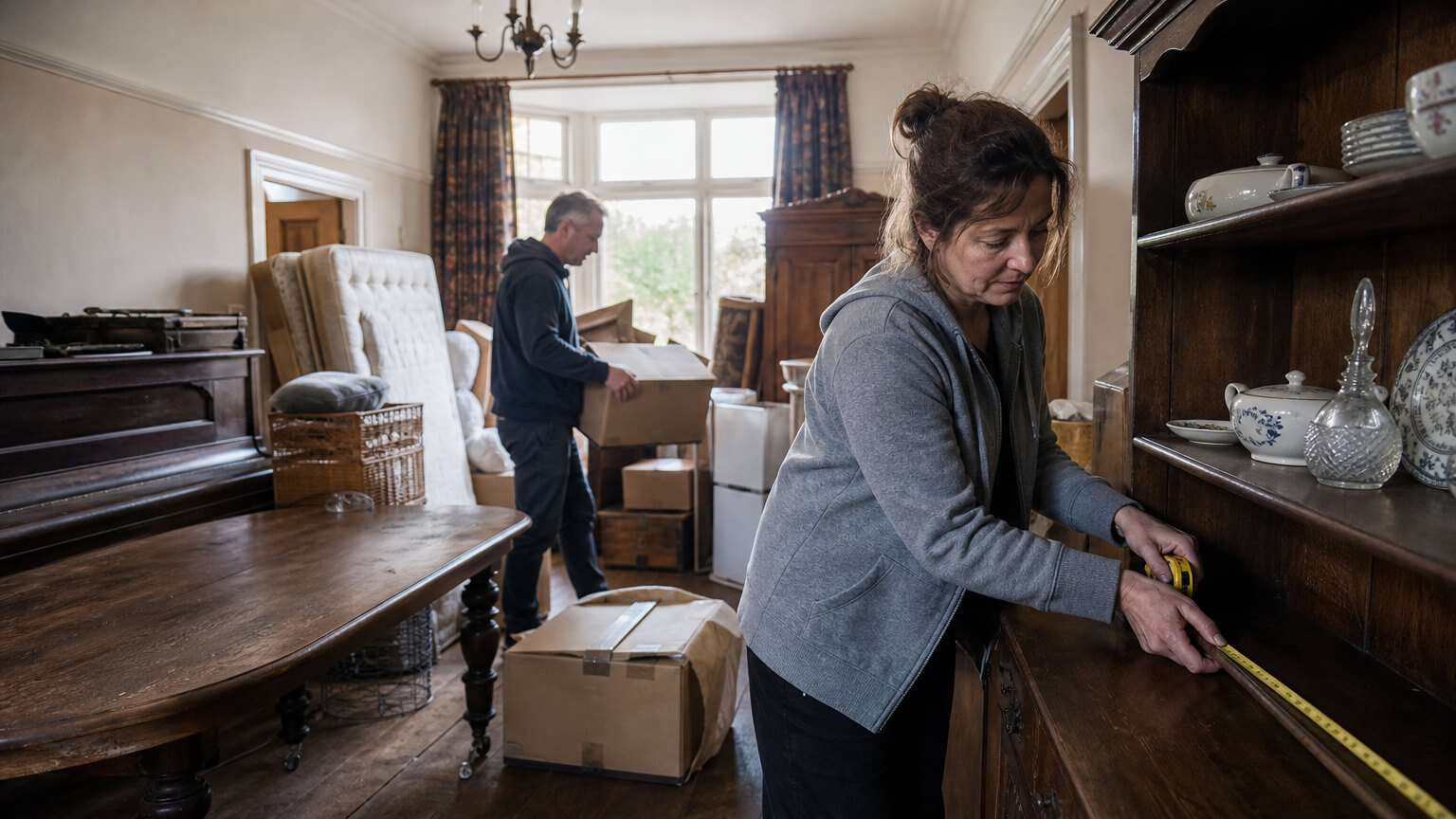
A single furnished room typically fits in a 25 to 50 sq ft unit. A full four-bedroom house clear-out needs 150 sq ft or more. Here is a rough guide, though the quote tool at quote.wigwamstorage.co.uk will give you a more accurate steer once you list what you are moving.
Sizing for a single room
A bedroom or study, cleared of bed, wardrobe, chest of drawers, and the usual accumulation of shelving and boxes, generally fits into a 25 to 35 sq ft unit if it is packed well. A living room with a three-piece suite, coffee table, bookshelves, and television typically needs 50 sq ft, sometimes more if the shelving is deep or there is a desk. The trick is to disassemble what you can. A wardrobe in three sections takes half the space of a wardrobe standing upright.
For a rough check before you call, see the pricing and size guide on the website. It walks you through the common unit sizes and what they hold, without locking you into a price before you are ready.
Sizing for a kitchen clear-out
Kitchens generate more bulk than most people expect. You have the appliances (fridge-freezer, washing machine, dishwasher), the wall and base units if they are being replaced, loose items from the drawers and worktops, and often a collection of things that have lived in the kitchen cupboards for a decade without anyone noticing. A kitchen clear-out frequently fills a 50 to 75 sq ft unit.
White goods and packaged goods store well in a clean, dry unit. The units are not temperature controlled, but a fridge in a dry, secure unit for four to six weeks is not at risk. Pack it empty, leave the door slightly open, and it will be fine.
Sizing for a full clear-out during a whole-house project
A whole-house renovation is a different scale of operation. The practical approach is to stage it: start with the room being worked on first, then rotate as each space is handed back. If you need to store a substantial portion of a house simultaneously, expect to need 100 to 150 sq ft for a three-bedroom house, more for a four-bedroom with loft contents. Again, the quote tool takes the guesswork out of it, and there is no cost for getting a quote.
Packing and protecting furniture before the trades arrive

Disassemble what you can, label every piece by the destination room, and move things out the day before the builder arrives, not the morning of. That one change reduces the stress of a renovation start day more than almost anything else.
What to disassemble, what to leave whole, and how to label it
Flat-pack furniture is straightforward: break it down to its boards and bag the fixings together with a label. Period joinery is a different matter. A solid-wood dresser from the 1920s often comes apart at the back panel and the feet. Do not force joinery that has set over decades; instead, wrap it in moving blankets and move it whole on a sack truck.
Mirrors and picture glass need to be wrapped individually in cardboard or bubble wrap, marked as fragile, and stood upright in the unit, never laid flat with weight on top. Label everything by the room it came from, not just by what it is. “Kitchen” on a box is useful. “Kitchen – right-hand cupboard above the sink” is more useful when you come back for one specific thing mid-renovation.
Packing blankets and stretch wrap are worth buying rather than borrowing. They go back into the unit with the furniture and protect it throughout the stay.
What not to store – and the contents-protection check
Wigwam units are for household goods. Prohibited items include anything flammable or hazardous, perishables, living things, and any vehicle including motorbikes. If you are clearing a loft, check the boxes before they go in: aerosol tins, old paint cans, and fuel canisters need to be disposed of before the move, not stored.
Contents protection is mandatory at Wigwam. You can take the Wigwam policy (RSA-backed, New-for-Old), or you can prove your own cover is in place. Either way, you will need to declare the full replacement value of what you are storing, not the purchase price or a conservative estimate. Under-insurance is settled in proportion to the shortfall. For antiques, period pieces, and anything that would be expensive or irreplaceable to replace, take the time to value it properly before you book.
Worth knowing: the policy covers theft after forcible entry to the unit, and excludes damage from atmospheric conditions. Read the detail at wigwamstorage.co.uk/contents-protection/ before you make a decision. We will point you there; the advice is yours to take.
The move-in logistics – van hire, timing, and using your smart entry access
Your unit is ready from the start date on your booking. Smart entry means you can arrive from 6am, seven days, and go straight to your unit. No need to call ahead, wait for a member of the team, or arrange a handover.
If you are hiring a van, book it for the day before the builder starts and move things in the evening or the following morning. This gives you a clear site by the time the trades arrive without a panicked same-day scramble.
One important note on deliveries: Wigwam sites are unmanned. We cannot sign for courier deliveries or builder drop-offs on your behalf. If a courier is sending something to your unit address, or a contractor is dropping materials, someone from your household needs to be there in person to receive it. Plan deliveries around your own access windows, not around a staffed reception that does not exist.
Short stays – the two-week minimum and what happens to unused days

The minimum stay is two weeks. If you leave before your billing period ends, the unused days are refunded. That is the straightforward version. Here is what it means in practice for a renovation stay.
How the two-week minimum and refund of unused days works
Renovation timelines slip in both directions. Trades finish a week early and hand back the keys on a Friday. Or a delivery runs late, the tiles have not arrived, and the kitchen fit pushes back by ten days. The Wigwam terms are built to flex around both.
If the project finishes sooner than expected, you clear the unit, give notice, and any unused days on your billing cycle are refunded. You are not paying for storage you are not using. If the project runs over, you simply continue. There is no penalty for a longer stay and no need to renegotiate. Just keep using the unit until the room is ready, then clear it when you are done.
The two-week minimum is the starting point. For most renovation projects, the actual stay is four to eight weeks. The pricing page at wigwamstorage.co.uk/how-much-is-self-storage-in-the-uk gives you a cost framework without binding you to anything.
The 14-day notice, and what comes back to you
There is no deposit to take the unit. Once you are ready to vacate, you give 14 days notice, clear your belongings out, and once the account is settled, any unused days are refunded. Nothing complicated, nothing that disappears into administration.
The 14-day notice is a separate step from clearing the unit. Give notice, then use those final days to make your last collection trips, then vacate. Any refund follows after you have left and the account is confirmed clear. Full terms at wigwamstorage.co.uk/terms-conditions/.
Ready to get a quote this week? Start at quote.wigwamstorage.co.uk. Free, fast, and no commitment until you are ready.
What you can and cannot store with us

We store household goods. Not vehicles, not leisure equipment, not business stock arriving on pallets. Here is the full picture, because knowing the limits in advance is more useful than finding out later.
Household goods, furniture, and the contents of your renovation
For a home renovation clear-out, Wigwam units cover virtually everything you will be moving: furniture, soft furnishings, white goods, boxed kitchen contents, tools, garden equipment, clothing in boxes or on rails, books, and personal effects. If it came out of a house and it is not hazardous, it almost certainly qualifies.
White goods store well in a clean, dry unit for the duration of a typical renovation stay. Pack them empty, defrost the fridge-freezer before it goes in, and they will come out the other side in the same condition they went in.
What we do not take – vehicles and the climate-control question
We do not store vehicles of any kind. No cars, no motorbikes, no caravans, no boats. If the renovation means the garage is out of commission and you need somewhere for the car, that is a specialist service. What we offer is for household goods only.
We also do not offer climate-controlled storage. The AI Mode summaries and some competitor pages recommend “climate-controlled units for electronics and artwork.” Our honest answer is this: the units are clean, dry and secure, individually alarmed, inside a secure building. That combination protects furniture, electronics, and stored goods from dust, humidity and opportunistic damage throughout a typical UK renovation window. What it does not do is maintain a set temperature or humidity band. If you are storing a museum-quality oil painting or a humidity-sensitive instrument, that is a different conversation for a specialist storage provider. For Victorian sideboards, kitchen white goods, boxed personal effects and solid-wood furniture, our units do the job.
Contents protection – what it means for period pieces
This is worth reading carefully if you are storing anything you could not easily replace. The Wigwam contents-protection policy is underwritten by RSA and operates on a New-for-Old basis. You can take it directly or prove your own equivalent cover is in place.
Declare the full replacement value. Not the price you paid in 1995, and not a cautious underestimate to keep the premium manageable. If you under-insure and make a claim, the settlement is reduced in proportion to the shortfall. A sideboard valued at £1,000 for insurance purposes that would actually cost £3,000 to replace is insured for one-third of its value in the event of a total loss.
The policy covers theft following forcible entry to the unit. Atmospheric damage is excluded. For the specific terms, exclusions, and what you need to provide to prove your own cover, see wigwamstorage.co.uk/contents-protection/. We point; the decision is yours.
Getting in and out – smart entry, 6am to 10pm, and handling deliveries

You can access your unit any day between 6am and 10pm using smart entry. No need to call ahead, arrange a time, or wait for a member of the team to let you in.
How smart entry works and when you can use it
Smart entry means you use your access credentials to open the site gate and your unit directly. If you need to grab a specific tool the builder mentioned he will need tomorrow morning, you can be there at 6am and back before the work starts. If a final load comes in after an evening trip to the house, you can drop it in at 9pm. The hours cover the working day and either side of it, which for a renovation project is usually enough.
What smart entry does not mean is 24-hour access. The site operates from 6am to 10pm and not outside those hours. Plan your collection and drop-off trips accordingly.
The sites are self-service. You access your own unit; you manage your own belongings. Team members at specific locations, such as Selina and the team at our market-town sites, are available for customer enquiries through the normal channels, but the site itself is accessed independently.
Deliveries, couriers and builder drop-offs
This is the one area where a clear understanding prevents real frustration.
Wigwam sites are unmanned. If a courier is delivering to your unit, or your builder wants to drop materials or equipment at the site, someone from your household must be there in person to meet them. Wigwam will not sign for deliveries, take packages on your behalf, or receive goods from contractors. There is nobody on site to do so.
If you are planning to use the unit as a staging point for renovation materials, coordinate the delivery timing so that you or someone you have authorised can be there to receive it. It is a simple arrangement once you know to plan for it.
Accessing your unit safely during the renovation period
Each unit is individually alarmed. The site is secure. The combination gives you the confidence to know that what you have put in is protected when you are not there.
A useful habit for a renovation stay is to plan your retrieval trips rather than make them on impulse. Make a running list of what you are likely to need during the renovation and retrieve in batches: tools on the Friday, specific boxes mid-week, and so on. It keeps the number of trips manageable and reduces the chance of needing to make an unplanned journey outside your usual schedule.
Find your nearest Wigwam and get a quote this week
Wigwam Self Storage has locations across UK market towns. If your renovation is in or near one of them, you can have a unit agreed and ready before the builder arrives, often within the same week you enquire.
Our market-town locations – and how to find the nearest one
Two locations with confirmed pages are Wigwam Self Storage Bath in Somerset and Wigwam Self Storage Lincoln in Lincolnshire. For the full list of our UK market-town locations, including Cheltenham, Tewkesbury, Marlow, Reading and others, see the locations hub and find the one nearest your renovation.
The pattern is consistent across the network: clean, dry and secure units, individually alarmed, smart entry 6am to 10pm, same short-stay terms wherever you book. The nearest Wigwam is the right Wigwam.
What the quote covers and what happens next
Getting a quote is free and takes a few minutes. Have ready: the address or town of the renovation, a rough list of what you are moving (one room, a kitchen, a whole house), and the likely move-in date. The quote tool at quote.wigwamstorage.co.uk walks you through the rest.
For cost context before you get to the quote stage, the pricing page sets out what units cost by size and stay duration. No prices are listed on this page, because the right number depends on your location, your unit size, and your dates. The quote gives you a real figure, not a range.
Once the quote is agreed and the paperwork is done, the unit is yours from the start date. Smart entry credentials are set up before you arrive. You turn up, you go in, you start filling the unit.
The builder starts Monday. Get the quote sorted today at quote.wigwamstorage.co.uk.
The things you move out of the room are not going far. They are in a clean, dry, alarmed unit a short drive away, waiting for the work to finish. When the plasterer hands back the keys and the paint dries, everything comes back to where it belongs. The renovation is not about clearing your home. It is about keeping what matters safe long enough for the house to catch up with it.
Frequently Asked Questions
In most cases, fast enough. The booking itself takes minutes through the quote tool, and once the paperwork is agreed and the smart entry is set up, the unit is yours from the start date. Plenty of customers in your position have a unit confirmed and ready to load within the same week they enquire, and a Friday booking for a weekend move is a common pattern rather than a tall order. The sites run on smart entry, so there is no reception to coincide with and no key handover to arrange in person.
Two things speed it along. First, get a quote with your details ready: the town of the renovation, a rough list of what you are moving, and your likely move-in day. That lets us confirm the right size and location quickly. Second, sort the contents cover at the same time, because cover has to be in place before goods go in, and it is the step people forget in a rush. Take the Wigwam RSA policy or have proof of your own ready.
The one thing not to leave to the actual day is the setup. Get the booking and the smart entry credentials sorted before the weekend, so everything is live when you arrive with the van. Then you simply turn up within the 6am to 10pm window and start loading. The access does not depend on the calendar, a Saturday or Sunday move-in is the same as any weekday, but the booking admin is best done in advance rather than in the car park.
Clear what you can, and prioritise by what the trades actually need gone and what is most at risk. Tradespeople need an empty room, not a tidy one, so the first things out are whatever blocks their access to the walls and floor they are working on. After that, the priority is anything you would hate to see damaged: period furniture, anything with a polished or upholstered surface, mirrors and picture glass. Those go to the unit even if some lower-value bulk has to stay behind under sheeting for a day or two.
If a full clear is not possible by the start date, talk to the builder about a phased start. Many jobs begin in one part of a room or one room of a larger project, which buys you a day or two to move the rest. A staged clear is far better than a panicked one: smart entry runs 6am to 10pm, seven days, so you can add loads in the evenings after the first day’s work and over the following days as you free things up. The unit does not have to be filled in one go.
What must not stay is anything fragile or valuable left in the active work zone. The contrast holds: everything in the unit has a locked, alarmed door between it and the dust, while everything left behind depends on your sheeting and taping to survive. So if you are short on time, get the irreplaceable things out first and let the robust, easily cleaned items wait. You can always bring them across on a later trip once the first rush is over.
No, and it is worth being clear about why before you make any arrangement. Access is by smart entry tied to the account holder, and the sites are unmanned, so there is no spare key to hand over and no member of staff to let a third party in. Wigwam does not hold keys, does not open units, and does not sign for or receive deliveries. The unit is yours, and access to it stays with you.
If you want a builder, a removals crew or anyone else to bring goods to the unit or move things in, the rule is simple: someone from your side must be there in person to let them in and oversee it. You cannot leave a contractor to load the unit unsupervised, and you cannot arrange for materials to be dropped at the site while nobody from your household is present. There is no reception to take them in. Plan any delivery or move-in around a window when you, or someone you trust from your household, can be on site.
This is not a Wigwam quirk; it is how almost all self storage works, and it is what keeps your goods in your control rather than anyone else’s. State it plainly to your builder so they do not assume otherwise and turn up expecting a staffed site. If the builder needs to retrieve a specific item mid-renovation, the practical answer is to arrange to meet them at the unit, or fetch it yourself and take it to the house.
You simply keep it, with no penalty and nothing to renegotiate. The two-week minimum is the starting commitment, not a fixed term, and after that the unit continues for as long as the job needs. Renovations over-run more often than they finish early, so the terms are built to absorb that: you carry on using the unit, the billing continues at the same rate, and there is no awkward conversation about extending. For most renovation stays the real duration ends up being four to eight weeks rather than the two-week floor.
There is no need to predict the end date when you book. When the work finally finishes and the room is ready to receive its contents again, that is when you act: give 14 days notice, clear the unit, and once the account is settled you are done. If you happen to finish earlier than your current paid period, the unused days are refunded, so an over-run that then resolves quickly does not cost you a part-period you did not use.
The practical upshot is that you should book around the start date, which you know, and not worry about pinning the end, which you do not. Smart entry from 6am to 10pm, seven days a week, means you can keep using the unit on your own schedule throughout, however long the build drags on. When the house finally catches up, the exit is clean: notice, vacate, settle, any unused days back.
It happens more than people admit, because a room of furniture takes up more space than it looks, and it is usually fixable. If you find on the day that the unit is too tight, speak to the support team about moving to a larger size at the same location, subject to availability. They handle sizing and availability, so they can tell you what the next size up holds and whether one is free. In a busy season availability is not guaranteed, which is the argument for booking a size up if you are genuinely unsure.
You can also often win back space with better packing before you conclude the unit is too small. Disassemble what comes apart: a wardrobe in sections takes half the floor space of one standing whole, table legs come off, bed frames break down to flat boards stood against the wall. Stand sofas and mattresses on their sides. Use the full height with stable, uniform stacks rather than spreading everything across the floor. A surprising amount of an apparent overflow disappears once the unit is packed properly rather than piled.
The general guidance, a single room in roughly 25 to 50 sq ft, a kitchen clear-out in 50 to 75, a whole three-bedroom house in 100 to 150, is a starting point, not a promise, because contents vary. If you are between two sizes and the move is last-minute, the safer call is the larger one: you can consolidate later, but you cannot conjure floor space that is not there when the van is already loaded. The quote tool gives a steer once you list what you are moving, so the fewer surprises on the day the better.