How do you keep period furniture safe once the builders move in?
Period furniture comes through building works better than most people expect. The walnut wardrobe, the Georgian sideboard, the long-case clock that has been in the family for three generations. They’re tough things, made to last. But they do need the right decisions around them during a renovation. Get those decisions wrong and it’s not the dust sheets or the climate that causes the damage. It’s the wrap, the stacking, and the unit size.
Most guides you’ll find tell you to choose climate-controlled storage and leave it at that. This one takes a different approach. It tells you what actually damages period furniture in storage, why packing technique matters far more than climate in most cases, and what the five most common mistakes look like. If you’re a week out from a major renovation and you’ve got a house full of furniture you care about, this is the honest version of the answer.
What Actually Damages Antique Furniture In Storage
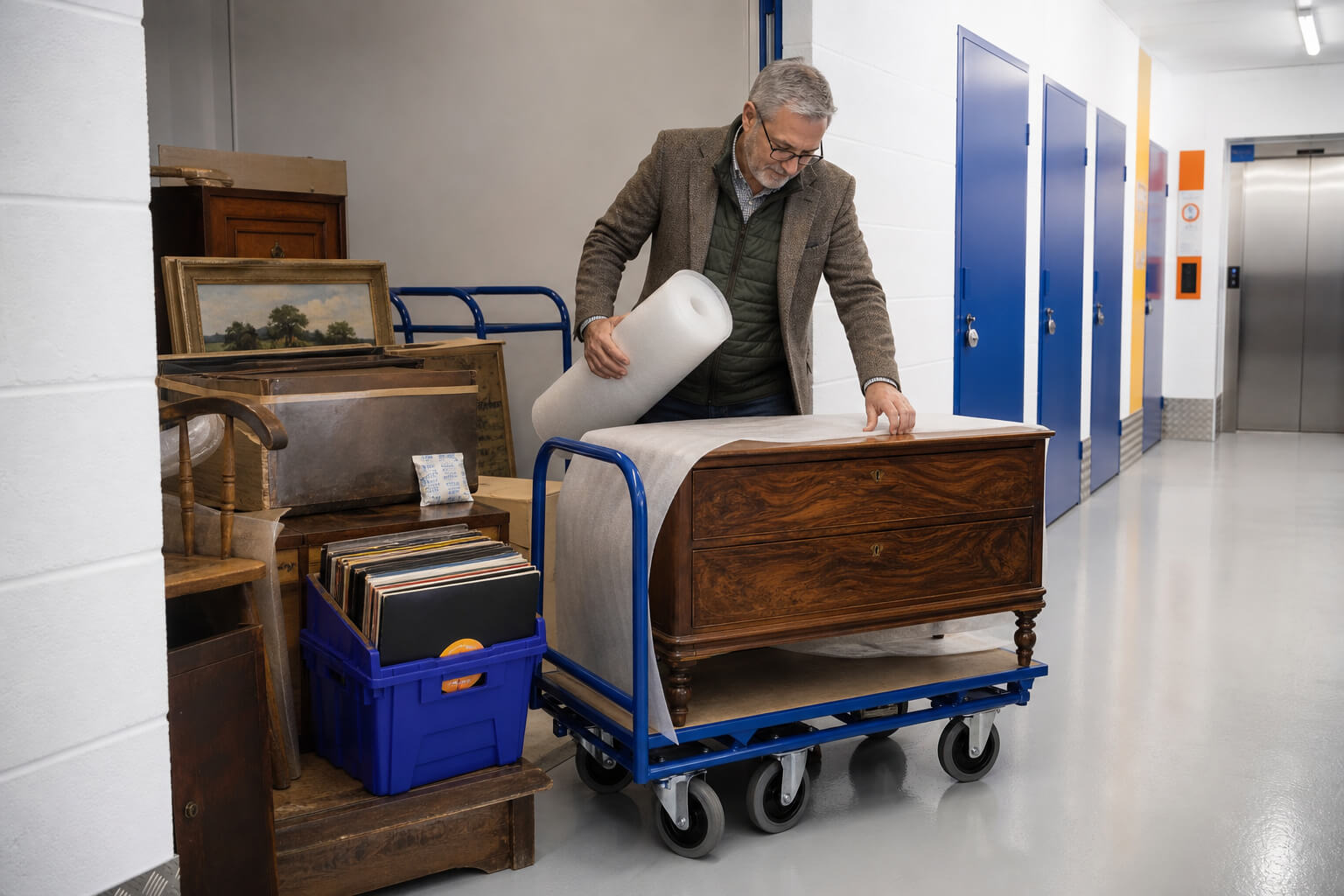
The single biggest misconception about storing antique furniture is that it needs controlled humidity. What it actually needs is stable humidity. That’s a different thing, and the distinction matters a great deal when you’re deciding where to store.
The humidity myth, and what really matters
Humidity fluctuation is the destroyer of period furniture, not humidity itself. Wood expands and contracts as moisture levels rise and fall. Over months, repeated cycles of that movement stress the joints, crack veneers, and lift marquetry. A stable environment at 40 to 60 percent relative humidity is adequate for the vast majority of period furniture without any active humidity control at all.
Most insulated UK self-storage buildings hit that band naturally year-round, because the building mass buffers the seasonal swings. The humidity doesn’t need to be low. It needs to be stable. The worry about self-storage being “too damp” is usually misplaced. What you should be asking is whether the building is properly insulated and whether there is any risk of actual damp ingress.
Active humidity control does matter in a small number of cases: marquetry with very fine veneers, certain keyboard instruments where the soundboard is under permanent tension, and extremely high-value pieces where any movement would be costly. For everything else, a well-built insulated building is sufficient.
Temperature, what is actually a problem
A stable 14 to 22 degrees Celsius is fine for period furniture. The risk is rapid temperature swings, which cause the same wood movement that humidity fluctuation causes. A warm afternoon followed by a cold night in a poorly insulated space is more damaging than a building that sits at a steady 10 degrees all winter.
Most converted-building self-storage maintains reasonable temperature stability without any active system, because the thermal mass of the structure does the work. You would want active climate control for genuinely extreme-value items, or for pieces stored in non-insulated buildings over a full winter. For a typical 4 to 9 month renovation stay in a solid insulated unit, temperature is rarely the thing that causes problems.
The actual destroyers: pests, damp ingress, and theft
Climate anxiety distracts people from the risks that actually damage furniture in storage. Mice and insects are the most common culprits. A gap under a door in an inadequate facility is all it takes, and the damage to upholstery or a wooden carcass can be considerable. Damp ingress from a poorly maintained building, a leaking roof, or ground water is another real hazard. Dust on upholstery becomes permanent if left undisturbed for months.
And then there is theft. This is where the unit-level security question matters most. At our UK market-town locations, every unit is individually alarmed. Nobody opens your walnut wardrobe’s door without the alarm triggering. That’s the security layer most people underestimate, and it matters more than a degree or two of temperature.
Most Wigwam locations are insulated converted buildings that sit comfortably within the 40 to 60 percent RH band without active humidity control. We’re honest about this because the honesty is the point. When we tell you that your furniture will be fine here, it’s because we’ve seen enough renovations to know what that looks like in practice. If your items genuinely warrant a specialist climate-controlled facility, we’ll say so.
Packing: The Difference Between Fine In Six Months And Damaged In Six Months
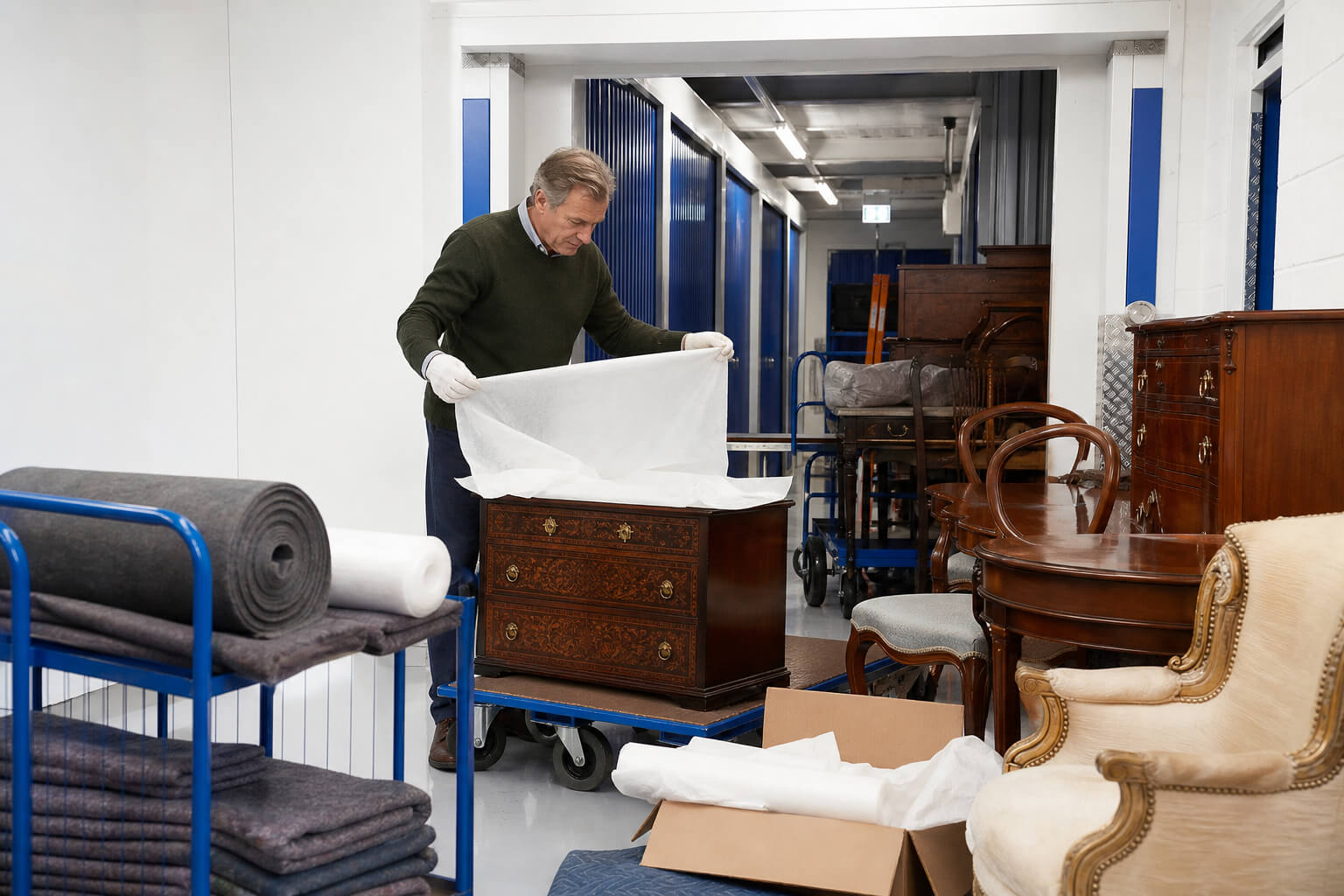
The removal van arrives with rolls of plastic sheeting and bubble wrap. For the journey itself, that’s fine. For six months in a storage unit, it’s the start of the problem.
What to wrap, and what not to
Upholstered furniture needs breathable furniture blankets. A velvet Victorian sofa wrapped in cling film for three months is going to trap whatever moisture is in the fabric, and that moisture has nowhere to go. Mould follows. Blankets allow air to move through the surface without letting dust in.
Polished wood is more forgiving than people think, but direct plastic contact on a lacquered or waxed finish can cause a reaction over time. The answer is a layer of acid-free tissue against the surface, then a furniture blanket over the top. The tissue creates a barrier between the finish and the textile fibres of the blanket, which can otherwise leave impressions.
Metal fittings and hardware should be dry before going in. Lightly oil iron or steel components if there’s any rust risk, then cover loosely. Don’t seal them in plastic.
Why bubble wrap is sometimes wrong
Bubble wrap earns its place in transit. It absorbs impact, protects glass and fragile surfaces for the hours they’re in a van. The problem is that it has no breathability at all. Sealed against a piece of furniture for months, it traps moisture between itself and the surface. On lacquered wood, the reaction can yellow or cloud the finish. On upholstery, it can deform the surface and create a humidity microclimate that encourages mould.
The transit-versus-storage distinction is the one removal companies don’t always explain. Their job is to get your furniture there without damage in transit. Yours is to protect it for the months it sits in the unit afterwards. Those two jobs need different materials.
The kit list: furniture blankets, acid-free tissue, what to buy
Furniture blankets are the workhorse. They’re cheap, reusable, breathable, and effective. You need more of them than you think. Most moves require two to three times the number of blankets people initially buy, because you’ll want to cover every surface and still have blankets left over to use as floor padding and stack-separators.
Acid-free tissue is for direct contact with finished wooden surfaces, silver, and gilded frames. It doesn’t react with finishes and doesn’t leave impressions.
Plastic sheeting has one legitimate job in storage: protecting the floor of the unit, under the furniture’s feet. Not over it. Under it.
Our team can advise on materials or point you towards a specialist supplier if your items are particularly valuable. Ask when you book.
The “no plastic on wood for months” rule
The specific damage mechanism is this: plastic film against a sealed wooden finish creates a small sealed environment. Any residual moisture in the finish, or any small fluctuation in the air around it, can’t escape. Over weeks, that moisture causes the finish to bloom or lift. Veneer edges can separate. On older polished surfaces where the finish is already fragile, the effect can be permanent.
Removal companies use plastic wrapping because it’s fast, it protects in transit, and their liability ends when the furniture reaches the door. Storage liability is yours. The fix is simple: blankets first, plastic only over the outside of the blanket where you genuinely need a dust or moisture shield.
The Five Mistakes We See Most Often
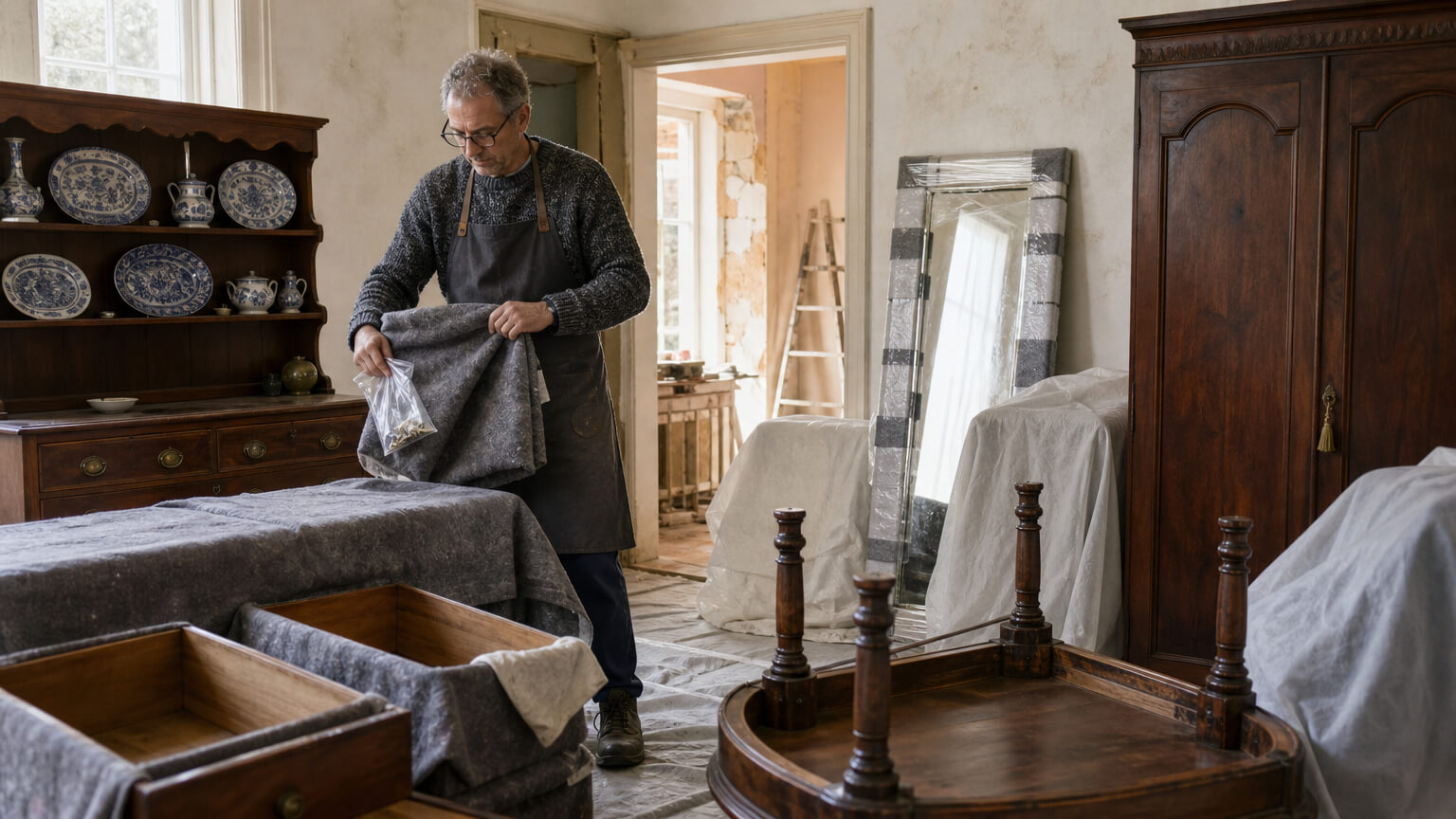
After supporting a good many period-property renovations at our UK market-town locations, the same five mistakes come up. They’re all avoidable once you know they exist.
Storing upholstery directly on concrete
Concrete breathes moisture. Not quickly, not dramatically, but over months it wicks dampness upward through anything resting on it. Upholstered furniture on a concrete floor for six months will absorb that moisture, particularly at the base and legs. The fix is straightforward: pallets, wooden boards, or four-inch plinths under anything upholstered or with wooden feet. This is one of the most common oversights we see, and one of the easiest to prevent.
Stacking too high, and what it does to drawers
Weight overhead puts pressure on the items below. For chests of drawers and cabinets, this pressure compresses the carcass and warps the drawer runners. The drawers then either jam or fall loose when you come to move back in. The rule of thumb is no more than three items stacked in a chest, and nothing heavy on top of anything with drawers. If you need height to use the unit efficiently, stack solid items, not drawer units.
Wrapping in plastic for months
Worth saying twice, because it’s common enough. People receive their furniture wrapped by the removal company and assume the wrapping stays on for storage. It shouldn’t, for the reasons above. When items arrive at the unit, the transit plastic comes off. Breathable materials go on instead. This is particularly important for upholstered items, where the plastic can trap humidity at the surface of the fabric.
Forgetting what is in the drawers
Furniture arrives with things still in it more often than you’d expect. Liquids left in a sideboard, documents filed in a bureau, small valuables left in a blanket chest. In transit, this is usually fine. In storage, a forgotten liquid bottle can leak over six months. Documents can yellow and stick. Jewellery or valuables shouldn’t be in a storage unit at all. Before the move, take five minutes to go through every drawer. Our team won’t open units to check, and we shouldn’t, so this one sits with you.
Under-sizing the unit and cramming
The instinct to save money on unit size is understandable. The result is furniture stacked tightly with no circulation, no access for mid-build retrieval, and compression across items that should have space between them. For period furniture, the right unit size includes room to walk along one side, and enough space that you’re not stacking items that shouldn’t be stacked. For valuable pieces, overestimate the size you need by one step. The extra cost is modest compared with the cost of compressed and cracked furniture.
We’ll gently mention any of these if we see them on arrival. Nobody takes it as criticism; it’s just what the job looks like in practice.
Insurance: What Is Actually Covered, And What Is Not

Most people assume their home contents insurance covers furniture while it’s in storage. Some policies do, but usually at a fraction of the replacement value, and with conditions worth understanding before anything moves.
Contents protection at Wigwam: how it works
Contents cover is mandatory at Wigwam. You can take our own contents-protection policy or prove your own cover at an equivalent level. Either way, cover is a condition of storage, not an optional extra.
The critical detail is declaring full replacement value. Under-insurance is settled proportionally. If you declare £10,000 for a collection worth £30,000 and suffer a loss, the settlement reflects that proportion. For period furniture, which can be expensive to replace, accurate declaration matters.
The unit-level security is the first line of protection: individually alarmed units, CCTV, secured perimeter. But insurance exists for the residual risk that security doesn’t eliminate.
A note on jurisdiction: contents insurance and liability are governed by the law of England and Wales. If you are based in Scotland or Northern Ireland, the legal framework differs in several respects. Please verify policy terms directly with your insurer, and consult a solicitor qualified in your jurisdiction for any specific legal questions. Nothing in this article constitutes insurance or legal advice.
Does your home contents insurance cover stored items?
Many home contents policies do include stored items, but at a capped amount. Commonly this is between £1,000 and £5,000, which is adequate for stored tools or a sofa from a budget furniture retailer. For a Georgian dining table, a Edwardian bureau bookcase, or a good Persian rug, it almost certainly isn’t.
Check your policy wording for the stored-items section specifically. The extension language typically refers to “temporarily removed” items, with a percentage of the total sum insured as the limit. The gap between that limit and the actual replacement value of your period furniture is where problems arise.
Scheduled cover for high-value antiques
When the replacement value of individual pieces exceeds the single-item limit of your existing policy, scheduled cover is the route. A scheduled item is listed individually in the policy at its appraised or agreed value, so the settlement is not subject to the standard cap.
The British Antique Furniture Restorers’ Association (BAFRA) can point you towards member firms with experience in conservation-grade valuation for insurance purposes. Specialist insurers offering stored-contents cover for antiques do exist, and a specialist policy alongside the Wigwam contents-protection cover is entirely possible. The two are not mutually exclusive. This is worth exploring if any single piece would be expensive and difficult to replace.
Special Cases: Pianos, Paintings, Mirrors, Clocks
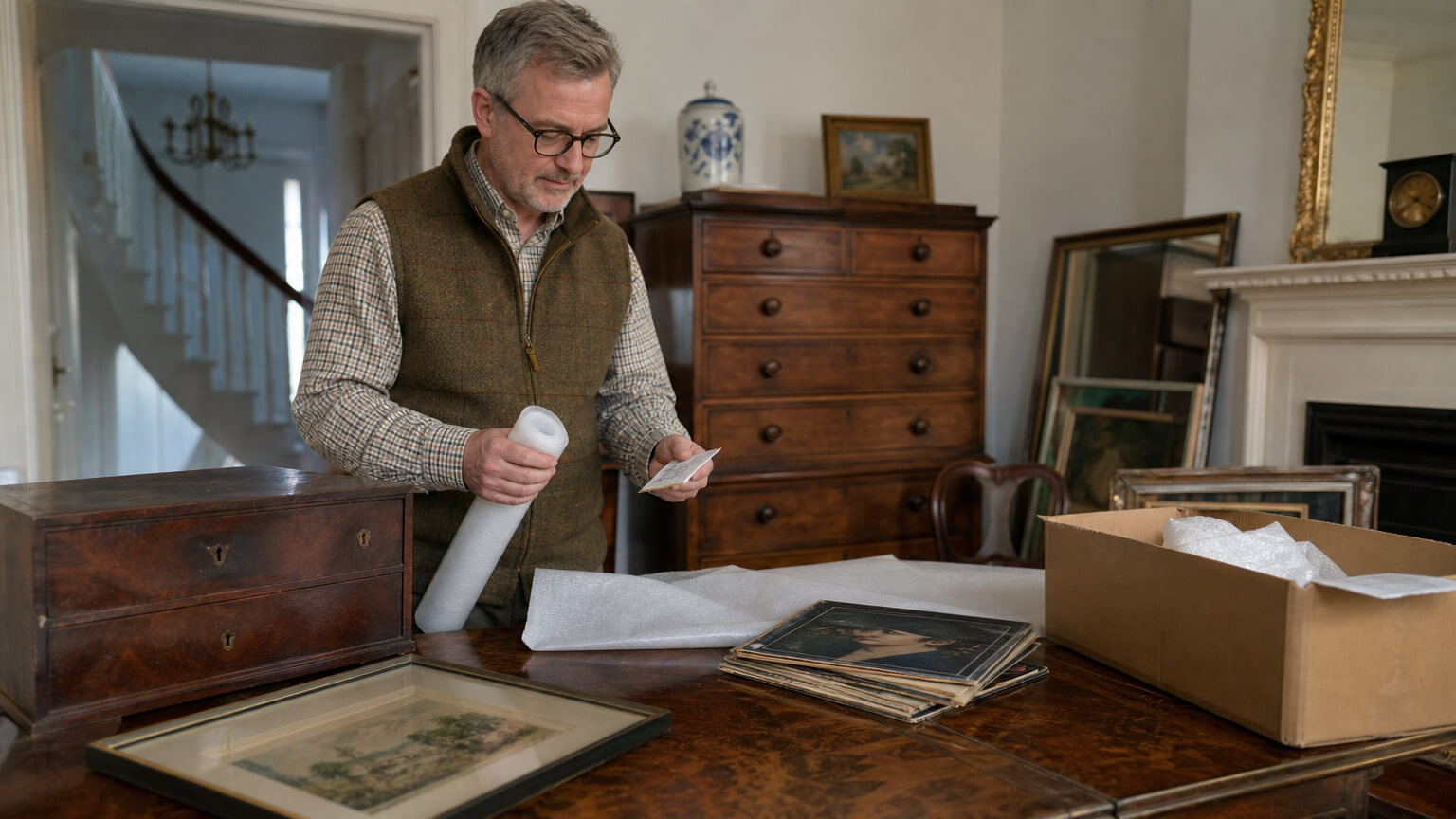
The piano question comes up more than any other. Here is the honest answer for that, and for the other items that come up regularly.
Pianos: floor loading, orientation, acclimatisation
Upright pianos are manageable in most standard self-storage units. The floor loading at our units is typically adequate for an upright, but if you have a baby grand or grand piano, confirm with the team before booking, particularly for upper-floor units. Ground-floor placement with drive-up access is usually the right answer.
Wrap in heavy furniture blankets, not plastic. Uprights must be stored upright, never on their side. The instrument’s structure is designed for the strings to run vertically under tension. Storing on its side puts that tension across the wrong axis.
When the piano comes back out, allow it a few weeks to acclimatise to its new environment before calling the tuner. The timber and soundboard will adjust to the change in humidity and temperature, and tuning before that adjustment settles is a short-term fix at best. One tuning appointment a month or so after reinstallation is the practical approach.
Call us before arriving with a piano. It helps us make sure the right space is ready.
Paintings: temperature, orientation, and keeping them upright
Stable temperature is adequate for most oil paintings. The risk, as with furniture, is rapid fluctuation rather than any particular level. Store paintings away from external walls where possible, as these see the greatest temperature variation across seasons.
Light is not a significant factor in storage, which is positive. The painting will be in the dark. What matters is orientation: always vertical, never flat. Lying flat puts uneven pressure on the canvas from the frame, and over time this can cause distortion. If you have multiple paintings, store them vertically with a blanket or foam sheet between frames to prevent contact damage.
For very high-value or fragile works, specialist art storage with climate control may be warranted. The British Antique Furniture Restorers’ Association or a specialist art conservator can advise on where the threshold lies for your pieces.
Mirrors and glass: always vertical, always labelled
The rule is vertical. Lying flat, a mirror or framed glass panel is vulnerable to impact from items placed on top, and to thermal stress if the backing and glass expand at different rates. Vertical storage eliminates most of that risk.
Cardboard corner protectors on all four corners, then a furniture blanket secured around the whole piece. Write “GLASS” clearly on the outer surface of the blanket before it goes in. The team won’t be moving items inside your unit, but if you or a contractor are retrieving things mid-renovation, a visible label avoids the wrong piece being shifted without care.
Long-case clocks: disassembly is not optional
A long-case clock that goes into storage intact, with the weights and pendulum in place, may arrive with a damaged movement. The pendulum swings during transport, and without the clock running in its normal regulated state, the swing is uncontrolled. One sustained period of free pendulum movement in the back of a van can bend a suspension spring or damage the escapement.
Disassemble properly before any move. Remove the pendulum and wrap it separately. Remove the weights and pack them individually, labelled. Wrap the movement in acid-free tissue, then a blanket, separate from the case. The case itself can travel and store upright. When everything comes back together, a specialist clockmaker should regulate and restart the movement rather than attempting to do it from memory. This is not a difficult job for the right person, but it is an easy way to create an expensive problem if it’s skipped.
Ready to get a storage plan in place for your renovation? Get a quote at quote.wigwamstorage.co.uk or find your nearest team at our UK market-town locations. If you have anything specialist, call us before you arrive.
Accessing Your Storage During The Renovation
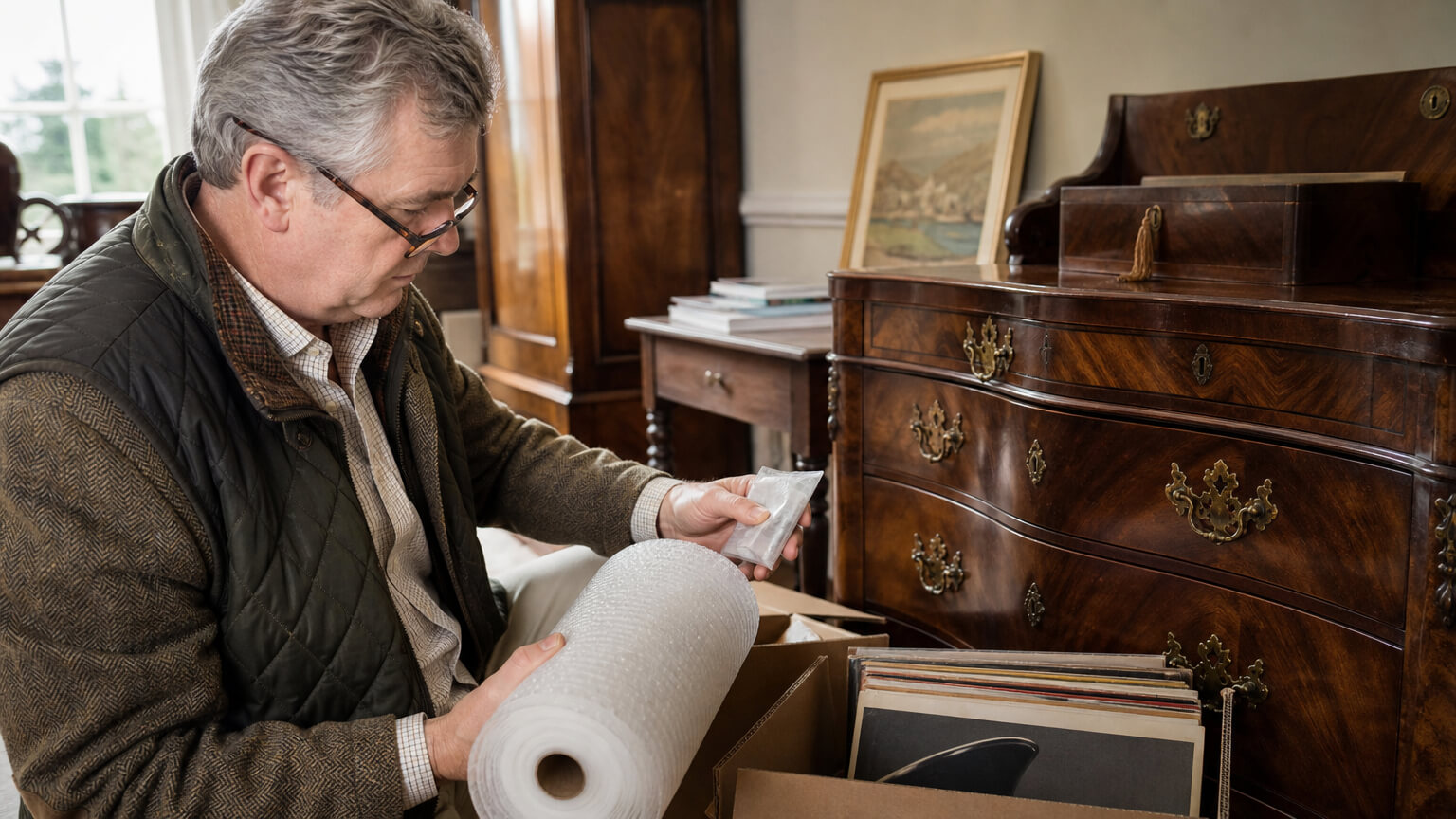
At some point in the renovation, someone will need a specific item from storage and they will need it on a Tuesday morning before the plasterer arrives. This is not an exception. It happens in almost every renovation we support.
When contractors need access mid-build
The scenario is familiar. The bathroom tiler needs the mirror that’s been in storage since week one. The decorator wants to check the colour of the cornice against the sample. The joiner arrives to fit the kitchen and needs the handles that were wrapped and stored in week two.
Plan retrieval points into your build schedule when you can. Not with the precision of a project plan, but with awareness. Keep a simple inventory of what’s in the unit, even if it’s just a phone-photo record taken as you packed. Know roughly where things are positioned, which is another reason not to cram.
You can authorise other people to access your unit. Your project manager or a trusted contractor can fetch items without you needing to be there. Our sites are unmanned, which means access is fast and straightforward for anyone with authorisation, but it also means we cannot coordinate contractor access on your behalf or receive deliveries for you. If anything is being delivered to the unit, someone from your team must be present. We don’t sign for anything.
Smart entry: practical implications for renovations
Smart entry allows access between 6am and 10pm, seven days a week. There’s no office to call, no one to coordinate with, no dependency on opening hours. An early start on a Tuesday works as well as a Saturday afternoon.
For a project manager running a build schedule, this flexibility is genuinely useful. The access can be granted to multiple people, so your project manager can collect the right piece without waiting on you. The only firm rule is that access is for the account holder’s authorised contacts, not for couriers or unaccompanied deliveries.
What to store near the door, and what can go deep
Phase your packing to reflect when you’ll need things back. Items you’ll want in the first three months of the renovation should be accessible near the front of the unit. Items you won’t need until the finishing stage can go further in, stacked more securely. This sounds obvious, but under the pressure of a move it’s easy to load the van without thinking about retrieval order.
There’s a practical truth about renovation storage: you will always need something you thought you’d stored safely at the back. Building a small cache at home of genuine daily essentials avoids the retrieval trip for the thing you need at 8pm when the unit access window is still open but you’ve already changed out of your work clothes. Think in phases when you pack. It reduces retrieval trips and makes the mid-build reality much calmer.
The team can advise on unit layout for phased retrieval when you arrive. It’s a straightforward conversation that saves a lot of disruption later.
How Long Renovations Actually Take, And What That Means For Storage

UK architects and project managers estimate accurately. The renovation itself almost always runs longer than the estimate, typically by 30 to 50 percent, for reasons that have nothing to do with the quality of the professional involved.
Why timelines slip, and why it’s predictable
Planning permission delays and listed-building consent processes run to their own schedule. Contractor availability gaps open up between phases. Surprise finds in older buildings are not rare: damp behind a wall, wiring that pre-dates current standards, structural adjustments that weren’t visible until the builders opened things up. Material lead times for period-appropriate joinery or specialist glass can extend unexpectedly.
These are predictable as a category, even when the specifics are not. The value of building slack into your storage estimate is not that it costs more upfront. It’s that it removes the anxiety of watching an overrun build collide with a storage end date you’ve already committed to.
The case for monthly billing, not an annual commitment
Monthly billing means you are never paying for time after you have finished. If the renovation takes eight months instead of six, you extend by two months. If it takes five months instead of six, you leave a month early and get those unused days back.
The two-week minimum stay is the floor. Above that, you’re billed monthly, with no long-term commitment. Some customers find a mild usefulness in the monthly billing as a project discipline: the unit cost appearing on the statement each month is a quiet reminder that the build clock is running. For most people it’s simply the fairest structure for a timeline that nobody can fully predict. See our current pricing for current rates.
When you’re ready to leave, give us 14 days’ notice. Once you have vacated and the account is settled, that’s the end of it, with any unused days refunded less anything owed. Two events: notice given, then unit vacated and account settled.
Unused days refunded when projects finish early
If the plasterer finishes three weeks ahead of schedule and you want to return the furniture early, the unused days are refunded. You booked for the time you needed, and you pay for the time you used. There is no deposit sitting alongside the day-rate either, so nothing has to be reclaimed.
This is set up the way it is because it’s what we would want as customers. Renovation timelines are genuinely unpredictable. The billing structure should reflect that, not punish it. Read the full terms at our terms and conditions.
Renovations slip. The billing structure means that slippage does not cost you more than it already costs you in time and disruption.
Talk To Us About Your Renovation
Every period-property renovation is different. The listed-building constraints, the Conservation Officer requirements, the contractor schedule that nobody controls entirely, the inherited furniture that carries more than monetary value. A conversation with the nearest Wigwam team gives you a practical plan for sizing, item-specific preparation, access logistics, and a realistic cost across the whole project timeline.
Here is what that plan is built around:
- Insulated converted buildings, naturally climate-stable for the majority of period furniture without active control
- Individually alarmed units, one alarm per unit, not one for the building
- Smart entry 6am to 10pm, seven days
- Monthly billing from a two-week minimum stay
- No deposit, and 14 days’ notice to leave
- Unused days refunded if you finish early
- Multi-unit option for phased renovations or very large furniture inventories
- A local team who knows the area, the building types, and the kind of items that come out of period properties
For customers in high-renovation-density locations, Wigwam Self Storage Bath is well placed for Georgian and Regency period properties throughout the city and the surrounding villages. Our other UK market-town locations cover a range of similar conservation areas and period-property concentrations.
If you’d like to understand costs, our pricing page sets out current rates. For contents cover, our contents-protection page explains the options. And if you have a piano, a long-case clock, or anything else that warrants a conversation before it arrives, the team will tell you exactly what preparation helps.
Get a renovation storage quote at quote.wigwamstorage.co.uk or find your nearest location to speak to the local team.
Whatever the project, we’ve probably seen something like it. Good luck with it.
Frequently Asked Questions
Document everything before it leaves the house, because a claim is far easier to settle when you can show what was stored and what it was worth. The single most useful thing you can do is photograph each significant piece from several angles in good light, including any maker’s marks, labels or signs of provenance, and note the dimensions. Keep those photographs with any receipts, auction records, or restoration invoices you already hold. For genuinely valuable pieces, a written valuation from a qualified appraiser, dated close to the storage period, is the strongest evidence there is.
This matters because of how cover works. The RSA Self Storage Customers’ Goods policy is settled against the value you declare, and under-insurance is settled in proportion, so an accurate, evidenced figure protects you twice: it sets the right premium and it removes the argument later. For the high-value end, the British Antique Furniture Restorers’ Association can point you to firms that do conservation-grade valuation for insurance purposes. We signpost the policy and the documentation discipline, but we do not give insurance or valuation advice, and we cannot tell you what your pieces are worth. That part sits with a qualified appraiser and your insurer. What we can tell you is that the inventory you build for insurance is the same one that makes mid-build retrieval easier, so it earns its keep twice over. Read the policy specifics on the contents-protection page before you settle on a declared figure.
It simply stays in the unit, and the billing follows the pause rather than fighting it. Period renovations stall for all sorts of reasons outside your control: a listed-building consent that takes longer than anyone forecast, a structural surprise that needs a new engineer’s drawing, a specialist joiner with a three-month waiting list, or a funding gap that means the work waits until spring. None of that should cost you more in storage than the time itself already costs you.
Above the two-week minimum the unit rolls on month to month with no fixed end date, so a pause just means the unit continues until you are ready to bring everything back. When the project restarts and finishes, you give 14 days notice, vacate, and once the account is settled any unused days are refunded. There is no penalty for a long stay and no surprise block billing. The one thing worth doing during a long pause is a periodic check of the unit, not because anything is likely to go wrong in a clean, dry, secure unit, but because it lets you confirm the furniture is sitting as you left it and gives you a chance to air anything you are slightly unsure about. Access is by smart entry from 6am to 10pm, seven days a week, so dropping in to check costs you nothing but the trip. The furniture waits as long as the building works do.
It depends on the piece and the specific site, which is exactly why this is a conversation to have before you arrive rather than a question to answer in a vague guide. A long-case clock case, a chest of drawers, most chairs and tables and wardrobes are manageable at any level. The pieces that need a conversation are the genuinely heavy ones: a cast-iron range, a large safe, a marble-topped washstand, a stone garden ornament, or a piano. As the body of this article notes, an upright piano is usually fine but a baby grand or grand needs confirming, and ground-floor placement with drive-up access is generally the right answer for serious weight.
Floor loading and the access route both matter. A piece that is heavy and also tall or awkward to turn can be harder to get into an upper-floor unit than its weight alone suggests, because of corridors, doorways and any lift. The honest approach is to call the local team before the removal day with a list of your heaviest and most awkward items and their rough weights and dimensions. They can tell you which units suit and reserve the right space, so the removal crew is not improvising on the day. Sites are unmanned for day-to-day access, but sizing and placement is exactly the kind of practical question the team handles before you book. Getting it right beforehand avoids the worst outcome, which is a heavy antique stuck halfway down a corridor with a crew on the clock.
A clean, dry, secure unit is a low-risk environment for furniture, and the simplest way to keep it that way is to be careful about what you put in. The things that do not belong in any storage unit are the obvious hazards: petrol, paraffin, gas canisters, paint thinners, fireworks, and anything flammable, corrosive or under pressure. During a renovation these are easy to mix up with the furniture, because the garage and the workshop are being cleared at the same time. Keep the decorating and building materials separate from the stored contents and do not let solvent tins travel in with the dining chairs.
Beyond that, go through every drawer and cupboard before the move, which the body of this article flags as one of the five common mistakes for a different reason. A forgotten bottle of spirits in a sideboard or an old tin of polish in a cabinet is both a leak risk and a fire-safety one. Documents, candles, and any battery-powered items are also better kept out. For the furniture itself, the breathable-blanket approach recommended above is the right one: no sealed plastic creating little trapped microclimates. If you are storing genuinely valuable or irreplaceable pieces, contents cover is mandatory in any case, so the residual risk that good housekeeping does not eliminate is the thing the insurance is there for. We do not give fire-safety or insurance advice beyond this, but the rule of thumb is straightforward: furniture and household goods in, hazardous and flammable materials out.
For most period renovations, storing the good furniture off-site is the safer choice, but a sealed-room approach can work for items you genuinely cannot move or do not want to. The case for off-site storage is simple: a renovation is a building site, with dust, footfall, trades coming and going, and a real risk of accidental damage to anything left in the way. A clean, dry, secure unit removes the furniture from all of that, and individually alarmed units mean it is secure while the house is open to contractors. The body of this article covers why packing technique protects the pieces while they wait.
A sealed room at home can be reasonable for very large or built-in pieces, or where the work is confined to one part of the house and you can genuinely close off the rest. The risks to weigh are dust ingress, the temptation for the room to become a dumping ground for tools, and the fact that a “finished” room often gets opened up again when the project changes scope. If you do keep pieces at home, treat them as you would in storage: breathable covers not sealed plastic, off the floor, away from external walls. Many people end up doing both, the irreplaceable and the in-the-way pieces go to the unit, and the largest fixed items stay home under cover. The local team can help you size a unit for whatever you decide to move out, and the quote tool will give you a figure. Whichever you choose, decide it before the trades arrive, not once the dust is already settling on the walnut.