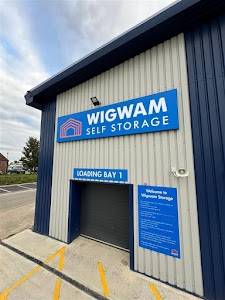
Paying prime rent for a back room full of archive boxes?
There is a cost hiding in almost every small business: the space you pay rent on that nobody sells from, nobody meets clients in, and nobody particularly enjoys. The back room stacked with last season’s stock. The corner of the studio piled with archive boxes. The desk nobody sits at because the surface is covered in kit waiting to go out on the next job. It does not feel like a crisis. But it is still costing money, every month, at whatever rate your commercial landlord charges per square foot.
Most business owners I speak to have done the arithmetic in their heads at least once. They just have not done it all the way through. This article tries to do it properly: what moving that dead weight off the premises actually costs, what a storage unit can and cannot be for your business, and where a market-town location might make the numbers work.
Why businesses move their storage off the high street

The pattern is almost always the same. A business grows into its space, and then a little bit beyond it. The surplus ends up in the office, the studio, the back of the van, the spare desk. Before long, the floor plan that made sense three years ago is carrying weight that the business is paying full rent on and getting nothing back from.
The space your business is really paying for
Take an honest look at your floor plan and separate the space that generates turnover from the space that just holds things. For most small firms in market towns, the holding space is significant. Boxes of archived client files from three tax years ago. A pallet of product you ordered at the bulk price and will not shift until Christmas. A set of tools that only go out on one type of job and spend most of the year on a shelf. None of it is junk. All of it is taking up room at office rates.
The stockroom behind the counter is the oldest version of this problem. The business needs it. Nobody would say otherwise. But it costs the same per square foot as the space where the real work happens, and it earns nothing.
What that floor space actually costs when you add it all up
Rent is only the start. Add business rates, which in England and Wales are calculated separately from your rent and can add a meaningful percentage to your total occupancy cost. Add utilities. Add the service charge if your lease includes one. And then add something that rarely appears on a spreadsheet but is real: the tie-in premium. A commercial lease commits the business to paying all of the above for the full term, whether the space is earning or not. If trade slows, if the team shrinks, if the project that drove the need for extra room turns out to be shorter than expected, the lease does not flex with you.
These are England-and-Wales observations on commercial property costs, leases and business rates. Scotland and Northern Ireland have separate rating systems and distinct tenancy law. If you are reviewing a lease or calculating your rates liability, your solicitor is the right person to talk to, not this article.
The point is not to frighten anyone. It is just that the cost of holding space inside a commercial property is rarely just the rent figure. The total occupancy cost is the number worth comparing against a storage unit.
What a business storage unit actually costs

A storage unit carries none of the costs that accumulate around commercial floor space. That is the core of the rent-arbitrage argument, and it is worth saying plainly before getting to the specifics.
The unit versus commercial floor space
There are no business rates on a storage unit. No utilities bill. No legal fees for taking a unit or leaving one. No long lease tying the business in for three years or five. The costs are simpler: a monthly amount for the unit, and no deposit at the start.
When you leave, you give two weeks’ notice. Any unused days are refunded once you have vacated and the account is settled, less anything owed. If you leave before the period you have paid for ends, unused days are refunded. That is the structure. It is designed to be easy to exit because a short-term overflow commitment should not feel like a property decision.
For the specific figures, see how much is self storage in the UK. Unit costs vary by town and size, and we do not publish a headline rate because the honest answer depends on where you are and how much space you need. What I can tell you is that many of the businesses we work with find the comparison between their old dead-weight space and a unit cost considerably more comfortable than they expected.
Ready to see what a unit costs in your town?
Get a quote at quote.wigwamstorage.co.uk
How unit size maps to what you store
The other half of the calculation is the physical fit. Not every business storage question needs a large unit, and it is worth thinking about this before you get a quote.
A small archive run, the kind that most professional services firms generate across a few years of client files and levy arch folders, often fits in a unit that would surprise people by how compact it is. If it is just paperwork, boxed and labelled, you may need less space than you think.
Mid-size stock holding, the kind that suits an e-commerce business with a seasonal peak or a retailer who buys ahead at the bulk price, typically needs something larger. Flat-pack product, seasonal inventory, packaging materials: these stack well if they are boxed and organised, but they do take floor space.
Larger kit, the tools, trade equipment or surplus office furniture that tends to fill corners in a workshop or office, often benefits from a unit with a bit of room to manoeuvre. You want to be able to get to the thing you came for without unpacking everything else first.
See the pricing page for size options and current unit availability in your area.
What you can store in a business unit, and what a unit cannot be

This is the section I want to get right, because the answer to one version of this question is cheerful and the answer to another version is a firm no.
Good fits: stock, seasonal overflow, tools between jobs, paper archives
A self storage unit works well as an extension of the business that holds things rather than operates them. Boxed archived documents. Business stock awaiting dispatch or the next trade fair. Trade tools and equipment between jobs. Seasonal retail overflow that the shop floor cannot carry during quiet months. Surplus office furniture from a recent move. Flat-pack and branded materials. All of this is the normal, practical business of a storage unit.
Each unit is individually alarmed. The space is clean, dry and secure. The customer holds the only access. That is what the unit is: a room your business controls, close to where your business trades.
The honest boundary: not a registered address, not a staffed shop, not a workshop
The question “can you run a business from a storage unit?” comes up regularly, and the honest answer is that it depends what you mean.
Storing the goods and equipment your business uses: yes. Operating your business from the unit, meeting clients there, using it as a staffed workshop or trade floor: no. And using a storage unit as your company’s registered address is not something the unit can provide or support. A storage address is not a legal registered business address in England and Wales. If you need a business address, that is a question for a serviced office, a registered office service, or your solicitor, depending on what your companies house filing requires.
Business address registration, what constitutes a “place of business,” and the planning law around trading from premises are matters of company and planning law in England and Wales. Scotland and Northern Ireland operate under parallel but distinct rules. Please speak with your solicitor on anything touching on this.
Archiving off the high street

This is one of the more satisfying shifts a professional services business can make. The archive boxes leave the office. The filing corner becomes a desk, or a small meeting space, or just breathing room. And the records are safer and tidier than they were wedged between the printer and the window.
A secure unit you control, not a managed records service
The unit is yours. Wigwam does not manage, index, retrieve or handle documents. We do not offer a document-management service. What we offer is a clean, individually alarmed, secure room that your business controls and accesses on its own terms.
Smart entry is available from 6am to 10pm, seven days a week. You access your unit directly. There is no check-in process, no staff member to route you through. You come when you need to, take what you need, and leave. The unit is secure when you are not there.
If you want to be able to get to a particular file at short notice, that is achievable. If you are archiving material you are unlikely to need again but need to keep, the unit works for that too. The access window is genuinely practical for most business hours and the hour on either side of them.
Keeping records dry and secure
The honest claim is what is on the tin: clean, dry and secure. The units are maintained to a standard that keeps stored goods in good condition. They are not climate controlled. There is no temperature or humidity management beyond what a well-maintained, enclosed storage unit provides. If you are storing materials that require precise environmental conditions, a self storage unit may not be the right answer and you should take advice on that specific question.
For most business archive storage, clean and dry is exactly what is required. Archived client files, lever arch folders, boxed financial records: these do well in a standard self storage environment if they are packed sensibly. Box them properly, keep them off the floor, seal the boxes against dust. That is the practical standard for archive storage, and it is within what these units reliably provide.
One important note: atmospheric and climatic damage is excluded from the contents-protection policy. See the contents protection page for the full terms.
On document retention: how long your business is legally required to keep different categories of records is a question of company law, HMRC requirements, employment law and in some cases GDPR. These obligations vary by business type and are not something Wigwam can advise on. Please speak with your accountant or solicitor about what your retention schedule requires.
Stock and seasonal overflow for growing firms

An e-commerce business is a slightly different shape of problem from a professional services archive, but the underlying logic is the same: the physical footprint of the business is outrunning the space it started in.
Short-term overflow without a long-term commitment
A storage unit can grow and shrink with the business cycle. In October, you fill it with Christmas stock. In February, it is half-empty again. In September, the school-term inventory arrives. The unit absorbs what the business needs to hold at any given point, and when the need drops off, you give two weeks’ notice and you are out. Any unused days in the final period are refunded once the account is settled and the unit is vacated.
That kind of reversibility is rare in commercial property. A lease commits you whether trade supports the space or not. A unit does not.
There is a two-week minimum stay, so this is not same-day storage, but for project-length or seasonal overflow it is well-suited. The minimum term is low enough that it does not feel like a commitment.
What stays in, what stays out
The practical list of what works: boxed business stock, flat-pack product, trade tools, seasonal retail inventory, archived files, branded materials, surplus office furniture and equipment. These are all straightforward uses of a business storage unit.
What does not work: the units are for goods storage, not vehicle storage. No cars, vans, motorbikes, caravans, motorhomes or boats. No hazardous goods. If you are in any doubt about whether your goods are suitable, the right thing to do is ask before you book rather than after.
Deliveries and access, the practical bit

This is important to understand before you plan your logistics around a unit, because the answer is different from what national operators sometimes advertise.
Sites are unmanned: what that means for your business
Wigwam sites are unmanned. There is no staff member on-site to receive deliveries, sign for parcels or hold goods on your behalf. If a courier is delivering to your unit, someone from your own business needs to be present at the site to accept the delivery. Wigwam cannot sign for parcels, cannot take goods in, and cannot hold deliveries.
This is not a complaint or an apology; it is just how the sites work, and it matters for planning. If you run an e-commerce business where courier deliveries are regular and you cannot be on-site for every one, you will need to arrange your dispatch and logistics around the access hours and your own availability. Some customers manage this easily. Others find it a constraint worth thinking through before committing.
The access system is smart entry, 6am to 10pm, seven days a week. Within that window, the sites are accessible and the process is straightforward. Outside that window, they are not.
Smart entry and your own schedule
Six in the morning to ten at night covers most of what a business working day demands. It covers early starts before the office opens. It covers late closes after the shop shuts. It does not cover genuine out-of-hours emergencies, and it is not intended to. If your business requires access outside those hours, this is worth factoring into the decision.
Within the window, the access is flexible and personal. You are not waiting for a member of staff to let you in or log you out. Smart entry means you go when you need to go.
Business storage in your market town

Why market-town storage beats the ring-road warehouse
The units closest to a business reduce the daily time cost of access. If the archive is fifteen minutes away on an industrial estate, getting a single file costs you thirty minutes of travel and the parking at the other end. If the unit is in the same town where the business trades, getting what you need and getting back takes a fraction of that.
This is the practical advantage of the market-town model. We are not on a ring road. We are in the towns where these businesses actually operate, which means the unit is useful for daily or weekly runs, not just occasional visits.
Our UK market-town locations
We have units across our UK market-town locations. Two worth naming for search purposes: Wigwam Self Storage Bath serving businesses in and around Bath, and Wigwam Self Storage Lincoln for businesses across Lincolnshire. We are also in Reading, Cheltenham, Burton upon Trent, Dorking, Marlow and several other towns, and the list is growing.
To see all current locations and find the one nearest to your business, visit the self-storage locations hub. If your town is not there yet, it is worth checking back or getting in touch directly.
If you do get in touch with a question about your unit or your account, the support team are genuinely helpful on the practical questions. They will not discuss your business plans, which is not their role, but on anything to do with access, the unit, or the booking, they are the right people.
Contents protection for business goods
The contents-protection policy
Contents protection is mandatory for all units: either take Wigwam’s policy or demonstrate that you already have your own cover in place. This is not optional, and it is worth understanding what the policy covers before you store.
The RSA Self Storage Customers’ Goods policy is offered on a New-for-Old basis. There is a GBP 50 excess. Theft claims require evidence of forced entry; opportunistic or undiscovered removal does not qualify under this requirement. Atmospheric and climatic damage is excluded from the policy, which is relevant for anyone storing paper records or goods sensitive to temperature and humidity changes.
Full details are on the contents protection page. For questions about your own business insurance position and whether your existing policy covers goods stored off-site, your insurance broker is the right person to ask. Wigwam can tell you what the policy covers. It cannot advise on your broader business insurance needs.
Insurance policy terms are governed by the policy contract and relevant FCA rules, which apply UK-wide. Your broker is your best starting point for any policy questions.
What to declare and why it matters
Declare the full replacement value of everything you are putting in the unit. This is not an occasion for conservatism. If the goods in the unit are worth GBP 20,000 to replace, declare GBP 20,000.
Under-insurance is settled proportionally. If you declare half the true value and suffer a total loss, the settlement will reflect the declared proportion, not the actual loss. For business stock or archived records, this can be a significant difference. It is worth taking five minutes to estimate the full replacement cost accurately before you set your declared value.
See the contents protection page for the full terms and how to register your cover.
Ready to move the overflow off the high street?
If the arithmetic looks right, the next step is a quote for a unit in your town. Costs vary by location and unit size, so the quote tool is the fastest way to see what is available and what it costs.
Get a quote for a unit in your market town at quote.wigwamstorage.co.uk
See current pricing | Find your nearest location | Terms and conditions
Frequently Asked Questions
In most cases the rental cost of a unit used wholly for the business is an allowable expense, but this is a question for your accountant, not for us. Wigwam cannot give tax advice, and the treatment depends on how your business is structured, what you store, and the rest of your accounts. What we can do is make the paperwork easy for whoever does your books.
You will get a clear monthly invoice for the rental. Keep those alongside your other overhead records and your accountant can treat them like any other business cost. Two points worth flagging to them. First, there is no deposit to account for, unlike a rental deposit on premises, so everything you pay us is an ordinary cost rather than part cost and part asset. Second, contents cover is a separate, mandatory line, so factor that in too. If you are weighing the unit against your existing commercial floor space, the comparison your accountant will want is total occupancy cost against the unit plus cover. The unit carries no business rates, no service charge and no utilities, which is most of where the saving comes from. Get the figures from your invoices, hand them over, and let the person who knows your full position decide how they are treated. That division keeps it clean: we supply the space and the paperwork, your accountant handles the tax.
The honest answer is that you should never let it get there, and the simplest protection is a Direct Debit set up at the start so a payment is never something you have to remember in a busy month. If a payment is missed, the account falls into arrears and there is a process that follows, set out in full in the terms and conditions. It is not instant and it is not arbitrary, but goods held against an unpaid account are not a position any business wants to be in, because access can ultimately be affected.
For a business storing live stock or records it needs, the practical steps are straightforward. Put the rental on Direct Debit. Keep the contact details on the account current, so any reminder actually reaches you rather than an old inbox. If cash flow is genuinely tight for a stretch, talk to the support team early, before a payment is missed rather than after. They handle the practical side of accounts, access and invoicing and will tell you plainly where you stand. What they will not do is restructure your business finances or advise on cash flow, because that is not their role and not their expertise. The terms that govern arrears, notice and the steps that follow are at wigwamstorage.co.uk/terms-conditions/. Read that section before you book if you want to know exactly how it works. The whole arrangement is designed to be easy to keep on top of, and a standing payment plus current contact details is almost always enough to keep it that way.
They can, but only when someone from your business is there to let them in, because the site is unmanned. There is no member of staff to receive a visitor, sign anything, or supervise a collection on your behalf. So a supplier or customer arriving at the site alone will not be able to get in, and Wigwam cannot hand goods over for you.
This shapes how you can realistically use a unit. It works well as a stock or archive store that your own people draw from. It does not work as a collection point you can leave running while you are elsewhere. If a courier or a customer needs to pick something up, you or a colleague meets them at the unit during access hours, which are 6am to 10pm, seven days a week, opens up, hands the goods over, and locks up again. For an occasional collection that is easy to arrange. For a business built on frequent third-party pickups it is a real constraint, and worth thinking through before you commit. It is also worth being clear that a storage unit is not a staffed trade counter or shop. You can store the goods your business sells and collect them yourself to dispatch or hand over, but operating a customer-facing collection service from the site, with people coming and going to a space you are not present at, is not what the unit is for. Plan your logistics around your own presence and the access window, and it works smoothly.
No. Within the access window there is no cap on how often you come and go, and no booking system to work around. Smart entry runs from 6am to 10pm, seven days a week, and you can use it as many times in a day or a week as the business needs. For a firm running regular stock pulls or dipping into the archive often, that matters, because the unit only earns its place if you can actually get to your goods on your own schedule.
There is no check-in process and no staff member routing you through, which is the practical advantage over a managed facility. You arrive, you let yourself in with your own access, you take what you came for, and you leave. A retailer topping up the shop floor twice a day, a tradesperson grabbing kit before each job, an office manager pulling a file at short notice: all of that is normal use. The one boundary is the window itself. Access is 6am to 10pm, not round the clock, and outside those hours the site is closed. If your business genuinely needs goods in the small hours, that is worth factoring in before you book. But for almost every business working pattern, including early starts before the shop opens and late finishes after it shuts, the window covers the working day and the hour either side of it comfortably. Within it, come as often as you like.
It can work well, and the question is really about where your access pattern centres rather than how wide your trading area spreads. If most of your runs to the store start and end near one town, a unit in that town keeps the daily time cost of access low, which is the main practical advantage of the market-town model over a unit on a distant ring road. Fifteen minutes each way to fetch a single file or a box of stock adds up fast when you do it weekly.
For a business spread across a region, there are a couple of sensible approaches. Pick the town closest to wherever the goods are most often needed or dispatched from, so the unit sits on a route you already travel rather than adding a special trip. Wigwam operates across a network of UK market towns, including Bath, Lincoln, Reading, Cheltenham, Burton upon Trent, Dorking and Marlow, with more being added, so there is a reasonable chance one sits conveniently for your operation. The full list is at the self-storage locations hub. If you genuinely need storage in two separate areas, there is nothing stopping you taking a unit in each, on the same flexible terms, though most businesses find a single well-placed unit does the job. The thing to avoid is choosing a location for the headline rate alone and then losing the saving in travel time and fuel every week. Put the unit where your people already go, and a multi-town operation gets the convenience the model is built for.