Moving abroad but not ready to sell everything you own?
There is a particular kind of move abroad where you do not burn the boats. The contract is for two years, or the adventure has no fixed end date, and the last thing you want is to sell the sofa, the books and the things that took a decade to collect, only to start from scratch if you come back. That is a different kind of move from emigrating for good, and it deserves a different kind of answer.
Storing rather than selling is how you keep the door open. It is how you stay the sort of person who could come home. This page is for you: someone going abroad with a UK base they want to mothball, not dismantle.
What follows is a plain account of how long-term self storage works for that situation, what it costs, how your things stay safe while you are thousands of miles away, and how you close the account cleanly when you are ready to come back, whether that is sooner than you planned or later.
Why store instead of sell or ship

Selling everything before a move abroad means buying it all again if you come back. For an open-ended absence, storing is often the cheaper and less final choice, and it keeps your options open in a way that a clearance sale does not.
When the move is open-ended or reversible
Some moves have a fixed end date. Most do not, not really. A two-year contract becomes three. A sabbatical turns into a life chapter. An adventure that was supposed to last twelve months stretches pleasantly into two. If you are honest with yourself, you are not sure when you are coming home, and you are not sure you want to commit to a date yet.
That is exactly the kind of move that self storage is built for. You are not being indecisive. You are being practical about a genuinely uncertain timeline. Storing what matters, rather than selling it at a loss under pressure, is the sensible call for anyone who wants to leave a door open behind them.
The cost of selling and rebuying
Think about what it would cost to replace a household from scratch. A decent sofa, a bed, a dining table, the accumulated kitchen equipment of years, the bookshelves, the art, the seasonal things you only need a few months a year. You would not get good money selling them in a hurry before a move, and you would pay full price to replace them when you came back.
Storing is not always cheaper than selling, but for a household that took years to build and would cost a great deal to rebuild, the arithmetic usually points in one direction. We do not quote prices here, but you can check what a unit costs on Wigwam’s pricing page and decide for yourself.
Freeing the house for tenants without a full clearance
Some people going abroad rent their home furnished and only need to move personal, sentimental or seasonal items into storage while tenants are in. Others clear the house completely before it goes to market or is let unfurnished. Both work. A storage unit gives you a place for whatever the house cannot hold in the meantime, whether that is a handful of boxes of irreplaceable things or the entire contents of a four-bedroom semi.
What to store, what to sell, what to ship

Not everything is worth storing for a year or more. Here is a plain way to sort the decision, based on what tends to be worth keeping and what tends to be cheaper to let go.
Worth storing: furniture, books, sentimental and seasonal items
Solid furniture, a good mattress, bookshelves and their contents, art, sentimental objects that cannot be replaced, musical instruments, sporting equipment you use seasonally, kitchen equipment that took time to accumulate, family documents and photographs. These are things that are either hard to replace, expensive to replace, or simply yours in a way that has nothing to do with money.
If you would feel the loss of it, it is probably worth storing.
Often worth selling: bulky low-value items you would replace cheaply
Flat-pack furniture that has been assembled and disassembled once too often, exercise equipment that was optimistic in the first place, large appliances in a property you are vacating, garden equipment if there is no garden to come home to. These are things that are straightforward to replace at modest cost and awkward to store efficiently. A good rule: if you can replace it for less than a year’s storage fee for the space it takes, let it go.
This is a heuristic, not a rule. Only you know what your things are worth to you.
Shipping is a separate decision: we store, we do not ship
If you want to take furniture or household goods abroad rather than leaving them behind, that is a decision for an international removals or shipping firm, not a self storage provider. Wigwam stores your UK household goods in the UK. We do not ship internationally, we do not advise on it, and we would not want to give you the wrong steer on something as significant as an international move. Find a reputable international removals company for that part of the conversation.
Ready to get a quote? Visit quote.wigwamstorage.co.uk to find your size and check availability at your nearest Wigwam location.
How long can you keep things in storage

There is a two-week minimum stay at Wigwam. There is no upper limit. Stay as long as you need.
The two-week minimum and no fixed upper limit
The shortest stay we offer is two weeks. Beyond that, there is no fixed end date and no pressure to commit to one. Your account runs for as long as you need it to, month by month, without penalties for an open timeline. If you know you are going for two years, fine. If you genuinely do not know, that is fine too.
This is not common across the industry. Some providers have minimum terms of a month or more, or expect you to commit to a fixed period. We do not, because we know that the nature of an open-ended move is that the end date is not yet known.
Why an open timeline suits an open return
The billing model is straightforward: you pay for the time your things are with us, and when you give notice we refund any unused days. There is no deposit. You do not have to decide how long you will be gone before you leave. The account simply runs until you are ready to close it.
That matters for someone going abroad without a fixed return date. You are not locked into anything. The unit is there, holding what you left behind, until the day you are ready to come home. It is the same principle as leaving the light on.
How Wigwam keeps it safe while you are away

Each unit is individually alarmed, and the buildings are clean, dry and secure. Here is what that means in practice, and what it does not mean.
Individually alarmed units, clean, dry and secure
Every unit at Wigwam has its own alarm. Not a shared corridor alarm, not a building-wide system that covers everything roughly. Your unit has its own alarm, so if it is opened without authorisation, that triggers its own response. The buildings are clean, dry and secure: maintained, well-lit, and built to keep your things in the condition you left them.
We do not offer climate control. We will not pretend to. The honest line is clean, dry and secure, and for household goods, books, furniture and the usual contents of a home, that is the right environment. If you need controlled temperature and humidity for something specialist, you need a provider that offers that; we do not.
Smart entry: access 6am to 10pm, seven days
Access to your unit is by smart entry, seven days a week, from 6am to 10pm. That covers most practical needs for you or for a person in the UK you trust with access.
We do not offer 24-hour access. You will see that claim from competitors, and it sounds reassuring. We think it is more useful to tell you the actual hours. If someone you nominate needs to collect something from your unit at 6pm on a Sunday, they can. If they need to get in at 3am, they cannot, and we would rather you knew that before you relied on it.
Unmanned sites: you control your own goods
Our sites are unmanned. That means there is no on-site team managing access or watching over units during the day. You, or a person you have authorised, access your own unit directly. That is the model.
It has one practical implication that is important to understand before you go abroad: if you are expecting a courier delivery to your unit, or if you need a courier to collect something from it, someone from your own household or business needs to be there in person to facilitate that. Wigwam does not sign for deliveries, accept parcels on your behalf, or manage courier access. The site is unmanned, so nobody can.
If you are managing a unit from overseas and you intend to have things delivered or collected, your nominated UK contact needs to be present for it. Plan for that before you fly.
What Wigwam does not offer: and why that matters
We do not offer climate-controlled storage. We do not offer 24-hour access. We do not store vehicles, caravans, motorhomes, motorbikes or boats. Sites are unmanned and we do not sign for couriers.
We tell you these things plainly because you are making a decision from a distance, and you deserve to know exactly what you are getting before you commit. A provider who tells you only the good things is not a provider you want to trust with your household goods for two years while you are on the other side of the world. Honest limitation is the trust signal. If any of those things matter to you, know now rather than after you have left.
Managing a unit from overseas

Running a storage account from another country is straightforward when you set it up properly before you go. Three things to sort before you fly.
Photograph and log what you store before you leave
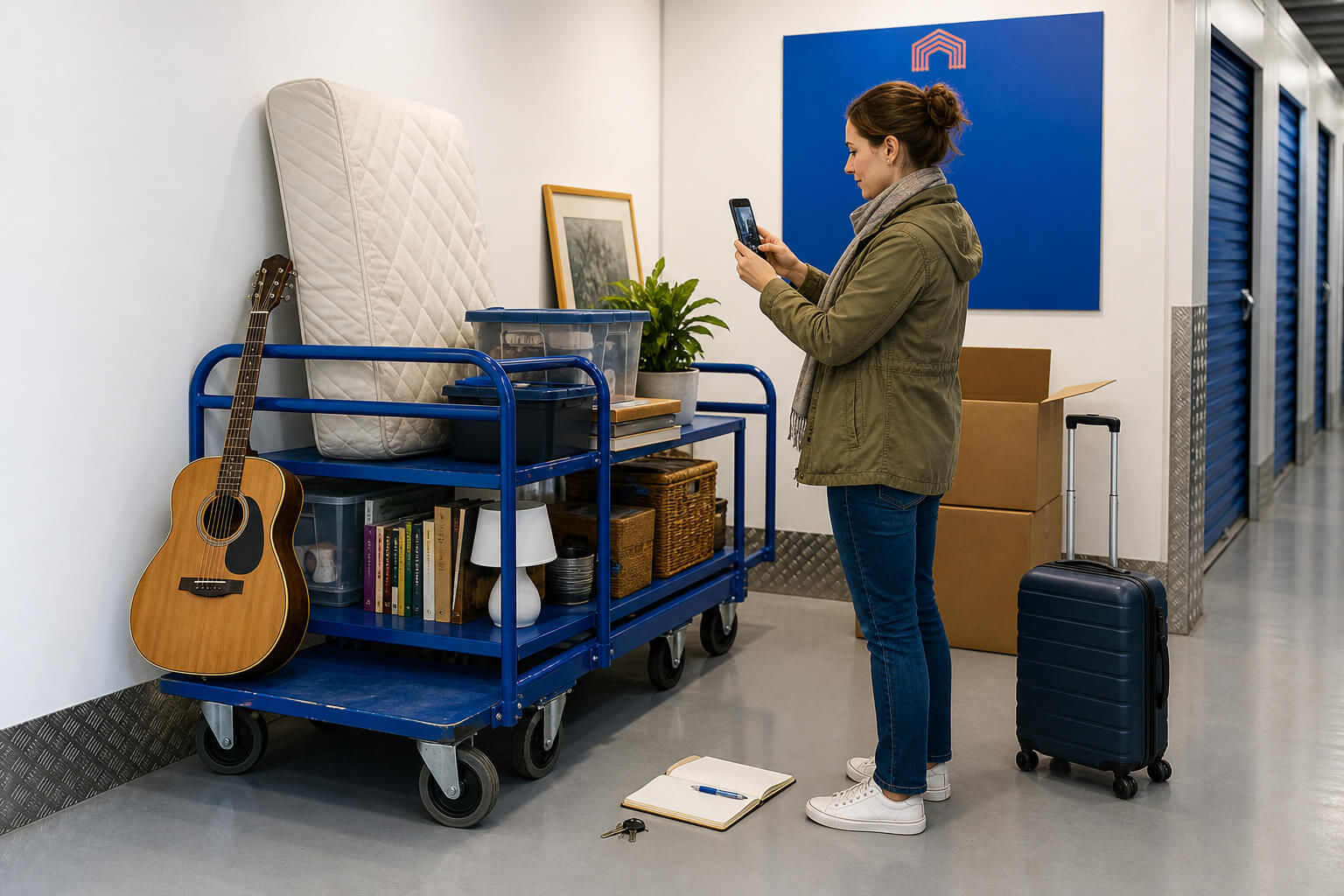
Before the unit is loaded, take a room-by-room photograph of everything that is going in. Then write a brief inventory: a list by category is enough, you do not need a spreadsheet. Keep a copy in cloud storage or on a device you carry with you.
This serves two purposes. It gives you a record for the insurance declaration. And it answers the question you will inevitably ask yourself from abroad, usually at 11pm: did I actually pack that thing? A photograph log is simple to make and very useful to have.
Set up a Direct Debit before you go
The simplest way to run a storage account from overseas is to set up a Direct Debit before you leave and let it run. No manual payments to remember, no risk of a lapse because you forgot what time zone the bank operates in.
If your banking arrangements change while you are abroad, update the Direct Debit promptly. A lapsed payment is the one thing that can complicate an otherwise straightforward long-term account. Sort it before you go.
Nominating someone in the UK to access the unit
You can nominate a person in the UK to access your unit on your behalf. A family member, a trusted friend, a solicitor. If you need someone to check on things, retrieve an item, or facilitate a collection, they can do it.
Two things to be clear on before you set this up. First, your nominated person needs their own access authorisation; check the terms and conditions for how that works. Second, and this follows from the unmanned-site point above: if a courier or delivery is involved, your nominated person needs to be present in person. They cannot call ahead and ask Wigwam to take in a parcel. Plan any deliveries or collections around someone being physically there.
Insurance for goods you leave behind

Contents protection is not optional at Wigwam. You either take the policy Wigwam offers or prove you have your own cover. Here is what the Wigwam policy covers, and what you need to know before you declare a value.
The RSA Self Storage Customers’ Goods policy: opt in or prove your own
The policy in place at Wigwam is the RSA Self Storage Customers’ Goods policy. When you start your rental, you either take that policy or demonstrate that you have equivalent cover in place through your own insurer. You cannot store without one of those two in place.
The full detail of what the policy covers and how to take it is on Wigwam’s contents protection page. Read it. We signpost it; we do not advise on it.
New-for-Old, the £50 excess, and declaring full replacement value
The RSA policy operates on a New-for-Old basis, which means a valid claim is settled at the cost of replacing the item new, not its second-hand value. The excess on any claim is £50.
The critical thing to understand about the policy is how underinsurance works. You must declare the full replacement value of everything you store. If you declare less than the true replacement value, and you need to make a claim, the settlement is reduced proportionally to reflect the gap between what you declared and what the items were actually worth. Declare honestly, based on what it would cost to replace everything new. This is how the policy works; it is not advice.
What the policy covers and what it does not
Theft is covered following forcible entry to the unit. Atmospheric or climatic damage is excluded. This is consistent with the fact that Wigwam does not offer climate control: the policy reflects the actual storage environment honestly, just as the service description does.
For the full list of what is covered and what is excluded, go to the contents protection page. Read the policy document, not just the summary.
A note on jurisdiction: This page describes self storage and insurance practice in England and Wales. Scottish and Northern Irish law and consumer contract practice differ in some respects. If you have any doubt about how these matters apply to your situation, speak to a solicitor or independent insurance broker in the relevant jurisdiction. We do not give legal or insurance advice.
What long-term storage costs
The cost depends on the size of the unit you need and how long you store. Wigwam does not list prices here, but the pricing page shows current rates.
How size and duration drive the price
Unit size is the main driver of cost. The larger the unit, the higher the fee. Duration works differently here than at some providers: there is no discount for committing to a longer term upfront, and there is no penalty for a shorter stay than planned. You pay for the time your things are there, and if you come home earlier than expected, unused days are refunded.
For current pricing by unit size, go to Wigwam’s pricing page. Take a look before you get a quote, so you have a sense of what size you need and what to expect.
Coming home, or moving on
When you are ready to leave the unit, whether that is sooner than you planned or later, the process is straightforward. Give notice, settle the account and collect your things.
Give 14 days notice and close the account
To close your account, give 14 days written notice. Once you have vacated the unit and the account is settled, with nothing outstanding, any days you paid for but did not use are refunded. That is the full sequence: notice, vacate, settle, refund.
This is worth dwelling on for a moment, because it used to work differently. We took a refundable deposit for years. We no longer take one from new customers, so if you book now there is no sum of yours sitting with us while you are abroad, and nothing to chase when you get back.
Refund of unused days if you return early
If you return home earlier than you planned, you do not pay for the days you do not use. Any unused days past your notice period are refunded.
This is the open return made concrete. The reason to commit to a storage unit rather than sell everything is that the decision is reversible, and the billing model confirms it. Come back in six months instead of two years and the account closes cleanly. You are not penalised for coming home. That is the point.
Whenever you are ready, get a quote at quote.wigwamstorage.co.uk and find your nearest Wigwam location.
Where you can store with Wigwam
Wigwam has self storage locations in UK market towns across England. If you are looking for a base that is genuinely local, not a warehouse on a ring-road outside a city, that is the kind of place we operate.
Our market-town locations
We have units in towns including Wigwam Self Storage Bath and Wigwam Self Storage Lincoln. For a full list of our UK market-town locations, including Reading, Berkshire, go to the locations hub.
Name a place you know and there is a reasonable chance we are nearby. And when you come home, the location you stored with is the same one you left. The same town, the same building, the same door. That matters when you are making a decision from the other side of the world.
Frequently Asked Questions
The cleanest answer is to set up a UK Direct Debit before you leave, and the most reliable way to run an account from abroad is to keep a UK bank account open and let the payment run from it automatically. Sorting the payment method while you are still in the country, with full access to your bank, avoids the single most common complication of a long-distance account: a payment that lapses because the arrangement was harder to manage than expected once you had flown.
If you cannot keep a UK account, this is worth raising with the support team before you go, because they can tell you what payment methods the account accepts and how to keep it current from overseas. What they cannot do is advise on foreign exchange, the cost of international transfers, or your banking arrangements, because that is well outside storage and into territory only your bank or a financial adviser can properly cover. A few practical habits protect you whichever route you use. Set the payment up before you leave rather than after you arrive. Keep the contact details on the account current so any reminder reaches an inbox you actually read. And if your banking changes while you are away, update the payment promptly, because a lapsed payment is the one thing that can turn a quiet long-term account into a problem. The storage side is simple and predictable; the money side is yours to keep flowing. Settle it before you fly and it looks after itself.
Nothing, because there is no date you are committed to in the first place. The account has no fixed end and no upper limit on how long you stay, so a return that slips from two years to three, or a plan that changes shape entirely, does not create a problem at the storage end. The unit simply keeps running, month by month, holding what you left until you are ready, whenever that turns out to be. An open-ended move is exactly what the terms are built for.
The mechanics are worth knowing from a distance. You only ever owe two weeks notice to close the account, given whenever your real return date firms up. The minimum stay is two weeks at the start, which has long since passed by the time an overseas absence is in question, and it does not compound with the notice period; they are separate things. The two practical risks to manage from abroad are both about keeping the account live, not about timing. Keep the payment running, ideally by Direct Debit, so an extended stay never trips over a missed payment. And keep your contact details current so we can reach you. If your return is delayed indefinitely, the account carries on as normal; if it is brought forward, you give your notice, your nominated UK contact or you clears the unit, and any unused days you have already paid for are refunded. There is no deposit to come back, because we don’t take one. So a changed return date costs you nothing in penalties. You pay for the time your things were actually with us, and not a day more.
Yes, provided you have set it up properly before you go. You can nominate someone in the UK, a family member, a trusted friend, a solicitor, to access the unit on your behalf, and that person can check on things, retrieve an item, or clear the unit entirely when the time comes. The arrangement has to be made in advance, because the same security that protects your goods means nobody gets in without authorised access. Your nominated person needs their own access authorisation set up on the account; the terms and conditions explain how that works, and it is worth confirming with the support team before you fly.
Two things follow from how the sites work, and both matter when you are managing this from overseas. First, the sites are unmanned, so there are no staff to let your nominee in or to hand goods over. They access the unit directly with their own authorised entry, within the access window of 6am to 10pm, seven days a week. Second, and this is the one people overlook, if a removal firm or courier is involved in emptying the unit, your nominated person must be physically present to let them in and oversee it. We do not sign for or release goods to a third party on your instruction alone, and we do not hold spare keys. So if you intend to have the unit cleared while you are still abroad, line up a UK contact with proper access, brief them on what is inside, and make sure they can be there in person for any collection. Get that in place before you leave, and closing the account from the other side of the world becomes a phone call and a visit rather than a problem.
Keep the policy live and the declared value honest, and review it if the contents change. Contents cover is mandatory throughout the let, not just at the start, so over a long absence the thing to avoid is letting it lapse. If you take the RSA Self Storage Customers’ Goods policy through Wigwam, it runs alongside the rental, so keeping the rental payment current keeps the cover current too, which is another reason a Direct Debit set up before you leave is the sensible default. If instead you are relying on your own insurer, the responsibility to keep that policy in force, and to confirm it genuinely covers goods in self storage over a long period, is yours, and it is worth checking with your insurer that a multi-year storage situation does not breach any condition.
The value you declare is the part that quietly matters most over a long store. You must declare the full replacement value of everything in the unit, because under-insurance is settled proportionally: declare half the true value and a claim pays out roughly half the loss. Replacement cost is what it would take to buy the items new today, which for a household built up over years is usually more than people first estimate, so add it up room by room rather than guessing. Over two years, prices drift and the contents may change if your nominated contact adds or removes items, so it is worth a mental review if anything significant alters. Wigwam can tell you what the policy covers and point you to the contents-protection page for the detail, but we cannot advise on your insurance position or whether the cover suits your circumstances; for that, speak to your insurer or an independent broker before you leave. Keep it paid, keep the value true, and the cover holds for as long as the unit does.
For ordinary household goods, no, provided they go in clean and dry, because the unit is clean, dry and secure, which is the right environment for furniture, books and the usual contents of a home over a long period. The honest framing matters here: we do not offer climate control, and we will not pretend to. There is no managed temperature or humidity. What protects your things over a long absence is a dry, secure, individually alarmed unit combined with sensible packing, and for the vast majority of households that is exactly what is needed.
The risk to manage is moisture you bring in yourself, not the unit. Anything packed slightly damp, cushions, a mattress put away after a wet move, will sit in that state for as long as it is stored, so let everything dry fully before it goes in. Lift furniture and boxes off the floor on a pallet or boards, leave a little air around larger pieces rather than sealing them tight in plastic, and use breathable covers rather than wrapping wood in sheet plastic that traps condensation against the finish. This is consistent with the policy, where atmospheric and climatic damage is excluded, which is the honest reflection of an environment that is dry rather than conditioned. If you own something genuinely sensitive that needs a regulated temperature and humidity range, a specialist instrument or a fine antique, that needs a provider offering climate control, and we would rather tell you that plainly than imply we can do something we cannot. But for the furniture, books, kitchen equipment and seasonal things of a normal home, packed dry and stored sensibly, a clean, dry unit holds them in good order for two years just as well as for two months.