Is it time the garden furniture came in before the weather turns?
There is a moment every autumn when you look at the patio table and chairs and realise the season is done. The garden has given you everything it is going to give this year. The cushions have had their last airing. And now the question is what to do with it all before the weather turns.
Most people leave it a little too late. October arrives, the first proper wet weekend comes, and suddenly there is a scramble for covers, old towels and places to stack chair legs. It does not have to be like that. If you think about it now, while a dry weekend in late September is still possible, the whole thing becomes a twenty-minute job rather than a damp, rushed one.
This is an honest guide. It covers the timing, the prep by material, the difference between covering and properly storing, and what to do when the garage is already full. That last part is the bit most guides skip. We will not.
When to Pack It Away

The honest answer is: before the first proper frost. In most of England that means keeping an eye on the forecast from late October. In the Midlands and the North it can come earlier, sometimes mid-October in a sharp year. In the South, including places like Bath and Cheltenham, you may have until early November. But the first frost is not the only signal. Sustained wet is just as damaging to furniture frames and cushions as freezing temperatures, and Britain does sustained wet very well.
Watch the First Frost: Late October into November in Most of England
Pack it away before the frost, not after. Frost does two things to garden furniture. It forces moisture into any tiny crack or joint and then expands it. That is how rattan splits and painted steel lifts. And it locks condensation under any cover you have put on, which creates exactly the damp environment you were trying to avoid. The window is late October in the Midlands and North, and creeping into November as you head south. Watch the forecast, pick a dry weekend, and move early.
The other reason to move early is that you have choices. Late October gives you time to sort, clean and decide. November, in a wet year, gives you a scrambling panic and nothing drying properly.
The End-of-Season Clean While the Weather Is Still Dry
Before any furniture goes into storage, it needs to be clean and fully dry. A sunny weekend in late September or early October is ideal for this. Cleaning damp furniture in November rain is unpleasant and, more importantly, damp furniture stored anywhere will develop mould. It does not matter whether it goes into your shed or a unit. Moisture in means mould.
A scrub with warm soapy water, a rinse, and a full day in decent sun is the standard. For wooden furniture, check whether a coat of teak oil or hardwood treatment is due. If it is, do it now, let it cure, then store. You are putting furniture away in good condition so it comes back in good condition.
How to Prep Furniture by Material So It Stores Well
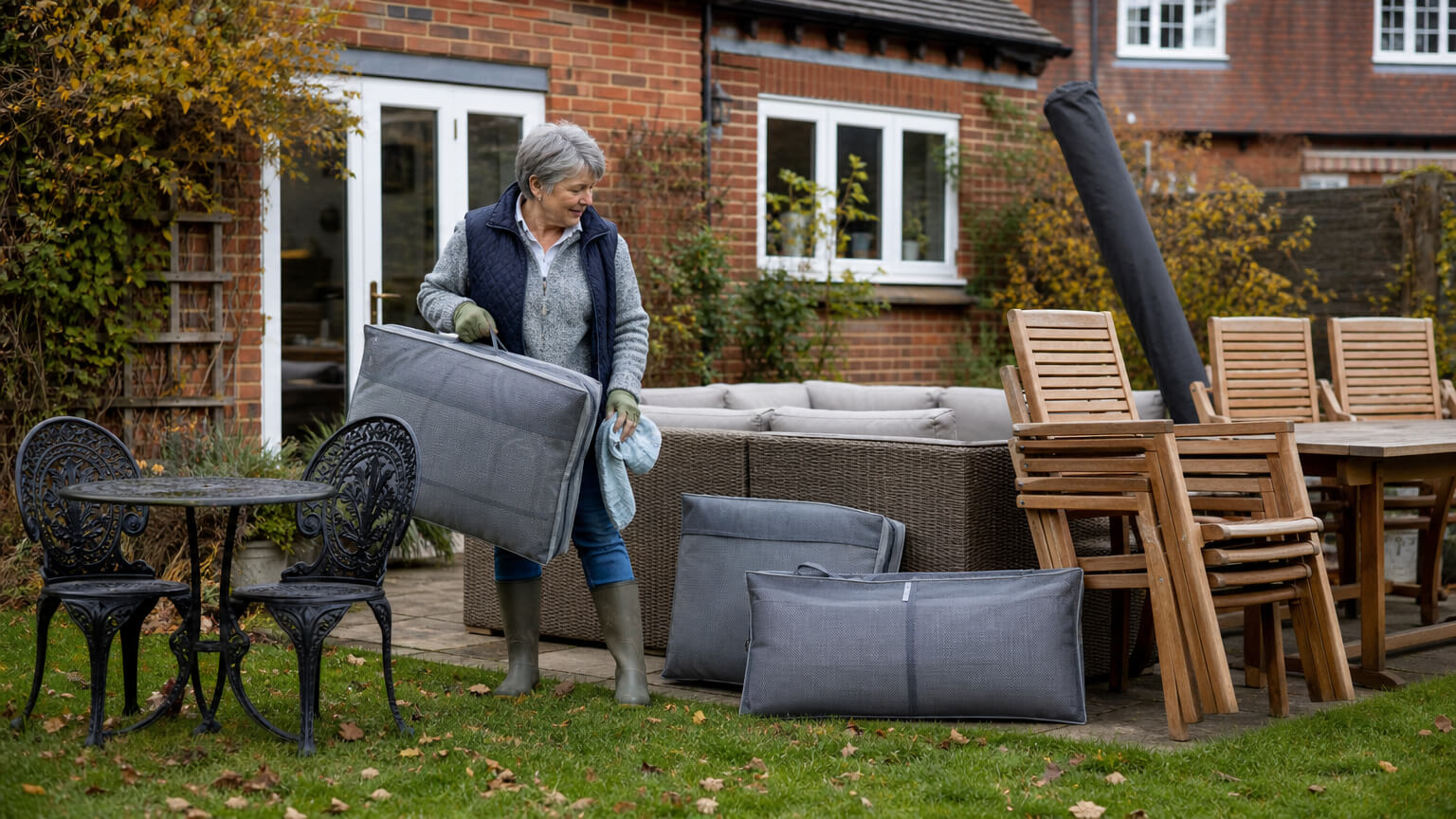
Different materials need slightly different attention before they go away. The general principle is always the same: clean, dry, protect. The detail varies.
Rattan and Wicker
Rattan is more vulnerable than people realise. It looks robust, and in summer it is. But repeated freeze-thaw cycles and sustained British damp will split the fibres and crack the weave over a full winter outdoors. Bring it in. Before you do, brush out any trapped debris from the weave, wipe the frame with a damp cloth, and let it dry completely. Store it flat or stacked where possible to avoid distorting the shape. A dry, enclosed space is the right home for rattan from October to March.
Wood: Teak, Eucalyptus and Other Hardwoods
Hardwood furniture can handle more than rattan, but it still repays care. The most important rule is never to seal moisture in. Make sure the wood is genuinely dry before any treatment or storage. If a coat of teak oil or hardwood feed is due, apply it while the sun is still warm enough to let it cure, then store. In a unit or a garage, keep flat pieces horizontal and chairs stacked if you can, with something protective between them if the finish matters to you.
For particularly treasured pieces, a breathable cover inside the unit adds an extra layer of protection against any dust. Not waterproofing. Just a layer of care.
Metal: Steel, Aluminium and Cast Iron
Aluminium is the most forgiving. It does not rust, and a season in a dry space will not trouble it. Powder-coated steel is robust too, but any chip or scratch where bare metal is exposed needs touching up with a matched paint before it goes away for winter. Water finds that chip and starts working. Cast iron needs the driest conditions of the three. If you have cast iron chairs or a bistro table, a dry unit is genuinely the best option.
A quick wipe of all metal frames with a clean cloth before storage removes any residual salts or moisture. For articulated or folding pieces, a light oil on the pivot points keeps them moving freely in spring.
Cushions, Parasols and Soft Furnishings
Cushions are the thing people get wrong most often. They go away slightly damp, into a sealed plastic bag, and come out in March smelling of mould. The rules are simple and they matter.
Cushions must be fully dry before they are packed. Not damp-dry. Properly dry. Leave them in sun for a full afternoon if you can. Then pack them in breathable bags, not sealed plastic. Woven storage bags or breathable fabric sacks are right. Plastic traps moisture that was not obvious when you packed them.
Parasols should be dried, then either put back in their carry case or wrapped in breathable cloth and stored upright or flat. A case that fits is the right answer for most parasols. Avoid folding them down hard at the ribs if you can. The hinge points weaken with repeated tight folding.
Clean, Dry and Sealed: What Proper Prep Looks Like Before Anything Goes Away
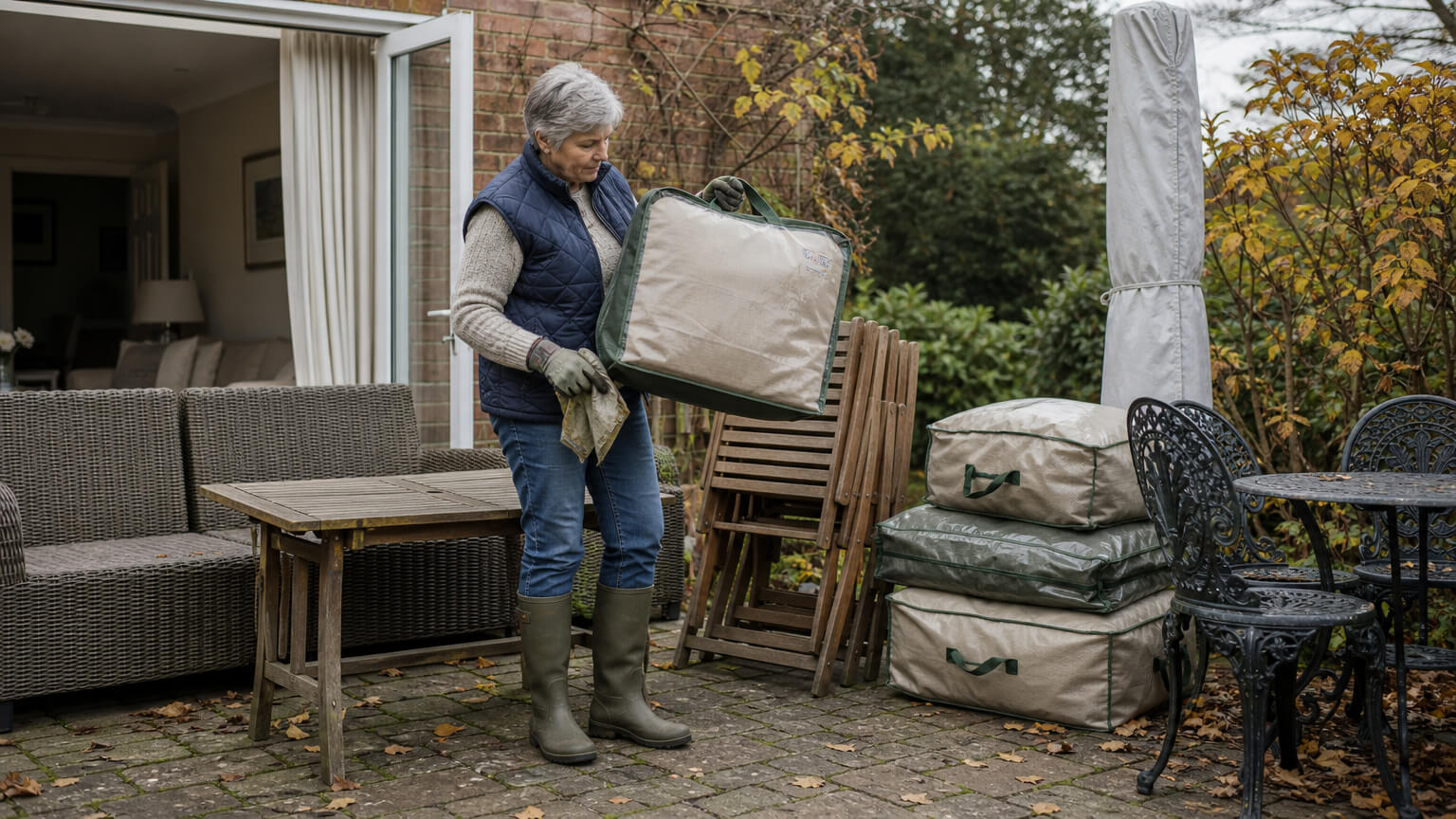
The whole prep process has one priority above all others: nothing goes away damp. That is the rule. If it is damp when it goes in, it will be mouldy when it comes out. This applies in a shed, a garage, a purpose-built unit, anywhere. Storage protects against the outside world. It cannot fix moisture you packed in yourself.
The Drying Rule That Matters Most
After cleaning, give everything a full dry day in good air before it goes anywhere. If the day is borderline, a second day costs nothing. For cushions especially, run your hand through the filling if you can. Foam holds moisture even when the surface feels dry. Better to wait than to pack something that will spend five months doing exactly what you were trying to prevent.
Labelling, Stacking and Protecting in Transit
A little organisation now saves twenty minutes of confusion in March. Stack chairs in pairs with the seats facing in if you can, and put folded fabric between them to protect painted or powder-coated surfaces. Label cushion bags by the piece they belong to: you will thank yourself when you reassemble in spring. Protect glass table tops with a blanket or bubble wrap on each face. Nothing spectacular, just the obvious care.
Cover It or Store It Properly: The Honest Comparison
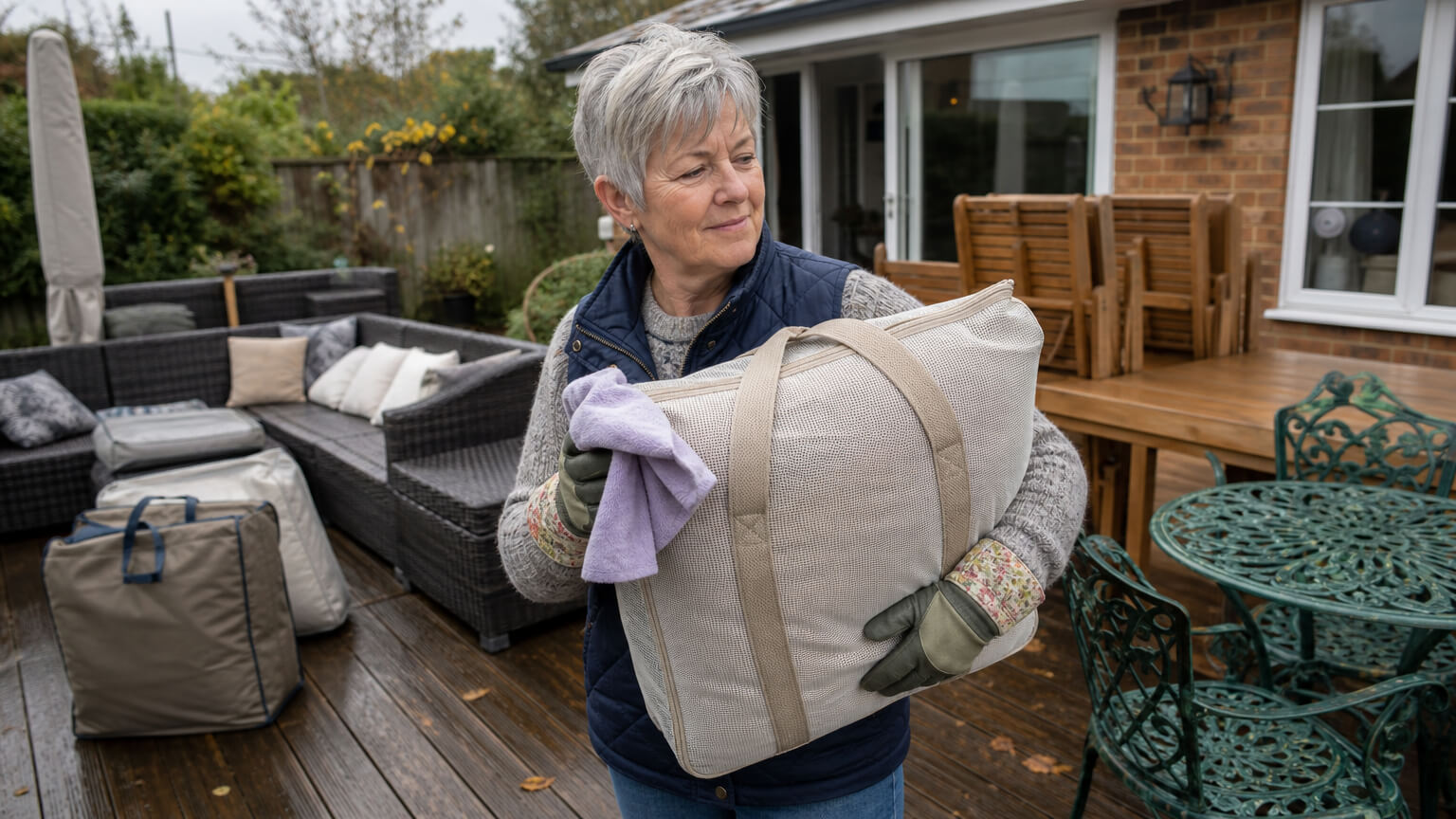
Covers have their place. They are not the whole answer.
What a Breathable Cover Actually Protects Against (and What It Does Not)
A good breathable furniture cover does a real job. It keeps the surface clean, blocks UV, protects against bird mess and surface rain, and keeps leaves out of crevices. If you are covering furniture that is staying outside in a sheltered spot, a breathable cover is the right choice. Not a tarp. A purpose-made breathable cover.
What a cover cannot do is stop condensation forming underneath it. Warm furniture cooling through a cold night draws moisture from the air and deposits it on every surface. A cover sits on top of that process, not outside it. After a month of British autumn nights, the underside of most covers is wet. The furniture underneath has been cycling through damp and dry, damp and dry.
Why a Tarp on the Lawn Is Not Enough
A tarp is worse than a breathable cover, not better. The plastic traps moisture underneath rather than letting it escape. Wind catches the edges and creates gaps, so rain gets under too. By November a tarp-covered patio set on a lawn is sitting in a warm, wet, enclosed environment. That is what mould needs. The only thing a tarp definitively protects against is direct rain on the top surface, and even that assumes it does not blow off.
If you are choosing between a tarp and a breathable purpose-made cover, choose the cover. If you are choosing between either of those and a dry enclosed space, choose the dry enclosed space.
When Bringing It Indoors Is Simply Not an Option
Here is the honest part most guides skip. A full garden set takes up real space. A six-seat rattan sofa set with a coffee table, a parasol and a set of cushions will fill most of a single garage. If that garage already has bikes, a pram, flat-pack boxes from a house move and two decades of things that were going to be sorted out eventually, there is nowhere to put the furniture. And a shed is usually smaller, often damper, and frequently full too.
That is the gap. Not a moral failing, just a practical reality. And it is the reason a short-term self storage unit makes sense as a seasonal tool.
If your garage is already full, there is a clean, dry answer. A seasonal unit at Wigwam Self Storage gives your furniture a proper winter home you control on your own schedule. Get a quote at quote.wigwamstorage.co.uk.
Where to Put It When the Garage Is Full
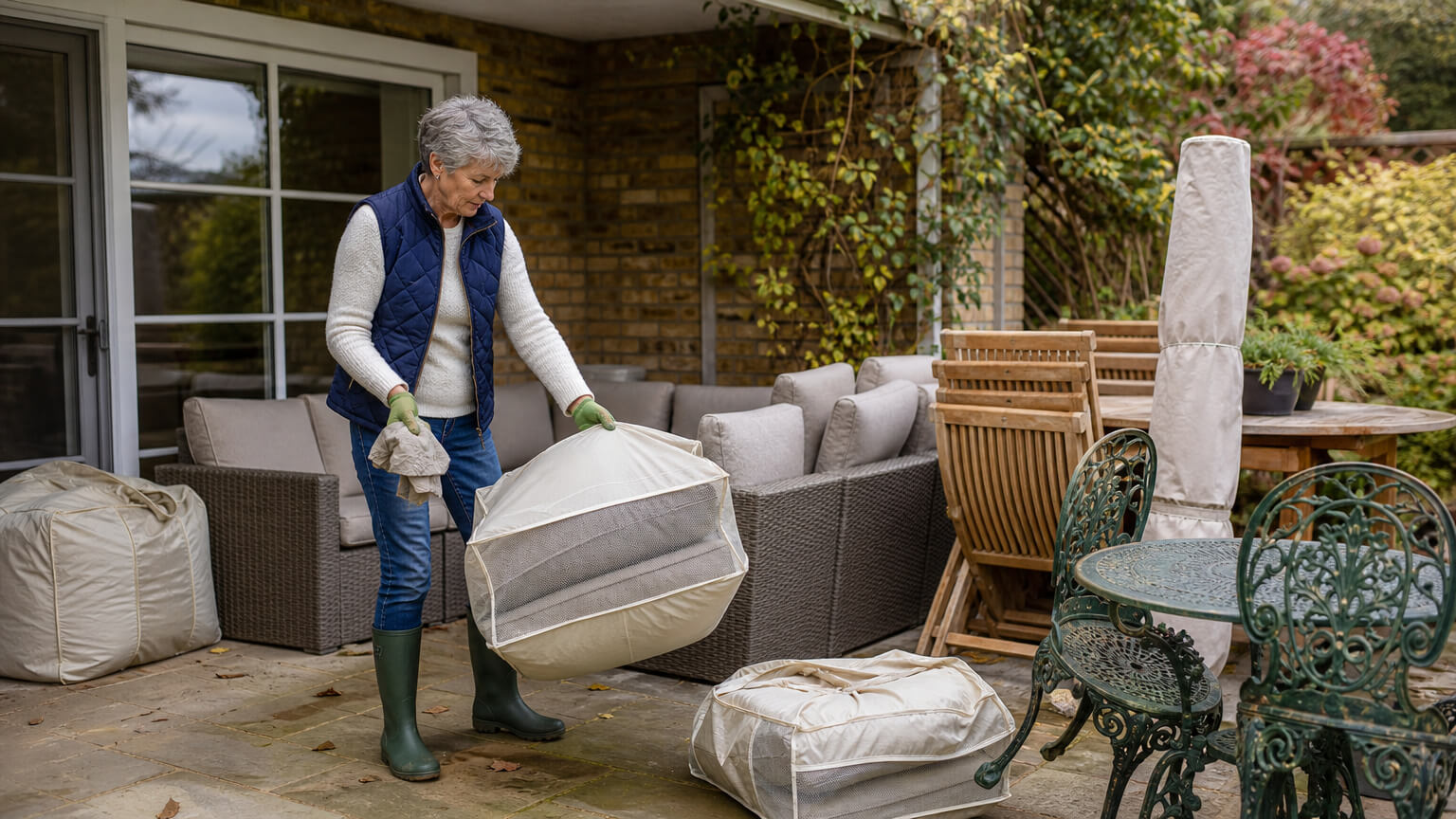
A seasonal self storage unit is not a last resort. For a lot of people with a good patio set and a full garage, it is the most sensible option. Clean, dry, individually alarmed, and taken only for the months you need.
What Size Unit a Typical Patio Set Actually Needs
Size is where people worry unnecessarily. A standard six-seat patio set, with a table, six chairs, a parasol and a bag of cushions, fits comfortably in a small unit once the chairs are stacked. Stack chairs two or three high, nest them if the legs allow, and you reclaim a lot of floor space. A four-seat bistro-style set with a compact table needs very little room at all.
The right approach is to measure what you have and ask when you enquire. For running cost guidance, the pricing page gives you a reference point without a quote commitment.
How Long You Actually Need It (The Seasonal Minimum)
The two-week minimum stay is important to understand. You are not signing up for a year. A typical garden furniture season runs from October to March, somewhere around five months. If you pack it in on a dry weekend in late October and collect it on a dry weekend in late March, that is the length of it.
If the weather surprises you, and a mild March arrives early, you can collect early. Unused days are refunded if you leave before your contracted end date. There is no deposit involved either. It is a straightforward arrangement for a short seasonal let, and it means you are not penalised for being organised.
Clean, Dry and Secure: What a Seasonal Unit Actually Gives You
The phrase clean, dry and secure is not a brochure line. It is the answer to a specific worry.
The worry is leaving a good garden set, possibly an expensive one, possibly one that carries a lot of family summers, somewhere unfamiliar for five months. Will it be damp? Will anything get to it? Will it come back in the same condition?
Wigwam units are individually alarmed. Each unit has its own alarm, not a shared perimeter alarm. The sites are clean and dry. That means your furniture is not in a damp shipping container on a muddy lot. It is in a clean, dry, purpose-built unit that you open and close yourself.
There is no climate control. The promise is dry and secure, not temperature-regulated. That is the right promise for garden furniture. What damages patio sets is damp, not cool temperatures. A dry unit at ambient temperature is exactly the right environment.
Contents cover is mandatory with any Wigwam let. You can take Wigwam’s RSA Self Storage Customers’ Goods policy or prove your own cover. Declare the full replacement value of what you are storing. Under-insurance is settled proportionally, which matters if you have a quality set worth several hundred or several thousand pounds. Note that climatic damage is excluded under the policy, which is consistent with the dry-not-conditioned framing above. Read the full policy detail on the contents protection page and the terms and conditions. If you have questions about how your insurance position differs in Scotland or Northern Ireland, or about any jurisdiction-specific detail on the policy, speak to your insurer or solicitor. Insurance arrangements differ between England and Wales, Scotland, and Northern Ireland.
Access, Timing and Getting It Home in Spring
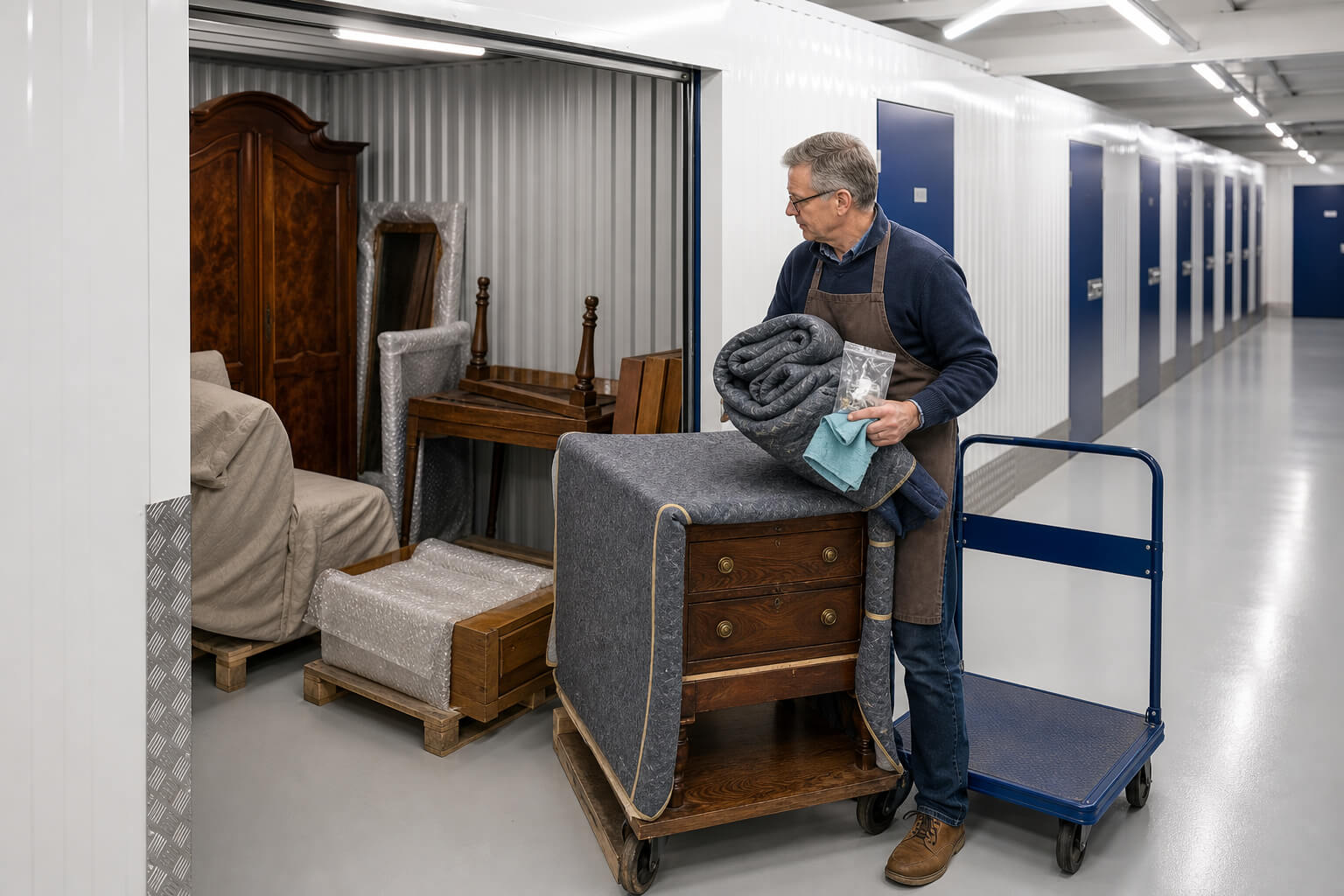
Smart Entry on Your Own Timetable
Sites are open for access 6am to 10pm, seven days a week, via smart entry. That covers a Saturday morning in late October and a Sunday afternoon in late March, which is when most people will want to move furniture. You do not need to book a slot. You go when it suits you.
The sites are unmanned. You access your own unit directly. If you have arranged for something to be delivered to the unit, someone from your household needs to be present for that. Wigwam does not receive or sign for deliveries on customers’ behalf.
Getting It Home in Spring (and What to Check Before You Do)
March is when most people bring the furniture home, though the right moment is when you are confident the hard frost risk has passed and you have a dry stretch ahead. Check a five-day forecast before you go to collect.
When you bring it home, give everything a quick wipe before it goes out onto the patio. Five months in storage is not five months of damage, but a light surface dust is normal. Five minutes with a cloth before you set up means the garden is ready for the season straight away.
A practical note on timing: the 14-day notice period applies at the end of your let. If you are planning to collect in late March, give your notice two weeks before. Any unused days are refunded once you have vacated and the account is settled. It is worth planning that sequence in advance so the timing is comfortable.
Wigwam Locations Near You
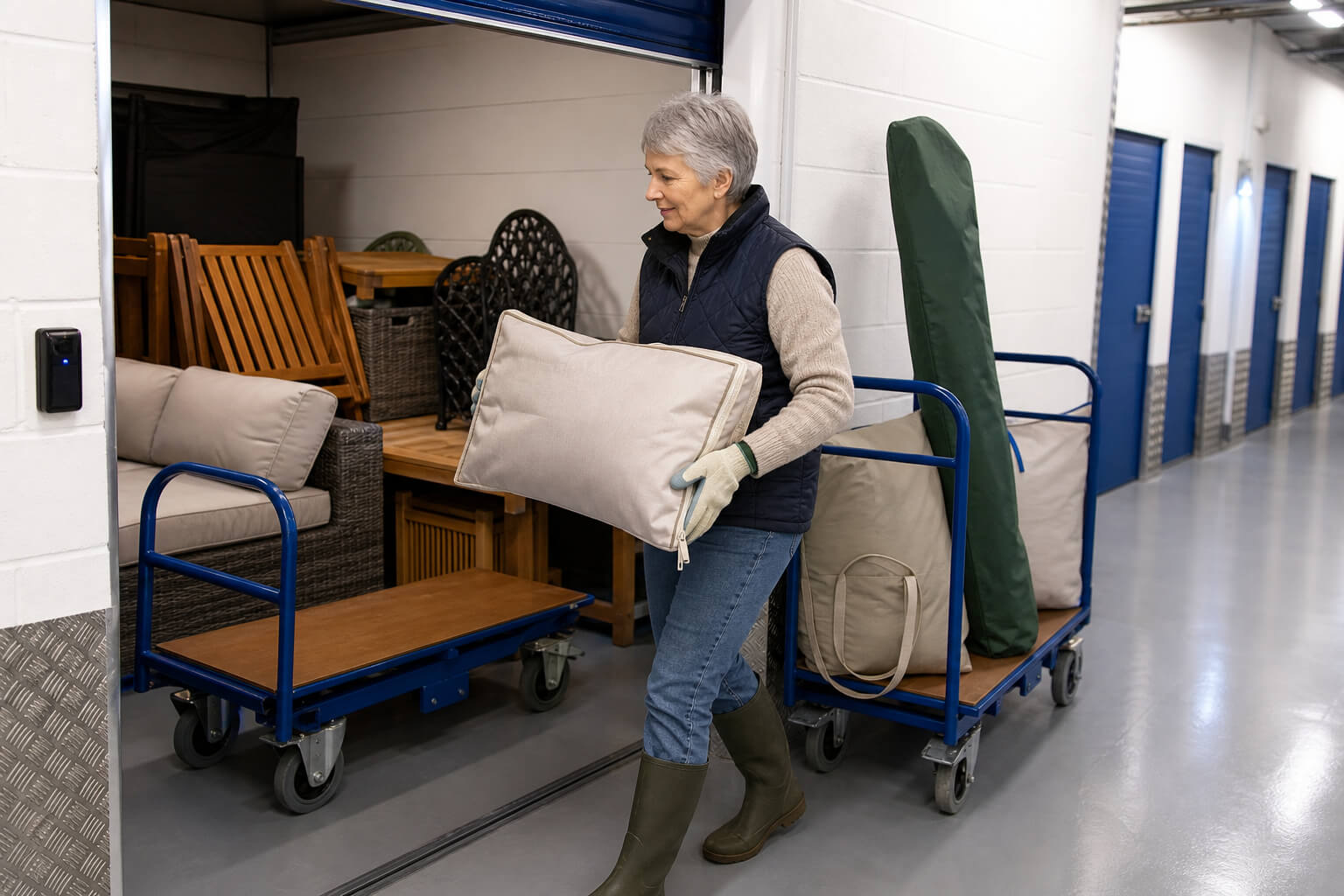
Market-Town Sites Across England
Wigwam Self Storage operates across our UK market-town locations, close enough to be practical and familiar enough to feel like the right sort of place to leave something you care about.
Wigwam Self Storage Bath in Somerset and Wigwam Self Storage Lincoln in Lincolnshire are two of the sites. For a full list of all locations, the locations hub shows everything with maps and contact details so you can find the one nearest to you. If you are in Cheltenham, Reading, Burton upon Trent, Dorking or somewhere nearby, there is likely a site that makes the drive straightforward.
Contents Protection: Take Wigwam’s Policy or Prove Your Own
Before anything goes into a unit, you will need to confirm your contents cover. The options are Wigwam’s RSA Self Storage Customers’ Goods policy, which you can take out as part of the letting process, or your own existing cover provided you can evidence it.
The key things to understand: declare the full replacement value of what you are storing. If you declare less and need to make a claim, the settlement is proportional to the under-declared amount. For a quality garden set, it is worth getting the valuation right. Climatic damage is excluded under the policy, consistent with the unit environment being dry rather than climate-controlled.
All the detail is on the contents protection page and in the terms and conditions. This is a signpost, not insurance advice. If your situation involves specific questions about cover in Scotland or Northern Ireland, where insurance arrangements differ from England and Wales, speak to your insurer or solicitor for guidance that applies to your circumstances.
Pack It Away Properly This Autumn
The English garden has a rhythm. Furniture out in April when the frosts are done. Long evenings through the summer. And then the quiet task of putting it away properly before the cold arrives, so it comes back in spring exactly as it went in.
For a lot of people that rhythm has a gap in the middle. The garage filled up. The shed was never quite right for the job. The choice until now was a cover on the lawn or nothing. That gap is a practical problem with a practical answer: a clean, dry, individually alarmed seasonal unit taken just for the months you need it, accessed on your own schedule, and handed back in spring.
Find your nearest location at wigwamstorage.co.uk/self-storage-locations or go straight to a quote at quote.wigwamstorage.co.uk. If you want to understand running costs first, the pricing page gives you a clear reference point.
Your furniture looked after this summer. Look after it this winter.
Frequently Asked Questions
Yes, and that seasonal pattern is one of the most sensible ways to use a unit. There is no obligation to keep a unit running year round. You take it for the months the furniture needs a home, October to March in most cases, give your notice in spring, and come back to it the following autumn. Each winter is a fresh let on the same flexible terms, so you are only ever paying for the months the set is actually in store.
A few practical points make the yearly rhythm smooth. The two-week minimum is the only floor, so a five-month seasonal stay sits comfortably within it. When you collect in spring, give your 14 days notice first, clear the unit, and settle the account. There is no deposit to reclaim, because we don’t take one. The following autumn you simply get a fresh quote and take a unit again. One thing worth knowing: the same specific unit will not necessarily be reserved for you across the gap, since once you give it up it becomes available to others, so each season you book whatever is free at the time. If you would rather guarantee continuity and the cost of holding it over the quieter months stacks up favourably for you, you can keep a unit running through summer instead, but most people with a purely seasonal need prefer to pay only for the winter. Either way, get a quote when autumn comes round and the arrangement is quick to set up again.
Answer first: dismantle what comes apart, pad every contact point, and lift rather than drag, because most transit damage happens in the handling, not the storage. A six-seat set is awkward and heavy, and the marks people find in spring are usually knocks picked up on the way in, not anything that happened over winter. A little care loading the van or car pays off.
The order of work that protects a set:
- Clean and fully dry everything first, because nothing should go into transit or storage damp, and a wet frame in a cold van invites exactly the mould you are trying to avoid.
- Take off and bag the cushions separately in breathable bags, so they are not crushed under furniture and not trapped in plastic.
- Stack chairs in pairs or threes with folded fabric between them, protecting painted or powder-coated surfaces from rubbing.
- Wrap glass table tops with a blanket or bubble wrap on each face and carry them flat or on edge, never loose.
- Protect carved or vulnerable corners and feet with padding before they go in the vehicle.
- Lift, do not drag, particularly cast iron and heavy hardwood, which chip and scratch the moment a leg catches.
At the unit, lift everything off the floor onto a pallet or boards, leave a little air around the pieces rather than cramming them tight, and put the cushions where nothing presses on them. Remember the sites are unmanned, so if you have arranged for someone to deliver the set to the unit rather than carrying it in yourself, someone from your household needs to be there to receive it; we do not sign for or accept deliveries on your behalf. Access runs 6am to 10pm, seven days a week, so you can pick a dry slot that suits. Handle it with that bit of care and it comes out in spring exactly as it went in.
Yes, and it is one of the few rules genuinely worth following to the letter, because cushions are the single thing people most often ruin. Frames, whether rattan, hardwood or metal, tolerate winter storage well once they are clean and dry. Cushions are far less forgiving: pack them slightly damp or seal them in plastic and they come out in March smelling of mould, and that smell rarely comes out. Treating them as a separate job, with their own preparation, is what prevents that.
The method is simple. Dry the cushions properly before anything else, a full afternoon in sun if you can get it, and run your hand through the filling to check, because foam holds moisture even when the surface feels dry. Then pack them in breathable bags, woven storage sacks or breathable fabric, never sealed plastic, which traps the very moisture you are trying to keep out. Label each bag by the piece it belongs to, so reassembly in spring is quick. In the unit, keep the bagged cushions off the floor and positioned where nothing heavy rests on them, since a stack of chairs or a table edge pressing on a cushion for five months leaves a mark. Storing them separately from the frames also means you are not forced to leave cushions strapped to chairs that then have to be stacked, which is how they get squashed and damp at once. The unit is clean and dry, which is the right environment, but it is not climate-controlled, so the protection comes from packing dry and breathable rather than from any temperature regulation. Get the cushions right and the rest of the set looks after itself.
A quick wipe is all it needs, not a full clean, because five months in a clean, dry unit is not five months of damage. The unit protects against the weather, the damp and the leaf litter that would have got to the furniture outside, so what you collect in spring is essentially what you put away in autumn, give or take a light surface dust. That is normal and takes five minutes to deal with, rather than the proper end-of-season scrub the furniture had before it went in.
The real cleaning effort belongs at the autumn end, before storage, not the spring end, after it. Everything should go into the unit already clean, dry and, where due, treated, so it sits the winter in good condition. Come spring, the job is just a freshening up: a cloth over the frames to lift any settled dust, a check of the cushions as you unbag them, and a glance over metal pivot points, where a touch of light oil keeps folding pieces moving freely. Before you go to collect, check a five-day forecast and pick a dry stretch with the hard-frost risk behind you, so the furniture goes straight back out rather than sitting around again. On the timing, remember the 14-day notice applies at the end of the let, so if you plan to collect in late March, give your notice a fortnight before, clear the unit and settle the account. Plan that sequence in advance and collection is relaxed. The furniture comes out ready for the season after little more than a wipe, which is the whole reward for having stored it properly in the first place.
It depends on the furniture and your situation, but for a good set with nowhere dry to go, a seasonal unit often works out the better protection and sometimes the better value too. The honest comparison is not unit versus cover in the abstract; it is what each actually protects against. A breathable cover keeps surface dust, leaves and direct rain off a set left outside, but it cannot stop condensation forming underneath as the furniture cools through cold nights, so after a wet British winter the underside of most covers, and the furniture beneath, has been cycling through damp and dry for months. A dry, enclosed unit removes that problem entirely.
So the value question turns on three things. First, the worth of the set: protecting a quality rattan or hardwood suite that would cost several hundred or several thousand pounds to replace justifies more than protecting a cheap aluminium bistro set that shrugs off a winter outdoors. Second, whether you have a genuine dry alternative; if the garage or shed has room, that is the free answer, and a unit only earns its place when those are full or damp. Third, the recurring cost of covers themselves, since a good breathable cover is not cheap and often needs replacing every couple of seasons as it weathers. Set the annual cost of replacement covers against a five-month seasonal let, with its two-week minimum, no deposit and a refund of unused days if a mild March lets you collect early, and for a treasured set the unit frequently compares well. The pricing page gives you running-cost guidance to do the sum for your own set. For furniture you care about with no dry home of its own, the unit usually wins on protection, and often on cost over time.