Decorators booked Thursday, but the old tenant’s furniture is still there?
The tenant has just handed back the keys. You walk in and there it is: the three-seater sofa pushed against the wall, the dining table that seats four, a wardrobe the incoming tenant never asked for, a bed frame and a mattress that has seen better days. The decorators are booked for Thursday. The gas engineer is coming Friday. And right now, none of them have room to work.
This is where most landlord articles skip ahead to the brochure. We will not. The furniture is the problem that stops everything else starting, and sorting it quickly is the whole job. If it can go somewhere safe and nearby for a few weeks, the rest of the turnaround follows.
That is exactly what local self storage is for. Clean, dry and secure, near the property, with a minimum stay short enough to fit a quick void. Here is how it works in practice.
Why landlords move furniture out between tenancies
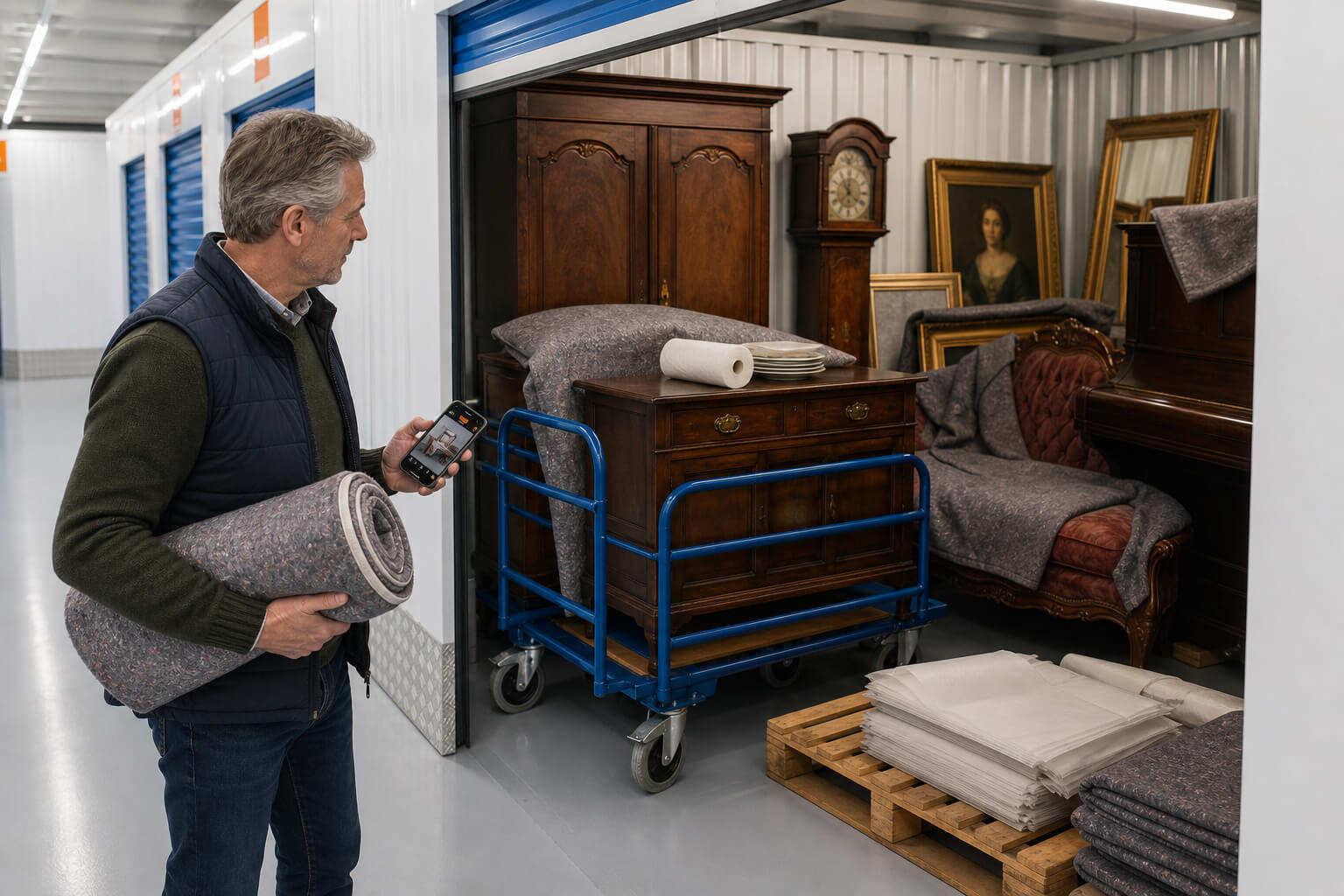
Furniture between tenants does three things: it slows down the contractors, it complicates viewings, and it reminds an incoming tenant of the previous one. Moving it out is not always necessary, but when it is, a local storage unit makes the window between lets work.
Clearing the property for cleaning, painting and safety checks
A furnished property mid-void is a sequence of obstacles. The deep clean needs clear floor space. The decorators want nothing near the skirting boards. The gas safe engineer needs access to every appliance. The electrical condition report requires unobstructed access to every socket and consumer unit. None of that happens efficiently around a dining table and four chairs.
Moving the furniture into a local unit at the start of the void is not extra work. It is the thing that lets every other job run on schedule. Contractors book slots, not open-ended days; a clear property lets them arrive, work and leave, rather than waiting for clearance or working round obstacles that should not be there.
When an incoming tenant wants the property unfurnished
Furnished lets attract some tenants and put others off. When the new tenant wants to bring their own things, or the market in your town has shifted toward unfurnished lets, good furniture ends up in the way. Not because it is worthless, but because it does not fit the next arrangement.
Skipping to the skip is the wrong instinct. The furniture you chose and maintained has value, and a sofa that was bought to last a decade should not end up at the tip because of a three-week gap in occupancy. A local storage unit holds it between arrangements: the new tenant moves in, the flat is clear, and the furniture waits for the next let, a different property in your portfolio, or a considered sale.
Staging and viewings without the previous tenant’s belongings
An empty property that is freshly painted and well-lit photographs better and shows better than one full of someone else’s furniture, even good furniture. Prospective tenants are looking for somewhere to put their own lives, not picking up a domestic interior that already has a story. A clear property, with the previous tenant’s furniture stored locally, is simply easier to let faster.
What a void costs you, and where storage helps

Every day between tenants is a day without rent. A short, planned use of local storage can cut that gap by letting the work happen faster, with decorators, safety checks and viewings running without furniture in the way.
Turning the property around faster
The direct link is straightforward. A furnished flat mid-void takes longer to clean, longer to paint and longer to show than a cleared one. When the furniture comes out on day one, the contractors can come in immediately. When the contractors finish quickly, the property photographs well and goes on the market. When viewings happen in a clear, freshly turned space, the time to a signed tenancy shortens.
A two-week minimum stay at your nearest Wigwam location fits a quick turnaround. The furniture goes in, the work happens, the new tenant signs, and the furniture comes back or stays in storage for the next requirement. The minimum stay is the exact window a fast void needs: no three-month contract, no guessing, no paying for time you do not use.
For the cost of the unit, the pricing reference is at wigwamstorage.co.uk/how-much-is-self-storage-in-the-uk. Unit rates vary by size and location; a quote gives the specific figure for your nearest site.
The two-week minimum and what it means for the maths
The two-week minimum stay is the number that makes self storage work for a landlord void. Most self storage contracts run to a month as a floor. Wigwam’s is a fortnight, which matches the realistic timeline of a quick repaint-and-relet. If the job runs shorter than expected, unused days are refunded. If it runs a little longer, you simply stay on.
There is no deposit to book the unit, so nothing of yours is tied up while the void runs. That is the maths your accountant needs to see on the quote: a rate for a defined window, and a refund of whatever days you do not use.
Prices are on the pricing page. There are no headline rates on this page; a quote from quote.wigwamstorage.co.uk gives you the specific figure for your nearest Wigwam location and the size you need.
What size unit for a flat or house of furniture

The question most landlords ask first is: will it all fit? The short answer is yes, with the right size unit. Here is a plain guide in furniture terms, not cubic feet.
A one-bed flat or studio’s furniture
A typical one-bed flat or studio, furnished for letting, will usually have a double bed and mattress, a wardrobe, a small chest of drawers, a two or three-seater sofa, a coffee table and a compact dining set. That kind of load fits comfortably in a small to medium unit. If you have a few boxes of soft furnishings and bedding on top, allow a little more.
The practical test: think about whether you could fit the contents of that flat into a small room or a large bedroom. If yes, a smaller unit works. If it would overflow, step up.
A two or three-bed house of furniture
A furnished two or three-bed house brings more volume: two or three bed frames, two or three mattresses, a double wardrobe, a larger sofa or sofa set, a full dining table with chairs, and likely side tables, bedside tables and accumulated soft furnishings. That needs a medium to large unit.
The rule of thumb: it is always better to err on the larger side. A unit that is three-quarters full is easier to work in and less stressful than one that is packed to the ceiling. If you are unsure, the quote tool shows available sizes at your nearest location.
Sizing tip: book a size up if you are unsure
If you are hovering between two sizes, take the bigger one. Furniture packs less efficiently than you expect, particularly sofas, bed frames and anything that cannot be disassembled. A mattress on its side takes more floor space than it looks. An extra foot of room in the unit saves time and stress on the day.
A quote from quote.wigwamstorage.co.uk takes a few minutes and shows you what sizes are available at your nearest Wigwam location, with current availability. It is the fastest way to confirm the unit before you book a removals firm.
Not sure what size you need? A quote at quote.wigwamstorage.co.uk shows the options at your nearest Wigwam location and takes a few minutes to complete.
Preparing furniture for storage

A few hours of preparation makes a real difference to how furniture comes out the other end. These are the things that actually matter.
Cleaning, wrapping and stacking
Start with the obvious: clean everything before it goes in. A mattress that goes in clean comes out clean. A sofa that has dried before wrapping does not carry moisture in. Our units are clean, dry and secure, and furniture that is properly prepared stores well in them.
For mattresses, a mattress bag is worth using. They are inexpensive and keep the fabric from picking up dust. For upholstered sofas and chairs, a breathable sofa cover does the same job. For wooden furniture, blanket wrap around table edges and chair legs prevents scratches in transit and in the unit.
Flat-pack what you can. A bed frame that comes apart stores in a fraction of the space of one that does not. Keep the bolts and fittings in a labelled bag taped to the frame. You will thank yourself when it comes back out.
Stack thoughtfully. Heavy items on the bottom, lighter items on top. Leave a clear path to anything you might need to access during the void.
What not to store
Wigwam units are for household and business goods. There is a clear scope to that: no vehicles, no caravans, no motorhomes, no boats. No flammable or hazardous materials, no perishables. If you have items that fall outside household goods, the terms and conditions set out the full list of what cannot be stored.
This is a unit you control and access yourself. Wigwam staff do not handle, catalogue or inventory your goods. What goes in is yours to manage.
Access on your schedule: 6am to 10pm by smart entry
Smart entry gives you access to the site from 6am to 10pm, seven days a week. That is early enough for a contractor starting at first light and late enough for an evening drop-off after a long day. It is not 24-hour access; plan around that.
The sites are unmanned. You, or a contractor from your own business, handles your goods. If a removals firm or courier is making a delivery to your unit, someone from your own side needs to be present to receive it. Wigwam does not sign for deliveries and does not take responsibility for goods left at reception or at the unit entrance. That is worth making clear to your removals firm or van hire before the day.
Insurance for stored landlord furniture

Your furniture is an investment. Whether it is covered while it is in storage depends on whether you arrange it.
The RSA contents protection policy available at Wigwam
Wigwam offers the RSA “Self Storage Customers’ Goods” policy, which you can opt into at the point of booking. If you already have your own contents cover that extends to goods in storage, you can provide proof of that instead. One or the other is required; cover is not optional.
The RSA policy is New-for-Old. That means if a covered item is lost or damaged in a covered event, the settlement is based on what it would cost to replace it new, not its depreciated value. To make that work in your favour, you need to declare the full replacement value of everything in the unit. Under-insurance is settled in proportion, which means if you declare half the value and suffer a loss, the payout is half of what you would otherwise receive.
Full details of the available cover are at wigwamstorage.co.uk/contents-protection/.
Jurisdiction note: Insurance terms, including what constitutes forcible entry for a theft claim and the scope of atmospheric or climatic damage exclusions, may operate differently in Scotland and Northern Ireland. If you have any complex insurance questions, or questions about your landlord obligations during a void period, speak to your own broker or solicitor. This page does not give legal or financial advice.
Honest limits of the policy
A few things worth knowing before you rely on the cover. There is a GBP 50 excess on claims. Theft claims require evidence of forcible entry to the unit; there is no cover for unexplained disappearance. Atmospheric or climatic damage is excluded from the policy.
These are not unusual exclusions. They are the standard terms for this kind of cover. State them plainly, read the policy wording, and if you have questions about whether a specific item or scenario is covered, speak to your insurer. The contents protection page has the policy details; this page gives you the headlines only.
Short stays, long voids and student lets

Not all voids are the same length. A quick repaint takes two to three weeks. A full refurbishment might run two to three months. Student let cycles mean the same furniture moves out every July and comes back every September. Wigwam works for all of them.
The quick turnaround
Two weeks is the minimum stay. That is the floor, not the standard. For a quick repaint and relet, two to four weeks is a realistic window: the furniture goes in, the contractors work, the property is let, the furniture comes back or stays on.
If you leave before the end of the month you paid for, unused days are refunded. The financial arrangement is clean: you pay for the time you use, and nothing is held back.
Longer voids and refurbishments
Some voids are not quick. A full kitchen and bathroom renovation might hold for eight to ten weeks. A property taken off the market for significant structural work might need longer still. The unit stays as long as you need it; there is no requirement to commit to a long contract upfront. The arrangement rolls month to month, with a 14-day notice when you are ready to leave.
For a landlord running a larger project, that flexibility is the point. You are not locked into a fixed term while the building work runs over, and you are not paying a penalty for leaving when the project finishes ahead of schedule.
Student let cycles
Landlords with properties near universities often run an annual furniture rotation. The furnished flat empties in July when the tenants graduate, sits through a summer deep clean and repaint, and needs to be clear for viewings before September’s incoming cohort signs. The furniture needs to be out for six to eight weeks, reliably, every year.
A local Wigwam unit near the property turns this into a repeatable workflow rather than a recurring problem. The furniture goes in each July, the flat gets turned around, and it comes back each September. Find your nearest Wigwam location to see whether there is a site convenient for your student let portfolio.
Where Wigwam stores landlord furniture

Wigwam operates self storage units across our UK market-town locations. If you own rental properties in any of these towns, there is likely a Wigwam site within a short drive of your portfolio.
Named market-town locations
Wigwam Self Storage Bath serves landlords across Bath Somerset, a university city with a strong furnished-let market and a regular student cycle. Wigwam Self Storage Lincoln covers Lincoln Lincolnshire, where landlords near the university and the cathedral quarter frequently use local storage to turn furnished properties between lets.
Beyond Bath and Lincoln, Wigwam has locations serving Reading Berkshire, Cheltenham Gloucestershire, Warminster Wiltshire, Leatherhead Surrey and Marlow Buckinghamshire, among others. For a full list and to find the site nearest to your property, the locations hub is the place to start.
A landlord with properties in more than one town
If your portfolio spans several market towns, having a Wigwam nearby in more than one of them is a practical advantage over using a national-average provider who cannot name the streets. The same process, the same terms, the same access hours: a consistent workflow wherever your properties are. Check the locations hub to see which of your towns are covered.
Getting started with a quote
When you are ready to look at options for your nearest Wigwam, a quote is the fastest way to see what is available, what sizes are at that site and what the cost looks like.
What to have ready for the quote
Three things make the quote straightforward. First, an idea of how much furniture you are moving: one-bed flat, two-bed house, or somewhere in between. Second, your preferred location or nearest town. Third, an approximate move-in date so the system can show you current availability. That is it.
Pricing reference and next steps
Unit rates vary by size and location. This page does not quote prices; for a clear explanation of how UK self storage cost is worked out, the reference is at wigwamstorage.co.uk/how-much-is-self-storage-in-the-uk. For the specific cost at your nearest site, in the size that fits your furniture, the quote tool is the right next step.
The notice period, and what comes back to you
There is no deposit, so nothing is held back and nothing has to be reclaimed. Unused days are refunded if you leave before the end of the period you have paid for. There are no hidden retention fees.
The full terms are at wigwamstorage.co.uk/terms-conditions/. Worth a read before you book, particularly the section on what can and cannot be stored, and the notice terms.
When you are ready to get a quote, head to quote.wigwamstorage.co.uk and tell us your nearest Wigwam market town. It takes a few minutes.
Frequently Asked Questions
You can physically store them, but the legal handling of goods a tenant has left behind is a matter for your own advice, not something Wigwam can guide you on. The unit gives you somewhere clean, dry and secure to put the items so you can get the property turned around, which is often the practical need: you cannot relet around someone else’s furniture, and you cannot simply skip it without risk.
The important boundary is this. The Torts (Interference with Goods) Act sets out notice requirements and timescales a landlord must follow before disposing of goods left by a former tenant, and getting that wrong can expose you to a claim. Wigwam’s support team handles storage questions, sizing, access, pricing, booking, and cannot advise you on the abandonment process or the notices you need to serve. That is squarely a question for a solicitor or your letting agent.
What the unit does is buy you the time and the secure space to do it properly. You move the goods out on day one so the void can proceed, you keep them safe and undamaged while you serve the correct notices, and you make a considered decision at the end rather than a rushed one. Keep an inventory and some dated photographs of what you stored. The two-week minimum and rolling terms mean you are not locked in for longer than the process takes, and when the job is done you give 14 days’ notice, vacate and settle the account.
In principle, storage taken wholly for the purpose of letting a property is the kind of running cost landlords commonly treat as an allowable expense, but how it applies to your specific situation is a question for your accountant, not for us. Wigwam can give you a clear, itemised quote and an invoice that shows exactly what you paid and over what period, which is what your accountant will want to see. We do not give tax or financial advice.
What helps at the bookkeeping end is the way the costs break down. There is a daily rate for the unit over a defined window, so the charge maps cleanly onto the void period it relates to. Unused days are refunded if you leave before the end of a paid period, which keeps the figure tied to actual use. And there is no deposit at all, so nothing sits on your books waiting to come back.
A few practical things to keep for your records: the invoice, the dates the unit covered, and a note linking the storage to the specific property and tenancy turnaround. If you run a portfolio across several towns and use more than one Wigwam site, keep them separated by property. For anything about how to claim, what is allowable against rental income, or how it interacts with your wider position, speak to your accountant. The full terms, including the notice arrangements, are at wigwamstorage.co.uk/terms-conditions/.
Yes, within limits, because the site is unmanned and access runs on smart entry rather than a key you hand over at a desk. The practical reality is that whoever needs to get in needs the smart-entry access for the unit. Many landlords running voids at arm’s length set this up so a trusted agent or a regular contractor can let themselves in to drop off or collect furniture without the landlord driving over each time.
Two things are worth being clear about. First, the access is yours to control and yours to manage responsibly: anyone you give it to is acting on your behalf, and the goods in the unit remain your responsibility. Second, the unmanned-site rule still applies to deliveries. If a removals firm or courier is bringing furniture to the unit, someone, you, your agent, or your contractor, has to be physically present with access to receive it. Wigwam does not sign for deliveries, hold spare keys, or accept goods left at the unit entrance.
For a landlord juggling a turnaround remotely, this tends to work well. You brief your agent or contractor, they hold the access for the duration of the void, and the furniture moves in and out on the schedule the works dictate, within the 6am to 10pm window, seven days a week. When the job is done, you reset the access and give your 14-day notice. Just make sure anyone receiving a delivery on your behalf knows the day and time, because an empty site means a wasted courier run.
It can, if the combined furniture fits and you are comfortable mixing two properties’ contents in one space, but in practice most landlords find it cleaner to think carefully before doing it. A single medium-to-large unit will hold the furniture of, say, two one-bed flats if it is packed well. The saving is real: one unit, one set of access details.
The complication is sorting it back out. When the first property relets and you need its furniture back, you do not want to be unstacking the second property’s wardrobe to reach it. If you do share a unit across two voids, load with the move-back-out order in mind: the furniture you will need first goes nearest the door, clearly labelled by property, with a path kept clear to it. Keep a simple list of what belongs to which address.
The alternative is two smaller units, which costs a little more but keeps each property’s contents self-contained and independently accessible. That is often the better call if the two voids are on different timescales, for example a quick repaint at one and a longer refurbishment at the other. If you are weighing it up, get a quote for both options at quote.wigwamstorage.co.uk; the tool shows available sizes at your nearest location so you can compare one larger unit against two smaller ones before you commit. Either way, the two-week minimum applies per unit, and neither carries a deposit.
You simply stay on, with no penalty and no renegotiation. The arrangement rolls month to month after the two-week minimum, so a void that turns from a quick repaint into a full refurbishment does not catch you out. There is no fixed term you breached and no fee for keeping the unit longer than you first guessed. When the job is finally done, you give 14 days’ notice, clear the unit and settle the account.
This is the difference that matters for a landlord. National operators often start at a one-month or three-month minimum, which means a short void costs you for time you do not use and a long one locks you into a term you have to actively exit. The Wigwam structure runs the other way: a genuinely short minimum, then rolling, so the unit stretches to fit the job rather than the job being forced to fit the contract.
One honest note on the minimum stay and the notice period, because landlords sometimes assume they compound. They do not. The two-week minimum is simply the shortest period you can take a unit for. The 14-day notice is what you give when you decide to leave. They are separate things, not added together. So a project that overruns just continues at the daily rate until you call time on it. Keep the invoices tied to the property for your records, and if the cost over a long refurbishment matters for your budgeting, the pricing reference explains how the rate is worked out.