Not the loft, not the skip — so where do the keepsakes actually go?
There is a particular kind of box that nobody can open and nobody can throw away. It sits at the back of the loft, or on the landing, or pushed under a spare bed. Inside are things that belong to someone you loved, or to a version of yourself you are not ready to let go of. You know they are there. You do not know what to do with them.
Most people end up doing one of two things. They push the box further back into the loft and try not to think about it. Or they feel the pressure build until one afternoon they carry it out to the skip, and regret it for years. Neither of those is the right answer, and somewhere underneath the guilt and the indecision, you probably already know that.
There is a third option. It is not dramatic. It is just a small, clean, dry, secure place that is yours to control, close to where you live, sized to what you actually have. This piece is about how that works, what protects sentimental things and what does not, and how to decide what you are keeping before you decide where it goes.
The loft is just a slower skip
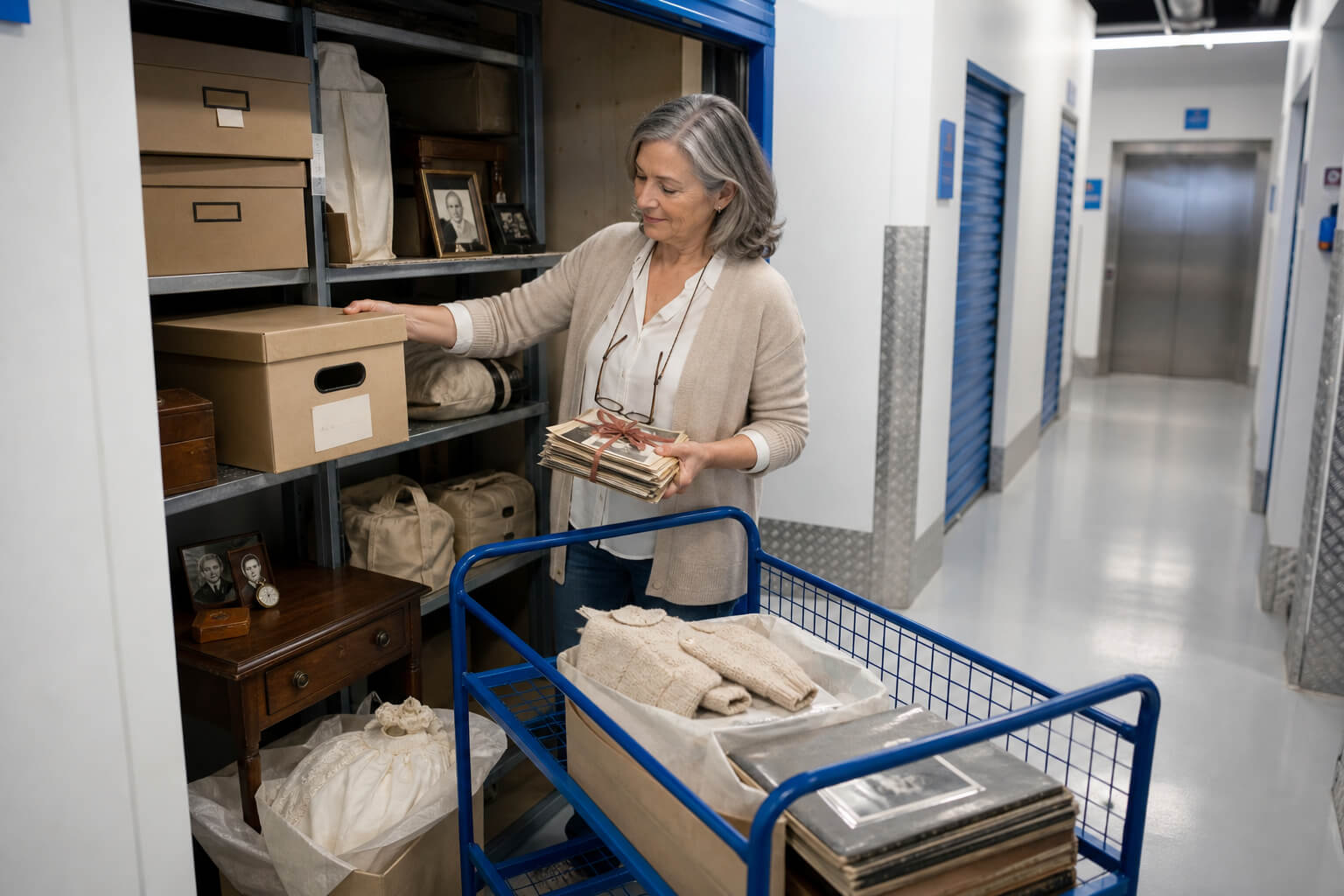
The loft feels safe because things go up there and stay up there. Out of the way, out of the decision. But a loft in a UK house is not a controlled environment. It is cold in winter, warmer in summer, and it breathes moisture up from the roof. Most loft spaces are not insulated against that movement. Things do not disappear up there. They degrade, slowly and invisibly, until one day you open the box and find that the photographs have stuck together, the paper has gone brown and spotted at the edges, and the fabric smells of something you cannot fix.
Why a cold, damp loft quietly ruins photographs, paper and wood
The damage is not from temperature. That is the common assumption, and it is the reason every storage advertisement reaches for “climate control” as its proof word. But in the context of a UK loft, the real enemy is damp, and specifically the condensation that forms when temperature changes cause moisture to move through uninsulated spaces.
Photographs suffer what archivists call foxing: the red-brown spots that appear on paper that has been exposed to humid conditions over time. The emulsion on older photographic prints can separate from the base layer when it absorbs moisture and then dries out repeatedly. Documents develop the same speckled browning. Paper warps and buckles. Wooden objects and furniture swell when they take on moisture and crack when they give it back. Textiles develop mildew that is very difficult to remove without damaging the fabric.
None of that requires a flood. It just requires a cold loft, a few winters, and the moisture that is already in the air of a British house. Clean, dry and secure storage interrupts that process honestly, without overpromising. That is the test that matters.
Why the skip feels final, and why you do not have to reach for it
There is a strand of advice that has spread through decluttering communities that says: if you want to keep a sentimental object but are not sure why, take a photograph of it and then let it go. The idea is that you keep the memory without the physical weight. It is not wrong, exactly. But it does not understand grief, and it does not understand the particular weight of objects that connect you to people you have lost.
The keeper is not being irrational. She is being responsible. These objects are not clutter in the ordinary sense. They are the physical evidence of people, relationships, and moments that deserve to be treated with some care. The pressure to “just sort it out” often comes from people who do not understand what is being asked of her when she is told to make that decision quickly, or on someone else’s terms.
You do not have to choose between the loft and the skip. You can choose to keep the things that matter, properly, in a place that looks after them. The question is how to do that without filling an entire room you do not have.
You can keep the things that matter, the defined-space way
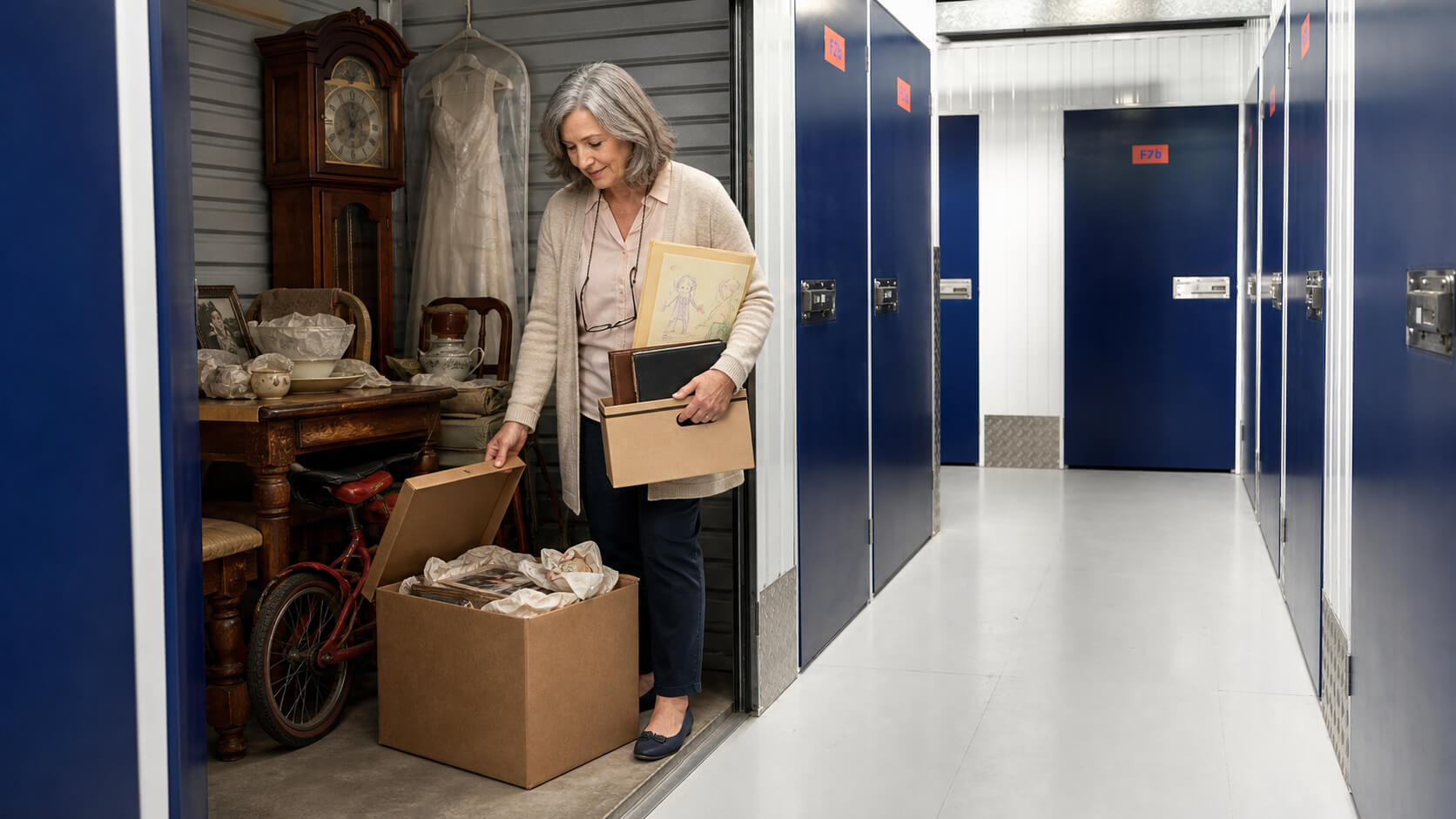
Keeping sentimental things well is not the same as keeping everything you have ever accumulated. The difference is intention. A defined space, decided in advance, gives you permission to keep without guilt, because you have chosen what goes in it rather than just avoiding the decision. That is the keeper doing the job well, not hoarding.
One memory trunk and a set number of archive boxes, not a room
The image worth holding onto is the trunk. One physical container for the things that are truly irreplaceable: the letters, the small heirlooms, the photographs of people who are gone. Beside it, a defined set of archive boxes, three or four at most to start with, for the wider category of things you are not ready to part with but that do not all need to live in the trunk. Together, that is a very small storage unit. It is not a wing. It is not a room. It is a deliberate, contained home for what matters.
This is where the idea of right-sizing begins to be practical rather than abstract. A 10 or 16 square foot unit is enough for a memory trunk and several archive boxes. A 25 square foot unit suits those boxes plus a few pieces of furniture you are holding from a family home. The point is that the physical container defines the category. You are not storing everything. You are storing the things that made it into the trunk and the boxes.
The 90/90 question, used gently, not as a rule to throw things away
You may have come across the 90/90 rule: have you used this item in the last 90 days, and will you use it in the next 90 days? If the answer to both is no, the rule says let it go. It is a useful question for a coat or a kitchen gadget. For a box of letters from your grandmother or the tea set from a marriage that no longer exists, it is the wrong tool, and applying it too strictly can lead you somewhere you will regret.
Will Stowe’s version is gentler: would it change something if this were gone? Would losing it be a loss you could not later undo? If the answer is yes, it belongs in the trunk. The 90/90 question can still help you decide what goes into the archive boxes rather than the trunk, and what you are perhaps ready to let go of. But it is a prompt, not a verdict. You do not have to follow it to the letter to feel like you are doing this right.
How to store sentimental things so they survive

Getting the items into a clean, dry, secure unit is most of the work. The packing matters too, and the principles are simple. The aim is to limit the movement of moisture and prevent physical damage from compression, contact and poor materials.
Packing photos and documents
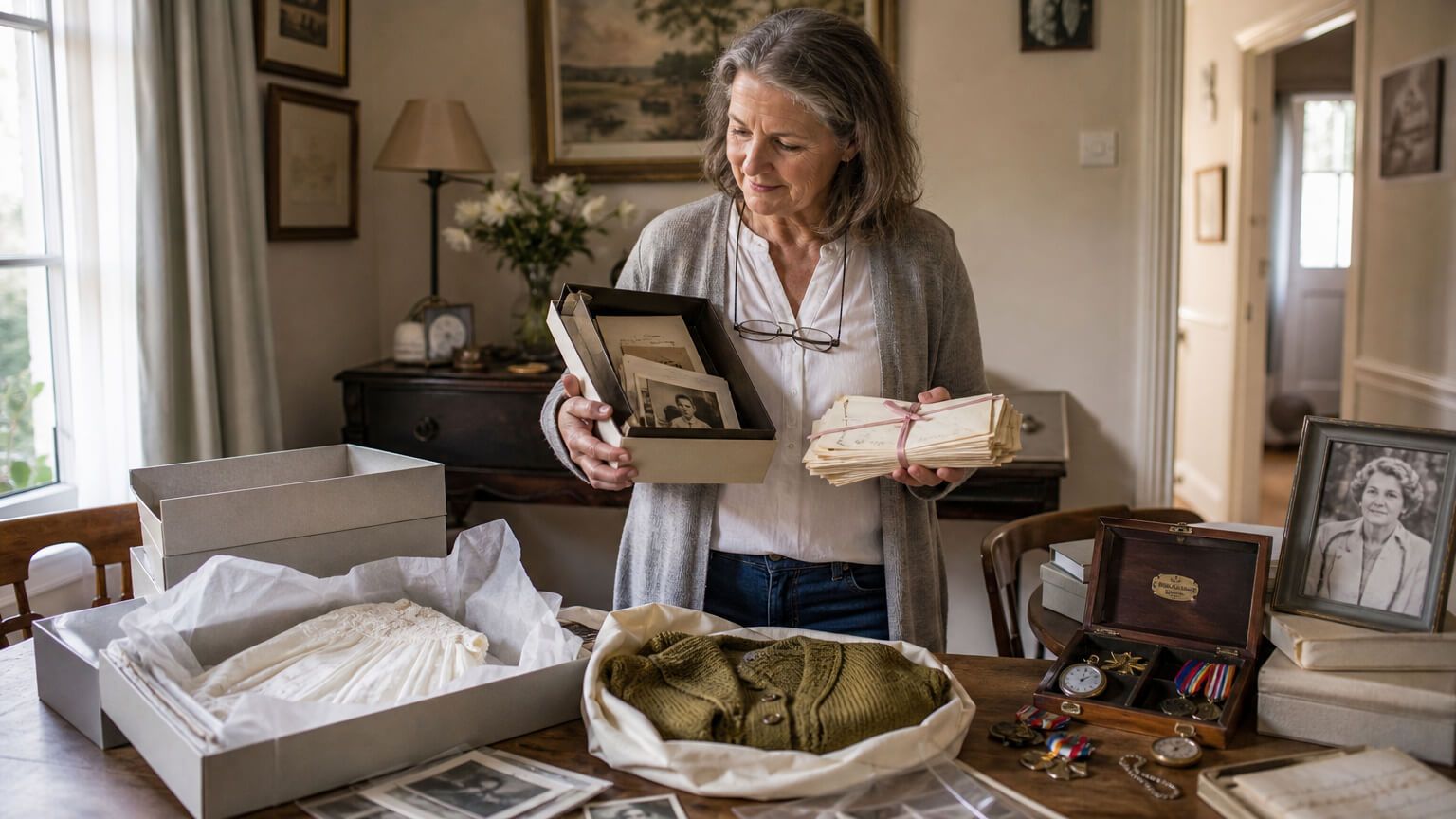
Photographs should be stored upright, not flat, in rigid boxes that will not flex under the weight of whatever is stacked on top. Do not put them in plastic bags: sealed plastic can trap condensation from the items themselves, particularly if they were not fully acclimatised before packing. Archival interleaving paper or acid-free tissue between prints prevents the emulsion from sticking to the surface above or below. Acid-free boxes and folders slow the natural deterioration of photographic paper and documents over time. Label each box clearly on the outside so you can find what you want without having to move everything to get to it.
Clothing and textiles
Clean the items before they go into storage. Any moisture, body oils or food residue left in a fabric will cause damage over time, and can encourage mildew if conditions change. Items need to be fully dry before they are packed. Use acid-free tissue to wrap individual pieces, and store in breathable boxes or cotton covers rather than sealed plastic containers. Vacuum-seal bags compress fabrics under pressure and can cause creasing that becomes permanent. They can also trap any residual moisture or off-gas from the bag material itself. Breathable is better.
Metals, silverware and small heirlooms
Silver tarnishes when it is exposed to sulphur compounds in the air. Anti-tarnish cloth wrapping or anti-tarnish strips placed in the storage box slow that process significantly. Wrap each piece individually so that surfaces are not in contact with each other. Note that silver can react with rubberised shelf liners, so if you are using shelves in your unit, lay a neutral cloth or acid-free tissue down first. Keep small valuables in a clearly labelled, sealed box where you can find them without disturbing everything else.
Furniture and wood
Breathable dust covers protect wooden surfaces from dust and from contact damage without trapping moisture against the wood. Plastic sheeting does trap moisture, which is the opposite of what you want. If the piece can be disassembled, do that before moving it into the unit: it protects joints under load and makes the most of a compact space. Elevate furniture off a concrete floor on boards or pallets, because concrete can transfer ground moisture upward. Clean the piece thoroughly and make sure it is dry before it goes in.
What actually damages keepsakes in storage, and what does not
Here is the honest version of an answer that most storage guides avoid giving, because most storage operators want to sell you climate control.
Damp is the enemy, not temperature: clean, dry and secure is the real test
Climate control in self-storage means maintaining a unit within a narrow temperature and humidity band year-round. It is expensive, it is energy-intensive, and for the vast majority of household keepsakes stored in a UK self-storage unit, it is more than the problem requires. The specific risk that ruins photographs, paper, wooden pieces and textiles in UK storage is damp: condensation from temperature change, moisture from packed-while-damp items, and humidity that has nowhere to go.
A clean, dry and secure unit, with individually alarmed access and a building that is properly maintained, addresses that risk directly. Wigwam does not offer climate control, and this is where that honesty matters: we are not a luxury product, and you do not need a luxury product for a memory trunk and four archive boxes. What you need is genuinely dry, genuinely clean, and genuinely secure. That is what we offer.
The practical things that make the biggest difference are within your control: bring items in dry, use breathable rather than sealed packing, place silica gel sachets in boxes to absorb residual moisture, and do not overpack so tightly that air cannot move. Damp arrives with the items more often than it arrives from the unit itself.
What does not belong in a unit at all
Honest limits are part of the service, so here they are. Perishable food does not belong in a self-storage unit. Hazardous or flammable materials do not belong in one. Living things cannot be stored. Wigwam sites are unmanned and not set up for animals of any kind. Vehicles, caravans and boats are not something Wigwam offers storage for. If you are clearing a family home and have items in those categories, those need separate arrangements.
This is not a long list, and it is not meant to be alarming. Most keepsakes, heirlooms, household textiles, furniture, documents and photographs are fine. The boundary is simply around the categories that create safety or legal risks in a shared, unmanned facility.
When you are ready to see what size unit suits what you have and get a quote, start here: quote.wigwamstorage.co.uk
How much space you actually need
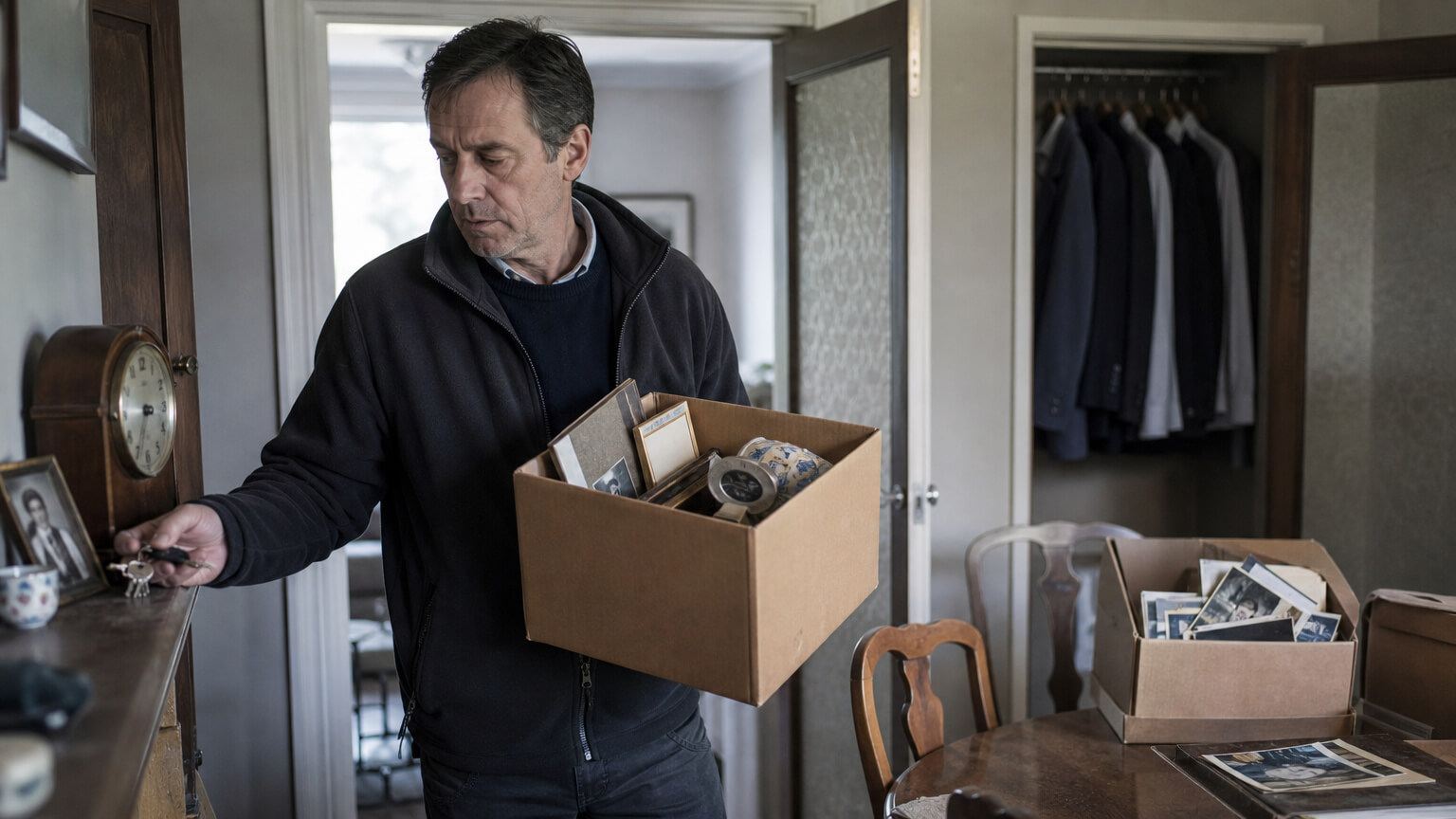
One of the things that holds people back from getting a unit is the assumption that it will cost more than it is worth, or that they will end up with a room they cannot fill and cannot justify paying for. The short answer is: for a memory trunk and a set of archive boxes, you probably need less space than you think, and the cost per month is likely to be considerably less than the guilt of leaving things in the wrong place for another year.
A few boxes versus a roomful: right-sizing so cost does not spiral
A 10 square foot unit fits a memory trunk and several archive boxes with room to access them comfortably. A 16 square foot unit gives you a bit more room around the trunk, or accommodates a couple of smaller pieces of furniture alongside the boxes. A 25 square foot unit is appropriate when you are also holding furniture from a family home: a chest of drawers, a bedside table, chairs wrapped and stacked. These are illustrative sizes; current dimensions and pricing are on the Wigwam pricing and size guide, which is worth checking before you book.
The right-sized unit is the one that fits what you actually have, with room to get in and find things, rather than the largest available on the assumption that you will fill it eventually. The defined-space approach means you already know roughly how much space the trunk and the boxes will need. That clarity makes the booking straightforward.
A two-week minimum stay and a refund of unused days if plans change
The minimum stay at Wigwam is two weeks. If you need to leave early after that, unused days are refunded. There is no deposit, so nothing of yours is held while the things are with us. The full terms are at wigwamstorage.co.uk/terms-conditions.
For someone who is unsure how long they will need the space, that flexibility matters. If you are clearing a parent’s house and holding things while the family makes decisions, you are not locked in to a year-long commitment. If circumstances change and you need the items back sooner than expected, the financial exposure is limited. That is worth knowing before you decide whether this makes sense for your situation.
Keeping them safe and keeping them close
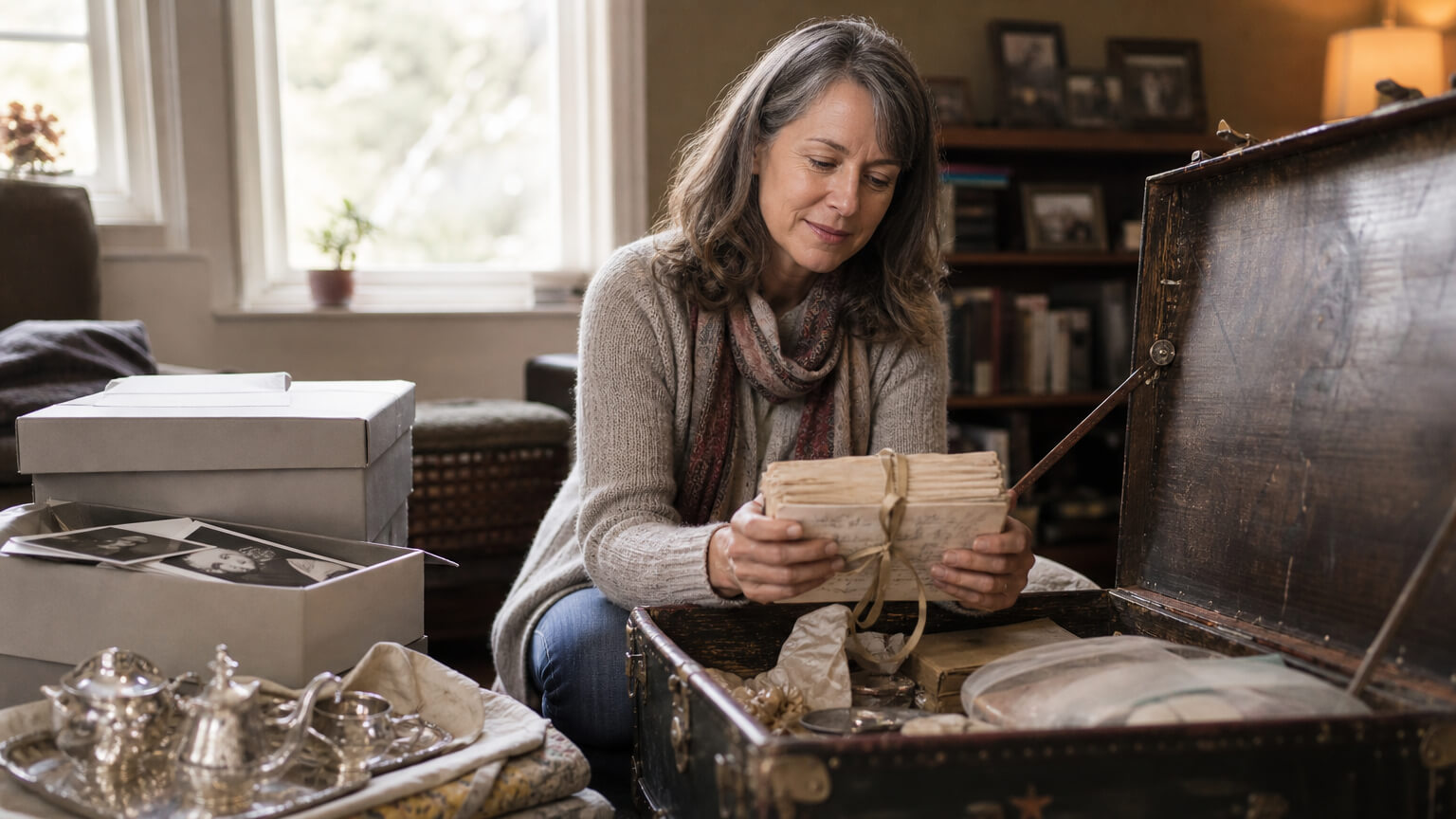
Security in self-storage is not just about the site perimeter. The meaningful question is whether your specific unit, with your specific things in it, is properly protected. Wigwam’s answer to that is individual alarm on each unit rather than shared site-level security alone.
Individually alarmed units, smart entry, access 6am to 10pm
Each unit at Wigwam has its own alarm. If your unit is accessed without your smart entry, the alarm is specific to your unit, not a general building alert. Access is via smart entry from 6am to 10pm, seven days a week. That is not 24-hour access, and if late-night access is a firm requirement for your situation, that is worth knowing before you book rather than after.
Wigwam sites are unmanned. You access your own goods directly. If you are arranging for items to be delivered to your unit, note that someone from your own party needs to be present to receive them. Wigwam does not sign for or receive deliveries on your behalf.
Visiting your things: storage does not mean out of your life
The keeper motif is important here. One of the fears that runs underneath the question of storage is that it becomes a form of abandonment: you put the things away and then you never see them again, and in five years you feel worse rather than better because they are in a box somewhere you have not visited.
That is not what storage has to mean. Six in the morning to ten at night, seven days a week, means you can go on a Saturday morning to find your grandmother’s tea set for a birthday. You can go in November to retrieve the box of Christmas things before the school holidays. You can add a new box of letters when a parent passes, and take the time to sit with the older ones if you need to. The unit is not a warehouse where things disappear. It is a place you chose, close to where you live, that you can visit whenever suits you. The keeper is still keeping.
Cover for the irreplaceable
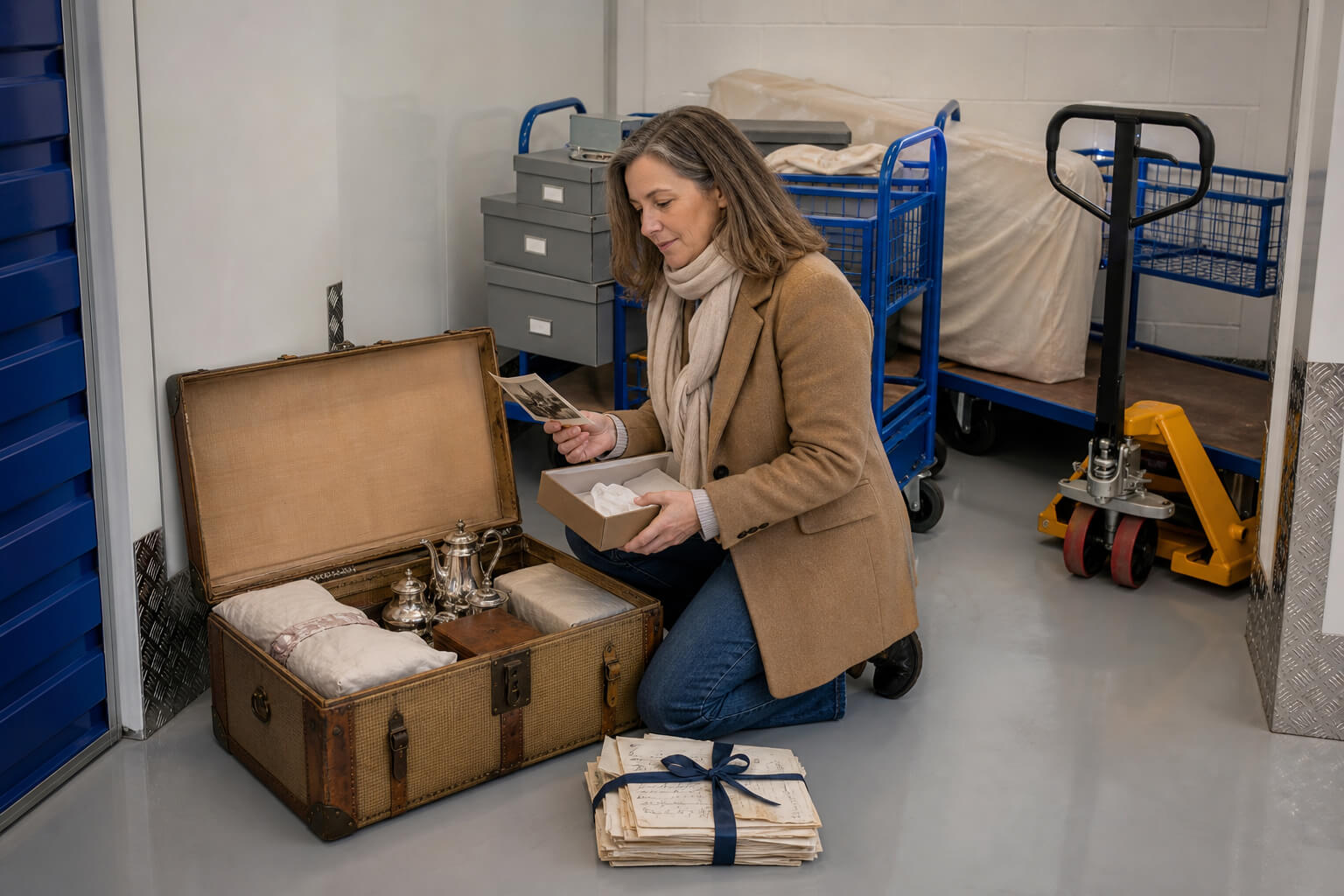
Before we get to locations, there is one more thing to address, because it is the question that tends to arrive late in the decision and then feel urgent.
Why you insure stored goods, and where to read the policy yourself
Contents cover is a requirement for storage at Wigwam. You can take Wigwam’s RSA “Self Storage Customers’ Goods” policy, or you can provide evidence that your own policy covers goods in self-storage. This is not optional, and it is worth taking seriously for sentimental items precisely because they are irreplaceable.
The key facts about the Wigwam policy are these, stated plainly so you can read them against your own situation: it is a New-for-Old replacement policy; there is a £50 excess; you must declare the full replacement value of your goods, and any claim is settled in proportion to the value declared (so under-declaring the value reduces your payout accordingly); theft is only covered if there is evidence of forced entry to your unit; and atmospheric or climatic damage is excluded. Those terms may affect your decision about which cover to take, and they are set out in full at wigwamstorage.co.uk/contents-protection.
For items of significant monetary or sentimental value, read the policy carefully. If you are unsure whether the cover is right for your specific situation, speak to your own insurance adviser. This is information, not advice, and the policy document is the right place to start.
Where to keep them, close to home
The practical final question is where. A unit that is an hour’s drive away is not the same as one that is part of your town.
Market-town locations and how to get a quote
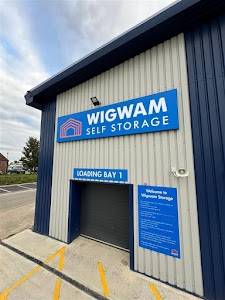
Wigwam is in UK market towns. That is the deliberate choice: not the industrial estate on the edge of a city, but the town you live in or near, where you can stop in on the way back from the farmers’ market or on a Sunday morning when you want to spend half an hour going through the boxes. Wigwam Self Storage Bath and Wigwam Self Storage Lincoln are two of those locations. For the full list, our UK market-town locations has every site with directions.
The quote is straightforward. It asks you for your postcode and a rough sense of what you have. It does not commit you to anything. It just gives you a number to work from so you can decide whether this makes sense. When you are ready: quote.wigwamstorage.co.uk.
Frequently Asked Questions
Yes, but deal with the damage and the moisture first, because storing a damp or musty item alongside dry ones risks spreading the problem rather than containing it. A clean, dry, secure unit interrupts further deterioration, which is exactly what you want for something that has already suffered in a cold loft. But the unit cannot reverse damage that has happened, and a piece that is still carrying moisture or active mould needs attention before it goes in, not after.
The honest approach depends on the item. Anything visibly mouldy or genuinely wet should not be packed straight into a box, because sealed in, the moisture has nowhere to go and the mildew keeps working. Let things dry out fully and air properly first. For textiles, that often means a gentle clean and complete drying before wrapping in breathable cotton or acid-free tissue. For paper and photographs, the damage from foxing or sticking is frequently beyond a home fix, and forcing apart stuck prints can destroy them.
For anything of real monetary or sentimental value that is already showing damage, the right call is to speak to a conservator before you do anything irreversible, rather than guessing. A specialist can advise on whether a piece can be stabilised and how to handle it. Once items are clean, fully dry and properly packed, breathable wrapping, silica gel sachets in the boxes, nothing sealed in plastic, a dry, individually alarmed unit gives them a far better future than the loft that damaged them in the first place. The packing section above sets out the method.
You manage this mostly through good packing and the occasional visit, rather than relying on any monitoring system, because a Wigwam unit is a clean, dry and secure space, not a climate-controlled one with humidity readouts. The building is maintained to stay dry, and that, combined with sensible packing, is what protects keepsakes from the damp that ruins them in a loft. What you bring to it is preparation and the habit of looking in now and then.
A few practical signals are worth knowing on a visit. A musty smell, any sign of condensation on surfaces, or boxes that feel damp to the touch are the things to notice. In practice, the moisture that causes trouble usually arrives with the items rather than from the unit itself, which is why bringing things in dry, using breathable rather than sealed packing, and placing silica gel sachets inside boxes matters so much. Refreshing or replacing those sachets is a good reason to drop in.
As for how often, there is no rule, and it depends on what you are storing and how settled your mind is. Some people visit every few weeks, partly to check and partly because the things still matter to them; others look in a couple of times a year. Smart entry from 6am to 10pm, seven days a week, means you can go whenever suits without booking ahead. For genuinely precious or fragile items, a check every few months to refresh silica gel and reassure yourself is sensible. The unit is not a place where things vanish; it is a place you chose, close to home, that you can keep an eye on.
You can keep adding, and most people do, because life keeps producing things that belong in the trunk. A unit is not sealed once you set it up; it is your space to come and go from within the 6am to 10pm window, seven days a week, by smart entry. You can bring a new box of letters when a parent passes, add the order of service from a funeral, or fold in the small inherited things that arrive as an estate is settled, whenever you are ready.
The thing to plan for is space. The defined-space approach in this piece, one memory trunk and a set number of archive boxes, works best when you allow a little room to grow rather than packing the smallest possible unit solid on day one. If you expect to add over the years, it is worth choosing a size with some give in it, so a new box does not mean a unit move. A 16 square foot unit, for instance, gives more room around the trunk than the smallest locker, and a step up again accommodates a few pieces of furniture alongside.
If you do outgrow the space, changing to a larger unit is straightforward: you take the new size and clear the old one, with the two-week minimum applying per unit, and no deposit on either. There is no penalty for resizing as your needs change. The practical tip is to keep the archive ordered as you add to it, label every new box on the outside, and put the things you visit most near the door, so the unit stays a place you can find things in rather than a pile that grows past the point of usefulness.
The trunk is for the irreplaceable: the things whose loss could never be undone. That is the test worth holding onto, and it is gentler and more useful than the 90/90 rule, which was written for coats and kitchen gadgets, not for a box of letters. The question to ask of each item is the one in this piece: would it change something if this were gone, and would losing it be a loss you could not later recover? If the answer is yes, it goes in the trunk.
The archive boxes are for the wider category: things you are not ready to part with, that have meaning but are not singular and irreplaceable. Duplicate photographs, the bulk of a collection, things connected to a memory but not the only evidence of it. The 90/90 question works gently here, as a prompt rather than a verdict, to help you decide what stays in the archive and what you might, in time, feel able to let go.
The let-go pile is for what you are keeping out of habit or guilt rather than meaning, and there is no rush to fill it. The whole point of a defined space is that you do not have to decide everything at once. Things can sit in the archive while you make up your mind, and a unit held on a flexible stay, two-week minimum, no maximum, unused days refunded if you leave early, means there is no deadline forcing the choice. Many people find the trunk fills quickly with the obvious irreplaceable things, the archive takes the maybes, and the let-go pile grows slowly and honestly over later visits, once the pressure is off.
The smallest unit is a small locker, and it is already modest, roughly the interior of a garden shed, but it is sized to hold a good deal more than one or two boxes. There is not a sub-locker tier below it, so if you genuinely have only a box or two, the honest position is that the smallest locker will have room to spare, and you are paying for a little space you will not fill. For most people that is still a sensible trade, because the alternative is leaving irreplaceable things in a damaging loft.
There is a practical upside to the spare room, though. A small locker that is not packed solid is easier to access, you can reach the box you want without unstacking everything, and it leaves room to add to over time, which sentimental collections tend to do. A single box today is rarely a single box in five years. So the locker that feels slightly large now often turns out to be the right size as letters, photographs and the occasional inherited keepsake accumulate.
If the cost of even a small locker feels out of proportion to one box, it is worth thinking about whether you can sensibly combine. Many people in this position are holding a memory trunk plus a few archive boxes rather than truly just one, once they gather everything scattered around the house. Pulling it all together often justifies the locker comfortably. For current sizes and what they cost, the pricing and size guide is the place to look, and a no-obligation quote at quote.wigwamstorage.co.uk gives you the figure for your nearest market-town location.