Turning the spare room into a nursery before the baby arrives?
You know the moment. You are standing in the spare room, the one that has been quietly gathering everything you did not know where to put, and you are working out how it becomes a nursery by the time the baby arrives. The sofa bed is in there. The wardrobe. Three boxes you have not opened since you moved in. There is no obvious answer about where any of it goes.
The good news is that there is more time than it probably feels like right now. The part nobody tends to mention is that the nursery does not actually have to be finished before your due date. It can wait. The baby cannot wait, obviously, but the room can.
That is what this piece is about. Clearing the spare room without throwing out the things you want to keep, finding somewhere clean and accessible for the furniture, and doing it at a pace that suits a real family, not a removal deadline.
There is no rush (the part nobody tells you)

Most people feel a quiet pressure to have the nursery finished, painted, furnished, and perfect before the baby comes home. That pressure is real but it is not backed by the evidence. The practical situation is more generous than the nesting instinct suggests.
Safe sleep and the first six months
The NHS and The Lullaby Trust both advise that babies sleep in the same room as their parents for at least the first six months of life. This is widely recommended guidance on safer sleep, and it means that a newborn does not need a fully fitted nursery on day one. They need you, and the cot or Moses basket beside your bed.
That single fact reframes the whole job. If the spare room will only be used as a nursery from around six months in, you have that time to clear it, decorate it, and furnish it without a hard deadline pressing on every decision. (For the current guidance in full, see the NHS safer sleep pages and The Lullaby Trust website. We are not giving medical advice here, only pointing to the source that confirmed what many new parents find genuinely reassuring.)
Clear the room at your own pace
Because the window is real, the job is a plan rather than a panic. One room, cleared in stages, with the displaced furniture going somewhere clean and reachable rather than into a skip or the back of a van to your parents’ house. You can decide what stays, what goes into storage, and what you are genuinely done with, without doing it all in a weekend under pressure. That kind of unhurried sorting tends to produce better decisions.
What to store and what to keep at home

Before you think about unit sizes, it helps to do the sort. Three piles is enough.
The keep, store, let-go decision
Keep at home the things you reach every day or need in the first few weeks: the Moses basket or bedside crib, the nappy bin, the bouncy chair, the monitor. Anything the baby or you will want in the first months stays in the house.
Store the things you want to keep but do not need daily: the spare bed or sofa bed, the wardrobe, the chest of drawers, seasonal clothes, boxes of things you are not ready to decide about. A unit that is a short drive away and open from 6am to 10pm means “stored” does not mean “lost forever.”
Let go the things you genuinely know you will not want again. That is entirely your call, and nobody should be making you feel guilty about it. This piece is not going to try.
The third pile is often smaller than people expect once they have thought it through calmly.
Storing for the next one: hand-me-downs, the cot, keepsakes
This is the part where the cot comes up. Many parents keep the cot from baby number one, the pram, the newborn clothes, the small things that accumulate meaning quickly. These are worth keeping, and a clean, dry, individually alarmed unit is the right place for them while you wait for the next time they are needed.
“Clean, dry and secure” is the honest description of what a Wigwam unit provides. We do not offer climate control and we will not imply it. What we do offer is a facility that is maintained, swept, individually alarmed, and dry, which is what hand-me-downs and keepsakes actually need. The pram stays in good condition. The cot flatpacks neatly. The baby clothes, well wrapped, will be ready when the second baby arrives.
Keeping these things is not hoarding. It is forward planning. The difference between a family that stores sensibly and one that throws everything out is usually a few hours of sorting and a reasonably priced unit.
When there is no spare room
Not every home has a dedicated room to convert. If you are in a flat, a smaller terrace, or a house where the “spare room” is more of a cupboard with aspirations, the nursery might be a corner of the main bedroom, a partitioned box room, or a section of the living room for the first year.
Self storage still helps here. The furniture and boxes that cannot fit anywhere inside the house have somewhere to go, and you get back the space you need without permanently losing what is in it. The unit becomes the overspill that every small home eventually needs.
Smart storage at home (what you do not need to send away)

Not everything in the spare room needs to go into a unit. Part of keeping costs sensible is using the space you have at home more cleverly before you rent anything at all.
Vertical space, under-cot baskets, and toy rotation
Wall shelving above head height holds a surprising amount. Under-cot baskets and drawer systems are purpose-built for nurseries with limited floor space. Vacuum storage bags compress seasonal clothes and spare bedding down to almost nothing. A simple rotation system, one box of toys in the nursery and one in the unit, means the nursery stays uncluttered without anything being thrown away permanently.
These small moves can reduce what you need to store outside the house by a meaningful amount, which keeps the unit smaller and the monthly cost lower. We would rather you rented the right size than a larger one you do not need.
What the unit holds that the home cannot
The home holds the things you reach every day. The unit holds everything else. The spare bed for when the grandparents stay over. The pram in the months between the baby fitting in the sling and needing the buggy again. The wardrobe of clothes to grow into. The boxes you want to revisit at six months when you have more headspace.
Smart entry runs from 6am to 10pm, seven days a week. If you need the travel system for a weekend away, or the Moses basket because you are going to stay with family, you collect it yourself when it suits you. Access is on your schedule, not ours.
What size unit you need
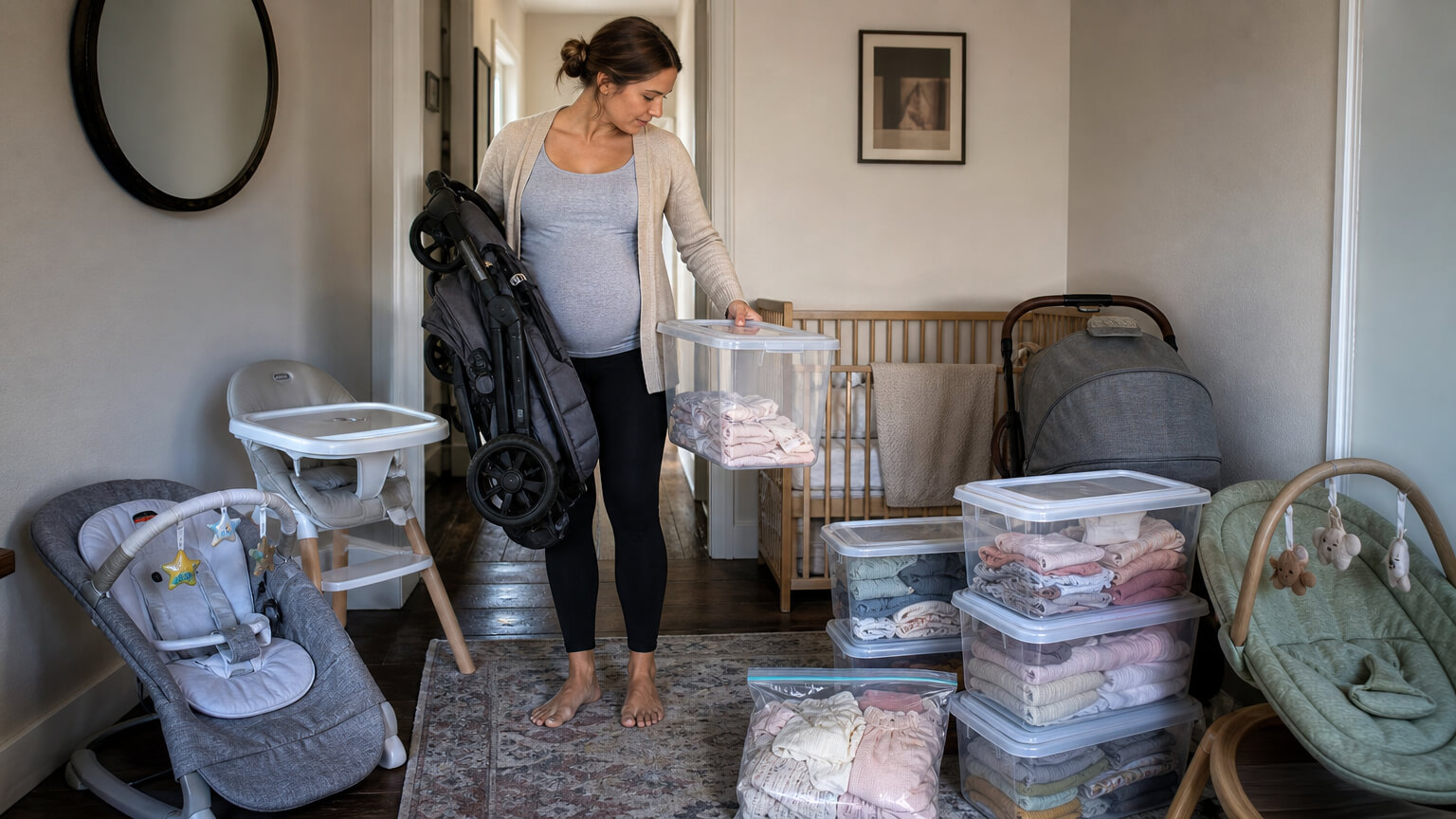
The honest answer for most new parents clearing one spare room is somewhere between 25 and 50 square feet. Here is a straightforward guide.
Sizing table
| Unit size | Fits roughly | Typical new-parent use |
|---|---|---|
| 25 sq ft | A few boxes, small furniture, keepsakes, baby clothes, toys | Clearing clutter and keepsakes from one wardrobe or corner |
| 35 to 50 sq ft | Spare bed or sofa bed, wardrobe, pram, cot, chest of drawers | Emptying a whole spare room or home office to become the nursery |
If you are in doubt, size up by one. Moving things twice because you underestimated costs more than the slight extra on a bigger unit from the start.
If you are not sure, start with a quote
The easiest way to size a unit is to describe what you are clearing. When you request a quote, tell us what is coming in and we will suggest the right size. There is no obligation in getting a number, and it is quicker than trying to measure the sofa bed.
Ready to see what a unit near you costs? Get a quote at quote.wigwamstorage.co.uk – no commitment, just a number.
How long, and how much

The cost of storage is one of the things people worry about most and look up least. This section covers the terms plainly and points you to where the pricing actually lives.
Flexible stays and the two-week minimum
The minimum stay at Wigwam is two weeks. That is genuinely short for a life-event hire, and it means you are not committing to months of storage while you are still working out what you want to do. After the minimum, the tenancy runs month by month. If your situation changes, or the nursery takes less time to clear than you expected, the tenure adjusts with it.
If you leave before the end of a billing period, unused days are refunded. You pay for what you use.
There is no deposit
There is no deposit when you take on a unit. After a 14-day notice period, once you have vacated the unit and your account is settled, any days you have paid for but not used are refunded, less anything outstanding on the account. That is the full picture.
We say this plainly because some storage providers do not, and we think you should know what you are agreeing to before you sign anything. The full terms are at our terms and conditions page.
Where to find the pricing
We do not list prices on this page because they vary by location, unit size, and time of year. The clearest place to see what storage costs across our UK market-town locations is the how much is self storage in the UK page. It will give you a realistic range before you commit to anything.
What happens to your things while they are in storage

Clean and dry matters when you are storing a cot, a wardrobe, and boxes of things you care about. Here is what that actually looks like in practice.
Clean, dry and secure: what that means in practice
Our units are individually alarmed, maintained, and on or near the high street in our UK market-town locations. We use “clean, dry and secure” because that is what we can honestly say. We do not offer climate control, we will not imply it, and any page that promises to regulate temperature or humidity for your stored keepsakes is overstating what standard self storage does.
What “dry” means in this context is that our facilities are maintained and not damp. What it does not mean is a controlled environment with guaranteed humidity levels. If you have specific concerns about very valuable or moisture-sensitive items, a conversation with a specialist storage provider or your insurer will give you a clearer picture than we can.
Contents protection: the honest picture
Contents cover is a requirement, not an option. You can take the Wigwam contents policy, which is underwritten by RSA under the Self Storage Customers’ Goods scheme, or you can bring proof of your own equivalent cover. Either way, cover is in place before your goods go in.
The most important thing to know about any storage insurance is to declare the full replacement value of what you are storing. Under-insurance is settled in proportion, which means if you declare half the value and make a claim, you recover roughly half of your loss. Declare the real figure. The contents protection page sets out the full detail of the policy available through us.
For keepsakes with high sentimental or financial value, jewellery, irreplaceable documents, or anything unusual, we would point you to your home insurer or an independent broker. We are not giving insurance advice, only being clear about what our policy covers and what responsible declaration looks like.
Unmanned sites and self-access
Our sites are unmanned. That is not a limitation; it is how the model works. You use smart entry to access your own unit from 6am to 10pm, seven days a week. You are in control of when you go in and what you move.
The one practical point to be aware of: if you are having something delivered directly to the storage site, whether a pram, a piece of furniture, or anything else, someone from your side needs to be there to receive it. Wigwam does not sign for couriers or accept deliveries on your behalf. This is worth knowing in advance so you can plan accordingly. The access hours give you a wide window; you just need to be the one there.
Why local self storage works for a new parent
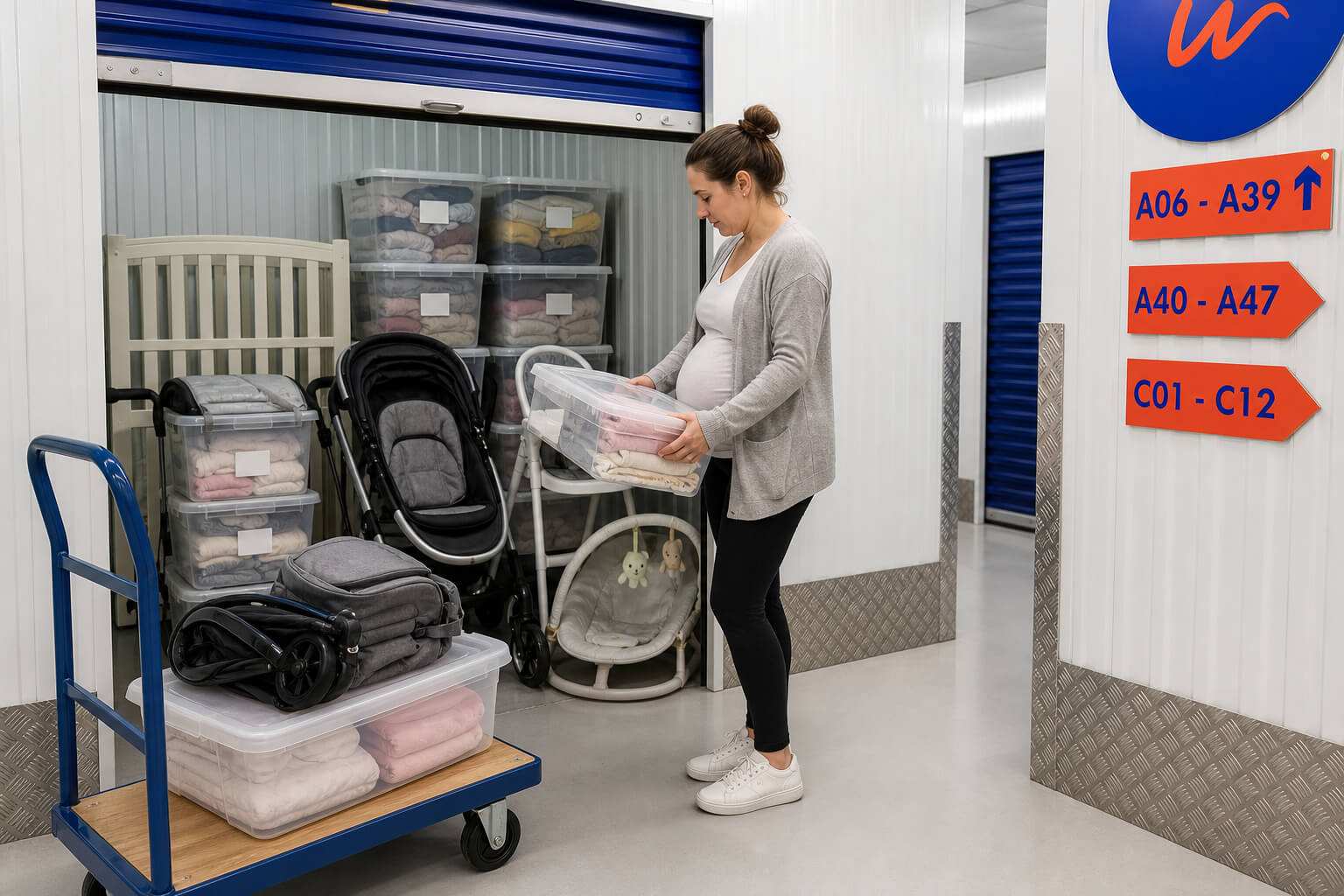
There is a difference between a national storage brand on a ring-road industrial estate and a market-town facility a short drive from where you live. The difference matters more when you are a new parent.
Near where you live, open when you need it
Wigwam Self Storage Bath and Wigwam Self Storage Lincoln are examples of the kind of locations we have. Market-town sites, accessible from 6am to 10pm, in towns where families actually live rather than in an out-of-town warehouse complex. For all of our UK market-town locations, the locations page will show you what is nearest to you.
Short distances matter when you have a newborn at home and a narrow window to collect something. Being ten minutes away rather than forty changes whether a trip to the unit is something you do or something you put off indefinitely.
No jargon, no pressure
The honest truth is that most storage providers talk about their units in terms of promotions, lock-in deals, and competitor comparisons. We tend not to do that. The people who enquire with us are usually at a practical decision point, and they want a straight answer about size, cost, and access, not a sales pitch.
If you are a new parent clearing a spare room, you have enough going on. The right answer for you might be a 25 sq ft unit for six months while you sort through what you want to keep. It might be a 50 sq ft unit for a year while the house adjusts to a new person living in it. It might be that storage is not the right move at all and the loft or a family member’s garage serves you better. We will tell you which, and we will not push you into a unit size or a tenure that does not suit you.
Getting started when you are ready
When the time feels right, the process is straightforward. Pick a location near you, get a quote that tells you what the right size unit costs, and move in what you want to keep safe. Your things are accessible from 6am, seven days, whenever you need them.
The room that was full of a sofa bed and three years of accumulated life becomes the nursery when you are ready for it to. Not on anyone else’s schedule. Not before the baby needs it. The things that belong in that room will be there, in a clean, dry unit nearby, waiting alongside you.
If you are still weighing the decision, the two-week minimum and the absence of any deposit mean you are not locked into anything long-term. Try it for the short stretch you need. If the room clears faster than expected, you vacate, give 14 days’ notice, and any unused days come back once the account is settled.
Find a Wigwam location near you and get a quote at quote.wigwamstorage.co.uk. No commitment, no pressure.
Frequently Asked Questions
Before, if you can, and ideally in the calmer middle stretch of the pregnancy rather than the last few weeks. The honest reason is energy and logistics. Once the baby is here, you have a newborn, broken sleep, and very little appetite for hauling a sofa bed out of a room. Sorting, packing and moving furniture is far easier while you still have two free hands and a reasonable night’s rest. If you are going to clear the room at all, the second trimester tends to be the sweet spot: the early tiredness has usually eased and you are not yet at the heavy, unwieldy stage.
That said, do not let “before” tip into panic. As the article explains, the room itself does not need to be a finished nursery on day one, because safer-sleep guidance has the baby in with you for the first months anyway. So the realistic plan is to do the heavy clearing before the birth, move the furniture you are keeping into storage, and then decorate and set the room up at a gentler pace over the following months. If the baby arrives before you have managed to clear it, that is genuinely fine, the room can wait, and you can move the furniture out when you have a free weekend and some help. The two-week minimum and the absence of a deposit mean you are not committing to a long stretch, so you can take a unit whenever the clearing actually happens rather than booking early and paying for empty weeks. Get the quote when you are ready to move things, not before.
Store it clean, fully dry, and protected from knocks, and it will be ready when you need it again. The two real risks to baby furniture in storage are damp getting into it and physical damage from being stacked badly, and both are avoidable with a bit of care at the packing stage. Our units are clean, dry and secure, which is the right environment for this, but how you prepare the items matters just as much as where they go.
A few practical steps:
- Clean everything first. Wipe down the cot, the changing unit and any plastics, and make sure fabric items like a Moses basket liner or cot bumper are washed and completely dry before they go in. Anything stored slightly damp can develop a smell or mould over months.
- Flatpack the cot if you can. A dismantled cot takes far less space, is less likely to get knocked out of true, and is easier to stack safely. Keep all the bolts and fittings in a labelled bag taped to one of the panels so nothing goes missing before reassembly.
- Bag soft items properly. Vacuum bags or sealed boxes keep newborn clothes, blankets and the mattress clean and dry. Store the cot mattress flat and off the floor, not folded.
- Label by what is inside. “Cot fittings”, “newborn 0 to 3 months”, “pram parts”, so you are not opening every box when the next baby comes.
One thing worth flagging on the mattress specifically: safer-sleep guidance is cautious about reusing cot mattresses, so when the time comes, check the current NHS and Lullaby Trust advice on whether to reuse or replace it. We are not giving medical advice, only pointing you to where the proper guidance lives. The furniture and the keepsakes store and reuse happily; the mattress is the one item worth a fresh look before the next baby uses it.
Yes, and a lot of new parents do exactly this, because a pram or travel system spends real chunks of its early life unused. Between the baby fitting happily in a sling and then needing the buggy again, or in the gap before a second child arrives, the travel system is bulky and in the way at home but you do not want to part with it. Storing it and fetching it when you need it is a sensible middle path. Smart entry runs from 6am to 10pm, seven days a week, so collecting it for a weekend at the grandparents’ or a holiday is a quick errand you fit around your day.
The thing to plan for is that you are the one who collects it. Our sites are unmanned, so there is no one to fetch it out for you or have it waiting at a desk; you go in yourself by smart entry and get it. That is easy enough if you pack with retrieval in mind: keep the pram near the front of the unit rather than buried behind the wardrobe, and store it assembled or part-assembled so you are not rebuilding it in a cold unit before a trip. If you think you will be in and out for the pram regularly, mention that when you get a quote, because it can be worth a slightly more accessible unit layout. Store it clean and dry, keep it reachable, and the occasional in-and-out is no trouble within the 6am to 10pm window.
That is a personal call, but storage can buy you time to decide rather than forcing the decision now, which is often the real value for parents who are genuinely unsure. The mistake people regret most is giving everything away in the exhausted first months, only to find a second baby on the way two years later and the cot, pram and clothes long gone and expensive to replace. Storing the core, reusable items, the cot, the pram, the better-quality clothes and the things that hold meaning, keeps the option open without cluttering the house. You are not committing to a second child; you are simply not closing the door while you are too tired to think clearly about it.
The way to keep this sensible rather than open-ended is to be honest about cost and selectivity. You do not need to store every babygro and broken rattle “just in case”. Store the things that are genuinely worth keeping and genuinely expensive or annoying to replace, and let go of the cheap or worn-out items now. A smaller unit holding the worthwhile core costs less than a larger one holding everything, and we would rather size you to what you actually need. The two-week minimum and the absence of a deposit mean you can revisit the decision whenever you like: if you reach a firm “no” on a second child later, you give 14 days’ notice, clear the unit and settle up. If you reach a “yes”, everything is ready and waiting. Storage turns an irreversible decision into a reversible one, which for an undecided family is often exactly what is needed.
Yes. Whatever the reason you are storing, household goods cleared from a spare room for a nursery included, the same contents-cover requirement and the same policy apply. There is no special category for “baby” storage; it is ordinary household contents, and ordinary household contents stored with us must be covered, either by Wigwam’s RSA “Self Storage Customers’ Goods” policy or by proof of your own equivalent cover. So a cot, a sofa bed, a wardrobe and boxes of clothes are covered on exactly the same terms as any other furniture and belongings.
The point worth dwelling on for a new parent is honest valuation, because baby items are easy to under-value in your head. A travel system, a good cot, a nearly-new mattress and a wardrobe of barely-worn clothes can add up to a surprising replacement figure, and the policy settles claims in proportion to the value you declare. If you declare half of what your stored items are actually worth to replace and then make a claim, you recover roughly half. So when you declare the value, price the items at what it would cost to buy them new today, not what you paid or what they would fetch second-hand. For high-value or sentimental pieces, jewellery, irreplaceable keepsakes or anything unusual, it is worth a word with your own home insurer or a broker, because those can need handling beyond a standard goods-in-storage policy. We can point you to the contents protection page for what our policy covers, but we do not give insurance advice; for valuation questions on your specific items, your insurer or broker is the right person to ask.