Container or unit — which one actually suits what you’re storing?
A shipping container is a serious piece of kit. They have crossed oceans loaded with everything from car parts to electronics, survived salt air and heavy weather, and ended up repurposed as workshops, cabins and roadside pop-ups. If you have a yard and the things you need to put away are tough enough to take it, a container can settle the question on price alone.
But most people asking this question are not storing scaffolding poles. They are emptying a room for a rewire, clearing a property between buyers, or packing up a parent’s home and trying to find somewhere the contents will not suffer for it. For that kind of storage, the question is not which is cheaper per square foot. It is which one keeps your things in the same condition as when you packed them.
That is what this comparison is for. We have no skin in the container game – Wigwam does not sell or hire containers – so we can give you both sides honestly.
The short answer (before you read the detail)
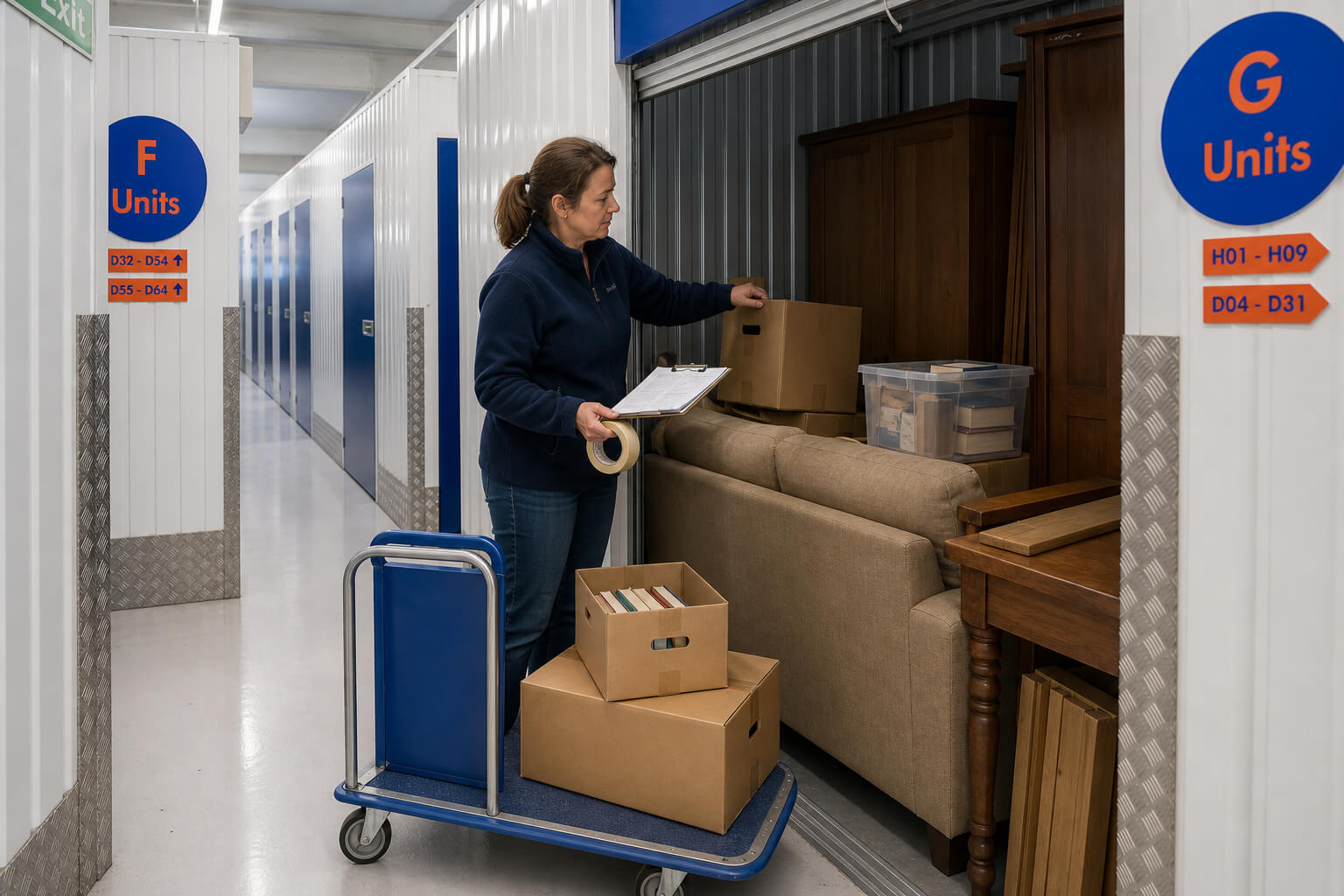
Here it is plainly, before any of the detail. A container tends to suit you if you own land with hardstanding, you are storing weatherproof kit for a long stretch, and the cost of delivery and setup is manageable against your timeline. A self storage unit tends to suit you if you are storing furniture, soft furnishings or household goods, you want clean and dry guaranteed, and you need flexible terms that follow the actual length of your job rather than locking you in.
The rest of this page walks through the why behind that steer across five practical axes: what you are storing, how long you need it, access, damp and security, and cost.
What “suits you” actually means
The decision is not really about price. It is about the relationship between your items and their environment. Outdoor-rated kit in a steel box on a yard is a sensible fit. A chipboard bookcase, a fabric sofa or a box of family photographs in an unheated steel container that sweats on cold nights is not. The access pattern matters too: if you need to get in and out regularly at short notice, the logistics of a container on your own land are different from a short drive to a market-town site with smart entry from six in the morning.
The one situation where a container probably wins
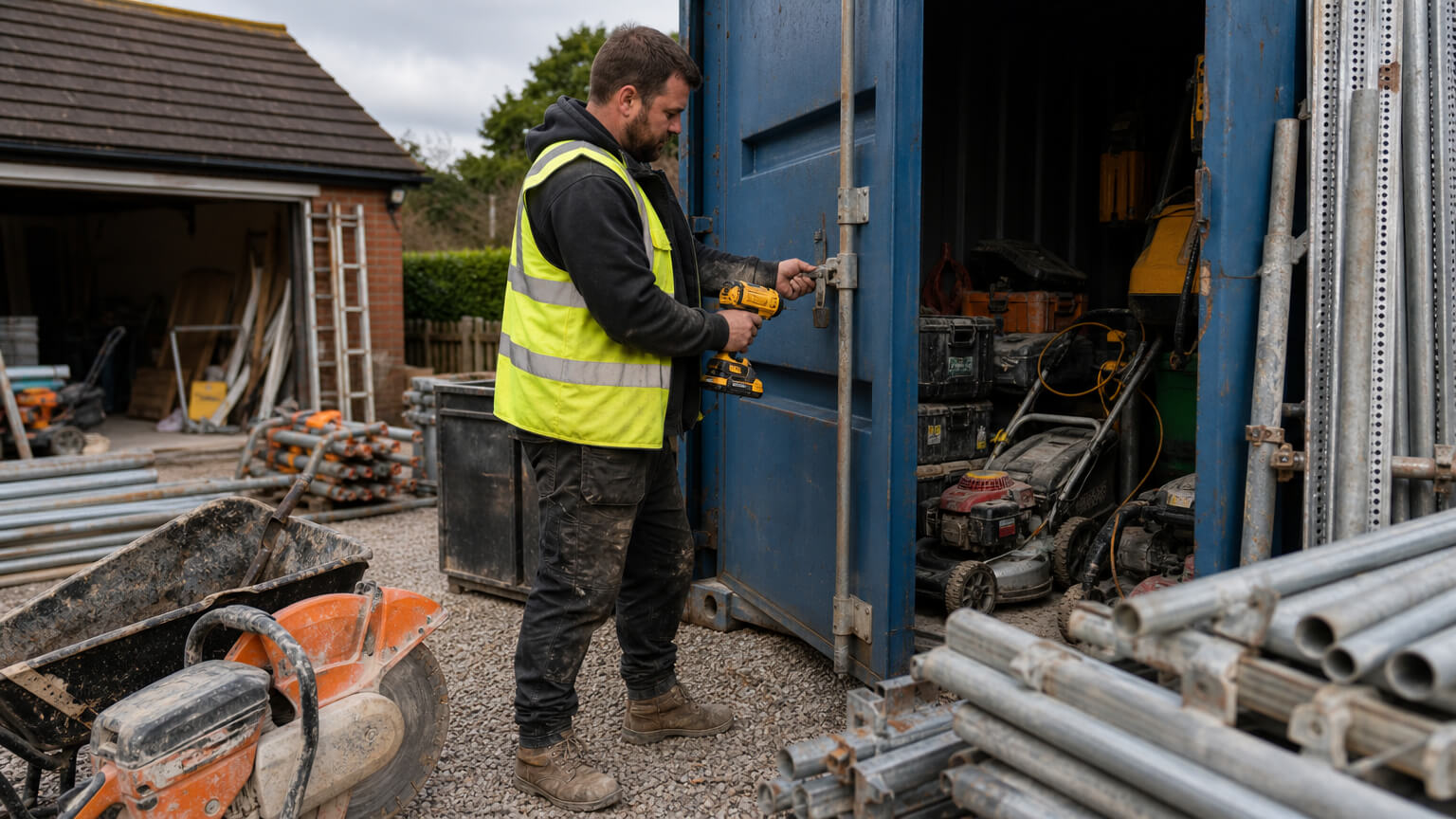
If you are a builder or a trade contractor with a yard, hardstanding already in place, and a stock of tools, machinery and building materials that can shrug off temperature swings and a bit of condensation – a container bought outright often works out cheaper over a year or more than paying monthly rent. That is a genuine advantage and it is worth naming. For that use case, the comparison is done before you finish reading.
What are you storing? The most important question

Your items decide the answer before anything else does. Getting this wrong costs you more than money.
Items that belong in a clean, dry, alarmed unit
Furniture. Upholstered chairs and sofas. Mattresses. Wardrobes and dressers in chipboard, MDF or veneer. Boxed books and paperwork. Clothing and bedding. Mirrors and framed pictures. Kitchenware and electrical goods. Anything with fabric on it, anything that absorbs moisture, anything that carries sentimental weight.
These are the things that a cold, sweating steel box can damage in weeks. Mould takes hold quietly. Chipboard swells and warps. Mattresses take on a smell they never quite lose. A clean, dry, individually alarmed unit in an enclosed building keeps all of that from happening. The contents stay as you left them.
Items that can genuinely cope in a container
Power tools rated for outdoor use. Lawnmowers and garden machinery. Steel building materials, scaffolding, pipe work. Heavy equipment already designed to sit outside between jobs. For these goods the container is a reasonable home: robust, weatherproof in the sense that it keeps direct rain off, and available in sizes from a single 20-footer to much larger.
The caveats worth noting: even weatherproof tools can take moisture damage if they are stored with damp packaging or sitting on a wet floor. And container condensation (more on this below) can still catch you out with tools that have wooden handles or electronic components. But for a working builder with dry kit and a practical yard, the container does the job.
What neither option will take
Neither a self storage unit nor a container is the right home for anything already damp or showing mould – you will seal the problem in and make it worse. Food, perishables and living things are out. Hazardous materials, flammable liquids, gas cylinders and anything that can leak or combust are not permitted in either a managed self storage facility or a responsible container hire arrangement. For the full list of what Wigwam does not accept, the terms and conditions set it out clearly.
How long are you storing for?

Duration changes the maths on both sides of this comparison. Knowing roughly how long you need the space tells you where each option works in your favour.
Short-term and medium-term storage (weeks to a few months)
A renovation that runs from four weeks to four months is the heartland for a self storage unit. The minimum stay at Wigwam is two weeks, and if the job finishes early, unused days are refunded. There is no need to buy something you then have to sell or arrange to have collected.
There is no deposit. That is the whole financial obligation: you pay while you use it, and nothing of yours is held back. Full terms are at wigwamstorage.co.uk/terms-conditions.
A container hired or purchased for the same short stretch carries a different shape of cost. Hire fees, delivery charges and collection at the end can add significantly to the headline rate. Buying a container outright gives you flexibility on timing but leaves you with a steel box you need to sell or move when you are done.
Long-term storage (a year or more) and the container purchase question
If you own land, you have hardstanding, and you are storing weatherproof goods for a long time – more than a year, say – buying a container can work out cheaper than monthly unit rent over that period. Container prices vary considerably by size, age and condition; sellers quote on request and the wider market is straightforward to search. The additional costs to budget for are delivery, any hardstanding or groundwork needed, and eventual removal or resale.
The honest caveat is this: if the goods you are storing are not actually weatherproof, the long-term cost calculation shifts. Replacing damp-damaged furniture costs more than the money you saved on rent.
Access: a steel box at home versus a unit a short drive away
Most people underestimate how much the access pattern matters until they are three weeks into a renovation and need to find the breadmaker at seven on a Saturday morning.
Having a container on your own land
The advantage is obvious: it is on your property, and you can get to it whenever you like. The practical considerations are worth running through. The container needs to be delivered, which means suitable vehicle access to your land. It needs to sit on a level, solid surface: a standard container on soft ground or an uneven drive will not sit right and the doors may not close properly.
Planning permission is worth checking before you commit. Whether a container on your land requires permission depends on your local authority, your property type, how long it will be there and what it is being used for. Rules differ across England, Wales, Scotland and Northern Ireland. Check with your own council and, if in doubt, take advice from a planning professional. No ruling is given here.
The container will also simply be there, in your garden or yard, for the duration. For some people that is fine. For others it is an unwelcome fixture while the house is already a building site.
Accessing a Wigwam unit
Smart entry runs from 6am to 10pm, seven days a week. Most of our UK market-town locations are a short drive from the town centre rather than an out-of-town depot. You go when it suits you, no advance booking, no waiting for someone to let you in.
Our sites are unmanned: you access and manage your own goods. If you are expecting a delivery to your unit, someone from your own side needs to be present to receive it – Wigwam does not sign for couriers or third-party deliveries on your behalf. That is worth planning for if your renovation has supplier deliveries going to the site.
Find your nearest location at wigwamstorage.co.uk/self-storage-locations.
Damp, condensation and keeping your things dry

This is the section where most self storage comparison pages reach for “climate control” as their winning argument. Wigwam does not offer climate control. What we offer is clean, dry and secure, which is an honest and verifiable claim. Here is why it matters more than it might sound.
Why a steel box sweats inside
A shipping container is made of steel. Steel conducts temperature. When the outside temperature drops overnight, the internal surfaces of the container cool down fast. The air inside holds moisture. When warm, moist air meets a cold steel surface, the dew point is reached and condensation forms on the walls, the ceiling and anything pressed against them.
The moisture load inside the container comes from two sources: the air itself and the goods you bring in. Cardboard boxes carry moisture. Furniture made of wood absorbs and releases it. Textiles hold it. In a sealed steel box with no ventilation and significant daily temperature swings, condensation is a recurring problem for anything that is not already outdoor-rated. This is not a sales point invented by self storage operators; it is a recurring topic in forums and reviews from people who used containers for household storage and regretted it.
Mitigations exist: vented containers, desiccant packs, pallets to lift goods off the floor. They reduce the problem; they do not eliminate it.
How a Wigwam unit stays clean, dry and secure
Wigwam units sit within enclosed buildings, not in open yards or on roadside plots. The buildings are weathertight. Units do not have the daily temperature cycling of an exposed steel box, and goods are not sitting on a floor that sees the full effect of cold ground underneath. The honest description is clean, dry and secure. That is not a marketing claim; it is what the environment actually provides.
Each unit is individually alarmed. You are not relying on a padlock on a shared door.
The one thing to note: do not store anything already damp in a Wigwam unit either. Sealed moisture will become a problem in any enclosed space. Start with dry goods and they will stay that way.
Security: steel doors versus an individually alarmed unit

A container is built from thick steel and the doors are heavy. That is real physical security. But the container’s security is only as strong as the lock on it. A good padlock discourages an opportunist; it does not alert anyone if it is defeated. A container on a private yard relies on the yard’s own security and the quality of that lock.
A Wigwam unit has its own individual alarm. The site itself is secure. You are not sharing a lock with a building full of other goods, and a breach of your unit triggers an alert independently, not just if someone gets into the building.
Contents protection is mandatory at Wigwam: you either take the Wigwam policy or prove your own cover is in place. Whichever option you choose, declare the full replacement value of what you are storing. If you under-insure and make a claim, the settlement is reduced in proportion to the shortfall. The detail of Wigwam’s policy is at wigwamstorage.co.uk/contents-protection. We signpost rather than advise: satisfy yourself on the terms before you store.
If you choose a container, check what your own home insurance covers for goods stored off-site. Policies vary. The same principle applies: declare full replacement value.
What each option actually costs

What the cost comparison depends on is duration, land ownership and what you are storing. Neither side can give you a clean number without those three inputs.
What a container costs to hire or buy on your own land
Container prices vary by size, age and condition. Sellers quote on request and the market is active. The costs beyond the box itself are worth budgeting for: delivery to your site, any groundwork or hardstanding needed, and at the end of hire or if you are selling, the cost of getting the box moved again. For short durations these additional costs can eat significantly into the headline cost advantage. For long-term storage of weatherproof goods on owned land, the purchase economics are more likely to work in your favour.
Renting a Wigwam unit: the notice period and what you get back
There are no hidden layers to the rental terms. No deposit is paid at the start. The minimum stay is two weeks. If you need to leave before your expected end date, unused days are refunded. When you are ready to end the tenancy, give 14 days’ notice, vacate, and settle the account.
No prices are quoted here – rates depend on unit size and location and are updated by the team. See current pricing at wigwamstorage.co.uk/how-much-is-self-storage-in-the-uk. Full terms are at wigwamstorage.co.uk/terms-conditions.
Unit sizes and not paying for space you do not need
Self storage unit sizes are quoted in square feet of internal floor area. A 50 sq ft unit is roughly the size of a large garden shed and suits the contents of a single furnished room. A 100 sq ft unit suits two or three rooms’ worth. The quoted dimensions are the usable internal measurements; what you get is what is described.
The practical question at the quoting stage is: how much furniture and how many boxes, and what are the largest items? The Wigwam team can talk that through with you when you get a quote.
Ready to see what a unit would cost? Get a quick quote for a unit near you at quote.wigwamstorage.co.uk.
So which one suits you? A plain recap
The two options genuinely suit different situations. Here is the self-select summary.
The case for a container (when it genuinely wins)
You own land with a solid, level area to receive it. You have enough access for a delivery vehicle. What you are storing is weatherproof: tools, machinery, building materials, garden equipment. You need the space for a long time – a year or more. The delivery and setup cost is manageable against your overall budget and timeline. For that combination, a container bought outright is a reasonable decision and this page is not going to argue otherwise.
The case for a Wigwam unit (when the things you are storing matter)
Your goods are furniture, soft furnishings, household contents, boxed paperwork, renovation-displaced belongings, or anything that damp, condensation or temperature swings can damage. You want to know they will be in the same state when you collect them as when you left them.
A Wigwam unit is clean, dry and secure. Each unit has its own alarm. Smart entry from 6am to 10pm, seven days, means you get to your things when you need to without booking ahead or waiting for someone to let you in. The minimum stay is two weeks, unused days are refunded if you leave early, and there is no deposit tied up in the meantime. No land, no hardstanding, no planning question to navigate, and no steel box to sell or move when you are done.
Our UK market-town locations are a short drive from where you live rather than an out-of-town depot. The team can walk you through unit sizes and terms. Find a location near you at wigwamstorage.co.uk/self-storage-locations – Wigwam Self Storage Bath and Wigwam Self Storage Lincoln are among the sites available, and the full list is on the locations page.
A word on contents protection (whichever option you choose)
If you store with Wigwam, contents cover is mandatory: take the Wigwam policy or show that your own is in place. Either way, declare the full replacement value of what you are storing. Under-insuring means any claim is settled proportionally. Full detail on the Wigwam policy is at wigwamstorage.co.uk/contents-protection. We point you to the page; the decision on cover is yours.
If you go with a container, check your home insurance for off-site storage cover. Many standard policies do not include it by default, or cap the value significantly. The same principle applies: declare what it is actually worth.
Get a quick quote for a unit near you at quote.wigwamstorage.co.uk.
Frequently Asked Questions
No, and this is one of the quietly significant differences between the two options. A Wigwam unit sits inside our building, on our site. There is nothing for you to install, site, or get permission for. You rent the space, you access it, and the question of planning never arises on your side. That removes a whole category of hassle and uncertainty that comes with putting a steel box on your own ground.
A container is the opposite. As the article notes, whether a container on your land needs permission depends on your local authority, your property type, how long it will be there, and what it is used for, and the rules differ across England, Wales, Scotland and Northern Ireland. That is a real piece of homework before you commit, and getting it wrong can mean being told to remove a box you have just paid to deliver. We do not give a ruling on that here because it genuinely is a matter for your own council and, if there is any doubt, a planning professional. The point for the comparison is simply this: if you do not want to navigate planning at all, the unit sidesteps it entirely. If you are set on a container, build a planning check into your decision before the delivery lorry is booked, not after. For most people clearing a room or storing household goods for a few months, avoiding the planning question altogether is one of the reasons a unit is the simpler path.
Yes, and it is more common than you might think, usually when someone has stored household goods in a container over a damp autumn and discovered condensation getting at the furniture. There is nothing stopping you taking a Wigwam unit at that point and moving the vulnerable items across. The terms are built to let you start when you need to: the minimum stay is two weeks, there is no deposit, and you only commit from your start date, so you are not locked into a long arrangement just because you are coming to us mid-problem.
The honest practicalities are worth flagging so the switch goes smoothly. First, dry the goods before they move into the unit. If condensation has already got into boxes or soft furnishings, airing and drying them first is essential, because sealing damp items into any enclosed space, a unit included, just traps the problem. Second, you will need to handle the move yourself, as our sites are unmanned and we do not collect from your container, so plan the transport and make sure someone from your side is present for any delivery to the unit. Third, get the size right at the quoting stage based on what is actually coming across, which is often less than the whole container once you separate the weatherproof kit you can leave behind. Many people end up splitting: the tools and machinery stay in the container, the furniture and soft goods come to a unit. The team can size that for you when you get a quote. Switching is straightforward; it is the drying and the transport that need a little planning.
They are different risk profiles, and the honest answer is that neither is risk-free, but an enclosed, managed site behaves differently from a steel box on open ground. A container sitting in a yard is exposed to whatever the ground and the weather do: standing water in a flood-prone spot, and the full effect of cold ground underneath that drives the condensation problem the article describes. It also relies entirely on its own padlock and the yard’s security. A Wigwam unit sits within a weathertight building on a managed site, is individually alarmed, and is not sitting on cold open ground, which is why the clean, dry and secure description holds.
Where this matters most is what you do about cover rather than which structure feels sturdier. Contents protection is mandatory at Wigwam, so whatever the building’s own protections, your goods are insured, either through our RSA policy or proof of your own, and you declare the full replacement value so a claim settles properly. With a container, the responsibility for insuring the contents against fire, flood or theft is entirely yours, and you need to check your home or business policy actually extends to goods stored off-site in a container, because many do not, or cap the value sharply. So the real safety question is not just “which structure is tougher” but “which arrangement guarantees my goods are covered if the worst happens”. The unit builds that cover in; the container leaves it to you to arrange and confirm. For peace of mind on irreplaceable or high-value goods, that built-in requirement is a meaningful difference. For the detail of what our policy covers, the contents protection page sets it out, and for your own container cover, ask your insurer directly.
That depends entirely on your hire agreement, and it is one of the timing risks that the unit simply does not carry. A hired container belongs to the hire company, and the terms of when it can be collected, how much notice you get, and what it costs to extend are set by them, not you. If your renovation overruns, or your move slips, you can find the collection date arriving before you have somewhere to put the contents, which means either negotiating an extension at whatever rate they quote, or scrambling to empty a steel box at short notice. Buying a container outright removes that particular pressure but leaves you owning a box you then have to sell or move when you are done.
A Wigwam unit does not have a collection date hanging over it, because nothing is being delivered to or removed from your land. You roll on for as long as the job takes, with no fixed end you have to hit. When you are ready, you give 14 days’ notice, clear the unit, and settle the account; if you leave before a period you have paid for ends, unused days are refunded. So a renovation that runs three weeks longer than planned costs you those three weeks’ rent and nothing more dramatic, with no third party telling you the box has to go. That flexibility is exactly why the article points to a unit for short and medium-term jobs of uncertain length. If your timeline is genuinely open-ended, the unit’s “stay as long as you need, leave on your own notice” model avoids the bind a container hire can put you in. For a long, fixed, weatherproof storage need on owned land, the container’s economics may still win; for an uncertain timeline with goods that matter, the unit’s terms are the safer fit.
Units come in a range of sizes, so the question is less about a hard limit and more about choosing the right size and access for your largest items. A container gives you a single open volume, which suits long or awkward kit that does not break down, scaffolding lengths, machinery, building materials. A storage unit gives you a defined, enclosed space sized to your needs, from a small locker up to room-sized units that hold the contents of several rooms. As the article notes, a 50 square foot unit suits a single furnished room and a 100 square foot unit takes two or three rooms’ worth, with the quoted dimensions being the usable internal floor area, so what is described is what you get.
The practical thing to sort at the quoting stage is your largest and most awkward items, because that often drives the size more than the total volume does. A long sofa, a wardrobe, a dismantled bed frame or a workbench need room to go in and to be reached afterwards, so it is worth telling the team the biggest pieces when you get a quote rather than just a rough box count. They can match what you have to a unit that takes it comfortably, and the general steer is to size up slightly rather than cram, because a unit a little too big is a minor cost while one too small means rebooking mid-move. Where a unit genuinely cannot help is with anything on wheels: Wigwam does not store vehicles, caravans, trailers or boats of any kind, so those belong with a container or a specialist vehicle facility regardless of size. For furniture, household goods, boxes and ordinary business stock, there is almost always a unit size that fits; the trick is getting it right at the quote, and the team is there to do exactly that.