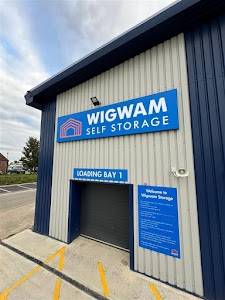
Does the house still belong to you, or has the business taken it over?
It starts as a minor inconvenience. A few boxes stacked in the corner of a bedroom. Then the landing. Then the garage. Then the car. Then one morning you are stepping over a pile of poly mailers at half past six, hunting for the parcel that needs to go out before the school run, and you realise the house no longer belongs to you. It belongs to the business.
The answer does not have to be a warehouse contract or a fulfilment company you have never visited. For a lot of UK online sellers, the right move is a self-storage unit a short drive from home. One where you hold the access code, you know exactly what is on each shelf, and you can be in and out before breakfast.
That is the model this page explains. Honestly, including the parts that other pages leave out.
Is a self-storage unit right for your online shop?

For most online sellers whose stock has grown beyond what the house can hold, yes, with one condition: you need to understand what “self-access” actually means before you sign. It is not a managed warehouse. Nobody picks for you, nobody signs for your deliveries, and nobody tidies the shelves between visits. That is the point. You are the one in control.
When the spare room, garage and hallway have run out
There is a moment every growing online seller hits. The business is doing well. The problem is that success looks like a hallway blocked with returns, a spare room that a guest cannot sleep in, and a car that smells faintly of packing tape. The home-as-warehouse arrangement that worked at twenty orders a month stops working at a hundred.
A self-access unit does not solve every problem. What it does is put a clear line between your home and your business. The stock goes in the unit. The house becomes the house again. Most sellers who make this move say they should have done it six months sooner. The decision feels bigger than it is, especially the first time you look at the monthly cost. But once you are picking orders from a unit you have properly organised, the alternative – the stepover, the search, the apology to your partner – quickly feels harder than paying a monthly fee.
A unit you control vs a hands-off 3PL
The honest comparison is this. A third-party logistics company picks, packs and ships for you. You never see the stock. You do not handle the orders. That is the right model for some sellers, particularly those with high volumes and no time to spare. But you lose visibility. You lose the ability to check a product before it ships. You lose the hands-on quality control that matters when you are the one who chose every item, graded every piece of clothing, described every listing.
A self-access unit is the opposite. You do the work. In return, you make every decision. You are still the one running every order, which for most sellers at this stage is not a compromise. It is the whole point.
What “inventory you access yourself” actually means
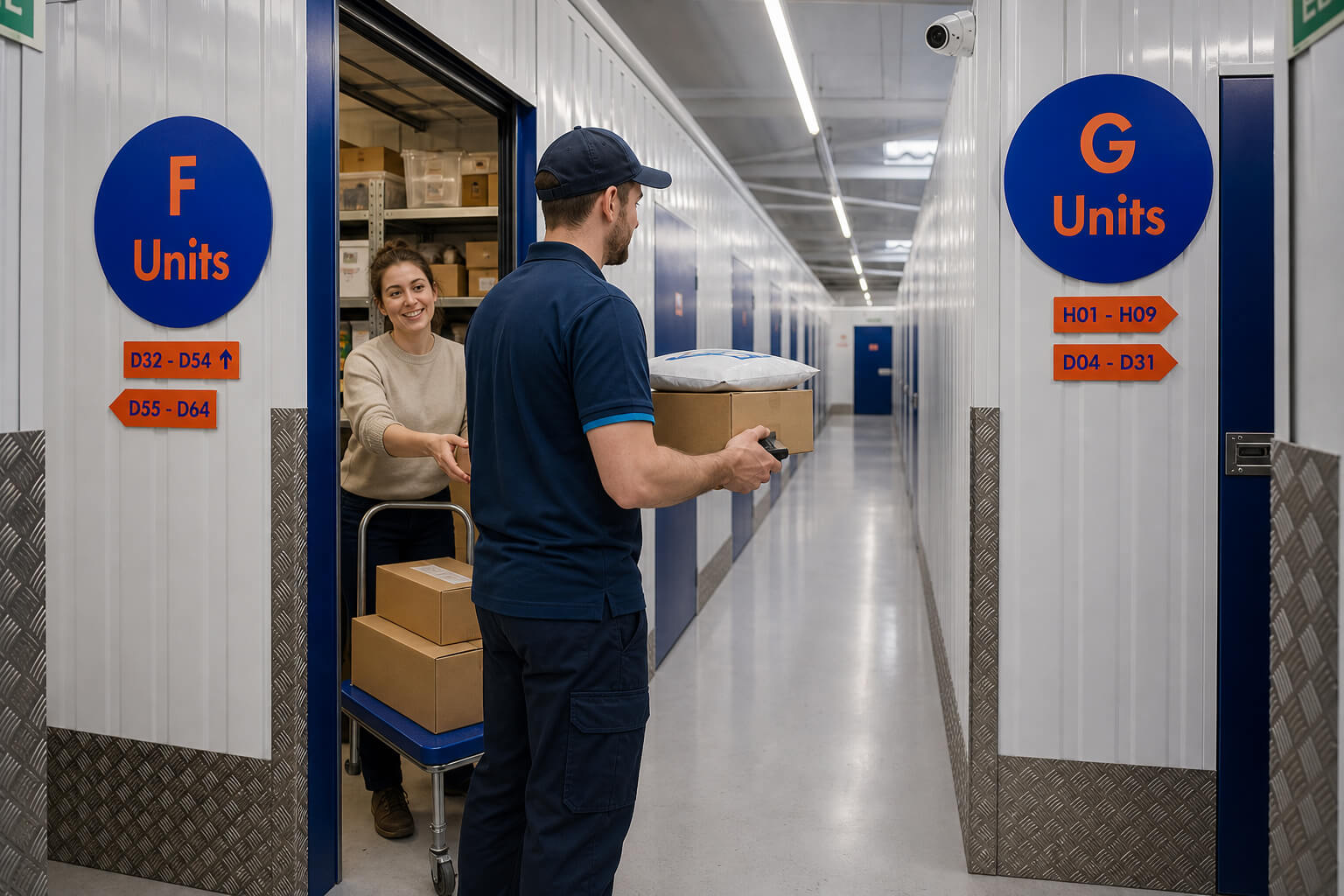
The phrase in the title is not marketing shorthand. It is a precise description of how this model works. You have the smart-entry credential. You open the unit. You find the stock. You pack the order. You lock up. At no point does anyone else do any of those things on your behalf.
You hold the smart-entry key and pick your own orders
Access is by smart entry, seven days a week, from 6am to 10pm. That is the real window. It is not 24-hour. It is not “24/7.” Several national competitors advertise that; we do not, because ours is 6am to 10pm and we would rather tell you plainly.
For the vast majority of online sellers, that window is more than enough. You can be at the unit at 6.30am, pull everything you need for that morning’s dispatch, and be back home before the children are up. You can restock on a Tuesday evening after the Vinted notifications come in. You can do a big Saturday morning sort before the market. The hours fit around a real seller’s day because most of the work happens at the edges of the working day, not at 3am.
No fulfilment middleman touching your stock
Every order goes through your hands. That means every order leaves the unit in the condition you intend it to leave. No pick errors from a warehouse system you did not set up. No mystery dents on a returned item. No batch-delayed dispatch because a fulfilment centre is processing a backlog.
The trade-off is honest: you do the work. Every trip to the unit, every box sealed, every label printed is yours. For the seller who takes pride in that, it is not a burden. It is the model.
Access hours and smart entry: the honest version
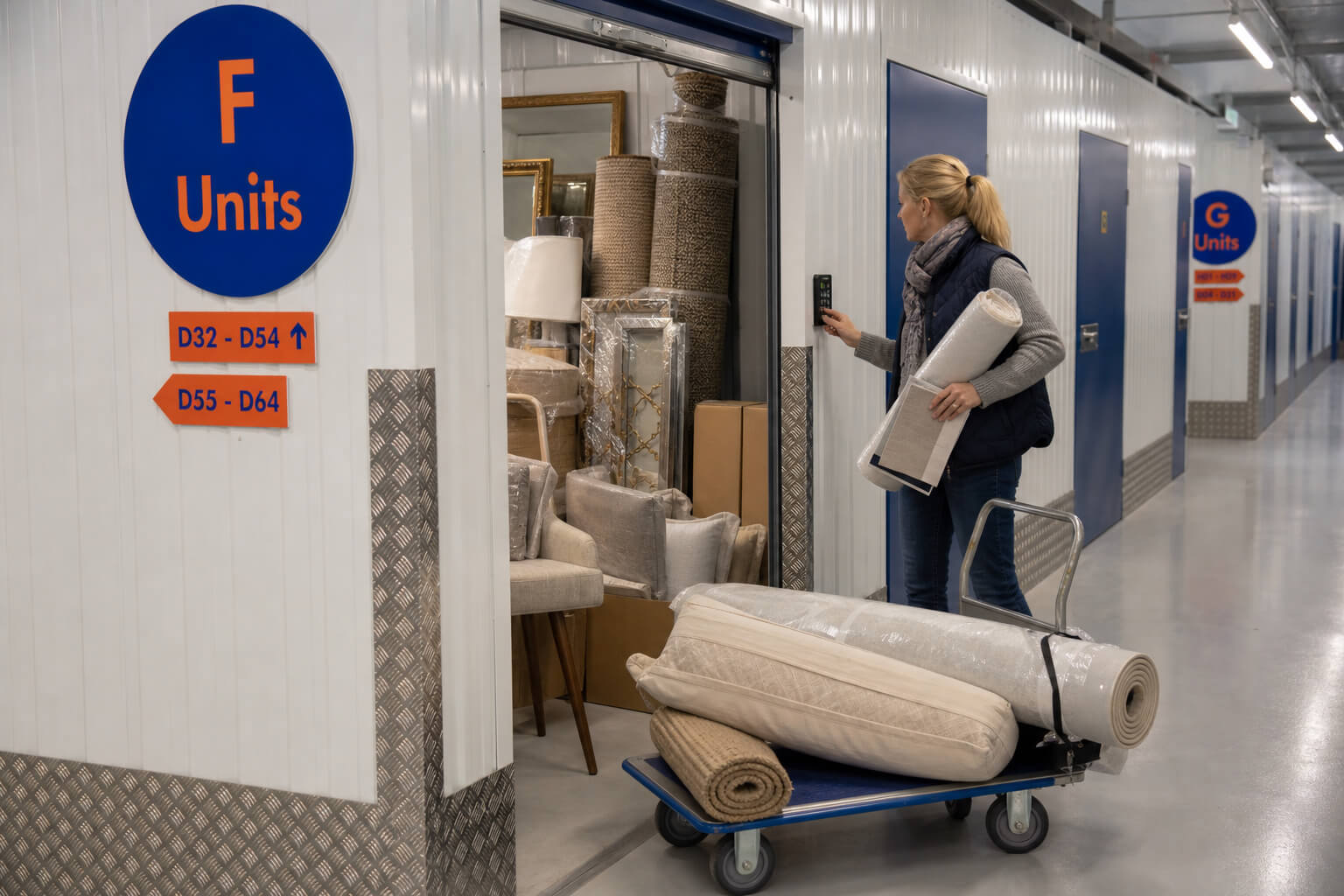
Access is 6am to 10pm, seven days a week, by smart entry. Not 24-hour. Here is why that distinction matters and why, for most online sellers, it probably does not.
6am to 10pm, seven days, by smart entry
Smart entry means no key to lose and no staff member to let you in. You arrive, you enter, you access your unit. The system works every day of the week, including bank holidays.
The 6am to 10pm window covers every practical dispatch and restock scenario for a seller running same-day or next-day fulfilment. The one scenario it does not cover is a late-night emergency restocking run at midnight. If your operation genuinely requires 24-hour access, that is worth knowing before you book, not after.
Competitors who advertise “24/7” may genuinely offer it. We are not in that comparison. We offer clean, dry, secure units with smart entry from 6am to 10pm, seven days, and we say so at the start.
Planning your pick-and-pack schedule around a 6am to 10pm window
The sellers who use self-storage well tend to build a routine around it rather than treating it as a drop-in whenever. A quick morning pick before 8am covers the orders that need to go out same-day. An evening run on Tuesday and Thursday handles restocking and labelling. A longer Saturday morning session deals with anything bulky or time-consuming.
That rhythm works well for a market-stall seller packing before a Sunday show, for an eBay reseller clearing a week’s worth of listings, and for an Etsy seller batching the packaging for a product launch. The window is not a constraint for most sellers. It is a timetable you can build a business around.
Deliveries, returns and the unmanned-site rule: read this before you commit

Our sites are unmanned. That means we do not sign for your couriers, we do not take in stock deliveries on your behalf, and we do not handle your customer returns. If a courier arrives at the unit, someone from your own business needs to be there to receive it. That is not a detail buried in the terms. It is the first thing we tell you.
Why our sites are unmanned and what that means for your stock
No staff member on-site means no staff member ever handles your goods. Nobody moves a box, opens a unit, or accepts a parcel on your behalf. The upside of the unmanned model is total control: from the moment your stock enters the unit to the moment it leaves, the only hands on it are yours.
The practical constraint is the other side of that same coin. When a supplier delivers a pallet, or when a courier comes to collect a customer return, someone from your business needs to be physically present at the site to receive it. You cannot book the unit and then arrange for your supplier to drop off while you are somewhere else. The key-in-your-pocket model means you are always the one holding the key.
For sellers who do not receive frequent inbound deliveries, this is rarely a problem. For those who take regular supplier drops, it is a logistical step that needs planning.
How online sellers handle inbound stock and customer returns in practice
The sellers who make this work tend to do one of a few things. They schedule deliveries for times they are already planning a unit visit, so the trip serves two purposes. They batch returns handling on a fixed day each week, so they are not making special trips. Where they have a business partner, a team member or a trusted colleague who can cover, they arrange someone to be present for large inbound deliveries.
What nobody should do is assume the site will handle it for them. We will not, and any operator who suggests otherwise is either misinformed or being imprecise about what “unmanned” means. The honest position is this: your stock, your responsibility, your control.
Ready to see what a unit costs near you?
Get a quote at quote.wigwamstorage.co.uk.
No obligation. Just a clear price for the size and town that suits your business.
Choosing the right size unit for your stock

The right size depends on two things: how much stock you hold at peak, not at a quiet month, and whether you need room to work in the unit as well as store in it. Most sellers start smaller than they think they need and move up once they see how the space fills.
From a few shelves of small parcels to pallet-scale bulk inventory
A small online seller running Vinted or eBay part-time might need nothing more than a couple of bays of shelving, enough room to stand at a folding table, and a corner for outbound parcels. A more established seller taking pallet deliveries from a supplier needs more floor space, a clear path in from the door, and room to open boxes and repack without creating a bottleneck.
The size you need is on the pricing and size guide. We do not publish prices on this page because the right size for your stock at a particular location is a conversation, not a fixed table. The guide gives you the framework; the quote gives you the number.
Room to pack as well as store
The unit works as a packing space as well as a storage space. Sellers use it to label, seal, sort and stage outbound orders. That is entirely within how the unit is designed to be used.
What it is not is a permanent manned workspace or a retail counter you open to the public. The unit is for storage and for the work of picking, packing and despatching your own goods. For the full list of what is and is not permitted, the terms and conditions are the place to look before you commit.
Storing by product type

The type of stock you sell changes how you set the unit up, not whether a unit works for you. Here is a plain-language guide to the three categories that come up most often.
Clothing and soft goods: rails, bags and breathable boxes
Clothing stores well in a clean, dry unit. The practical setup is straightforward: a freestanding rail for anything that needs to hang, breathable garment bags for better stock, and clearly labelled lidded boxes for folded items by size or SKU. A unit on a solid floor with good ventilation and no damp is what you need for soft goods, and that is what you get.
One thing to be clear about: there is no climate control. No temperature regulation, no humidity management. The unit is clean and dry and secure. For clothing that is not temperature-sensitive, that is sufficient. For specialist fabrics or items with specific storage requirements, pack accordingly and check your own product guidance.
Boxed goods, small electronics and moisture-sensitive items
Units are clean, dry and individually alarmed. For boxed goods and standard retail stock, that is more than adequate. Electronics and anything moisture-sensitive need sensible packing: sealed boxes where possible, silica gel packets where appropriate, and placement off the floor rather than directly on it.
There is no climate control at any Wigwam site. If your product requires a temperature or humidity-controlled environment, this is not the right storage for it. If it needs clean, dry and secure, this is exactly the right storage. That is an important distinction to make before you book.
Larger or bulkier items and mixed-inventory sellers
Larger items need a clear path from the door and enough floor space to manoeuvre without knocking over shelving. The practical solution is a zone layout: an inbound zone near the door for new stock as it arrives, a main shelving zone for live inventory, and an outbound staging area where packed orders wait before you take them to the post office or courier depot.
Mixed-inventory sellers, those running multiple product lines or selling across platforms simultaneously, often find that sizing up by one unit size removes the daily frustration of a bottlenecked packing corner. A little room to breathe is worth more than the marginal saving on a smaller unit when you are in the space every other morning.
Running a tidy pick and pack from your unit
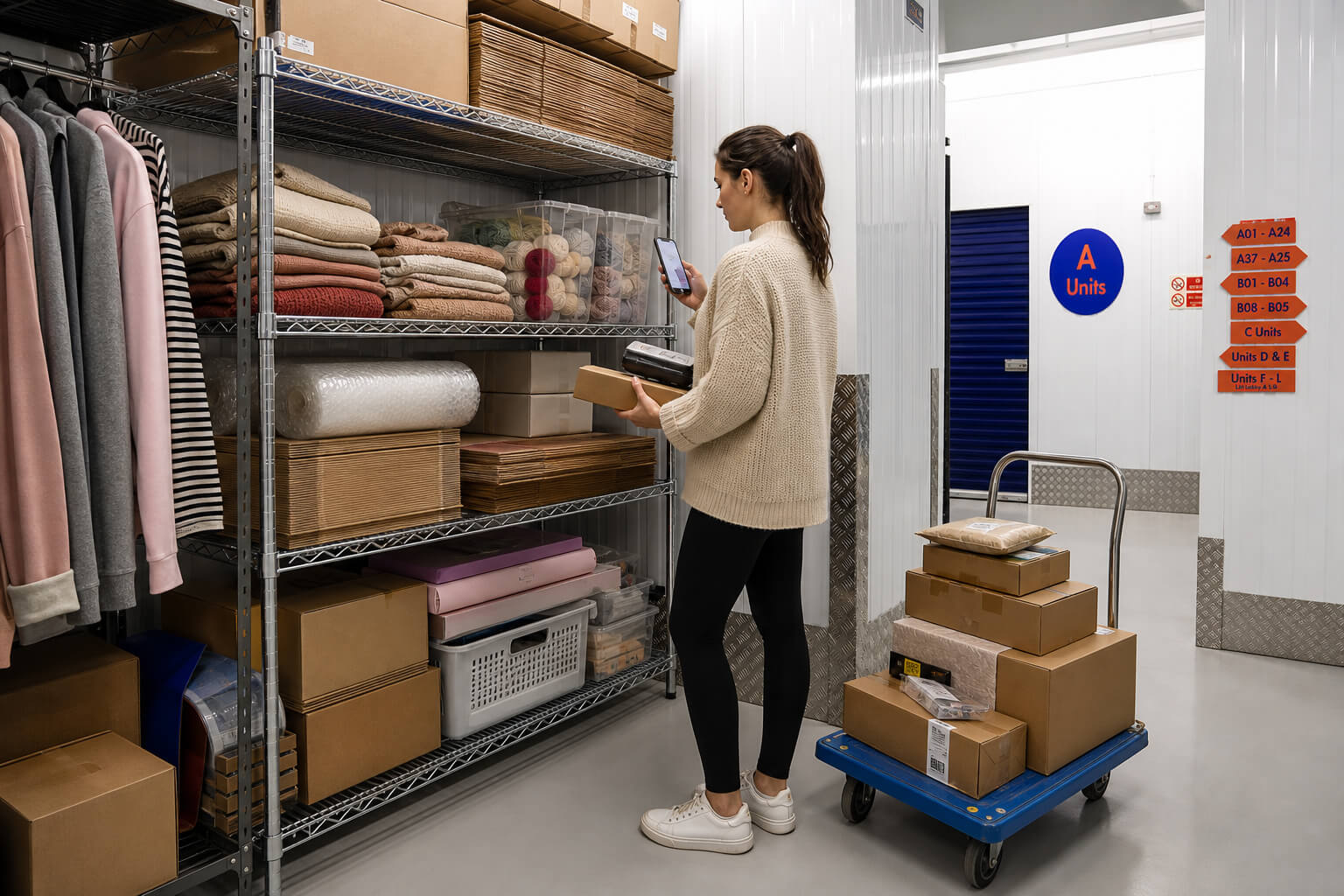
A well-organised unit is not complicated. It is a shelf for each product line, a clear path from the door to the packing corner, and a labelling system you can read at 7am without the lights fully on.
Shelving, a simple location code and keeping the fast-movers near the door
Freestanding shelving makes a significant difference to usable space because it takes inventory vertical rather than spreading it across the floor. The location system does not need to be sophisticated. A shelf letter and a box number is enough for most small sellers. Shelf A, Box 3 is a faster find than a spreadsheet search when you are trying to pick six items before 7am.
Fast-movers, the SKUs that go out daily, belong nearest the door. Overstock and seasonal items go at the back. New deliveries go in the inbound zone and only move to the shelving zone once they have been counted and labelled. That simple discipline means the unit stays usable rather than becoming the tidy version of the hallway problem you left at home.
A packing corner and a clear route to the door
A folding table, a roll of tape, a label printer if you use one, and a clear sight line from the shelves to the door. That is the packing corner. Keep inbound stock separate from outbound stock. Empty flattened boxes out of the unit regularly, because collapsed cardboard on the floor is the most reliable way to make a small space feel smaller than it is.
The unit should work like a micro-warehouse with a logical flow through it: in, process, out. Not as a general dumping ground that happens to be outside the house. The sellers who get the most from a unit are the ones who spend ten minutes at the start setting it up properly and five minutes at the end of each visit maintaining that order.
What it costs, and the honest answer to “is there a cheaper alternative?”
The honest answer is: it depends on what you mean by cheaper. A spare room costs nothing in rent. A 3PL may or may not cost less than a unit, depending on your order volume and the provider. A self-access unit sits in the middle: a predictable monthly cost you control, with no long-term contract locking you in.
Unit vs spare room vs 3PL, honestly
The spare room is free, in the sense that you already pay the mortgage or rent. But it comes with a ceiling on your stock volume, a practical limit on how professionally you can run orders from a residential space, and the ongoing friction of your home and your business sharing the same square footage. At some point the cost of that friction, to your home life and to your ability to scale, outweighs the absence of a storage fee.
A 3PL handles the physical work for you. For high-volume sellers who cannot be at a unit themselves, that makes sense. For a seller who wants to stay hands-on, who wants to see every product before it ships and handle every return personally, handing the stock to a third party is a loss of the thing that makes the business theirs.
A self-access unit is the in-between. You pay a monthly cost. You do the work. You keep complete control. That combination is not for everyone, but for the hands-on seller whose stock has outgrown the house, it is the option that preserves the model without requiring a warehouse lease.
No deposit, two-week minimum stay and refund of unused days
There is no deposit. Nothing is held while your stock is with us, so nothing has to be reclaimed when you go. What does come back is any unused days, after a 14-day notice period, once you have vacated the unit and your account is settled with nothing outstanding. The notice period is set out in the terms and conditions.
The minimum stay is two weeks. If you leave before the end of a paid period, unused days are refunded. That is the honest contrast with a warehouse lease or a 3PL contract: you are not locked in for a year. You give notice, you clear the unit, and you get the unused days back once everything is settled.
For exact costs and size options, the UK pricing guide is the right place to look. Prices vary by location and unit size, which is why we do not list them here.
Security and peace of mind for your stock
Each unit is individually alarmed, clean, dry and secure. That is the real claim, stated plainly. For a seller whose stock is also her business asset and her income, those four words matter more than any marketing phrase.
Individually alarmed units, clean, dry and secure
Individual alarms mean the unit is monitored at unit level, not just at site level. If something happens to your unit specifically, the alarm responds to that unit specifically. Clean and dry means no damp, no mould risk, no pest concern for a unit that meets the standard. Secure means the site and the unit are both protected.
There is no CCTV claim to make on this page beyond what the live site confirms. There is no climate control to add to the list. The honest security offer is individually alarmed, clean, dry and secure, and for stock that does not require specialist environmental conditions, that is a solid baseline.
Insuring your stock
Contents cover is mandatory when you store with Wigwam. You can take out our RSA “Self Storage Customers’ Goods” policy, or you can prove that your own commercial contents insurance covers goods held off-premises in a self-storage unit. What you cannot do is store without cover in place.
A jurisdiction note: the information below describes the policy available at Wigwam sites in England and Wales. If you are storing at a location in Scotland or Northern Ireland, regulatory and legal differences may apply. This page is a signpost only. Speak to your own insurance adviser for guidance specific to your situation and your business.
The RSA policy, what to declare and the under-insurance rule
The RSA “Self Storage Customers’ Goods” policy is opt-in. New-for-Old replacement. A GBP 50 excess. The detail that matters most is this: declare the full replacement value of everything you store. If you declare less than the full value and you need to make a claim, the settlement is proportional to the shortfall. Under-insure by a third, and a claim is settled at two-thirds.
Theft claims require evidence of forced entry. Climatic damage is excluded, which is consistent with the fact that there is no climate control in the units.
For anything specific to your policy or your situation as a business owner, your own adviser is the right person to speak to. The full details of the contents protection available through Wigwam are on the contents protection page.
Find stock storage in your market town
We are based in market towns across the UK, not city-centre depots. For most of the sellers who use our units, the site is a short drive from home, which is what makes the self-access model practical. You are not committing to a forty-minute each-way journey every time you need to pick an order. The unit is nearby, and nearby matters when you are going in before breakfast.
Our UK market-town locations
We have units in locations including Wigwam Self Storage Bath and Wigwam Self Storage Lincoln, as well as market towns across the rest of the UK. The full list of our locations is on the locations page. Find the town nearest you, check the unit sizes available, and get a quote from there.
We do not name a hard location count here because it changes as we grow. What stays the same is the model: market-town sites, short drives from home, smart entry from 6am to 10pm, and units that are yours from the moment you access them to the moment you hand them back.
Get a quote for your unit at quote.wigwamstorage.co.uk.
No obligation. Just a clear price for the size and town that suits your stock.
Frequently Asked Questions
This is a question to raise with our support team for your specific site, because the answer depends on the location and on what you mean by “use the address.” A storage unit is a stockroom, not a registered trading premises or a staffed receiving address. The sites are unmanned, so nobody here can take in a returned parcel, sign for a courier, or hold post for you. Listing the unit as your customer returns address, where buyers post items back to the site, does not work, because there is no one to receive those parcels and we do not accept goods on your behalf.
What sellers do in practice is keep their own home or registered business address as the contact and returns address, then batch the physical handling at the unit on a fixed visit. If you have a question about company registration, VAT, or how HMRC treats a storage address, that is one for your accountant. Our support team can talk you through sizing, availability, access, pricing, invoicing and booking, but they are not the right people to advise on tax or how you structure the business. For anything beyond storage logistics, speak to a professional adviser.
Access is tied to the account and the smart entry credentials issued for it. If you run the business with a partner or have a trusted team member who needs to pick and pack while you are elsewhere, the practical step is to talk to our support team at your site about how access is set up on your account, rather than passing your own credentials around informally. The key point under the unmanned model is that whoever opens the unit is someone you have authorised, because there are no staff on site to check anyone in.
This matters most for inbound deliveries. If a supplier is dropping a pallet while you are away, someone from your own business has to be physically present to receive it, because we will not take it in for you. Many sellers solve this by having a partner or colleague cover those slots. Build it into the rota the same way you would a dispatch shift. The honest position is that the goods are your responsibility from the moment they arrive to the moment they ship, so the access arrangement needs to reflect who is actually doing the work.
Update your declared value as your stock grows, rather than leaving it at the figure you set when the unit held half as much. Contents cover is mandatory, and if you take Wigwam’s RSA “Self Storage Customers’ Goods” policy you declare the full replacement value of everything in the unit. The detail that catches sellers out is the under-insurance rule: if you declare less than the true value and you make a claim, the settlement is reduced in proportion to the shortfall. Declare half of what is actually there, and a claim pays at half.
For a growing online shop, stock value is a moving target. A unit that held a few thousand pounds of inventory in spring can hold several times that by the Christmas peak. The sensible habit is to review the declared figure whenever your holding changes meaningfully, not just at renewal. We are signposting here, not advising. The full detail on the policy, the GBP 50 excess, the New-for-Old basis and what is excluded, is on the contents protection page. For whether the cover suits your particular business, speak to your own broker.
A courier can come to the site, but someone from your own business has to be there to hand the parcel over, because the sites are unmanned and we do not release goods, sign for collections, or supervise handovers on your behalf. So a courier collecting outbound orders works only if you have planned to be present for that slot. Buyers turning up to collect in person is not how the unit is designed to be used: it is a stockroom in a storage facility, not a shop or a click-and-collect counter, and you cannot run retail sales or a public collection point from it.
The way sellers make collections work is to batch them around a visit they are already making. If a courier collects at a set time on a fixed day, you are there for that window anyway, picking and packing. For returns coming back in, the same rule applies in reverse: you have to be present to receive them, so most sellers handle returns on one scheduled day a week rather than expecting the site to take them in. Plan the collection and return runs around your own presence, and the model works cleanly.
No. Access is 6am to 10pm, seven days a week, by smart entry. It is not 24-hour, and we will not pretend otherwise even though some national operators advertise round-the-clock access. For the overwhelming majority of online sellers, the 6am to 10pm window covers every realistic dispatch and restock scenario, including an early pick before the working day and an evening restock run. The one thing it does not cover is a genuine midnight emergency, and if your operation truly depends on overnight access, it is better to know that before you book than after.
The honest way to think about it is that storage with smart entry is not the same as a manned fulfilment centre running shifts around the clock. Nobody picks for you, nobody ships overnight, and the unit is locked outside the access hours. What you get in return is total control of your own stock at a predictable monthly cost, with no fulfilment middleman touching your goods. For a hands-on seller building a routine, that trade is usually the whole point, not a limitation. Build your dispatch rhythm around the window and it rarely feels like a constraint.