Next job’s ten days off and the van’s still full of materials?
You finish the first fix and the back of the van is still half full. Boards for the next phase, a box of tiles, the fixtures you ordered early because they were on discount. None of it can go on the client’s drive, the garage at home is already rammed, and you are not starting the next job for another ten days. So the materials sit in the van, and every morning you move them to get to what you actually need.
Most tradespeople have been there. The gap between jobs is not a planning failure; it is just the reality of running several things at once. The question is not whether to store materials off site. The question is how to do it properly without spending money you do not need to spend or tying yourself to a contract you cannot get out of.
This is the plain version of how self storage works for exactly this situation. What fits, what does not, how to keep timber and boards in good order, what the minimum stay means in practice, and what happens at the end when the job is done and you want to close the unit.
Why materials between jobs need a better address than the van
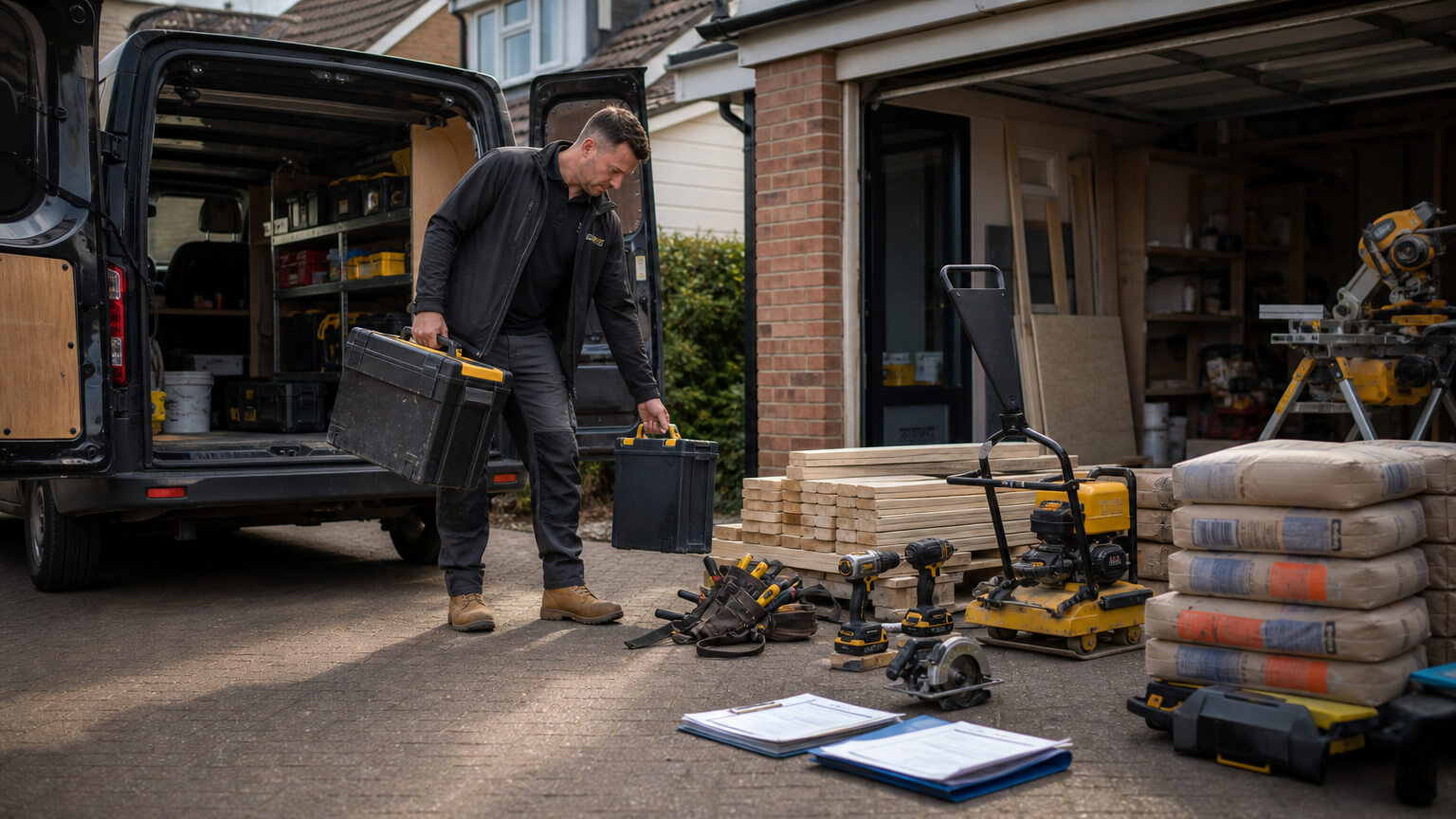
The van, the garage and the client’s driveway each cause the same problem in a different way. The job-site answer to where to put excess materials is usually none of the above. A self storage unit is not a complicated solution; it is the obvious one when the alternatives are all worse.
The van, the garage and the client’s driveway are not storage
A van is a work vehicle, not a materials rack. When the back is taken up with boards and tile boxes you cannot fit what you need for the current job without spending twenty minutes rearranging at the start of every day. Timber that lives in a van all week is subject to whatever the weather does: condensation in the morning, heat in the afternoon, boards picking up a twist you will only notice when you try to use them.
The garage at home is usually either full already or full of things that belong to the household rather than the trade. Mixing domestic and work kit creates friction with everyone in the house and makes it harder to keep tabs on what you actually have.
Leaving materials at a client’s address is the option that feels convenient right up to the moment it stops being convenient. Clients agree to it and then change their minds when their drive becomes awkward. A relation or neighbour has a key and “just moved the boards.” Nobody is liable for anything.
A unit you control, close to home
A self storage unit gives you a lockable, alarmed space that is yours alone for as long as you need it. You have sole access. You decide how it is organised. You know exactly where everything is and you can be confident it is still there when you come back. For a sole trader, that kind of certainty is worth real money, especially when the contents represent the margin on the next job.
Wigwam’s units are in UK market towns, which means they tend to be close to where tradespeople actually live and work rather than on an industrial estate twenty minutes down the motorway. That matters when you are loading at ten past six before a job starts.
What building materials fit a standard self storage unit
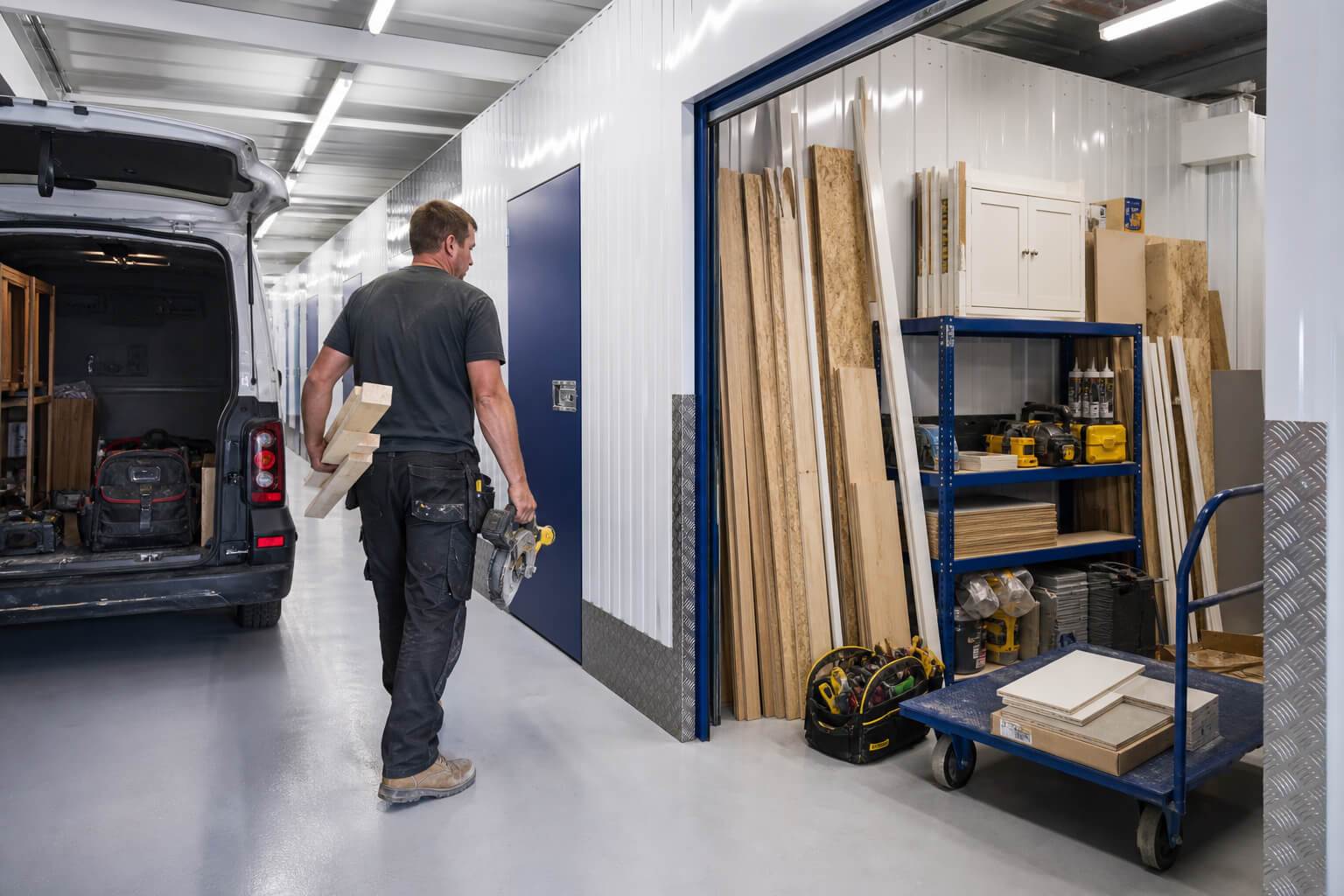
Timber, tiles, fixtures and tools all fit and all store well in a standard unit. For dry goods between jobs that is the complete list; a self storage unit is the right answer for everything that goes into a building without being flammable or reactive. The practical question is what to put where and how to stack it, which is covered below.
Timber, sheet boards and mouldings
Lengths of timber, sheet boards (OSB, plywood, MDF, hardboard), mouldings, skirting, architrave and door linings all store straightforwardly in a self storage unit. The key requirement is that they go into a dry space and are supported so they do not take on a bow while they wait. A unit that is clean and dry gives you that.
On longer lengths you will want to stack flat on something that keeps the timber off the concrete floor. Scaffolding boards or spare timber offcuts work fine as a base. Even spacing along the length prevents sag. More on that in the conditioning section below.
Planed timber is more sensitive than structural softwood, and hardwoods are generally more stable than softwood in the short term, but the same principle applies to all of it: off the floor, supported evenly, stacked flat and covered loosely so air can still move around the stack. A standard Wigwam unit is clean and dry, which is what dry goods between jobs actually require.
Tiles, flooring and fixtures staged for the next phase
Ceramic and porcelain tiles travel well in storage as long as the boxes are kept flat and the stack is not so tall that the weight becomes a problem. Most tile boxes are designed for stacking to a reasonable height; the risk is from moisture getting into cardboard, not from the tiles themselves.
Engineered flooring boards are slightly more sensitive than tiles and should be kept in their packaging to stabilise. Solid wood flooring boards need the same treatment as timber above.
Fixtures and fittings (kitchen units, bathroom furniture, pre-hung doors, radiators, cabinet carcasses) are all straightforward to store. A unit that stays clean and dry protects them adequately. If packaging is intact, leave it on. If not, loosely wrap or cover the faces to protect them from dust and minor knocks.
Staging materials for the next phase is one of the genuinely sensible uses of a self storage unit. You order when availability and price are right, you put the materials somewhere they are safe, and you collect them when the job is ready. It takes that particular anxiety completely off the list.
Tools, fixings and hardware
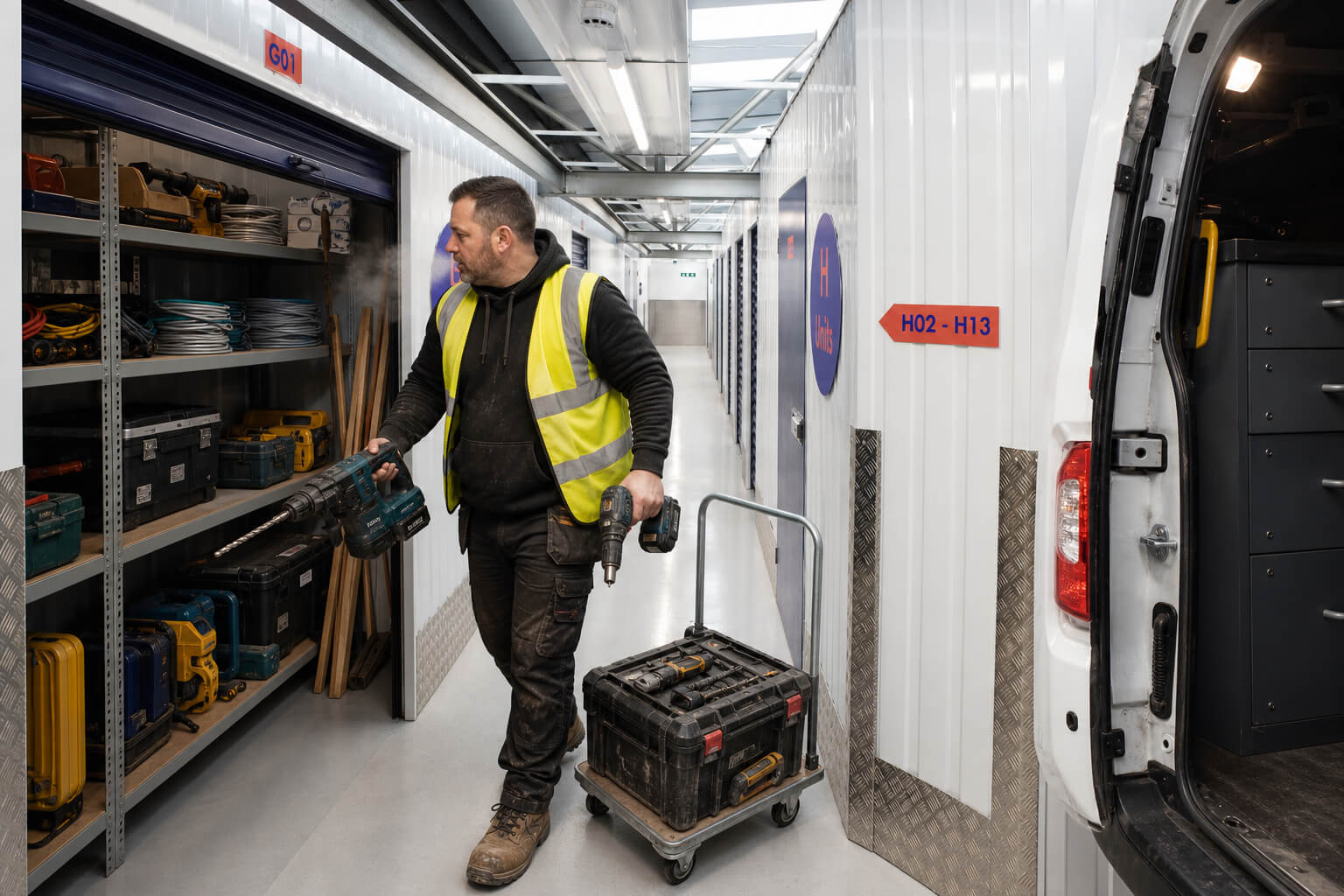
Power tools, hand tools, fixings and hardware are among the most common things tradespeople store between jobs. A locked, individually alarmed unit is a significantly better home for them than a van overnight or a garage that the family also uses.
Heavier kit (table saws, routers, compressors, nail guns, heavy drills) takes up floor space in a unit but leaves the worktop of your van free for smaller daily items. For a carpenter or joiner, a unit that holds the specialist kit between jobs means the van only carries what is needed for the current one.
Contents cover is worth reviewing for high-value tools. See the section on insurance below.
What you cannot store (and why the rules are not negotiable)
The list of prohibited items is short and the reasons behind it are clear. You cannot store anything flammable, any fuel, gas or bottled gas, paint thinners or solvent-based liquids, or anything that can ignite, release fumes, or react with other materials. If a substance needs ventilation to be safe, it cannot go in a self storage unit.
Flammables, fuels, gas and paint thinners
In practice this means: no petrol, diesel, LPG, propane or butane cylinders, no paint thinners, white spirit, acetone or other solvents, no aerosol paints or spray cans containing flammables, no oil-soaked rags, no adhesives with flammable carriers.
Common trade materials that many people assume are fine but are not: brush cleaner, cellulose thinners, contact adhesives in tins, fuel cans even when empty. If the safety data sheet lists flammable or highly flammable, it does not go in.
Cement, plaster and bonding are a separate question. They are not flammable, but they absorb moisture from the air and can go off in the bag if conditions are not right. Whether a bag of material survives in storage depends on how airtight the packaging is and how long it is in there. The honest answer is that bagged dry-mix goods are a risk, and you are better off buying fresh when you need them rather than hoping a half bag will come out usable three weeks later.
Why the rules exist on an unmanned site
Wigwam’s sites are unmanned. There is no on-site staff member monitoring the units during access hours, which is one of the things that keeps costs down and access straightforward. The consequence is that fire or chemical risk from one unit has implications for every other unit in the block. The prohibition list is not a formality; it is the condition that makes a self storage site work safely when nobody is watching.
For detailed guidance on safe storage of hazardous materials in a trade context, HSE.gov.uk carries authoritative UK guidance on materials storage and waste management. Wigwam is the storage expert, not the safety authority; the HSE is the right place for the regulatory picture.
Keeping materials in good condition while they are in the unit
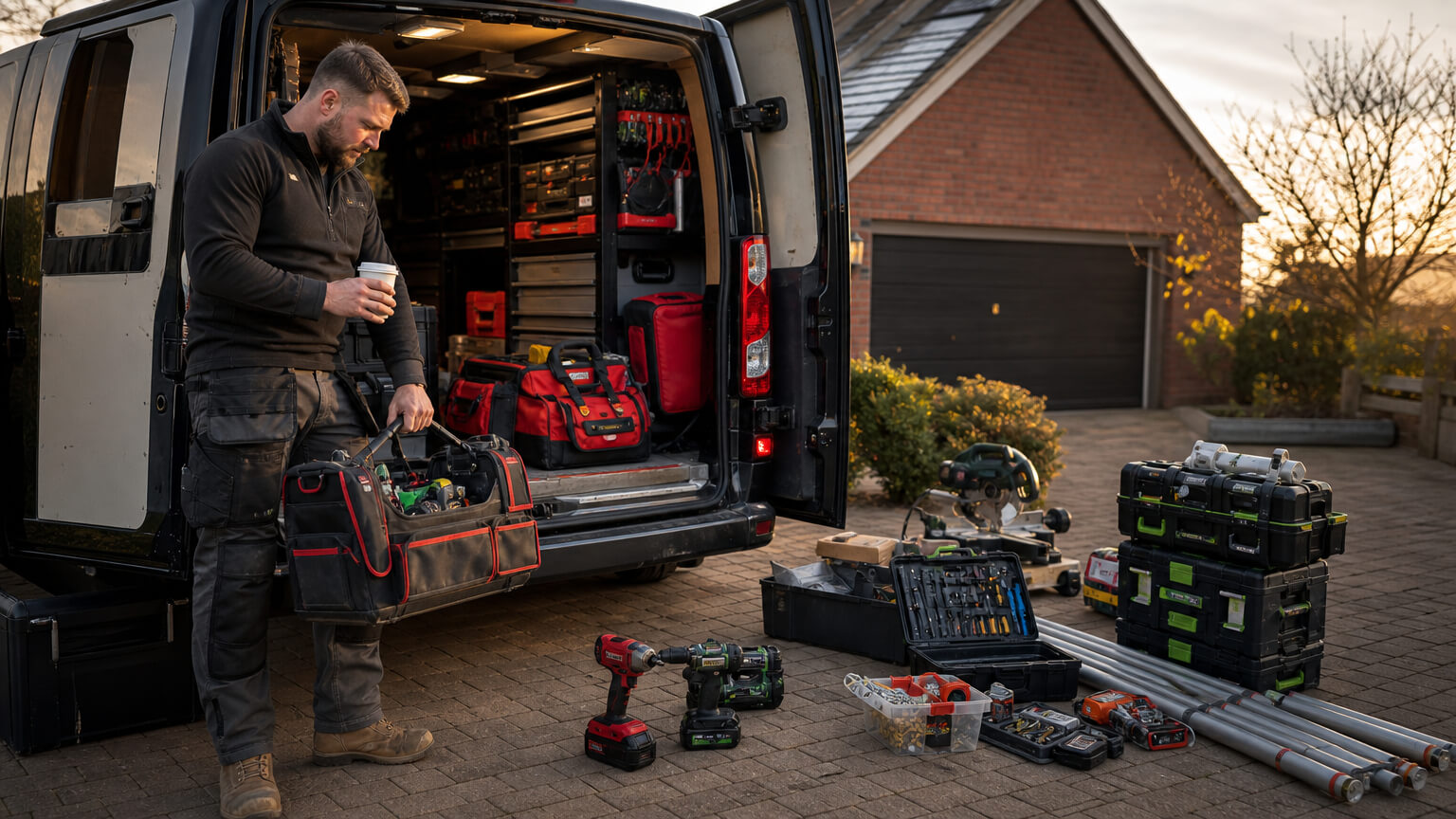
Your boards come out the same way they went in, if you give them a bit of thought when you stack them. A clean, dry, individually alarmed unit does its part; how you stack and organise the unit does the rest. Neither is complicated.
Off the floor, with air moving around the stack
The concrete floor of a self storage unit does not transmit moisture in the way a garage floor does, but it is still good practice to keep timber and sheet goods off it. A couple of scaffold boards or spare lengths of timber across the width of the unit give you a platform that keeps everything a few inches clear of the ground and allows a small amount of air circulation underneath.
Do not seal a stack of timber in a plastic sheet. Plastic traps any humidity that enters with the timber and holds it against the boards. A breathable cover (old dust sheets, a canvas tarp) will keep dust off without creating a moisture problem.
Stacking timber and boards so they stay true
Longer lengths of timber warp if they are supported at the ends but not in the middle. Space your supports evenly underneath the stack, ideally at about 400 to 600 millimetre intervals for anything over two metres. Sheet goods (OSB, plywood, MDF) are better stored flat than standing on edge; an unsupported eight-foot sheet standing vertically on one corner will develop a bow given a few weeks.
If you are storing a mix of lengths, start with the heaviest and longest at the bottom and work up to lighter, shorter pieces. This keeps the stack stable and means you are not shifting heavy material to get to what you need at the bottom.
Planed timber and hardwoods are worth stacking with small pieces of timber (stickers, if you have them, or offcuts) between layers to maintain air gaps and even support across the width. This is standard workshop practice and it applies in storage too.
You load and stack the unit yourself, so do it safely
Nobody else loads your unit. You have sole access, which means you organise it exactly as the job needs, but it also means the safety of the stack is your responsibility. Do not build anything higher than you can comfortably reach and handle alone. Do not lean sheet goods against the wall in a way that could topple if you brush the base. Heavy materials at the bottom, lighter items on top, clear aisle to the back of the unit so you are not reaching over a wall of boxes.
For formal guidance on manual handling and materials stacking at height, HSE.gov.uk sets out the current UK requirements. These apply to you as a self-employed tradesperson in the same way they would in any work environment.
Clean, dry and secure is what dry building materials actually need

Dry goods between jobs need a dry, secure home. That is the honest answer, and it is a simpler requirement than the online climate-control advice suggests. A Wigwam unit is clean, dry and secure. That is what we actually deliver, and for the vast majority of building materials a sole trader stores between jobs, that is what actually works.
What “clean, dry and secure” means in practice
Each unit is individually alarmed. Clean and dry means no damp, no condensation, no moisture transfer from a leaking roof or a flooded floor. The unit is a sealed, alarmed space, not a marquee or a garden shed.
There is no temperature or humidity regulation. Climate-controlled storage is a different product, aimed at long-term archival storage of things like antique furniture, documents, wine or instruments that cannot tolerate any seasonal variation at all. It exists, it has a place, and it is not what building materials between jobs require. Timber that has been properly dried and is stored for two to six weeks between jobs does not need temperature control; it needs to stay dry and be properly supported. Clean, dry and secure gives it both.
Worth noting: the Wigwam contents-protection policy (and most storage contents policies) excludes atmospheric and climatic damage. This is standard across the industry and it is honest. What it means in practice is that protection against ingress damage (a unit that floods or a fire in an adjoining unit) is what the policy covers; slow moisture damage from improperly sealed or pre-damp materials is not. The unit provides the right environment; the customer provides well-conditioned, properly packaged goods.
If dry goods between jobs is what you need, we can match you to your nearest market-town location. Get a no-obligation quote at quote.wigwamstorage.co.uk.
Short stays between jobs and what the minimum means in practice

The minimum stay at Wigwam is two weeks. That is the shortest contract, and it suits most between-job gaps well. If you finish a job sooner than expected and empty the unit before the two weeks are up, any unused days beyond your minimum are refunded.
Two-week minimum, unused days refunded
Most trade gaps between phases run from one to four weeks. The two-week minimum means you are not being pushed into a monthly arrangement when you only need a fortnight, and the day-rate refund for early departure means the cost scales down to what you actually used, not what you originally booked.
To end your stay you serve a 14-day notice, which is set out in the terms and conditions. There is no deposit to reclaim, because we don’t take one. This is not a rolling annual contract; it is a short-term, low-commitment arrangement that is designed for exactly the between-jobs situation.
Smart entry 6am to 10pm, seven days
Access is by smart entry, seven days a week, 6am to 10pm. In practice that means you can get into the unit before the first job of the day starts and drop materials off after the last job ends. For a tradesperson working a 7am start, the unit is available when you need it.
Access is not 24-hour. If you need something at 11pm, you plan ahead. But for everyday trade use, 6am to 10pm covers the working day and then some.
Can a supplier or courier drop materials directly at the unit?
They can deliver to the site, but someone from your own business must be present to receive the delivery. The sites are unmanned, which means there is no one from Wigwam to sign for goods, accept deliveries on your behalf, or take responsibility for materials left in a common area. If you have a supplier dropping materials, you or a member of your team needs to be there to meet them and take the goods directly into the unit. Plan the delivery slot around when you can be present.
Choosing the right unit size for a part-load of materials
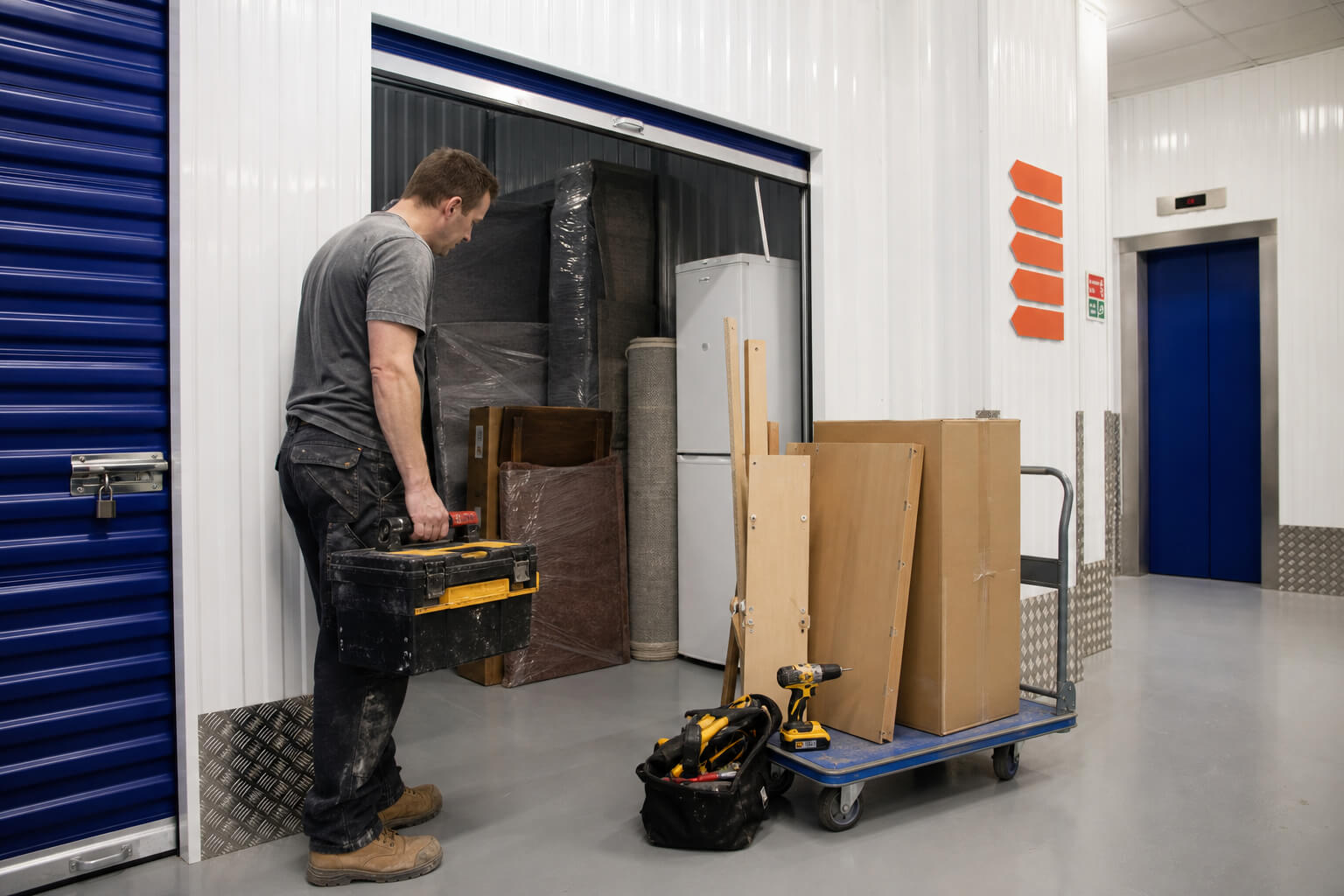
The right unit size is the one that holds what you need to put in it without paying for empty space. For a part-load of building materials the practical way to think about it is by job type rather than square footage: what are you actually storing, and how much of it?
A small unit (around 25 square feet, roughly the size of a large wardrobe) will hold a few boxes of tiles, a set of tools, a run of mouldings and a couple of door linings. It is the right size for a part-load from a bathroom fit-out or a small joinery job.
A mid-size unit (around 50 square feet, closer to a single garage bay) will hold the materials from a kitchen fit-out, a set of pre-hung internal doors, a stack of sheet goods and associated hardware. For most between-jobs trade use, this is the most practical size.
A larger unit (75 square feet or above) starts to suit projects where you are staging materials from multiple phases or have bulky items alongside sheet goods and tools.
These are illustrative; unit sizes vary by location and what is available. The pricing page sets out the sizes available and what they cost, and when you get a quote you will be matched to what is free near you.
Costs and what you get back when the job is done
There is no deposit. That is worth saying plainly at the start, because the deposit is the question that makes most people hesitate before booking. You pay for the weeks you use, you give the required 14-day notice when you leave, and unused days beyond the two-week minimum are refunded.
No deposit, 14-day notice, unused days refunded
The process at the end of a stay is straightforward. You serve your 14-day notice (the terms and conditions set this out in full), you clear the unit and settle the account. There are no hidden admin fees on the way out and no deposit to chase. If a job finishes faster than expected and you clear the unit early, the unused days count back against what you owe.
This structure suits the between-jobs situation specifically because the commitment is short and the exit is clean. You are not locked in for six months hoping the work keeps coming.
What the costs look like and where to find pricing
Prices are not published on this page because they vary by location and unit size. The pricing page has the current figures, and a quote from quote.wigwamstorage.co.uk will give you the specific cost for your nearest location and the size you need.
As a general shape: the cost of a small unit for two to four weeks is, for most trades, less than the cost of one spoiled sheet of plywood or a set of replacement tiles. Whether that makes it worth it is a practical calculation you can make once you have the actual numbers.
Contents cover for your tools and materials
Contents cover is required. You can take Wigwam’s own RSA “Self Storage Customers’ Goods” policy or provide evidence that you have equivalent cover in place. Either way, you must declare the full replacement value of what is in the unit; if you under-declare and have to make a claim, the settlement is calculated in proportion to what was declared. For tools, the replacement cost is usually higher than people expect, so it is worth taking the time to total it up properly.
The policy covers theft that involves forced entry. Atmospheric and climatic damage is excluded (as noted above). For the detail, including what the policy covers and what it does not, the contents protection page has the full picture.
Jurisdiction note: Contents cover, insurance obligations and the applicable policy terms are governed by English law. If you operate primarily in Scotland or Northern Ireland, terms may differ. Confirm the detail with your insurer or a qualified adviser rather than relying on what is on this page.
Where to find your nearest Wigwam location
Wigwam operates across UK market towns, which means a unit is usually closer to a tradesperson’s regular patch than a national operator on an out-of-town retail park. Wigwam Self Storage Lincoln in Lincolnshire and Wigwam Self Storage Bath in Somerset are two of the named locations, and the full list is on the locations page.
If you are based near one of our other market-town locations, find it on the locations page and the quote tool will confirm what is available at that site.
Get a quote
If you have dry goods that need somewhere clean, dry and secure while the next job gets ready, a short-stay unit is a practical answer. The minimum is two weeks, there is no deposit, and unused days are refunded if you finish early.
Find your nearest location at wigwamstorage.co.uk/self-storage-locations and get a no-obligation quote at quote.wigwamstorage.co.uk.
Frequently Asked Questions
No. A storage unit is for storage, not for working in. You can load, stack, sort and collect your materials and tools, and organise the space however the job needs, but the unit is not a workshop. You cannot run power tools, cut timber, assemble units, mix anything, or use it as a working bay. The reason is partly the unmanned model and partly safety: dust, offcuts, running machinery and the fire risk that comes with cutting and powering tools are not compatible with a block of sealed units where nobody is on site to respond.
It is worth being clear because tradespeople sometimes assume a unit can double as a temporary workshop between jobs. It cannot. What it does brilliantly is hold your part-load of materials and your specialist kit safely between phases, so the van only carries what the current job needs and the materials for the next one are staged and ready. Think of it as a secure store you load from, not a place you build in. For the full list of what is and is not permitted, the terms and conditions set it out. If you need a working space, that is a different kind of premises altogether.
That is not a problem, because there is no fixed end date you are locked into. After the two-week minimum, the stay is open. You keep the unit for as long as the work needs and give 14 days’ notice when you are ready to clear it. If a phase slips by a fortnight, you simply keep paying for the time you use; there is nothing to renegotiate and no penalty for the gap running longer than planned. Trade timelines move, and the terms are built to move with them.
The flip side is just as useful for the opposite case. If a job finishes faster than expected and you empty the unit early, the unused days beyond the two-week minimum are refunded, so the cost scales down to what you actually used. Between those two ends, an overrun and an early finish, you are covered either way. To end the stay you serve the 14-day notice set out in the terms and conditions, clear the unit and settle the account. No deposit, no rolling annual contract, no being tied in while you hope the work keeps coming.
Each unit is individually alarmed, not sharing a single site-wide alarm, so if anyone attempts to access your unit specifically, the alarm responds to that unit. The sites are clean, dry and secure, and you hold the only smart entry credentials for your unit. For high-value tools, that is a far better overnight home than a van, which is a known target, or a garage the family also uses. Nobody else accesses your unit, and we do not hold spare keys or open units on anyone’s request.
On the insurance side, be precise about what the cover does. Contents protection is mandatory, either Wigwam’s RSA “Self Storage Customers’ Goods” policy or evidence of your own equivalent cover. The policy covers theft that involves forced entry, so the security of the unit and the evidence of a break-in both matter to a claim. You must declare the full replacement value of your tools, and for tools that figure is usually higher than people expect, so total it up properly. Under-declare, and any claim is settled in proportion to the shortfall. Atmospheric and climatic damage is excluded. We are signposting, not advising. The detail is on the contents protection page, and whether the cover suits your kit is a question for your insurer.
The account and the smart entry credentials sit with one person, so a unit cannot be jointly held with two independent parties each having their own separate access. Whoever holds the account is the one in control of the space, the payments and the contents cover, and they are the only one who can get into the unit. The sites are unmanned, so there is no way for a second tradesperson to be let in independently on request.
That does not mean two trades cannot come to a private arrangement between themselves, where one holds the account and the other contributes, but that is an arrangement between you, not something we administer or split on the invoice. Think it through before you commit, because the named account holder carries the responsibility, and the contents cover needs to reflect the full value of everything in the unit, whoever it belongs to. If both of you are storing significant kit, declare the lot. For most sole traders, a small or mid-size unit in their own name is the cleaner answer. Our support team can talk you through sizing, availability, access and pricing, but the cost-sharing side is for you to settle between yourselves.
Cement, plaster and bonding are not on the prohibited list the way flammables are, so strictly they can go in, but the honest answer is that storing part-used bags is usually a false economy. These materials absorb moisture from the air and can go off in the bag, and whether a bag survives depends on how airtight the packaging is and how long it sits. A half bag left for three weeks often comes out part-set and useless. You are generally better off buying fresh when the next phase starts than gambling on a part-bag keeping.
If you do store them, seal the bags as airtight as you can, keep them off the concrete floor, and use them as soon as the job restarts rather than leaving them to linger. What absolutely cannot go in is anything flammable, any fuel, gas or bottled gas, solvents, thinners, or anything that can ignite or give off fumes, because the sites are unmanned and a chemical or fire risk in one unit affects every unit in the block. Worth noting too: the contents policy excludes atmospheric and climatic damage, so slow moisture spoiling of a poorly sealed bag is not something a claim would cover. For the regulatory picture on storing trade materials safely, HSE.gov.uk is the authority. We are the storage expert, not the safety regulator.