Home /
Worried something in your boxes will get you turned away at the unit?
Most people come to us with the same worry. They have a van to fill, a moving date approaching, and a nagging feeling there might be something in there that will cause a problem. It is a reasonable worry. The last thing you need, after weeks of packing, is to be turned away at the unit.
So let me say this plainly: the list of things you actually cannot store is short. If you are moving house and your boxes contain the usual mix of furniture, clothes, kitchen gear and loft things, almost all of it will be fine. The rules exist because a small number of items genuinely threaten the safety and condition of the unit, for you and for the people storing next to you. Once you see why those items are on the list, the list stops looking like a trap and starts making sense.
What follows is the plain version. The short list of what is banned, the items that quietly catch people out on moving day, and the much longer list of what stores well. If you finish reading and you are still not sure about one specific thing, ask before you load.
The short list of what you cannot store

The list has four categories. If your things do not fall into any of them, they are almost certainly fine. The Self Storage Association UK frames these four buckets, and you will see variations on the same list at every reputable operator in the country, because the reasoning behind each category is the same.
No living things
No pets. No animals of any kind. No plants, however small or easy to care for. This is a hard rule with no exceptions. A storage unit is not a suitable environment for a living creature, and no conscientious operator will make an exception here.
Plants left in a unit will die and decay. That creates moisture, then mould, then a problem that spreads to your other belongings and potentially to your neighbours’ goods. The rule protects your things as much as anything else.
Nothing that can leak, ignite or give off fumes
Petrol, diesel, LPG, paint, solvents, pesticides, herbicides, fireworks, gas cylinders, aerosols under pressure. All banned, no discussion required. One spill or slow leak in an enclosed unit can contaminate an entire corridor. One ignition source near stored fuel is an emergency. The clean, dry and secure environment that keeps your grandmother’s armchair in good condition for six months depends on keeping every unit free from anything combustible or corrosive.
The practical application of this rule trips people up, and I will come back to it in the next section.
No food, perishables or waste
Opened or unsealed food, anything that will decay, household waste, compost. The reason is straightforward: scent attracts pests, and pests do not respect the walls between units. A bag of dog food you forgot to clear out of a kitchen box can bring in mice that work through your belongings and your neighbour’s before anyone notices.
A note on sealed tins: they are not formally banned, but pests can track the scent of food even through intact packaging. If you are clearing the kitchen before a move, the better option is to use what you have, donate what you cannot, or run it to a food bank. Do not put groceries in a storage unit.
Nothing illegal, stolen or counterfeit
This one needs no elaboration. Prohibited substances, illegal weapons, counterfeit goods, stolen items. None of it belongs in storage, and none of it will be accepted.
The items that quietly trip people up

These are not on the obvious banned list, but in our experience running sites across the country, they are the ones that cause real difficulty on moving day. Most are easy to deal with if you know about them in advance.
The damp trap: dry everything before it goes in
The rule here is simple and the consequences of ignoring it are slow and nasty. Anything that goes into a unit damp will stay damp, and then become mouldier.
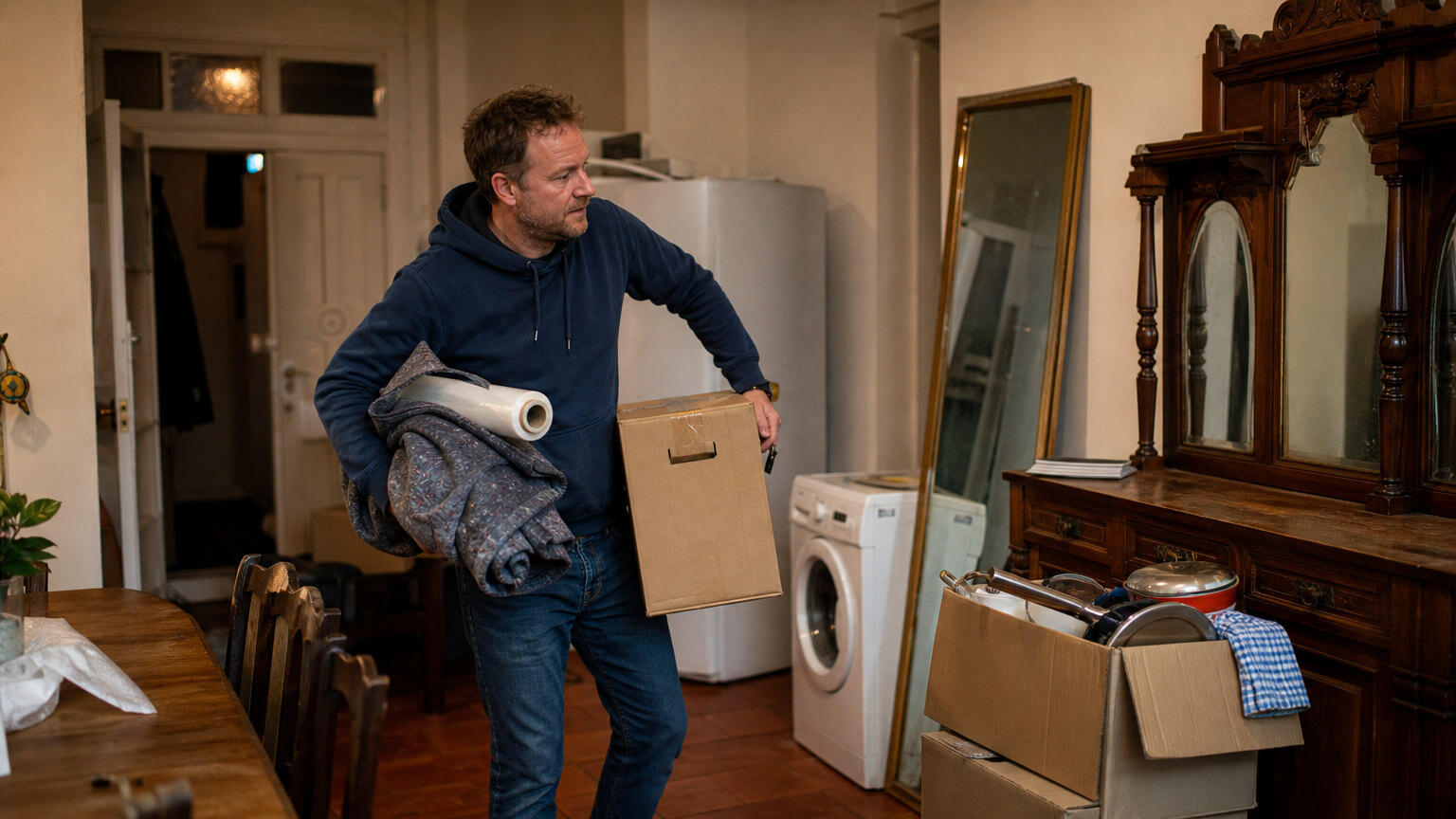
Think about the garden chest that has been sitting in the garage all winter. The set of garden chairs stored under a tarpaulin. The boxes you carried to the van in the rain and stacked straight in. The chest of drawers from the outbuilding that never quite dried out after last autumn. None of these items are banned outright. The problem is what they do inside an enclosed unit.
Our units are clean, dry and secure. That promise holds because every customer puts dry goods in. Moisture from one damp item creates condensation that spreads to wooden furniture, soft furnishings and cardboard boxes stored nearby. It does not stay in your unit. It finds a way to your neighbour’s things as well.
The solution is not complicated. Dry everything properly before it goes in. Leave garden furniture in the sun for a day. Air out a chest of drawers. Let anything that got wet in the move dry off before it goes into storage. It is worth the extra time.
Do not be tempted to assume a damp item will dry out once inside. There is no climate control in a self-storage unit. The protection comes from what you put in, not from what we regulate inside. Bring dry things, and they stay dry.
Batteries and fuel: the modern catch-out
This is the one that has become significantly more common in recent years. The petrol mower with a little fuel still in the tank and carburettor. The e-bike in the garden shed. The e-scooter bought during lockdown and barely used since. The lithium battery pack that is bolted into the frame and will not come out.
Petrol-powered equipment must be run completely dry before storage. That means the tank emptied and the carburettor run clear. A small residue of petrol is still petrol. This rule applies to lawnmowers, generators, chainsaws, pressure washers, anything with a combustion engine. Run it dry, then bring it in.
Lithium batteries present a different issue. A lithium battery that can be removed from the item should be removed and kept elsewhere. A lithium battery that is permanently fixed and cannot be removed makes the item itself a fire risk. If the battery cannot come out, the item cannot come in. This applies to e-bikes and e-scooters with non-removable battery packs.
The same logic applies to propane tanks, camping gas canisters and anything pressurised. Run the equipment dry, detach what can be detached, and if in doubt, ask before you load.
High-value items: cash, deeds, fine jewellery and where they really belong
A unit at one of our sites is individually alarmed, clean, dry and secure, and it is space only you can access. It is not a managed vault, and it is not a records archive. That honest distinction matters for certain categories of items.
Cash belongs in a bank. Title deeds and wills belong with your solicitor. Fine jewellery and items of serious monetary or sentimental value are better housed in a bank safety deposit box.
For items that do go into storage but carry real value, contents protection matters. Cover is mandatory at Wigwam: you can take our RSA Self Storage Customers’ Goods policy, or you can demonstrate equivalent cover of your own. Either way, declare the full replacement value. Under-insurance is settled proportionally, not in your favour. New-for-Old replacement means a genuine claim pays out at today’s replacement cost, not the original purchase price. Theft cover requires evidence of forced entry.
More detail on the policy, and what you need to declare, is on our contents protection page. We signpost it because it matters; we do not advise you on it because that is your insurer’s job.
Jurisdiction note: for legal documents such as title deeds, wills, or Powers of Attorney, storage requirements and access rights can differ under Scottish law and Northern Irish law compared to England and Wales. If you are storing legal documents and are based outside England and Wales, consult your solicitor. The guidance on this page reflects the position in England and Wales.
Why we do not store vehicles, caravans or tyres
Our units are for goods, not for vehicles. We do not store cars, caravans, motorhomes, boats, trailers, tyres or leisure transport. No exceptions, and this is not a conversation worth having in advance to see if we will make one.
If you are looking for vehicle or caravan storage, you need a different kind of operator. We are a market-town goods-storage business, and our units are sized and designed for that.
What you can store with confidence

The ban list is genuinely short. Here is the much longer, more reassuring half of the picture.
Household furniture and belongings between homes
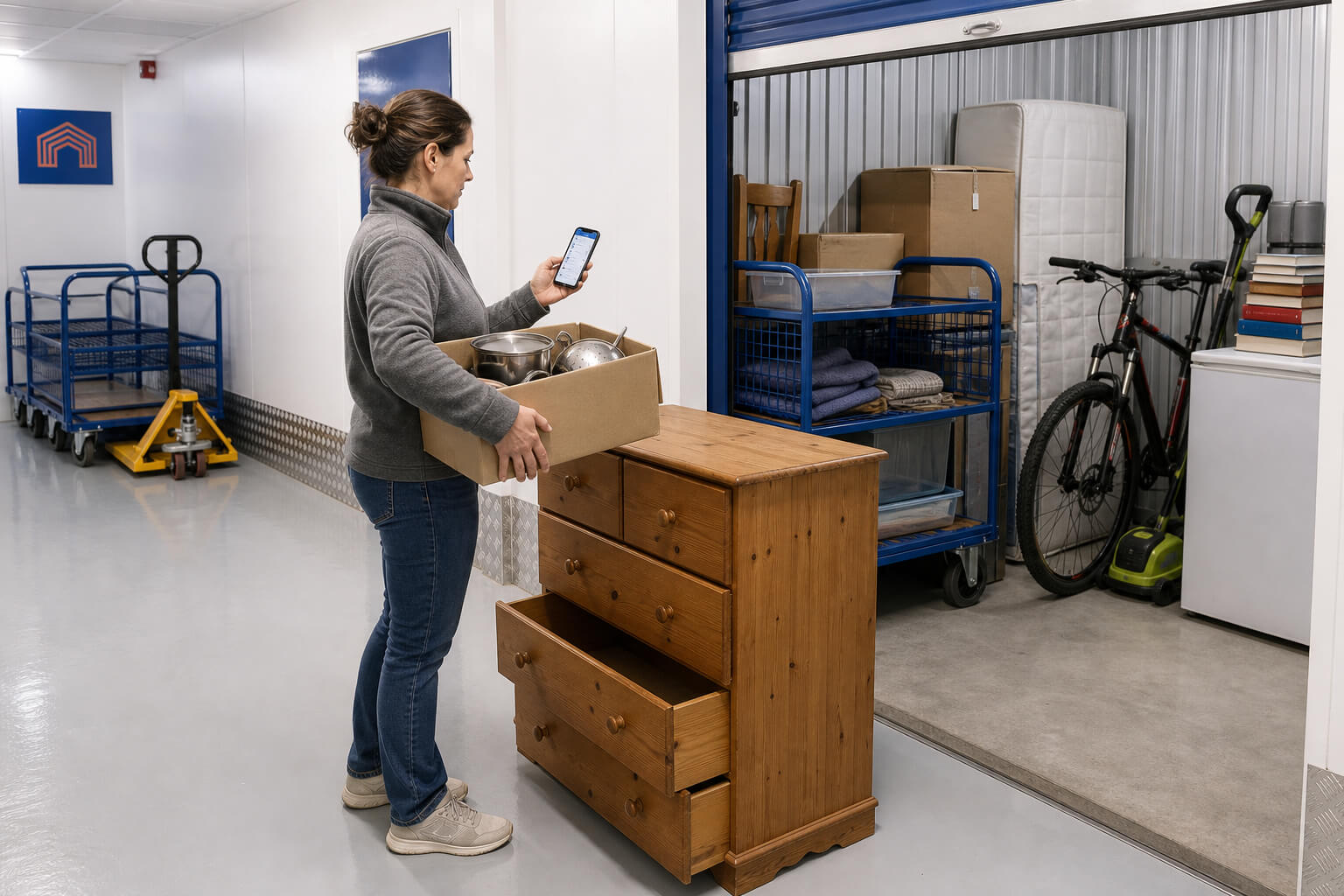
Furniture, boxed household belongings, white goods that are clean and fully defrosted, bicycles (standard, pedal-powered), seasonal items, garden tools that are fuel-free, clothing and textiles, sporting equipment, musical instruments, books, pictures, mirrors and anything else from a home that does not fall into one of the four banned categories.
Smart entry runs from 6am to 10pm, seven days a week. If you pack the unit in a hurry and realise two weeks later you cannot find the box of things you needed, you can pop back on a Sunday morning to retrieve it. You are not locked to office hours.
Business stock, equipment and trade goods
Boxed stock, retail displays, non-petrol tools and equipment, office furniture and equipment, sample sets, seasonal overflow for an e-commerce business. A storage unit makes a practical short-term or long-term stockroom for a growing business.
One thing worth being clear about here: our sites are unmanned. Smart entry means you come and go without needing a member of staff present. If a courier is delivering to your unit, someone from your own business must be there to receive them. Wigwam does not sign for parcels, accept deliveries or hold items on your behalf. If a delivery arrives when no one from your business is there, it cannot come in. Plan your deliveries accordingly.
A future article will cover the business-storage and e-commerce angle in more detail. For now, if you are a sole trader with non-petrol tools and trade equipment, the unit works well.
Documents and records you need kept safe
Boxed paper records, archive files, business ledgers, family documents accumulated over decades. A self-storage unit is secure space that only you can access. It is not a managed records service: we do not catalogue, retrieve or manage the files inside. Access is yours; the organisation inside is yours.
For documents with legal status, title deeds, wills and court orders, see the guidance above in the high-value section and consult your solicitor if you are unsure about what applies in your jurisdiction.
How size and how long affect what you bring

Knowing roughly what you plan to store makes choosing the right unit straightforward. Our pricing and unit-sizing guide walks through the options and helps you match the volume of what you have to the unit that suits it. There are no prices on this page; the guide covers that.
Two points worth knowing before you book. The minimum stay is two weeks, and if you leave before your time is up, unused days are refunded. That makes short awkward-period storage workable, the fortnight between keys where you have nowhere to put things, the month between a sale completing and a purchase going through.
Smart-entry access runs from 6am to 10pm, every day of the week. You are not relying on office hours or a site manager being available. If you want to add something to the unit on a Saturday evening or retrieve something early on a weekday morning, you can.
What to do if you are unsure about one item

If you have read through the sections above and you are still not sure whether one specific thing is allowed, ask before you load the van.
That is a genuine offer, not a formality. Tell us what the item is, and we will give you a straight answer. Not a policy document. Not a referral to the terms. An actual answer about your actual item, from a person at your local site.
Ready to check your items and get a price?
Head to quote.wigwamstorage.co.uk and add your question in the quote request. We will come back to you with a plain answer and a unit option that works. No commitment required to ask.
You can find your nearest site on our locations page. Our UK market-town locations include Wigwam Self Storage Bath in Somerset and Wigwam Self Storage Lincoln in Lincolnshire, among others across the country.
Keeping your goods covered: contents protection

A unit with an individual alarm is secure space. Contents protection adds the financial layer on top.
Cover is mandatory when you store with us. You can take the RSA Self Storage Customers’ Goods policy that we offer, or you can show us you have equivalent cover of your own in place. What matters is that the cover exists and that you have declared the full replacement value of what you are storing. Under-insurance is not corrected in your favour at claim time: if you declare half the value, you recover half of any loss.
The RSA policy runs on a New-for-Old basis and requires evidence of forced entry for a theft claim. Climatic damage is excluded.
For the detail of what the policy covers and what you need to do before you move in, visit our contents protection page. This is a signpost, not advice. Your insurer is the right person to advise you on whether your existing home or business policy extends to goods in storage and what its limits are.
Jurisdiction note: insurance requirements and cover rules for goods stored in self storage can differ between England and Wales, Scotland, and Northern Ireland. If you are storing in Scotland or Northern Ireland, or if you have a claim query, confirm the position with your insurer and, where legal documents are involved, with your solicitor.
The rules, the terms and where to read them

The four categories above align to standard UK self-storage practice as the Self Storage Association UK recognises it. Wigwam’s full terms and conditions set out the complete picture: your rights, our rights, and the specific prohibited-items list that applies to every one of our sites.
You can read them at wigwamstorage.co.uk/terms-conditions/.
On deposit: when you book, a deposit is taken. It is refundable. Once you have given your 14 days’ notice, vacated the unit, and settled the account, the deposit is returned to you, less anything owed. That is the full picture.
There is no fine print designed to catch you out. If you read the terms and you have a question about what something means, ask. That is what we are here for.
Ready to check your list against a real site?
You have seen what is allowed and what is not. If your things pass the test, the next step is finding the right unit and getting a price.
Get a quote and, if you have a question about a specific item, add it in: quote.wigwamstorage.co.uk. We will give you a plain answer and a unit option that suits what you have.
Find your nearest location at wigwamstorage.co.uk/self-storage-locations/. For unit sizes and what they cost, the guide is at wigwamstorage.co.uk/how-much-is-self-storage-in-the-uk.
Frequently Asked Questions
Can I store paint, weedkiller or a half-full gas bottle if I seal it really well?
No, and sealing it tighter does not make it allowed. Anything that can leak, ignite or give off fumes is banned regardless of how well you think you have contained it, because the risk is not really about your packaging. It is about what happens in a sealed unit over weeks and months, and what one container failing would do to a whole corridor of other people’s belongings.
The category is broad on purpose: paint and solvents, weedkiller and pesticides, petrol and diesel, LPG and camping gas, aerosols under pressure, fireworks. A seal that holds today can fail in heat or with age, and a slow leak in an enclosed space contaminates the air and the goods around it. A gas bottle, even one you believe is empty, can retain enough residual pressure to be a genuine hazard. None of this is us being awkward; it is the same rule you will find at every reputable operator, and it is the reason a clean, dry, secure unit stays that way.
So the practical answer is to deal with these items before the move rather than trying to store them. Use up the paint or take it to a household waste site that accepts it. Return or properly dispose of gas bottles through the supplier. Empty fuel from equipment. If you are genuinely unsure whether a specific product counts, describe it when you ask, and we will give you a straight yes or no before you load it rather than turn you away at the unit.
Where exactly is the line between “household goods” and “a vehicle” for things like a ride-on mower or a trailer?
The line is whether the thing is, in effect, a vehicle or leisure transport, and a couple of the awkward cases fall on the no side. We store household and business goods, not vehicles, and that exclusion covers cars, motorbikes, caravans, motorhomes, boats, trailers and tyres. A ride-on mower sits in the difficult middle, and the deciding factors are that it is engine-powered and that it carries fuel, both of which push it toward the prohibited side rather than the ordinary-goods side.
Here is the cleaner way to think about it. A push mower or a hand tool with no engine and no fuel is ordinary garden equipment and stores fine once it is clean and dry. A petrol mower has to be run completely dry of fuel before it could even be considered, because residual petrol falls under the hazardous-items rule, and a ride-on adds the question of whether it is really a small vehicle. A trailer is excluded outright as leisure or transport equipment, regardless of what you would tow it with. Tyres are out too, on their own, because of how they behave in storage.
If you are clearing a garage that contains a mix, the boxed tools, the shelving and the garden bits are welcome; the engine-driven, fuelled or wheeled-transport items are the ones to query or rule out. Rather than guess, list the borderline items when you request a quote and we will tell you which side of the line each one falls. It saves a wasted trip with something in the van that was never going to be allowed in.
Who is responsible if something I stored damages a neighbouring unit, like a leak or pest problem?
The responsibility sits with the person who stored the item that caused it, which is exactly why the rules on damp, food and hazardous goods exist. The units share an environment to a degree, so a problem that starts in one unit, mould from a damp chest, mice drawn to a forgotten bag of food, a leak from something that should never have been stored, does not always stay politely within its own walls. The rules are there to stop that happening, and following them is how you protect both your own goods and everyone else’s.
This is the practical reason behind advice that can otherwise sound fussy. Drying everything before it goes in is not about the unit being damp; it is about one wet item creating condensation that can travel. Keeping food out is not pedantry; it is because scent attracts pests that do not respect the boundary between units. The hazardous-items ban protects the whole corridor from one container failing. When everyone puts in dry, clean, permitted goods, the shared environment stays clean, dry and secure for all of it.
Contents protection is the financial backstop, and it is mandatory for that reason. Your own cover, whether the RSA policy we offer or your own proven cover, protects your goods. It is not a substitute for following the rules, though. The honest summary is: store what is permitted, in the condition the rules require, and you are very unlikely to be the cause of a neighbour’s problem or the victim of one. If you ever spot something amiss, a smell, a damp patch, signs of pests, tell us, so it can be dealt with before it spreads.
Can I store opened food or drink for a short stay, like a week or two?
No, and the short stay does not really change the answer. Opened or unsealed food, anything perishable, and household waste are out regardless of how long they will be in the unit, because the issue is scent and decay, and both can start working within days, not months. A week is plenty of time for a forgotten box of kitchen goods to attract attention you do not want.
The reasoning is the pest one. Mice and insects track the scent of food, and they do not distinguish between a fortnight and a year; they simply follow the smell to its source. Once they are in, they work through your belongings and can move to a neighbour’s before anyone notices. That is why this rule is firm even for a short overlap between homes. Sealed tins are not formally banned, but I would still keep them out, because pests can detect food even through intact packaging, and a few tins are not worth the risk to a whole unit of furniture.
If you are clearing a kitchen ahead of a move, the better routes are to use up what you can, donate unopened, in-date items to a food bank, and dispose of the rest properly before moving day. Pack the kettle, the mugs and the empty, clean kitchen equipment, all of which store perfectly well, and leave the actual food behind. If you are unsure about a specific item, a sealed bottle of oil, say, ask before you load and we will give you a plain answer.
If an item I want to store is borderline, who actually decides, and how fast can I get an answer?
You ask the support team and they give you a straight answer, usually quickly, before you ever load the van. The decision rests on the rules, the four banned categories plus the no-vehicles exclusion, applied to your specific item, and the team are there precisely to apply them to real cases rather than leave you guessing from a list. It is a genuine offer, not a formality: tell them what the item is and you get an actual answer about that actual item.
The fastest way to get that answer is to fold the question into your quote request. Head to the quote tool, describe the borderline item in plain terms, and the team comes back with a yes or no and, where it is a yes-with-conditions, what those conditions are. For example, a petrol tool can come in once it is run completely dry; a battery item is fine if the battery is removable and removed, but not if the pack is fixed in. You get the reasoning, not just the verdict, so you know how to prepare the item.
One boundary worth setting: the team decide on storage questions, not on anything outside their lane. They will tell you whether your item can be stored and how to prepare it. They will not advise you on insurance choices, legal documents or how to run a business; those get signposted to the right professional. For the question that matters here, “can I store this thing”, they are exactly the right people, and asking first is always cheaper than turning up with something that was never going to be allowed in.
Customer Reviews