Has the business finally outgrown the spare room?
Most UK e-commerce founders we work with start in a spare room and hit a wall around £5,000 to £8,000 in monthly revenue. That’s when stock volume, returns, and packaging finally outgrow the space the rest of the household is willing to give. Here’s what’s actually happening at that tipping point, and the maths that justifies moving to self storage rather than jumping straight to a warehouse lease.
There is a very specific version of this moment. It’s a Sunday. You’re at the kitchen table with a coffee, Q4 somewhere on the horizon, surrounded by packaging and a returns pile that has been there since Tuesday. Your partner has stopped offering to help because there is nowhere useful to stand. You are not failing. You are growing. But the house has quietly started to lose.
This article is for founders at that exact moment. Not the ones who are ready to sign a three-year warehouse lease, and not the ones who are just starting out. The ones in the middle, building something real, who need to know whether now is the time to move, and where to move to.
The £5k Tipping Point: What We Keep Seeing

Across the e-commerce businesses that use our locations, the same pattern comes up repeatedly. At around £5,000 to £8,000 a month in revenue, home stops working as a fulfilment base. Not “could do with more space.” Stops working.
The pattern across dozens of growing brands
We have watched this play out many times. A business that started on one table, in one room, gradually colonises the landing, then a second bedroom, then the living room. The stock count grows. The SKU rotation gets complicated. Returns arrive and don’t leave quickly. Packing essentials spread into shared spaces.
The pattern isn’t random. It tracks revenue, because revenue tracks volume, and volume tracks cubic feet. The businesses that start to struggle are the ones where the operation has genuinely outgrown the building. Not every founder notices the revenue number. Almost every founder notices the space.
What Wigwam offers is not a particularly radical observation. It’s just that we’ve seen it from the other side often enough to recognise the shape of it.
Why £5k: the revenue-to-space maths
The £5,000 number isn’t arbitrary. Here is roughly what it represents.
A typical UK e-commerce order runs around £35. At £5,000 monthly revenue, that’s around 140 orders a month. With a modest SKU count of 200 to 300 product variants, and standard stock rotation, you’re turning over significant volume every month. Each of those orders needs somewhere to live before it ships: a pick location, a packing surface, and space for the returned version if it comes back.
At that volume, the amount of physical space required to run the operation starts to exceed what a typical spare room can hold without the room serving exclusively that purpose. Most spare rooms are not exclusively that purpose. Most spare rooms also contain a bed, a desk, a wardrobe, and a family member’s goodwill.
These are illustrative figures and will vary considerably depending on your product type, returns rate, and average order size. The principle is consistent: around £5k to £8k monthly revenue, the maths starts to tip.
The four signals you have hit it (even if the revenue number says you haven’t)
Revenue is not always the clearest signal. Sometimes the business is there before the number confirms it. If three of these four sound familiar, keep reading:
- Stock has moved from one room to two.
- Returns are arriving in the kitchen.
- Your partner has stopped making jokes about it.
- You have started apologising when people visit.
The last one is the one founders remember most clearly when they describe the moment they decided to act. “I was apologising to my own mother about the hallway” is a sentence we have heard more than once.
Why Your Spare Room Stopped Working
The spare room is not getting full. It has already lost. The real question is how much of the rest of the house goes with it before something changes.
The kitchen-table packing problem
Picture the actual logistics. You finish dinner, clear a space, bring in the packing supplies, process the day’s orders, seal the boxes, and then clear everything away before the table can be used again in the morning. That setup and clear-down takes time. Across a week of trading, that can account to thirty to forty-five minutes a day of work that has nothing to do with actually building a business.
Over a quarter, that’s a working week. A full working week, spent assembling a packing station from scratch and dismantling it again. The business is losing that time to the friction of not having a dedicated space, and the cost never appears on any spreadsheet.
A storage unit with a dedicated packing area doesn’t require setup. You open the door, you work, you leave. The packing station stays ready. The kitchen table stays a kitchen table.
The returns pile that ate the living room
Returns are the volume most founders underestimate, and they’re harder to deal with than outbound stock. An item that comes back is not done. It needs assessment, a condition decision, re-packaging if it’s sellable, a restock decision, and then a physical location. A returned item that arrives on Thursday doesn’t leave until you have had time to deal with all four of those steps.
In a spare room that is already operating at capacity, returned items stack up because there is no dedicated triage space. The pile grows. The pile moves to the living room. The living room becomes part of the operation.
The relationship cost: the one that doesn’t go on a spreadsheet
This is the variable most founders don’t mention when they describe their decision to move. They talk about space. They talk about the maths. They don’t always talk about the fact that the business has been quietly taking up more of the household’s tolerance than its square footage.
Every founder who has made the move to storage has at some point told us some version of the same thing: “I should have done this six months earlier.” Not for business reasons, for domestic ones.
The spare room doesn’t just hold stock. It holds a negotiation. And that negotiation has a finite amount of patience in it. The relationship cost is the variable that usually makes the decision obvious, even before the maths does.
Why A Warehouse Lease Is Usually The Wrong Next Step

The most common thing founders at the £5k point tell themselves is: “I should just get a warehouse.” Most of them should not. Here is why.
The minimum-term problem
Most UK commercial warehouse leases run three to five years as a minimum. Some shorter-term arrangements exist, but they tend to come at a premium, and the more flexible the exit, the higher the rate.
At £5,000 to £15,000 in monthly revenue, consider what a three-year commitment actually requires. Can you project your business trajectory confidently for three years? What happens if growth stalls for six months? What if you pivot into a different product category that needs less space, or more? What if a 3PL arrangement starts to make more sense at scale?
For many founders at this stage, the honest answer is that a three-year lease represents a level of certainty about the future that the business has not yet earned. The downside is not just inconvenient. A lease you cannot exit on a business that has stalled is a financial liability that continues regardless of what the business is doing.
The hidden costs of a warehouse
The headline rate per square foot is rarely the real cost. The actual cost of a warehouse space in the UK includes business rates, which typically add around 30 to 40 per cent to the net rent. It includes fit-out costs: shelving, lighting, security systems, and basic infrastructure, which can add significant one-off expenditure before you have moved a single box in. It includes utilities, broadband, insurance, and potentially separate office space if you need anywhere to work that isn’t a concrete floor.
These figures reflect England and Wales; business rates structures, reliefs, and administrative arrangements differ in Scotland and Northern Ireland. Founders in Scotland or Northern Ireland should verify costs and eligibility with their local authority or a business adviser before making any comparison.
The practical result is that the cost per usable square foot is often substantially higher than the headline quoted rate. What looks like a straightforward comparison against self storage becomes considerably more complicated when the full cost stack is assembled.
When a warehouse is actually right
This section matters, because the honest answer is that warehouses are sometimes exactly right, and a piece that ignored that would be doing founders a disservice.
The signals that genuinely point toward a warehouse include: predictable monthly revenue above roughly £25,000 to £30,000, a growing team with specific operational needs, volume that justifies the infrastructure of a dedicated pick-and-pack facility, and a business trajectory you can forecast with reasonable confidence over three or more years.
For most founders at the £5,000 to £15,000 monthly revenue stage, those conditions are not yet met. The business is real and it is growing, but it has not yet reached the point where the infrastructure cost of a warehouse is proportionate to the certainty of the return.
For most businesses at the £5k to £15k stage, there is a more proportionate option.
The Self-Storage Middle Path: How E-Commerce Brands Actually Use It

Self storage for e-commerce is not self storage as most people picture it: a unit full of furniture from a house move, sealed and forgotten. It is a working fulfilment space. Here is what that looks like in practice.
What founders actually do in their units
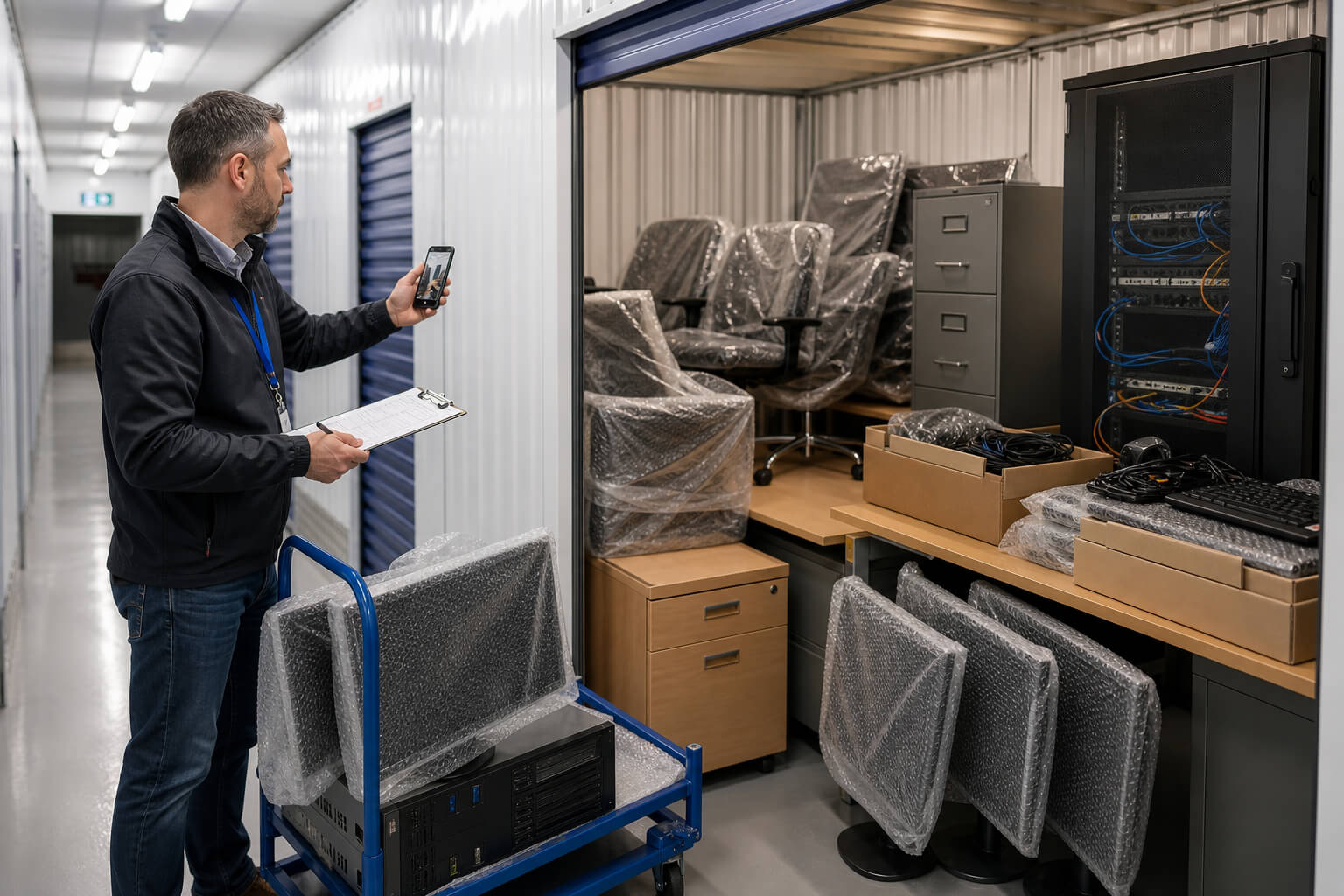
The operation runs like a small warehouse, without the lease, the business rates, or the fit-out bill. Stock sits on shelves that you put up. Orders come in through Shopify, WooCommerce, or whichever platform you’re using. You drive to the unit, open the roller door, pick the order, pack it on the worktable inside, and leave the door open for the courier collection window.
Returns come back to the unit address, handled during a dedicated triage session rather than spread across a kitchen that also needs to function as a kitchen. Q4 scaling is handled by taking an additional unit for November and December, then releasing it when the peak passes. Multi-channel sellers on Etsy, eBay, or multiple Shopify stores run the same stock from the same space without any of the channels knowing the difference.
The unit stays set up between visits. You don’t break it down. You don’t apologise for it. It’s a business space.
Multi-unit scaling: start with one, expand as the business needs it
One of the constraints of a warehouse lease is that you commit to a fixed size. You’re in 2,000 square feet for three years, whether your stock needs 800 or 2,400 of it.
Self storage doesn’t work that way. You start with a unit that fits what you have now, typically 50 to 100 square feet for a business at the £5k to £8k revenue point. As stock grows, you take an adjacent unit. As the business scales further, you add a third. You’re not renegotiating a lease or moving premises. You’re adding a unit.
Multi-unit arrangements are available across our UK market-town locations. Speak to the business team about what’s possible for your specific operation.
The features that matter for e-commerce, and what they actually mean
Drive-up access, where available, means you back up to the door and unload. No corridor, no lift, no carrying boxes through a shared building. It is not a small thing when you are moving stock regularly.
Smart entry, available from 6am to 10pm seven days a week, means your packing runs fit around your actual schedule rather than a landlord’s office hours. You are not locked out of your own operation because it’s a bank holiday.
The two-week minimum stay means you can test a unit before committing your whole operation. Move the slow-moving stock in. See how the access works. Run a pack-and-ship. Then commit to the longer term once you’ve seen it work.
VAT invoicing is standard. Your accountant will find the paperwork straightforward.
Units are individually alarmed and your goods are kept clean and dry. No climate control is offered or implied: the units are built for standard stock, not specialist goods with temperature or humidity requirements.
There is no deposit. Any unused days are refunded after your 14-day notice period, once you’ve vacated and your account is settled. Full details are in the terms and conditions.
A note on couriers: Wigwam sites are unmanned. For any courier collection or drop at your unit, someone from your business needs to be present. The sites operate on smart entry, not staffed reception, so Wigwam cannot sign for or receive deliveries on your behalf. Plan your collection windows accordingly, and brief your courier accounts with your access schedule.
Contents cover is mandatory for all Wigwam customers. You can take Wigwam’s own policy or demonstrate equivalent cover from your own insurer. Whichever route you take, declare the full replacement value of your stock. Under-insurance is settled in proportion. Full details at the contents protection page.
Ready to look at options for your operation? The right unit size and location for your fulfilment geography is something our team works out with you. It usually takes around 15 minutes. Start at quote.wigwamstorage.co.uk.
The Maths: Storage vs Warehouse vs Staying Home

The question most founders want answered is: what does it actually cost? Here is a comparison across three options at three approximate revenue points. These are illustrative ranges only; treat them as a framework rather than a quote.
Monthly cost comparison
| Monthly revenue | Approx. stock SKUs | Space needed | Self storage (indicative) | Warehouse lease (indicative, England and Wales) | Staying home |
|---|---|---|---|---|---|
| £5,000 | ~200 | ~150 cu ft | Around £75/week (50 sq ft) | Typically uneconomic at this scale | Time cost + relationship cost |
| £10,000 | ~500 | ~400 cu ft | Around £150/week (100 sq ft) | £1,500 to £2,000/month, including indicative rates | Strained |
| £20,000 | ~1,200 | ~900 cu ft | Around £300 to £400/week (200 sq ft, multi-unit) | £2,500 to £3,500/month, including indicative rates | Breaking |
All storage figures are illustrative only. For actual pricing at our UK market-town locations, see the self-storage pricing page. Warehouse cost estimates reflect England and Wales and do not include fit-out, utilities, or broadband; verify with a commercial agent for your area.
The hidden cost of home-based fulfilment
The “staying home” column in the table above carries four costs that don’t appear in a simple rate comparison.
Time: that daily setup and clear-down adds up to roughly a working week per quarter at the volumes this article describes.
Space: a room that functions as a fulfilment space cannot function as anything else. That room has a rental or mortgage equivalent that the business is occupying without paying for it explicitly.
Relationship: finite and real, as described earlier.
Professional presentation: at some point, suppliers, wholesale buyers, or collaborators may visit or ask about your operation. “I run it from my spare room” is not a problem in itself, but it can become one when you are trying to establish the kind of business relationships that require credibility.
When storage starts to pay for itself
The break-even point is not the same for every business, but the pattern is consistent. For most founders at the £5,000 to £8,000 monthly revenue range, the combined time cost, relationship cost, and opportunity cost of staying home starts to exceed the monthly cost of a storage unit. Most founders who work through this with our team find that the maths have actually been pointing toward a move for two to four months before they ran the numbers.
If you want to run this maths against your own situation, our team will do it with you.
How To Plan The Move Without Disrupting Trade

Moving stock to a storage unit while keeping orders flowing is manageable if you sequence it correctly. Here is what tends to work.
When to move
The lowest-risk windows are Q1, roughly January to February, and Q3, July to August. Order volumes are lower in both periods. A packing mistake or a missed collection during transition costs proportionally less when you are not at peak volume.
Avoid moving during Q4 if you can help it. The cost of any disruption during peak season is disproportionate to the benefit of getting into a unit a few weeks earlier. If the tipping point has arrived in October, the pragmatic answer is often to plan the move for January and use that time to get the unit set up and ready.
What to move first
Start with slow-moving stock: lines that sell steadily but are not urgently needed in the next forty-eight hours. Leave fast-moving stock and packing essentials at home for the first week as a fallback while you settle into the unit.
Set the unit up properly before you move the main operation in. Shelving, a logical layout by SKU, clear labels. Do a dry-run pack-and-ship from the unit before committing. Find out where the natural packing position is, how the light falls, where you’ll put the tape gun. Small things, but they matter when you are trying to maintain pace on a working trading day.
How to keep fulfilment running during the transition
Stage the move over two to three weekends. Run home and the unit in parallel for the first week: if something is urgently needed and hasn’t made it to the unit yet, you still have a fallback. Most founders who try to do the move in a single weekend find it more stressful than necessary.
Brief your courier accounts well in advance. Give them the new collection address, your access schedule, and the contact number for whoever will be present for the collection. Remember: someone from your business needs to be at the unit for any courier collection or delivery. Smart entry means the site is unmanned, so couriers cannot be left to collect unattended.
Once the dry-run pack-and-ship from the unit has worked, commit. The home fallback has served its purpose.
What Happens When It Works: The Pattern We See At Wigwam Bath

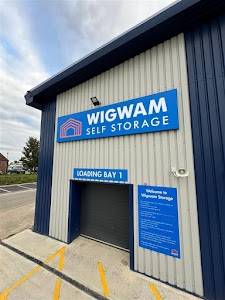
Wigwam Self Storage Bath has become a natural home for a number of e-commerce businesses, including product brands that started exactly where this article describes: stock on a kitchen table, a spare room that had given up the fight, a growing order count and nowhere clean to process returns.
The moment the spare room loses
The shape of the story is consistent across the businesses that have made this move. At a specific point in growth, the signals from the earlier section of this article all land at once. The SKU count reaches a level where a single room cannot hold the logic of the operation. Returns start arriving faster than they can be triaged. The domestic truce that has been holding since the business started finally breaks.
The decision to move is rarely made on a spreadsheet. It is made on a Sunday afternoon, looking at what the house has become, and deciding that the business deserves a proper space.
What founders almost always say afterward
The most consistent thing we hear from founders who have made the move, regardless of the specific business or location, is some version of the same sentence: “I should have done this six months earlier.” Not because the earlier arrangement was unworkable in a logistical sense. Because the domestic cost of waiting was higher than they had admitted to themselves.
The six months earlier point is almost always identifiable in retrospect. The four signals from earlier in this article had been present for a while. The revenue maths had tipped. The relationship cost was real. The move had been the right call before the founder made it.
What the operation looks like once it’s settled
Within a month of the transition, the pattern tends to look the same. A working unit: shelves by SKU, a packing station that stays set up, a clear triage area for returns. Orders shipped on schedule. The kitchen table used for meals again. Access from 6am when an early dispatch window is needed, or an evening packing run when the day’s orders have come in.
The business hasn’t changed. The space it occupies has. That separation is the thing most founders say they underestimated. When the operation is in a unit, it belongs to the business. When it’s at home, it belongs to the house.
If your business is at that point, the same conversation our team has had with founders who’ve made this move is available to you.
Talk To Our Team: A 15-Minute Conversation, Not A Sales Call
The £5,000 tipping point is not a precise number. It is a pattern, and only you can tell where your business sits within it. If this article has landed, if you recognised the four signals, the returns pile in the kitchen, the partner who has gone quiet, the warehouse hesitation, then the proportionate next step is a 15-minute conversation with someone who has helped many e-commerce brands through exactly this stage.
What the call covers
The call is specific. Where your business actually sits right now: revenue, SKU count, and the cubic footage that implies. Which of our UK market-town locations suits your fulfilment geography. Realistic cost projections at your current revenue and at the next likely growth point. A specific recommendation, including, if the evidence points that way, an honest “a warehouse is probably the better fit for you at this stage.” That honesty is not a problem. It is the point.
It is not a sales call. We are not trying to put every founder in a storage unit. We are trying to give you a clear-eyed view of your options, from people who have watched many businesses make this decision.
What Wigwam offers for e-commerce businesses
For the right business at the right stage, here is what is available:
- Two-week minimum stay: test the unit before you commit the whole operation
- Multi-unit option: start with one unit, add capacity as your stock grows without moving premises or renegotiating anything
- Drive-up access at available locations: back up, unload, and get on with the day
- Smart entry from 6am to 10pm, seven days: access that fits around packing runs, not office hours
- VAT invoicing: straightforward for business accounts
- No deposit: nothing held back, so nothing to reclaim when you leave
- Individually alarmed units, kept clean and dry
- Contents protection: mandatory for all customers; take Wigwam’s policy or demonstrate your own cover. Full details at contents protection
No prices on this page: storage costs vary by location, unit size, and current availability. For accurate figures, use the self-storage pricing page.
Find our UK market-town locations to see which site suits your fulfilment geography.
How to start
Whatever you decide, even if it’s another six months at home while you track the numbers, we hope this helped you think it through clearly.
Book a 15-minute consultation at quote.wigwamstorage.co.uk. Tell the team where you are with the business and what you’re working out. They will help you think it through.
Frequently Asked Questions
That is a question for the team and your own admin setup rather than something I would assume yes to. A storage unit is built to be a working stock and fulfilment space, not a registered office or a trading address in the way a serviced office is, and how you can use it for correspondence depends on the specifics. Before you put the unit address on Companies House, your invoices or your courier accounts, ask the support team what is and is not appropriate for your site.
What the unit genuinely does well is the operational side: somewhere to hold stock, pick and pack orders, and run returns triage. Where people get into trouble is treating it as a manned premises it is not. The site is unmanned, so post and parcels are not received on your behalf, and there is no reception to take a delivery while you are elsewhere. If you list the unit as the delivery address for courier collections of your own outbound orders, that works because you are there to hand them over within the access window. Using it as a passive receiving address does not, because no one from Wigwam signs for anything.
So the honest steer is: ask the team about address use for your specific situation, and keep the distinction clear in your head between an operational space you actively work from and a registered or receiving address that implies someone is there to act on your behalf. For the legal and tax side of where your business is registered, your accountant is the right adviser, not a storage company.
Nothing ships unless someone from your business is at the unit to do it, so this is worth planning for before it bites. The site is unmanned and runs on smart entry, which means access is yours and no one else picks, packs or hands goods to a courier on your behalf. If you are on holiday or off sick, the unit does not run itself, and a courier cannot be left to collect unattended.
The realistic answers are about cover, not about the unit. Most founders at this stage either build a short pause into their dispatch promise around known absences, or give a trusted person, a partner, a part-time helper, their own smart entry arrangement so orders keep moving while they are away. Some hold a small buffer of fast-moving stock and packing materials at home as a fallback for exactly these gaps, which is also useful during the first week of a move into the unit. The point is that the operation is still person-dependent: the unit removes the space problem, not the staffing one.
This is one of the honest differences between a storage unit and a full 3PL arrangement. A fulfilment provider ships in your absence because that is their job; a unit is your own working space that runs when you or your people are in it during the 6am to 10pm window. For most founders at the five to fifteen thousand a month stage that trade-off is the right one, because the flexibility and cost suit the stage. But plan your absences around it rather than assuming the unit covers them.
Quickly in principle, but it depends on what is available at your site when you ask, so the practical advice is to flag a peak before it arrives rather than the week it lands. Multi-unit arrangements are available across our market-town locations, and the model is designed to let you add capacity for November and December and release it afterwards, without renegotiating a lease or moving premises. That flexibility is one of the main reasons the storage route beats a fixed warehouse for a seasonal business.
The constraint is simply stock of units. At a busy site heading into Q4, an adjacent unit may already be taken, so the founder who tells the team in September that they expect to need a second unit for the peak is in a far better position than the one who calls in late November. The team can talk through whether an adjacent unit, a second unit elsewhere on the site, or a single larger unit is the cleaner answer for how you actually pick and pack. Bring them your expected peak volume and they will work the options.
There is no penalty built into scaling up and down: the two-week minimum and the refund of unused days mean a unit taken for the peak and released afterwards costs you the time you use, not a long commitment. The thing to manage is timing and availability, not contract risk. Treat the second unit as something you reserve ahead of the curve, the same way you would forecast stock, and the peak handles itself.
If your stock genuinely needs a controlled temperature or humidity, a standard unit is not the right home for it, and I would rather say that plainly than have you assume otherwise. We do not offer climate control and we do not imply it. The honest description of what a unit gives you is clean, dry and secure, which is the right environment for the large majority of e-commerce stock, packaging and equipment, but not for goods with specific conditioning requirements.
The grey area is worth thinking through carefully. Plenty of products that sound sensitive are actually fine in a clean, dry space: most homewares, textiles, hard goods, sealed dry stock. Where you need to be cautious is anything with a manufacturer-stated storage temperature, certain cosmetics and skincare, supplements, anything food-adjacent with a shelf life affected by warmth, or items that degrade in humidity. For those, the controlling factor is your supplier’s storage guidance and any regulatory requirement on your category, not what is convenient for your fulfilment.
So the steer is: check your product’s stated storage conditions first. If it is happy in an ordinary dry room, a unit suits it and the access, cost and flexibility all work in your favour. If it has a defined temperature or humidity window, you need a specialist facility for that line, even if the rest of your range stores with us perfectly well. And remember the support team handle storage questions, not your product compliance or your business decisions; for what your specific goods require, your supplier and your own regulatory checks are the right sources.
The principle is the same, contents cover is mandatory and you declare the full replacement value, but the valuation is more dynamic for a business, so it needs active management rather than a one-off figure. With a house move you declare the value once and it sits largely static. With trading stock, the value in the unit rises and falls as you buy in, sell through and hit seasonal peaks, and your declared value needs to reflect that, because under-insurance is settled in proportion.
Here is the practical consequence. If you declare the value of your stock in January and then triple your holding for a Q4 peak without updating the figure, a claim during that peak could be settled against the lower January declaration, leaving you recovering a fraction of the loss. So for a business unit, treat the declared replacement value as something you review when your stock level changes materially, not as a number you set once and forget. You can take the RSA “Self Storage Customers’ Goods” policy we offer or demonstrate your own equivalent business cover; either is acceptable, but the goods must be covered before they go in.
I will signpost the contents-protection detail and stop there, because the choice of cover and the right level for a trading business is a conversation for your insurer or broker, not for a storage company. What I can be clear on is the discipline: declare honestly, update as your stock grows, and check whether your existing business policy already extends to goods held off-site in a storage unit, because many do not without a specific endorsement. Get that right and the insurance side of running stock from a unit is straightforward.