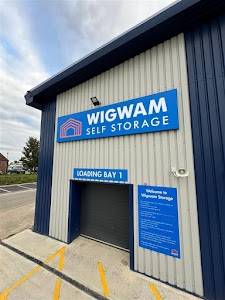
Every Thames Valley office has one. A cupboard, a spare corner, a room that started as “just while we sort this out” three years ago and is now doing the job of a filing warehouse. Nobody put it in the office plan. Nobody budgeted for it. It just grew, quietly, until it was taking up more floor space than anyone realised, and you were the one who noticed.
If that’s you, here’s the quick version: a single archive corner, drawers and shelving and all, usually occupies about as much floor space as one or two desks. That’s not a guess, it’s a measurement, and it’s the whole story of this page.
If you just need to know whether this is realistic, skip to what one archive run costs you in floor space, below.
If you’re worried about how collections and drop-offs work with no staff on site, skip to the section on that.
If you already know you want this and just need the next step, skip to the end.
What business storage at Wigwam Reading actually is
Wigwam Self Storage Reading, at 7 Bridgewater Close, Reading, RG30 1JT, offers unit storage sized for exactly this kind of overflow: archive boxes, retired equipment, seasonal stock, event props. It’s built for commercial use as much as household use. Businesses already use Wigwam Reading for stock storage for online sellers, tool storage for tradespeople, and equipment storage for people who work outdoors. An office archive corner is a very ordinary addition to that list.
Who this suits
If you’re managing space at an office anywhere near Green Park, Winnersh Triangle, Arlington Business Park in Theale, or central Reading, and you need somewhere to put things you touch a few times a year rather than a few times a day, this is built for you.
What it isn’t
Wigwam Reading doesn’t do container storage, vehicle storage, or climate control. More on all three later, so you know exactly where the edges are before you plan around this.
Access built around a working day, not a 24-hour warehouse shift
Units at Wigwam Reading are accessible from 6am to 10pm, every day. That’s a window built to match how a business actually operates, not a blanket round-the-clock claim. You’ll see plenty of storage providers advertise 24-hour access as standard. Wigwam Reading doesn’t, and that’s a deliberate choice worth being upfront about rather than apologising for: it’s a working-day window, wide enough to cover early starts and late finishes, not a warehouse shift pattern nobody in an office actually needs.
Storage access vs office hours
It helps to know these are two different things. Unit access runs 6am to 10pm, seven days a week. The Reading office and reception, separately, keep more limited hours: Monday to Friday 9am to 6pm, Saturday 9am to 2pm, closed Sunday. If you need to speak to someone, that’s the window. If you just need to get into your unit, the wider one applies.
The one thing to know before you send anyone else to collect for you
Wigwam Reading is unmanned. There’s no staffed reception to receive a delivery or supervise a collection on your behalf. So if you’re sending a courier, a cleaner, or a contractor to drop something off or pick something up, someone from your own business needs to be there to meet them.
Why this matters for archive runs and equipment swaps
This is the detail that trips people up precisely because the rest of the arrangement feels so hands-off. It’s genuinely low-maintenance once it’s set up, but the handoff itself still needs a person from your side present, every time. Plan for that and the whole thing runs smoothly. Assume someone else will handle it and you’ll have a courier standing outside a locked gate.
Smart entry, explained
Access itself is straightforward: a smart entry system gets you and your team in and out without anyone needing to be handed a key. Units are individually alarmed, and the site carries externally monitored CCTV around the clock. That convenience is genuine. It just doesn’t extend to someone else managing your comings and goings for you.
What one archive run costs you in floor space
Here’s the comparison, stated plainly: a typical small-office archive corner, the kind with four to six filing cabinets and a shelving unit for retired kit and stationery overstock, occupies roughly the same floor area as one to two desk workstations. Clearing it doesn’t create money. It creates usable floor space, and what you do with that space is entirely up to you.
The comparison, worked through
| Item | Approx. floor footprint |
|---|---|
| Standard 4-drawer filing cabinet (with drawer-pull clearance) | In the region of 5 sq ft |
| Small-office archive corner (4 to 6 cabinets plus a shelving unit) | In the region of 25 to 35 sq ft |
| One desk-and-chair workstation, including immediate circulation space | In the region of 25 to 35 sq ft |
This is the desk-and-chair footprint itself, not the fuller per-person allowance an office planner sets once corridors, meeting rooms and breakout space are apportioned across a whole floor (the British Council for Offices puts that broader figure nearer 10 square metres per person). Put side by side, an archive corner and one or two bare desk footprints sit in the same order of magnitude. That’s the whole argument. Move the archive off site and you’ve physically freed the equivalent of a desk, maybe two, not saved a sum of money.
The Thames Valley office-park scenario
Picture a composite office at one of the Thames Valley’s well-known business parks, Green Park, Winnersh Triangle, Arlington Business Park in Theale, the kind of setting most Reading office managers will recognise even if the exact one isn’t theirs. The stationery cupboard turned into an archive years ago. Five years of retained paperwork, two retired printers nobody got round to disposing of, a pallet of old marketing collateral. It all goes into a Wigwam Reading unit in one run. The corner it leaves behind becomes a two-person hot-desk nook. As covered above, that move still needs the office manager, or a colleague, there to meet the van. It’s not a staffed goods-in service. But the space it frees is real, and it’s the kind of thing you can point to and say: that’s what we got back.
Moving in is a straightforward next step from here, and the terms are plain (more on those just below). If you want to see what fits your situation, get a quote at quote.wigwamstorage.co.uk.
What Wigwam Reading staff can and can’t help with
The Reading team can help with sizing, availability, access, and booking or invoicing questions. What they won’t do is discuss your business plans, or give you legal, insurance, or compliance advice.
Document retention and compliance
If part of what’s driving this is a retention obligation on old paperwork, that’s a sensible concern, and the boundary is worth stating directly: Wigwam staff can help you find the right unit for the volume you’re storing, but they can’t validate a retention schedule or tell you what you’re legally required to keep. That’s a question for your own compliance adviser. Being told that plainly, rather than getting a vague reassurance, is usually the more useful answer.
What’s included, and what Reading doesn’t offer
Units at Wigwam Reading are clean, dry, and secure. That’s the claim, and it’s a deliberately precise one.
No climate control
There’s no temperature or humidity control on offer here, at Reading or anywhere else in the Wigwam estate. Clean, dry and secure is what you’re getting, not a controlled environment, so check anything you’re storing is suited to that before you commit.
No vehicle or container storage at Reading
Wigwam Reading doesn’t store vehicles, motorcycles, or caravans, and it isn’t a container storage site. If bulk archive at container scale is genuinely what you need, that’s available at three other Wigwam sites, Shipston-on-Stour, Chipping Norton, and Warminster, though that’s a different conversation from the unit storage this page is about.
Terms in plain terms
Three separate facts, stated separately on purpose. A deposit is required when you move in. You’ll need to give notice before leaving or downsizing, and the exact notice period is confirmed when you book, so check it against your own agreement rather than assuming a figure. Any unused pre-paid days are refunded when you go. Those are three distinct parts of the arrangement, not one simplified line, and it’s the whole picture before you sign up.
Is this the right fit for your Thames Valley office?
For a business with modest but genuine overflow, archive boxes, retired kit, seasonal stock, that needs occasional access on business days, Wigwam Reading is a sensible, low-drama fix. If what you need is round-the-clock access, vehicle storage, or container-scale volume, it isn’t the right site, and it’s better to know that now than after you’ve moved a van-load of boxes.
Next step
Check sizing and availability for Reading, then get a quote when you’re ready. You’ve already seen the space argument, so there’s nothing more to make here beyond the practical bit: browse Wigwam’s business storage options or get your quote directly at quote.wigwamstorage.co.uk. If this is a household move rather than an office one, the general Reading self storage page is the better starting point.
Frequently Asked Questions
No. Units are accessible from 6am to 10pm, every day. It’s a window built around a working day rather than round-the-clock access.
No. Wigwam Reading is unmanned, so someone from your own business needs to be present to meet anyone collecting or dropping off on your behalf.
Yes, within the size limits of the unit you book. There’s no climate control and no vehicle storage, so bear that in mind for anything sensitive to temperature or humidity.
No. Container storage is only available at three Wigwam sites: Shipston-on-Stour, Chipping Norton, and Warminster. Reading offers unit storage only.
A deposit is required when you move in, and you’ll need to give notice before leaving or downsizing, the exact period is confirmed at booking rather than fixed across every account. Any unused pre-paid days are refunded when you go.