You know exactly where the desk is going. You’ve pictured the chair, maybe even ordered the monitor arm. What’s stopping you is the thing nobody puts on a moodboard: the bed, the wardrobe and the chest of drawers that have lived in that room for years and now need to be somewhere else. That one unresolved question is enough to stall a project for months, and it’s the actual reason so many “we’re turning the spare room into an office” plans quietly stop at the planning stage.
If you’re short on time, start here:
- In good condition and you don’t need it back: sell it or donate it.
- Worn, broken or incomplete: book a council bulky waste collection (check the collector first if you’re not using the council, see below).
- You’ll want it again in a few months: store it.
- Someone’s offering to clear it for you fast: read the collector check before they touch it.
Why the Furniture Is the Real Blocker (Not the Desk)
The room can’t become an office until the old furniture is gone, and that’s precisely where most conversions grind to a halt. It’s not the shopping list of desk, chair and lighting that stops people. It’s not knowing what to do with a guest bed, a wardrobe and a set of drawers that still work perfectly well, which makes throwing them out feel wasteful and sorting them feel like a chore for another weekend. That other weekend rarely comes.
Whether the room’s been a spare bedroom that’s hosted the occasional visitor, a junk room that absorbed whatever didn’t have a home elsewhere, or a nursery that never quite became one, the same blocker shows up: good, usable furniture sitting there with no obvious next step. Once you’ve read this, it won’t be a mystery any more.
Sort Item by Item, Not the Whole Room

The trick is to stop trying to solve “the room” as one decision and start solving one item at a time. Treated as a single lump, a spare room full of furniture is genuinely overwhelming. Treated as four or five individual objects, each with its own quick answer, it’s a Saturday morning.
The four routes at a glance
- Keep or repurpose elsewhere in the house: a bedside table might be exactly what your hallway or landing needs.
- Sell: Facebook Marketplace or Gumtree work well for anything in decent, usable condition.
- Donate: charities will take clean, complete pieces, with one condition worth knowing before you book a collection (more below).
- Dispose: council bulky waste collection for anything too worn or broken to pass on.
- Store: the honest option for whatever you’ll want back within a few months, or don’t have time to sort properly before the desk needs to go in.
Decide the guest bed’s fate, and the wardrobe’s decision usually follows the same logic. Work through the room this way and it resolves itself, one item at a time, rather than sitting there as one intimidating pile.
The One Check Before You Let Anyone Take It Away

If you’re tempted to get someone in to clear the room fast, there’s one check worth doing first: make sure whoever’s taking your furniture away is on the register of waste carriers. Skip that check and use an unregistered collector, and if your old bed or wardrobe ends up fly-tipped, the liability can land on you, the householder, not them.
What counts as “anyone else”
This applies whenever you use anyone other than your council’s own bulky waste service, whether that’s a “man with a van” found through a classified ad, a Facebook group or a quick web search. It’s exactly the route a time-pressured room-clearer reaches for, because it promises to make the problem disappear this afternoon, which is why it’s worth the thirty seconds it takes to check. It doesn’t apply to your council’s own collection service, and it doesn’t apply to a registered charity collection booked through the charity’s own official channel. GOV.UK is direct about the consequence: if you hand your waste to someone who isn’t entitled to take it, and you didn’t do the necessary checks, you could be issued a fixed penalty notice by your local council. A quick search of the register before you book is the whole check; it isn’t a delay, it’s a five-minute safeguard.
General guidance, not legal advice
This is general information, not legal advice. The rules and the checking process are laid out on GOV.UK’s household waste disposal guidance: a two-minute check before you agree to anyone taking your furniture away, and the right place to confirm the detail for your own council and situation. The guidance covers England; Scotland, Wales and Northern Ireland run their own equivalent rules, so check your own nation’s if you’re outside England.
What to Do With Each Item: The Decision Table

Match each piece to its condition and whether you’ll want it back, and the right route falls out quickly.
| Item | Good, clean, complete condition | Worn, broken, or incomplete | You’ll want it again within months |
|---|---|---|---|
| Spare/guest bed | Sell (Facebook Marketplace/Gumtree) or donate (charity collection, if it has its fire label) | Council bulky waste collection (check the collector is registered first if not using the council, see above) | Store it: keep it for when family visit, retrieve it for a weekend |
| Wardrobe/chest of drawers | Sell or donate | Council bulky waste, or a household waste recycling centre drop-off | Store it if the change is temporary (for example, you might move again) |
| Bedside tables/lamps | Sell, donate, or repurpose elsewhere in the house | Recycle at a household waste recycling centre | Rarely worth storing alone, so bundle with larger items in one unit if you’re storing anyway |
| Sentimental pieces (a relative’s furniture, a child’s old bed) | n/a | n/a | Store it, regardless of condition: this is exactly what storage is for |
Donating upholstered furniture comes with one condition to check first: it needs its fire label intact, which the British Heart Foundation sets out clearly on its donation page. No label, no donation, no matter how good the sofa or bed still looks.
When Storage Is Genuinely the Right Call (and When It’s Overkill)

Storage earns its place for anything you’ll want back within a few months, anything sentimental, or when the desk needs to go in before you’ve had time to sort the rest properly. It isn’t the default answer for everything, and it shouldn’t be sold to you as one.
The honest cases: the guest bed you’ll still want when family visit at Christmas; a relative’s furniture from a downsizing or clear-out you’re not ready to make a final decision about, where storing it costs nothing but a little time and protects you from a decision made in a hurry; and the time-pressured situation where the office has to be usable this weekend and disposal can wait until you’ve actually decided what’s staying and what’s going. None of these need you to have made your mind up today. Storage buys you the time to decide properly instead of deciding under pressure.
When it’s overkill: a single worn bedside table, or anything you have no attachment to and no real plan to reuse. That belongs with sell, donate or dispose, not in a unit you’ll be paying for.
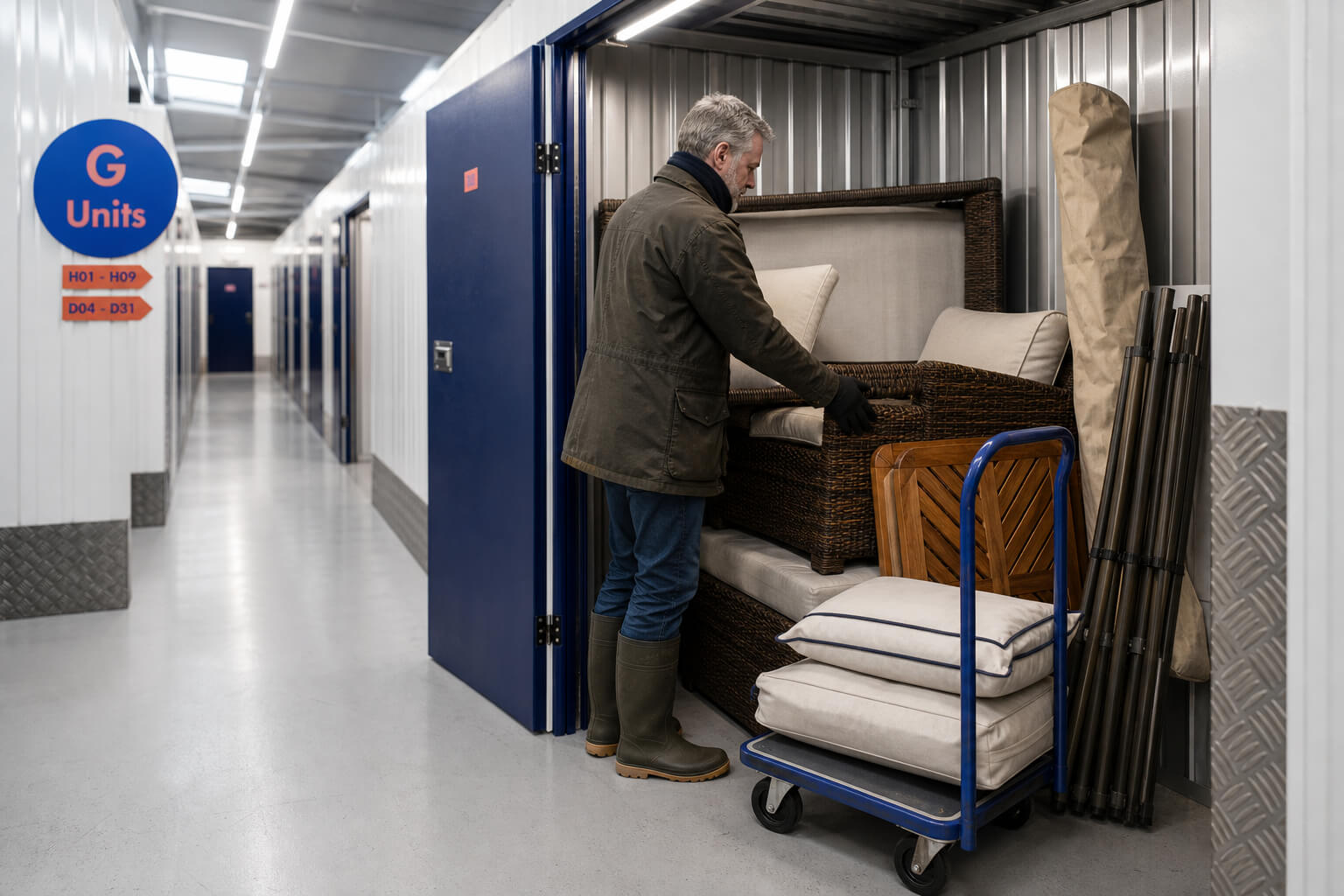
If storage is the right call for your situation, here’s what you’re actually signing up for: no deposit, a minimum two-week term, a transparent weekly rate, and unmanned smart-entry sites, so you come and go on your own schedule between 6am and 10pm, seven days a week. Decide to leave and you give 14 days’ notice; any unused days are refunded once the unit’s vacated and checked. Because sites are unmanned, if a courier or removal firm is dropping items at the unit for you, someone from your side needs to be there to let them in and help unload: it isn’t a staffed move-in service. You can check current Wigwam prices or find your nearest Wigwam if that sounds like your situation.
The Real Cost Comparison: Pay to Get Rid of It, or Pay to Keep It a While Longer

If you’re weighing up disposal against storage, it helps to see both costs side by side rather than guessing. A council bulky waste collection for one to three items typically runs somewhere in the region of £24 to £72, depending on your council, as of July 2026. Councils set and revise these fees themselves, so check your own council’s current price rather than assuming a single figure applies everywhere. Against that, Wigwam’s own smallest units start from around £6 to £16 a week depending on location. If you only need to park the furniture for a few weeks while you make up your mind, the weekly rate can work out cheaper than paying to have it taken away permanently before you’re sure. If you know you’re never getting it back, disposal is the simpler, cheaper route. It’s a genuine trade-off, not a foregone conclusion, so do the sum for your own timeframe before you decide.
What Happens to the Room Once the Furniture’s Out
If you still want to host the occasional guest, that doesn’t mean the bed has to stay. Multi-purpose and fold-away furniture exists precisely for rooms doing double duty as an office and an occasional guest room, a sofa bed, a Murphy bed, a daybed that reads as office seating most of the year, though picking the right desk-that-hides-a-bed setup is really its own project, not something to solve here. If you’re repurposing a piece elsewhere in the house rather than parting with it, our hidden storage ideas for your home piece has more on making the rest of the house absorb what the spare room no longer needs to.
Sorted, Not Just Moved: Getting the Room Office-Ready
Once every item has a route, kept, sold, donated, safely disposed of, or stored, the room is actually resolved, not just rearranged. That’s the difference between shoving furniture around and getting the office you’ve been picturing for months. Work through each piece using whichever of the four routes fits it, and the desk can go in this week, not “eventually.” If you’ve been clearing out a room for a similar reason before, from making room for a baby to this, the same logic tends to hold: sort item by item, and the room stops being the problem.
Need somewhere for the furniture while you decide? Check current Wigwam prices, or find your nearest Wigwam if you’d rather see what’s closest first.
Frequently Asked Questions
No. Bulky items like beds, wardrobes and chests of drawers need a separate, booked collection in almost every UK council area; they aren’t picked up with your regular household bin round.
Often, yes, provided the item is clean, complete, and for upholstered pieces, carries its fire label. Book directly with the charity rather than through a third party claiming to collect on its behalf.
There’s no single verified UK figure for the break-even point, so treat it as a comparison to make for yourself: weigh the weekly storage cost against what the item would cost to replace, or what it’s worth to you sentimentally, over the time you actually expect to need it stored.
Only if they’re on the register of waste carriers. If you use someone who isn’t, and you didn’t check, the liability for fly-tipped waste can fall on you rather than them. Check the register before you book anyone outside your council or a registered charity.
This article is general guidance, not legal advice. For rules that apply to your specific council or situation, check GOV.UK.