There’s a version of decluttering before a move that goes smoothly: you work through each room, everything finds a home, and you arrive at the new place with exactly what belongs there. Then there’s the version most people actually live through, standing in the middle of a room full of “maybe” piles, a moving date closing in, worried they’ll get a call wrong. Donate something that turns out to be unsafe. Bin something with real resale value. Box up things they’ll never unpack.
Check legality first. Some items, like fire-label-less upholstered furniture and children’s safety gear, can’t legally be donated or resold no matter how good the condition. Once that’s checked, ask if you need it in the new home. If not, sell what has resale value, donate the rest where it’s accepted, bin or recycle what fails either check, and store what you’re keeping but don’t yet have room for.
Quick triage, if you’re short on time:
- Holding an upholstered chair or sofa with no label sewn into the frame? Skip donate or sell. It’s a bin, recycle, or keep-for-yourself-in-storage call. See Step 1 below.
- Holding a car seat, cot, highchair or pram? Almost every UK charity refuses these outright. Go straight to recycling or a manufacturer take-back scheme. See Step 1.
- Everything else, and you don’t need it in the new place? Sell it if it’s worth £20 or more and in demand, otherwise donate it. See Steps 2 and 3.
- Want to keep something but the new place has no room yet? That’s what short-term storage is for. See Step 4.
What to check before you bin, sell or donate anything
Most decluttering advice starts with “do you love it, do you need it.” That’s the wrong first question. The one that actually changes the outcome is legal, not sentimental: certain items cannot be resold or donated second-hand in the UK at all, regardless of condition. For those, the real choice isn’t donate-versus-store, it’s bin-or-recycle-versus-store. Everything on this page runs through that one check before anything else.
Why most decluttering guides get the order wrong
A sofa can look perfectly fine and still be legally unsellable. A cot can be spotless and still get refused at the door. Sorting by sentiment first, checking legality second, is how people end up with a wasted charity collection or a private sale they shouldn’t have made. Check the legal gate first, and the rest of the sort gets much simpler.
What you probably can’t legally donate or resell

Two categories catch people out most: upholstered furniture without its fire safety label, and children’s safety equipment. Neither is a shop preference. One is a legal requirement on whoever supplies it second-hand, including charities and private sellers, and the other is a standing safety policy most UK charities apply regardless of condition.
Furniture without a fire safety label
If a sofa, armchair, upholstered headboard or dining chair doesn’t have its original permanent fire safety label attached, it cannot legally be resold or donated for resale. This isn’t a courtesy request from charity shops. Gov.uk’s guidance on the Furniture and Furnishings (Fire) (Safety) (Amendment) Regulations 2025 confirms that second-hand supply of furniture still requires a permanent label, and that anyone supplying second-hand furniture, including charities, needs to meet the requirements set out in regulation 14 of the underlying 1988 regulations. No label means the piece stays with you, or it’s bin and recycle territory, not the donation pile.
Car seats, cots, highchairs and prams
This is the single most common “wait, I can’t donate that?” moment for anyone moving with young children. British Heart Foundation’s published list of items it cannot accept names car seats and booster seats, cots and cot mattresses, highchairs, and prams and pushchairs outright. It’s a standing safety-testing policy, not a condition or cleanliness judgement. Most UK charity shops run similar checks, though policies vary between charities, so it’s worth confirming with your local branch before you load the car. Mattresses, pillows, duvets and quilts tend to be refused too, this time on hygiene grounds rather than safety.
Electricals: not as donatable as you’d think
Large appliances like tumble dryers and washer-dryers, electric blankets, and any model caught up in a manufacturer recall are the electricals people most wrongly assume are always fine to hand in. BHF’s refusal list for electricals is extensive for exactly this reason. If it’s sound and working, a registered WEEE recycling point or a retailer take-back scheme is usually the better route than a charity shop, but check locally rather than assuming.
| Category | Can I donate or resell it? | Where it actually goes instead |
|---|---|---|
| Upholstered furniture, label attached | Yes, if in good condition | Sell or donate as normal |
| Upholstered furniture, no label | No, not legally | Bin, bulky waste collection, or keep for your own use in storage |
| Mattresses, pillows, duvets, quilts | Usually refused (hygiene) | Council bulky waste or recycling route |
| Car seats, cots, cot mattresses, highchairs, prams | Refused outright by most charities | Recycling or manufacturer take-back scheme |
| Large or recalled electricals | Often refused | WEEE recycling point or retailer take-back |
This is general information, not legal advice. Rules and charity policies change, so check current gov.uk guidance and your chosen charity or council’s own policy before you rely on it.
Sell or donate, once legality clears
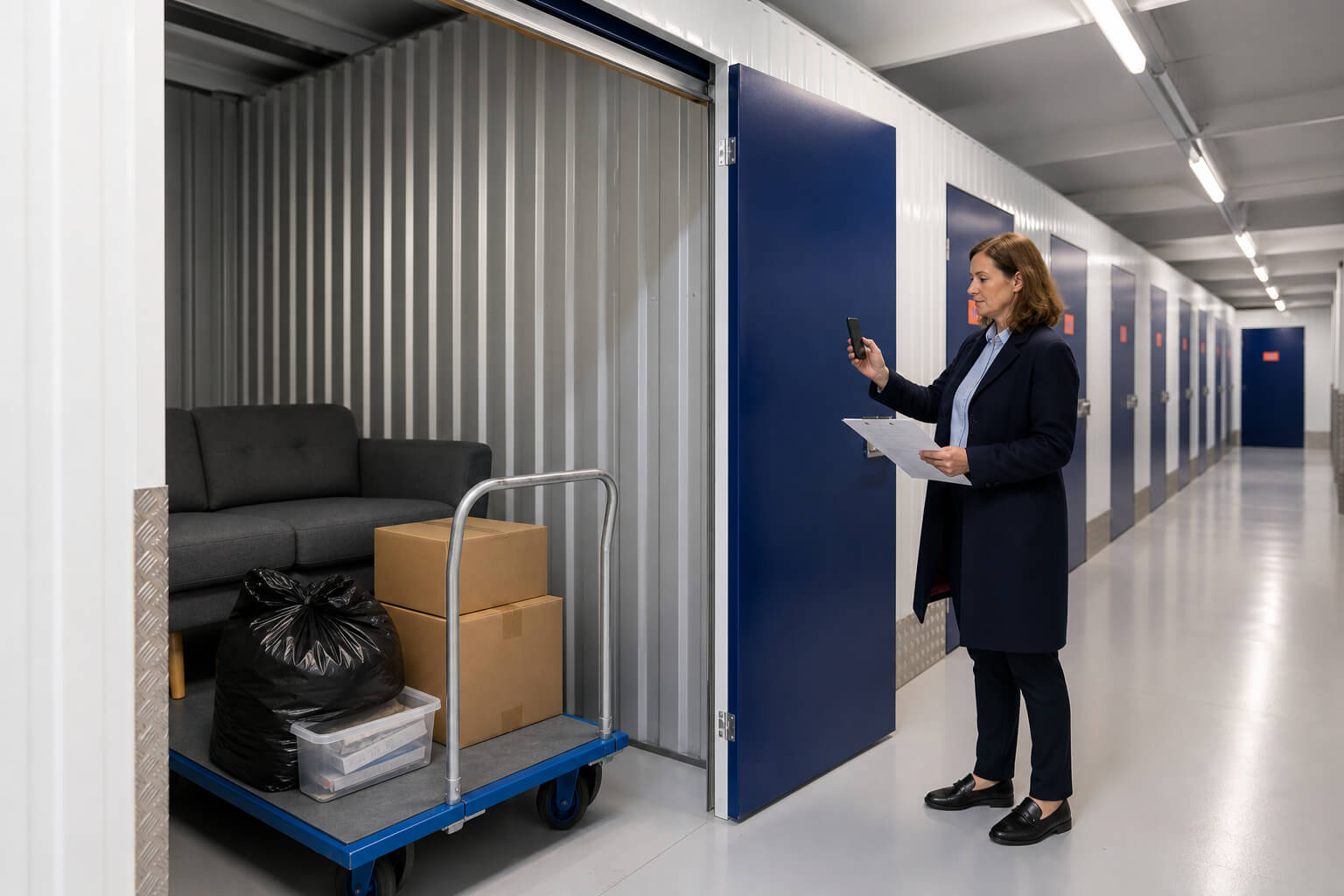
Once an item passes the check above, the question gets much simpler: sell it, or donate it?
When selling makes sense
Furniture, electronics, branded items and children’s gear that’s passed the legal check all deserve a look on a marketplace, at a car boot, or through a consignment shop if they’re worth £20 or more and there’s demand for them. It’s easy to underestimate what’s sellable and bin it out of impatience. A five-minute check before you do usually pays for itself.
When to just donate
If something’s in good condition but low demand, or you’d rather move quickly than manage a sale, donating is the better call, once it’s cleared the check above. Marketplace and platform fees shift often enough that quoting a figure here would be out of date within months, so treat any number you see elsewhere as illustrative, not gospel.
When storage is the right fourth box

Storage isn’t for anything you haven’t decided about yet. It’s for things that pass the keep-test, you genuinely want them, but fail the fits-in-the-new-home-right-now test.
Renovation, a gap between moving day and completion, or just no room yet
If there’s a stretch between your moving date and completion, building work waiting at the other end, or a smaller new place that simply can’t take everything on day one, that’s exactly what short-term storage solves. It’s not a place to dump indecision, it’s a place to hold what you already know you’re keeping.
Why a short minimum term matters here
The “am I locking myself in” worry usually peaks right here, exactly when you’re already juggling a dozen other moving decisions. Wigwam Self Storage runs a two-week minimum term, which means storing things “until I’ve unpacked and actually know what I’ve got room for” doesn’t commit you to months you don’t need. The contractual steps matter enough to state plainly: there’s no deposit taken at the start, and when you’re ready to leave, a 14-day notice period applies. Any unused days are refunded once that notice period has run its course. It pays to read the full terms rather than assuming.
Curious what storing the in-between stuff would actually cost? Get a price and see what a couple of months at one of Wigwam Self Storage’s UK market-town locations would run to, no obligation.
Wigwam runs 15 UK market-town locations, from Bath to Lincoln, so there’s a reasonable chance one sits near your route between houses.
Sentimental items: a quick note

Not everything that’s hard to part with is about space or legality. Some things are just hard to let go of, full stop, and that’s a real problem worth taking seriously, not a rushed footnote here. If that’s where you’re stuck, treat it as its own category with its own answer, and come back to the sorting method below for everything else.
A worked example: the sofa that couldn’t be donated
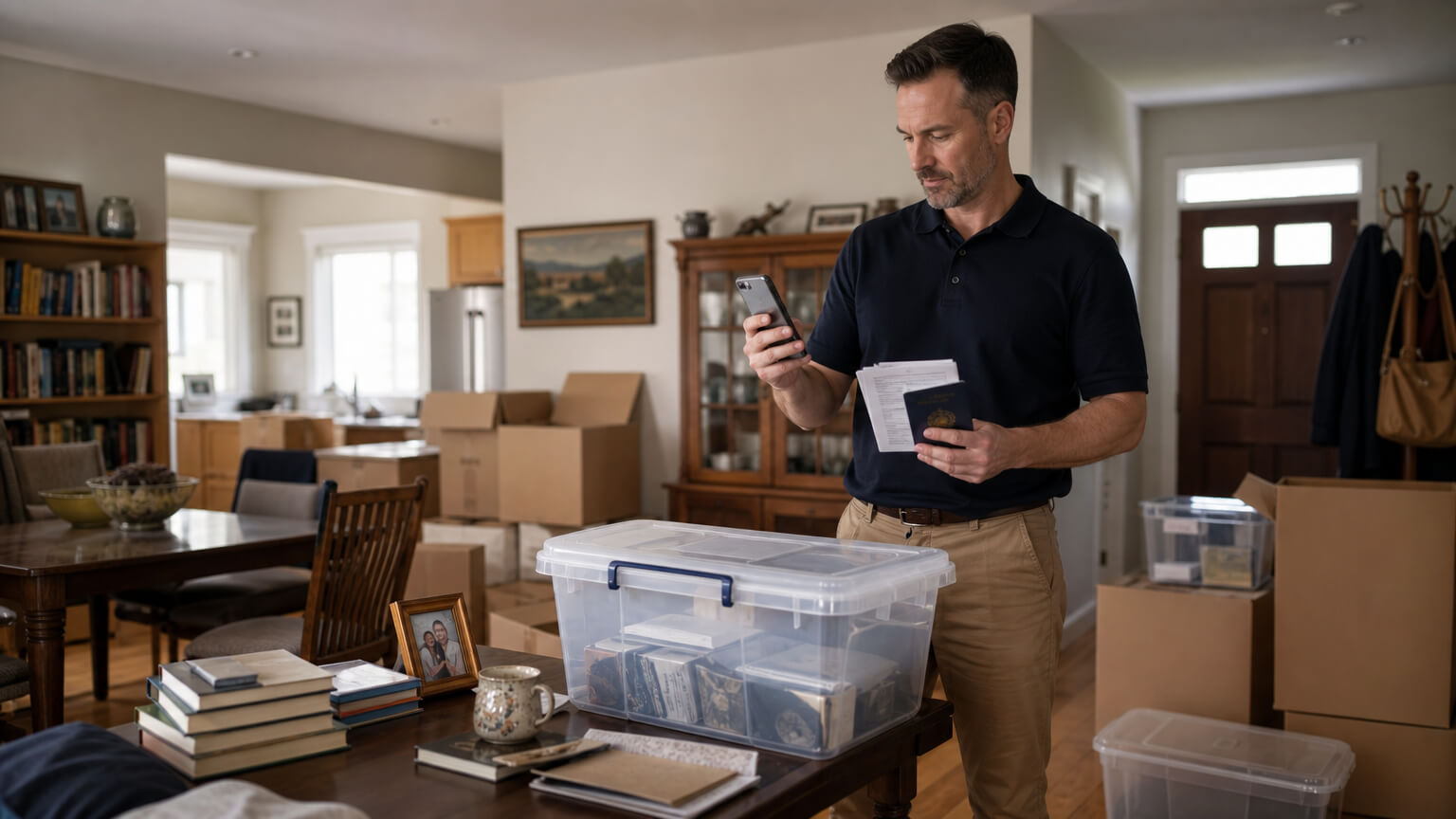
Sort by sentiment first, and this is how it usually goes wrong. Someone decides “I’ll donate the old sofa,” books a collection, and only then discovers there’s no fire safety label sewn into the frame. Best case, the charity turns it away on the day and a collection slot is wasted, sometimes for a fee. Worse case, it gets sold on privately without anyone checking, and the person who supplied it without a label is the one who’s technically in breach, not the buyer.
Checking the table above first avoids both outcomes. It takes two minutes to look for a label. It takes considerably longer to rebook a collection or explain to a charity why an unlabelled sofa turned up on their doorstep.
What NOT to pack into a storage unit either
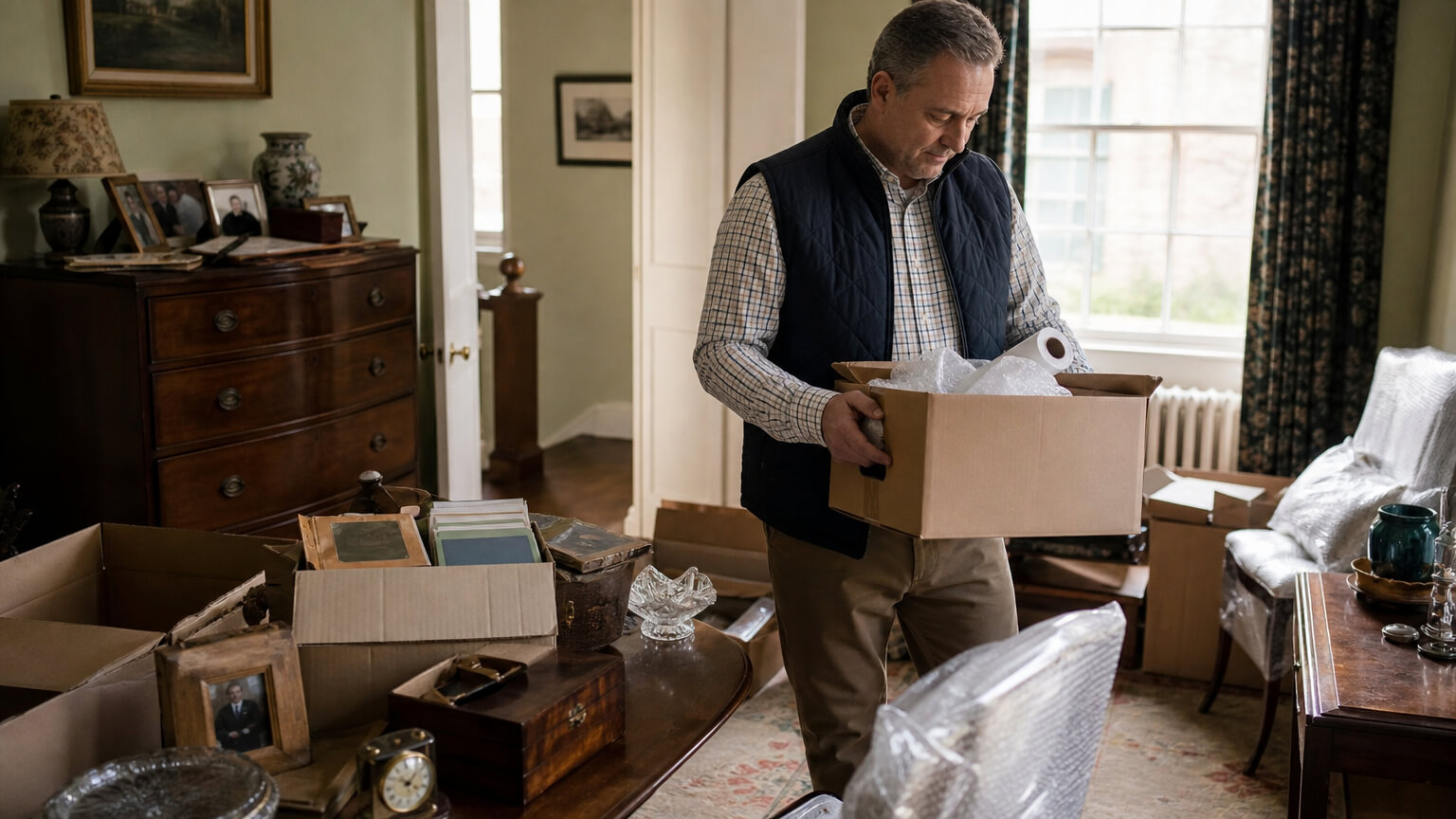
It’s a different gate to the one above, and it pays to keep the two separate in your head. The bin-sell-donate-store decision covers what you can legally pass on to someone else. Separately, self-storage providers, Wigwam included, have their own list of items they won’t accept into a unit at all, regardless of who owns them.
Check before you box it
Before you tape up a box destined for storage, take a minute to check what you can and can’t store in a self-storage unit. It’s a short list, but it catches a few things people assume are fine.
Your quick-reference sorting table
Here’s the whole decision tree in one place, bookmark it or screenshot it for the day you’re actually doing the sort.
| Step | Question | If yes | If no |
|---|---|---|---|
| 1 | Can it legally and safely be sold or donated? | Go to Step 2 | Bin, recycle, or keep it for your own use in storage |
| 2 | Do you need or want it in the new place? | Go to Step 4 | Go to Step 3 |
| 3 | Is it worth £20+ and in demand? | Sell it | Donate it, where accepted |
| 4 | Do you need it soon and have room now? | Take it with you | Store it until you do |
Once you’ve worked through the table, if storage is where a few things land, get a price for a Wigwam unit near you, call 0800 245 5585, or email hello@wigwamstorage.co.uk. Wigwam’s own decluttering storage page is there too, for anyone who’s already decided storing is the answer.
None of this needs to be rushed or perfect on the first pass. Run each item across the table once, and the room clears itself, one honest call at a time, until what’s left is only what actually belongs in the new place.
Frequently Asked Questions
No. Under the Furniture and Furnishings (Fire) (Safety) Regulations, as amended in 2025, second-hand upholstered furniture needs its original permanent fire safety label to be legally resold or donated for resale. Without it, the sofa isn’t a donation candidate, it’s a bin, recycle, or keep-it-yourself item.
Some do, but many large appliances, electric blankets and recalled models are refused. British Heart Foundation’s own published list excludes several electrical categories outright. A WEEE recycling point or a retailer take-back scheme is often the better route for working appliances a charity won’t accept. Check with your local branch before assuming either way.
Wigwam, like any self-storage provider, has its own list of prohibited items separate from the donation rules above. See what you can and can’t store in a self-storage unit before you box anything up.
With Wigwam’s two-week minimum term, you’re not locked into anything long. You can store items while you decide, then give 14 days’ notice when you’re ready to move them on. Any unused days are refunded once that notice period completes.
It depends on the item and how much your time is worth. Selling can recover some value but takes effort and time you may not have in the run-up to a move. Storing a genuinely useful item for a short period, until you know what room you actually have, is usually the more practical call, and a short minimum term keeps that decision low-risk. For a clearer picture, see current storage costs across Wigwam’s locations.