There is a particular kind of stress that sets in when you are staring at a storage listing that says “75 sq ft” and trying to work out whether that means your whole house, half your house, or just the contents of your loft. Your van might already be half packed. Your completion date might be looming and refusing to line up with your move-in date. And the number on the screen means almost nothing to you yet.
Most people size their unit by guessing from their bedroom count. It is a reasonable starting point, and often it is close enough. But two three-bedroom houses can hold very different amounts of stuff, and this guide gives you a better way to check: build the picture room by room, like assembling a jigsaw, rather than force-fitting your move into a single label that may not actually match your home.
If you are in a rush and your home is a fairly typical size, skip ahead to the quick shortcut and our per-town pricing.
If your home does not fit a clean label (a converted loft, a box room used as an office, an oversized kitchen-diner, or a garage stacked with tools), go straight to the room-by-room method and the worked example.
If you already have a rough number and the only open question is the garage, shed or loft, jump to the swing factor.
How much storage space do you need when moving house?
The fast answer: for a typical UK home, bedroom count gives you a reasonable starting size, and we cover those numbers in the next section. The accurate answer takes a little longer: add up what is actually in each room, and let that total tell you the size, rather than the label on the door of your house. Both routes point you toward the same set of unit sizes, from around 10 sq ft for a few boxes up to 150 sq ft and beyond for a whole house including the garage, shed and loft.
Why bedroom count alone can mislead
A “three-bed house” is not one fixed quantity of belongings. One three-bed has a loft conversion doing double duty as a home office and an empty garage. Another has a box room stacked to the ceiling and a garage full of tools, bikes and Christmas decorations. Same label, genuinely different amount to store. Bedroom-count guides are a fine starting point for a typical home, but if yours has an atypical room, or you simply want to double-check the shortcut against your real inventory, the room-by-room method below is the more rigorous check. We will come back to this: two houses, same bedroom count, rarely hold the same amount of stuff.
The quick shortcut, if your home is a typical size

If your home is a fairly standard one, two or three-bedroom property with a typical amount of belongings, our existing size guides give you a fast, reliable number without needing to work through every room yourself.
When the shortcut is enough
Use these if your home matches its label and you want a number now, not a calculation:
These are built for typical size, typical amount of stuff. If that sounds like your move, you can stop here and head to our pricing page to see what is available near you.
One clarifying paragraph on the UK vs US unit-size confusion
If you have been looking at storage listings online, you may have seen American sites describing units like “10×20” that sound enormous compared with the UK square footage you see quoted here. UK storage is conventionally sized and priced in square feet of floor space, and US listings often describe far larger units under a similar-sounding name. If you want the full breakdown of how that confusion plays out for a typical house move, our 3-bed house move sizing guide covers it in detail. For now, the short version: trust the sq ft figure, not the shape of the name.
The room-by-room method: walk the house, not the label

Here is the method in one sentence: go room by room, count your boxes, and flag anything large (furniture, appliances, bikes), and each room’s rough total builds up toward one of our standard unit sizes.
Living room and kitchen
A typical living room runs to somewhere around 10 to 20 boxes of books, electronics and soft furnishings, but boxes are only half the story. A three-seat sofa, an armchair and a TV stand between them can add up to as much again in bulk as the boxes themselves. Kitchens tend to run 8 to 18 boxes of crockery, small appliances and pantry items, but the real space-takers are the fridge freezer and the washing machine, which between them can occupy as much room as a small mountain of boxes. These typical UK estimates are drawn from removals-industry sources dated 2026, not physical constants, so treat them as a starting point rather than a precise count.
Each bedroom, counted per room, not per house
This is where most people undercount. Each bedroom typically runs to somewhere around 5 to 15 boxes of clothing, bedding and personal items, plus the bed, wardrobe and chest of drawers in that specific room. The single most common mistake is estimating “bedrooms” as one lump figure for the whole house, when the honest total is each bedroom’s contents added separately. A main bedroom with a double bed and a full wardrobe genuinely adds up to more than a box room with a single bed and a bedside table, and your total should reflect that difference.
Bathrooms, utility and the rooms people forget
Bathrooms and utility spaces are usually small, roughly 2 to 6 boxes of towels and toiletries, and rarely change the size decision on their own. But they belong in your total all the same, because it is the small rooms people forget to count that quietly push a “just about fits” estimate into “doesn’t quite fit” on the day.
One quick note before you total anything up: storage units are usually quoted in square feet of floor area, assuming roughly 8 feet of stacking height, while the box and item figures above are given in cubic feet of volume. We will do that conversion for you in the worked example next, so you do not need to do the maths yourself.
Try it yourself: a worked example and your own room-by-room table

Meet the Marchetti family (an illustrative example, not a real Wigwam customer), moving out of a typical three-bedroom semi. Here is their room-by-room total, worked through in full, followed by a blank version of the same table for your own move.
| Room | Typical box/item count | Rough volume | What this means for your total |
|---|---|---|---|
| Living room | 12 boxes, three-seat sofa, armchair, TV stand | Roughly 130 cu ft plus boxes | The biggest single-room contributor after the bedrooms |
| Kitchen | 14 boxes, fridge freezer, washing machine | Roughly 95 cu ft plus boxes | White goods dominate here, not boxes |
| Main bedroom | 10 boxes, double bed, two-door wardrobe, chest of drawers | Roughly 180 cu ft plus boxes | The single largest room total in the house |
| Second bedroom | 8 boxes, single bed, two-door wardrobe | Roughly 135 cu ft plus boxes | |
| Third bedroom or box room | 6 boxes, bedside table and odds and ends | Roughly 40 cu ft plus boxes | Often the room people forget to count |
| Bathroom and utility | 4 boxes | Small | Rarely changes the decision alone, but still add it in |
| Garage, shed and loft | 12 boxes, bicycle, lawnmower, toolbox | Roughly 90 cu ft plus boxes | This is exactly the swing factor we cover next |
Add it all up and the Marchettis land at roughly 66 boxes plus the furniture and appliances above, which rounds to our 150 sq ft tier, the size that includes garage, shed and loft clearance alongside the furnished house. It is the garage, shed and loft row specifically that pushes their total past our 100 sq ft threshold. Confirm the shortcut and you would have arrived at broadly the same answer, but now you can see exactly why.
The contrast case: same bedroom count, a different answer
Now picture a different three-bedroom house. Same bedroom count as the Marchettis, but the loft has been converted into a home office rather than left as storage, and there is no garage at all. Walk that house room by room and the total lands closer to 100 to 125 sq ft, not 150, simply because there is no garage, shed or loft row to add in. Two houses, same label on the door, genuinely different amount to store, and only the room-by-room method catches the difference before moving day rather than on it.
Your version: fill in your own table
| Room | Your box/item count | Rough volume | What this means for your total |
|---|---|---|---|
| Living room | |||
| Kitchen | |||
| Bedroom 1 | |||
| Bedroom 2 | |||
| Bedroom 3 (if applicable) | |||
| Bathroom and utility | |||
| Garage, shed and loft |
Total your boxes and items, then round to the nearest of our standard sizes: 10, 25, 50 to 75, 75 to 100, 100, or 150+ sq ft.
Once you have your own number, you are ready to act on it. You can find your nearest Wigwam location in this size, or get a quote confirmed for your move.
The garage, shed and loft swing factor
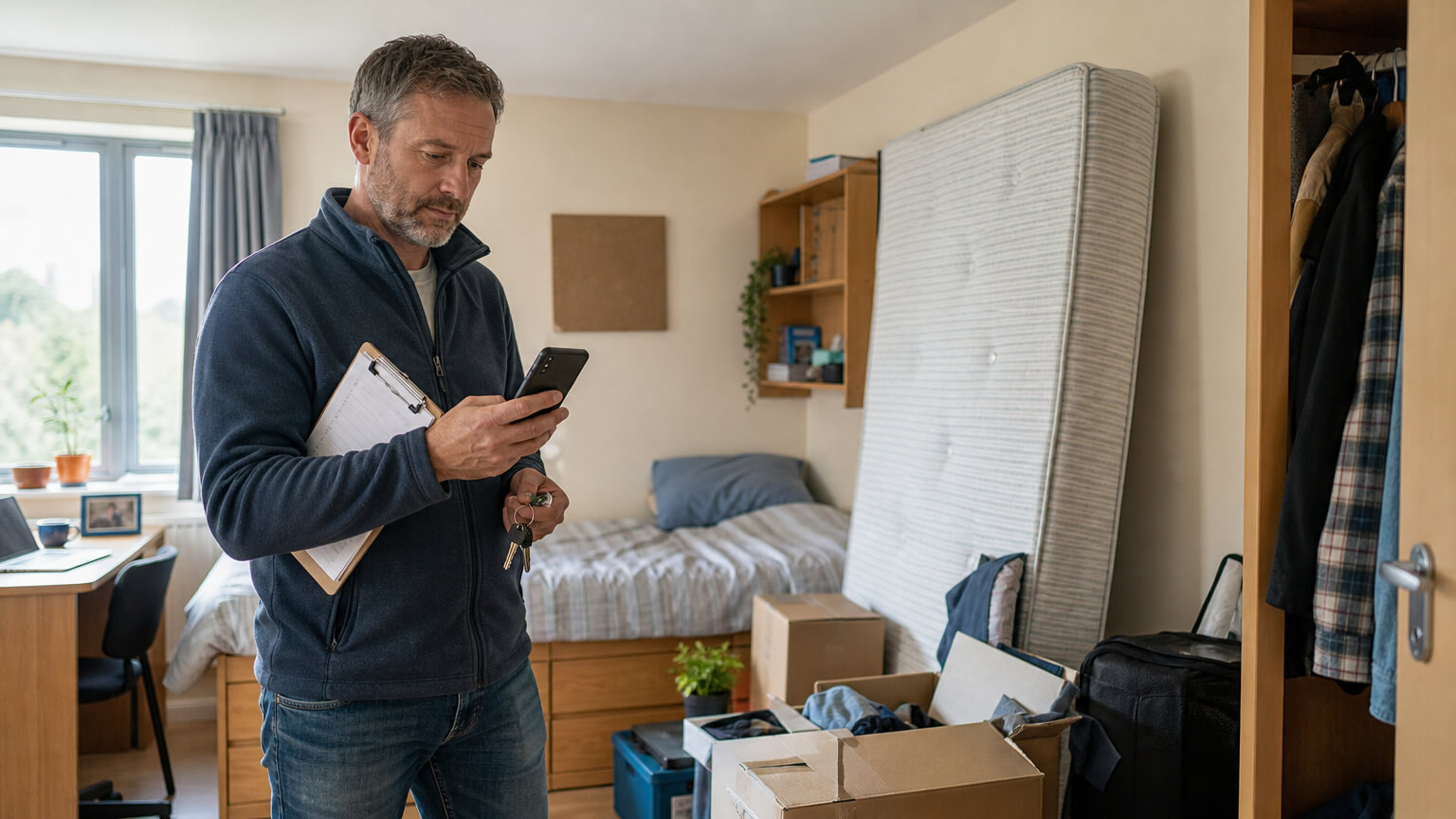
If there is one single lever that changes the whole calculation, it is the garage, shed or loft. The worked example above just proved it: the difference between our 100 sq ft and 150 sq ft tiers is, almost exactly, the difference between clearing the house alone and clearing the house plus its outbuildings.
Our own 100 vs 150 sq ft fork
We size a typical three-bed house move two ways: 100 sq ft covers the furnished household contents only, with no garage, shed or loft clearance included. 150 sq ft covers the same house’s contents when you are clearing the outbuildings too. The deciding question is simple: are you clearing the whole property, garage and all, or leaving the outbuildings to sort out later? If you are not sure yet, our 3-bed house move sizing guide walks through the fork in full. It is the missing piece that changes the whole picture, so it is worth settling before you book.
How much to book if you’re not sure

When in doubt, book slightly generous rather than exact. Here is why that costs you very little.
Why generous beats exact for a move under time pressure
If your completion date and your move-in date do not quite line up, you are probably choosing a unit size under some pressure, and it is worth knowing our terms make a slight overestimate cheap to correct. Booking involves four weeks paid upfront and no deposit. Separately, when you are ready to leave, you give 14 days’ notice, and once that notice period has run its course, any unused days on your contract are refunded. Those are two distinct steps, not one, so it is worth knowing both rather than assuming a refund lands the moment you hand in your notice. Set against that, the cost of booking one size up for a short overlap is small change next to the stress of a unit door that will not close on moving day, in front of the removal team, with everywhere else to be.
Quick answers on sizing

A couple of the questions people search alongside this one are worth a direct answer here, before the full FAQ below.
How many moving boxes fit in a 10×10 storage unit? This is one of those places the US-vs-UK naming confusion shows up again: a “10×10” in US listings describes a unit considerably larger than most UK-quoted equivalents, so treat the number of boxes as specific to whichever country’s listing you are reading, not a universal figure.
What size storage unit is 75 square feet? In our own sizing, that sits around the upper end of a typical one-bedroom flat’s worth of belongings, or a modest slice of a larger house’s contents; see the 1-bedroom flat guide for the fuller picture.
Get the right size booked
Room by room beats guessing every time. You have now walked through your own house, room by room, piece by piece, and the picture is assembled: not a bedroom-count guess, but a number built from what is actually in your home.
When you are ready, check pricing for storage near you, or get your size confirmed with a quote. And if your circumstances change, remember the terms are built to flex with you: a 14-day notice period, no long tie-in, and nothing that punishes you for booking a size that turns out to be one notch bigger than you strictly needed.
Frequently Asked Questions
It depends on the piece and how it will be moved and stacked, but as a general rule, lighter items travel more safely separated into boxes rather than left loose in drawers during transit. Ask your removal team or our team on site if you are unsure about a specific piece.
That is a sensible default, especially if your move is time-pressured. A slightly larger unit costs little extra against the stress of running out of room, and our flexible terms mean you are not locked into a long commitment either way.
In most cases, yes, subject to availability at your chosen location. It is best to check with your local team as early as possible if you think you might need more room than you first booked.
Square feet measures floor area, which is how storage units are conventionally quoted. Cubic feet measures volume, which is how removals companies often describe individual items and boxes. We assume roughly 8 feet of stacking height when translating one into the other, which is why a room’s cubic-feet total converts into a manageable square-footage recommendation rather than a one-to-one figure.
It depends on the house, which is exactly why bedroom count alone can mislead. Use the room-by-room method above, or start with our quick shortcut guides if your home is a typical size.
If you have seen this description, it is very likely from a US storage listing, where unit dimensions and naming conventions differ from the UK’s square-footage system. See our 3-bed house move guide for the full UK-vs-US comparison.