You know the feeling. It’s ten minutes into a client call and you’re still digging through a box under the printer for a file you were sure was “somewhere obvious.” Or it’s a new client’s first visit, and you catch them clocking the stack of old marketing boxes by reception before they’ve even sat down. None of that means you’re running a disorganised business. It usually just means your desk has quietly turned into a warehouse, when its only job was ever to be the place where the work actually happens.
In a hurry? Pick your situation.
If you just want the problem named, read on from here.
If your real worry is losing access to a client file the moment you clear space for it, skip to “The Two-Pile Test.”
If you want to see this done rather than just explained, jump to the worked example below.
If you’re after the practical detail on security and access hours, go straight to “Keeping archived client files secure.”
Is your office actually costing you focus, not just floor space?
Workplace-design research is fairly blunt about this: environments that create ongoing visual, physical or acoustic distraction are consistently linked to reduced concentration, satisfaction and perceived performance. That’s not a tidiness complaint dressed up as science. It’s a productivity question, and it’s one that a lot of office-based professional services businesses, accountants, solicitors’ admin teams, consultancies, letting agents, never quite get around to asking, because clutter builds up so gradually that nobody notices the drag until it’s already there.
What “clutter” actually means here. The strongest evidence isn’t about a stray coffee cup or an untidy desk in isolation. It’s about the broader category of distraction-heavy office environments, open-plan layouts, background noise, visual overload, of which physical clutter is one contributor among several. Being clear about that matters, because overstating it the other way (“clutter alone destroys your output”) isn’t what the research shows.
Why this matters even if the office “still works.” A business can function perfectly well with boxes stacked in the corner. Nobody’s missing deadlines because of it, necessarily. But there’s a reputational cost too: a client-facing office that looks chaotic can quietly signal disorganisation to the people you most need to trust you, even when your work is sound. That deserves naming plainly, not as a shame exercise, a real cost sitting alongside the productivity one.
The research: why a badly optimised office can cancel out any savings you make

Here’s the headline finding, and it’s a striking one. A comparative review of office-design concepts, open-plan offices, activity-based working and traditional single-office setups, published in Management Review Quarterly, found that just a small decline in productivity, as little as two percent, is enough to wipe out the entire cost saving a business makes by fitting more people into less space. In other words: the space you save by cramming can cost you more than it’s worth, if the crowding comes at the price of focus.
The same review found that in open-plan settings, the vast majority of participants reported concentration problems caused by background noise, and that workers in unbounded, open offices reduced face-to-face interaction by around seventy percent compared with more contained layouts. Single-office settings consistently outperformed open-plan and activity-based working across distraction, satisfaction, health and performance measures, with job satisfaction reported as lowest in open-plan environments. (Read the study: The productivity tax of new office concepts, Management Review Quarterly.)
What the research does not say. It isn’t a study of desk clutter in isolation, and it would be overstating things to present it that way. What it does show, reliably, is that office environments creating ongoing distraction, whether from noise, layout or visual overload, correlate with reduced concentration and performance, and that cost-driven space decisions which ignore this can be false economies.
A separate peer-reviewed ergonomics review adds a narrower but relevant point: visual and display clutter specifically impairs visual search and attention management, a fair supporting reason why a paper-stacked office makes “quick find” tasks slower than they need to be. The UK’s Health and Safety Executive also links poor working conditions to distraction and reduced performance more broadly (see their guidance on workplace factors and performance). Taken together, the honest version of the claim is this: an office cluttered with things nobody uses day-to-day is one contributor to a distraction problem with real, measurable costs, and clearing it out deserves doing properly rather than as an afterthought.
The Two-Pile Test: sorting what stays from what can move, in an afternoon

You don’t need a renovation project or a weekend lost to a skip. You need an afternoon and two piles. And critically, nothing your team uses day to day has to leave the building. Say that part plainly upfront: it’s usually the exact fear that stops people starting.
Walk the office and sort everything, every box, folder, cabinet and shelf, into two piles:
- Pile A, anything touched in the last three months, or anything that legally or practically needs to stay instantly accessible: active client matters, this year’s invoices, kit you use daily.
- Pile B, anything not touched in three months or more, but that you can’t simply throw away: closed-matter client files still inside their retention window, seasonal stock, superseded equipment, older paperwork.
| Pile A: stays on the desk | Pile B: moves, and that’s not “losing” it | |
|---|---|---|
| Examples | Active client matters, current invoices, daily-use kit | Closed-matter files within retention, old stock, superseded kit |
| Where it lives | On-site, in reach | A labelled, indexed storage unit, one hop away |
| How fast can you get it back | Immediately, it never left | Same site visit, if it’s properly indexed |
| Why it stays or moves | You genuinely need it today | You don’t need it today, but you might need it eventually |
Pile A stays exactly where it is. Decluttering should never mean staff lose same-day access to what they actually use, and if a method asks you to do that, it’s the wrong method. Pile B is what moves, into a labelled, indexed self-storage unit. A simple numbering system, box number plus a one-line description on a shared spreadsheet, means any archived file can be identified and physically collected within a single site visit. That’s your desk staying the net, not the warehouse: Pile B is one hop away, not gone.
Why guessing wrong costs more. The instinct a lot of businesses follow instead is to buy another filing cabinet and squeeze it in somewhere. That’s the exact false economy the research above warns about: spending money and floor space to store things nobody needs quick access to, while the things staff do need daily stay buried underneath. The fix was never more storage inside the office. It’s the right storage, in the right place. For the fuller arithmetic on why that’s usually cheaper than it sounds, our guide on self storage that’s cheaper than office rent walks through it in full.
Once Pile B has somewhere to go, the “will I still be able to get to it” question mostly answers itself: business storage units are reachable with smart entry between 6am and 10pm, seven days a week, so a labelled box is a same-day retrieval, not a booked appointment. If you’re ready to see what that looks like for your office, you can get a quote for business storage and start with exactly the space you need for Pile B, nothing more.
A worked example: one small office’s afternoon of sorting
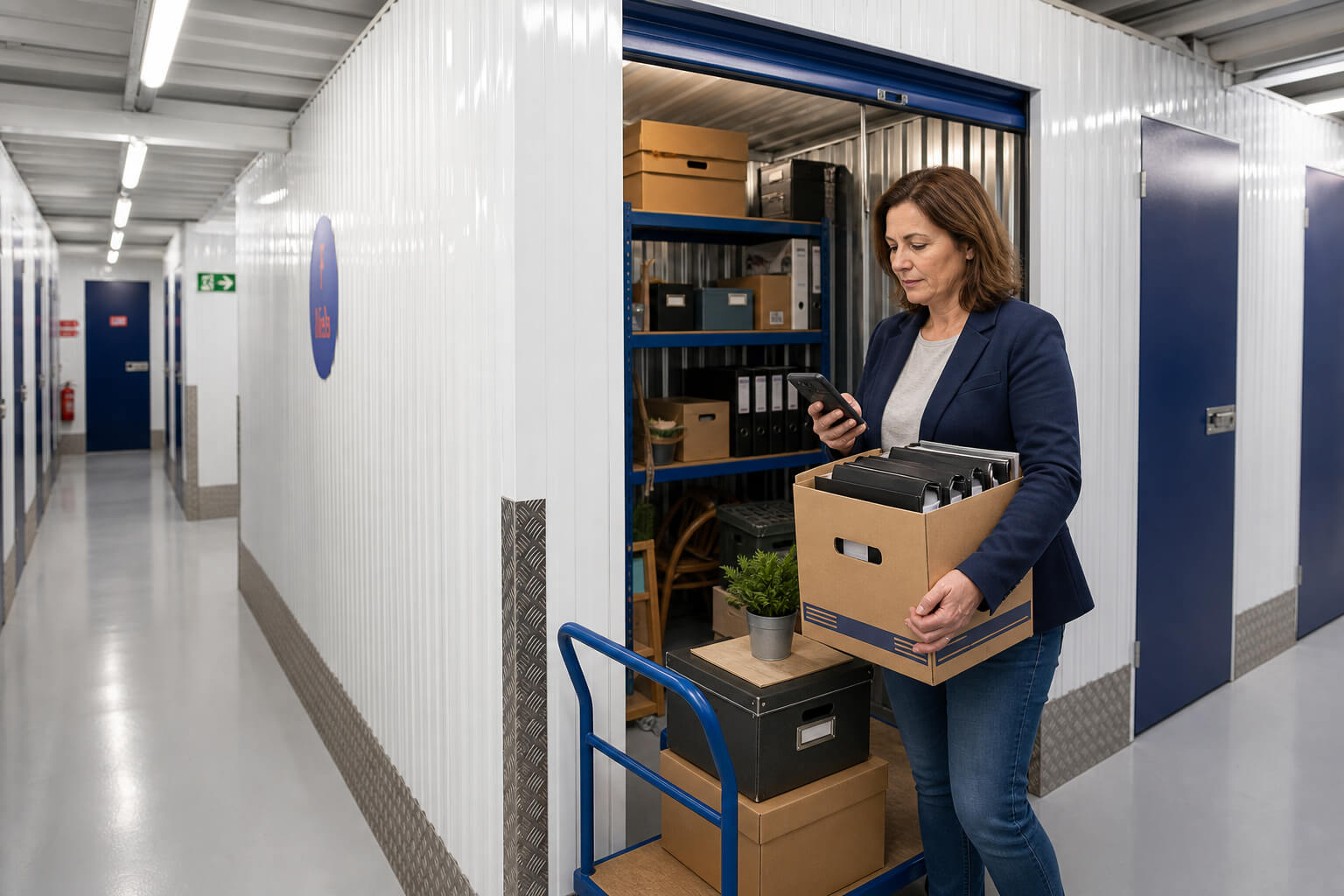
Roughly a quarter of this office’s usable floor area turned out to be tied up in things nobody had touched in over a year, and clearing it made room for a second meeting table without a single archived file becoming harder to reach.
What they found when they sorted. A four-person consultancy office, around 250 square feet, ran the Two-Pile Test on a quiet afternoon. The sort turned up eleven archive boxes of closed client files (still inside their retention window), two old filing cabinets no longer in daily use, and a shelf of superseded marketing stock. This is an illustrative example rather than a named client case, but it’s a realistic shape for a small office that’s simply never had a proper clear-out.
What changed on the day nothing moved back. Pile B went into a small, indexed storage unit. The reclaimed space became a second meeting table, something the team had wanted for months but never had room for. And because every box was numbered and logged, any of those archived files could still be collected the same day if a former client called with a query. Nothing was lost. The desk just stopped doing the warehouse’s job.
Keeping archived client files secure, findable, and accessible when you need them
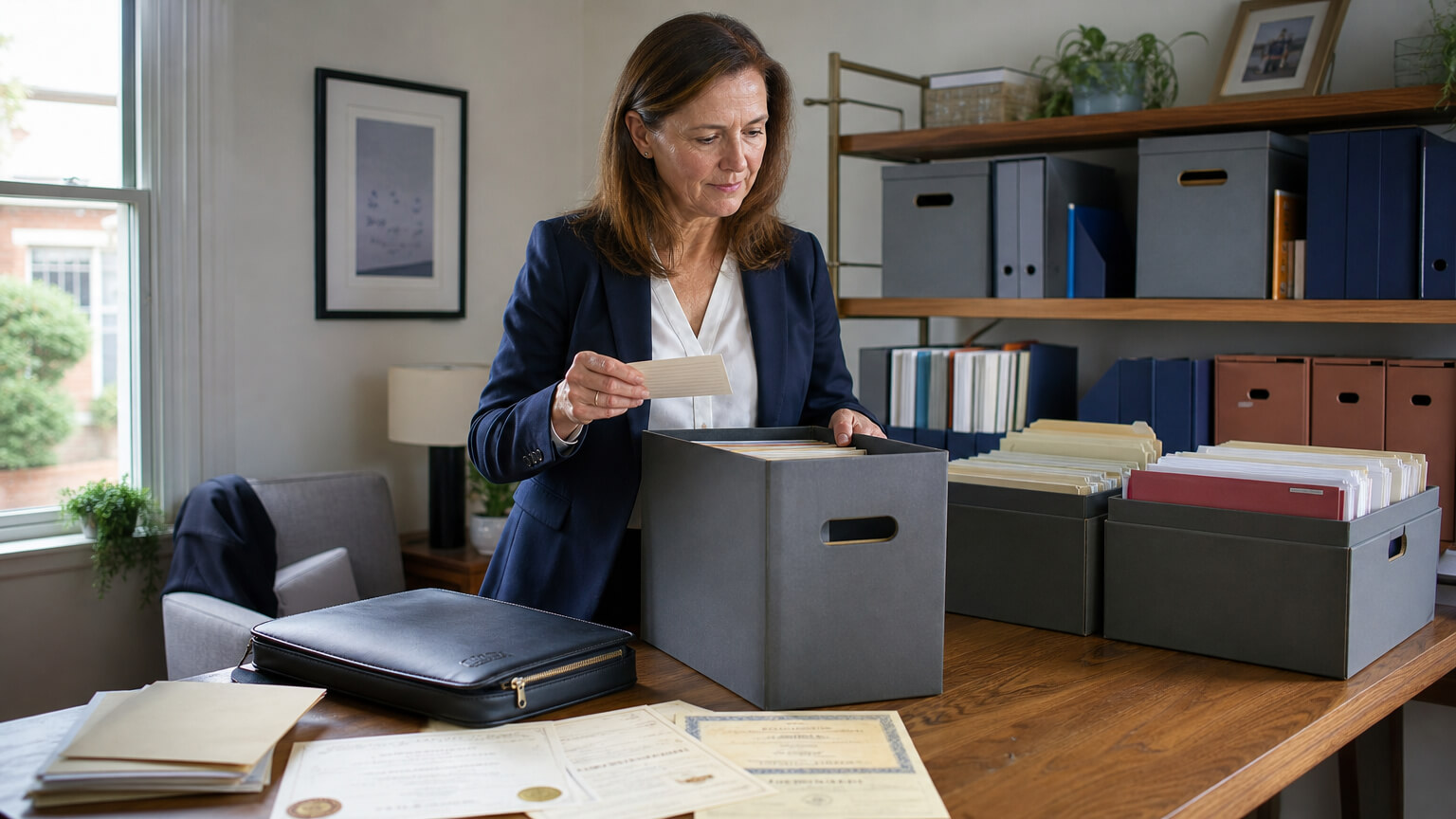
The short answer to the confidentiality question is that indexed archiving plus straightforward access means you’re not choosing between a tidy office and a fast retrieval. Both are available at once.
How the indexing actually works. The method is deliberately low-tech: a box number written on the outside, and a one-line contents log kept on a shared spreadsheet everyone on the team can search. It takes no special software and no dedicated system to maintain, just the discipline of logging a box once, when it goes in.
Getting to a file when a client calls. Units are reachable using smart entry, six in the morning until ten at night, seven days a week. Because sites are unmanned, if you ever need a courier or removals firm to help move something in or out, someone from your own business needs to be there with them, support staff on site can’t unlock a unit or take receipt of anything on your behalf. Worth knowing before you plan a bigger move, not a surprise on the day.
What we mean by secure, and what we don’t claim. Units are clean, dry and secure. They are not climate-controlled, so that’s not a claim we’ll make, or one you should expect, for paper archives that don’t need it. On the contractual side: there is no deposit, and a fourteen-day notice period applies when you want to end your agreement, so read the full terms before you sign rather than relying on a summary.
What about the retention question, and what about cost?

How long do you need to keep client files? This is a genuine question, and the honest answer is that it depends on the type of record, and it isn’t a self-storage question to begin with. Retention periods vary by document type, signed contracts and general correspondence, for instance, are treated differently, and the right answer for your business sits with your own professional body, HMRC or ICO guidance, not with us. What we can say is that “still inside its retention window” is the right way to think about Pile B: not urgent, but not disposable either.
Is this worth it versus more filing cabinets? As covered above, buying more cabinets to cope with volume is the false economy the research warns about, more spend and more floor space for things you rarely touch. If cost comparison is your main question rather than the productivity angle, our pricing guide for self storage in the UK covers that in more depth than makes sense here.
When storage furniture isn’t the answer (and when off-site space is)

The furniture-fix trap. A lot of advice on office clutter stops at better shelving or smarter desk organisers. That’s not wrong, exactly, it just solves a different problem. Furniture rearranges what’s already in the room. It doesn’t remove the volume, so the room stays just as full, only tidier-looking for a while. If your team has outgrown the space, no amount of clever shelving fixes that.
When your team has outgrown the office. Growing past your floor plan doesn’t have to mean a lease renegotiation or a costly office move. Off-site storage scales with you: add space for Pile B as the team grows, without signing up to more office than you need today. See how business storage compares with commercial storage if you’re weighing that decision properly.
Clear the desk, keep the file: start with an afternoon, not a project
Your next afternoon, planned. This doesn’t need to be a renovation or a lost weekend. Walk the office, sort into Pile A and Pile B, log what moves, and find Pile B somewhere to go. That’s it. Keep the net clear, and let the warehouse live one hop away, present in the plan, absent from the desk, but never out of reach.
Ready to give Pile B somewhere to go? Get a quote for business storage and see how much space you’d need, or call our team on 0800 245 5585 for a straight answer.
Frequently Asked Questions
No. The whole point of the Two-Pile Test is that anything you use day to day stays exactly where it is. Only closed-matter files and dormant items move, and those are still retrievable the same day with proper indexing.
A simple box-number-plus-one-line-log system on a shared spreadsheet is enough. No special software is needed, just the habit of logging a box before it goes into storage.
Units are clean, dry and secure, with smart entry access, though they are not climate-controlled. For paper archives that don’t need temperature or humidity control, that’s not a limitation.
Smart entry access runs from 6am to 10pm, seven days a week. Sites are unmanned, so if a courier or removals firm is helping you move something in, someone from your business needs to be there with them.
Anything touched in the last three months, or anything that must stay instantly accessible, stays in the office (Pile A). Everything else that you can’t simply throw away, closed files still in their retention window, old stock, superseded kit, is a candidate for Pile B and off-site storage.