There is a particular kind of clutter that only a small business owner recognises: stock boxes on the landing, a folding market table wedged behind the sofa, two years of paperwork you know you have to keep but can’t quite find a home for. Every time a new delivery arrives, there’s a flicker of dread about where it’s going to go. None of that means the business isn’t working. It usually means the opposite, it’s growing faster than the space around it. You don’t need a bigger office. You need a smaller footprint, and somewhere else to put everything that isn’t a desk.
In a hurry? Start here.
If your stock has outgrown the spare room, jump to “Four Ways Small Businesses Actually Use It” below.
If you’re worried this isn’t “proper” storage for a business, jump to “What It Is Not.”
If you just want the cost logic in one line, jump to “The Split-Site Mechanism.”
If you want the day-to-day mechanics (access, deliveries), jump to “How It Actually Works Day To Day.”
What Business Storage Actually Means
Business storage is simply self storage used by a business rather than a household, to hold stock, tools, files or equipment away from the main workspace. It lets a business keep a smaller office, or work from home altogether, while a storage unit takes the overflow. It typically runs on a short rolling term rather than a fixed lease, and it is not a registered business address or a staffed premises, it’s a secure box for the things a business owns but doesn’t need to touch every day.
That’s a genuinely different question from “commercial storage” or “industrial storage,” which usually means large-scale warehousing or distribution space leased by bigger operations. Business storage, in the sense this article means it, is a self-storage unit, the same kind a household would rent, used by a sole trader, a small partnership or a growing team instead.
You’re also not testing something unproven. The Self Storage Association UK’s Annual Industry Report 2026 puts the UK market at £1.3bn in annual turnover across 3,143 stores and 67.5M sq ft of space, and its figures show that 76% of use is by domestic customers citing lack of space at home. Turn that figure around and it means close to a quarter of all UK self-storage use is already by businesses, not households (SSA UK, 2026). If this is the first time you’ve considered it, you’re joining a pattern that’s already well established.
What It Is Not: The Boundary To Know Before You Book
If you’re wondering whether this is even allowed, here’s the reassurance up front: it is, within one clear boundary. A storage unit cannot be your registered business address, a staffed or customer-facing premises, or a permanent place of work. That isn’t a restriction designed to trip you up, it’s the line that keeps the arrangement simple and keeps your customers, your post and your compliance obligations exactly where they already sit.
That answers two of the most common questions people search before they book: can you legally use a storage unit as an office, and can you run a business from a storage unit in the UK. The honest answer is that you can use one to hold everything the business owns that doesn’t need a customer-facing room, but the office function itself, the desk, the meetings, the registered address, has to live somewhere else. For most of the small businesses that use storage this way, that somewhere else is already home, or a small rented room, and nothing about that changes.
The Split-Site Mechanism (Cost, In One Paragraph, Not A Chapter)

Here’s the mechanism in one line: the admin and customer-facing side of the business, the desk, the laptop, the invoices, the client calls, stays exactly where it already is, while the stock, tools, files and seasonal kit move into a storage unit. The business ends up leasing less square footage overall, and it isn’t locked into a fixed-term commitment to hold things it only needs some of the time. That’s the saving, not a cheaper rent per square foot, but less space rented at all.
We won’t run the full pound-for-pound comparison here, that argument, storage against renting extra office space, deserves its own proper working and its own article. For the detailed cost breakdown against a serviced office or extra floor space, see our piece on self storage for business that’s cheaper than office rent.
Four Ways Small Businesses Actually Use It

Most small businesses that use storage fall into one of four patterns. See which one is yours, then read on, or follow the link straight to the deeper piece on your situation.
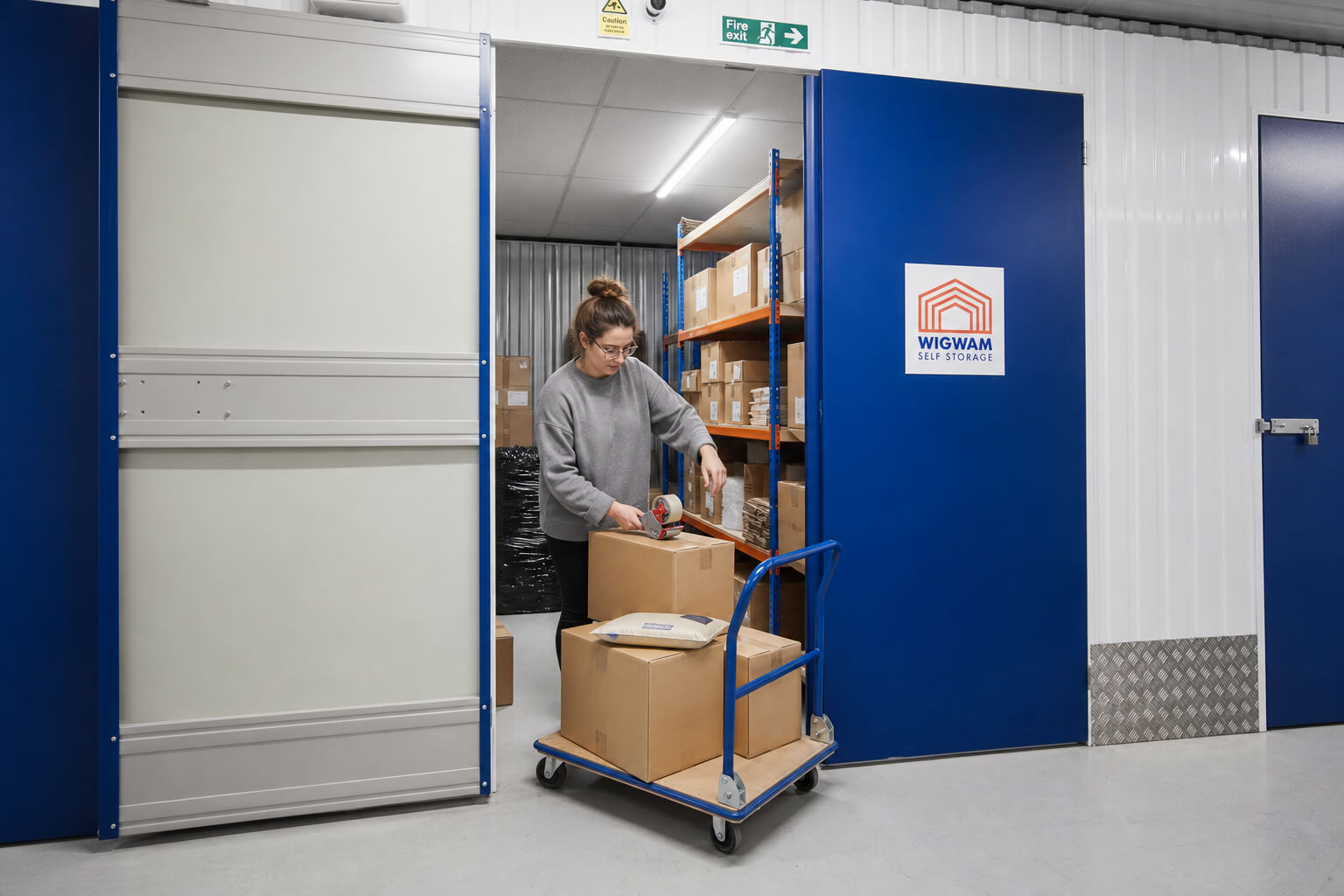
Stock and e-commerce overflow. If you sell online and your stock has outgrown the spare room, a unit holds the inventory, packaging and mailing supplies your kitchen table was never meant to manage. More on managing seasonal and stock overflow in our guide to where SMEs keep seasonal stock, archives and equipment.
Tools, van stock and seasonal kit. Tradespeople and field-service businesses, electricians, gardeners, caterers, cleaners, tend to accumulate equipment that’s essential in season and dead weight out of it. A unit holds the kit between jobs rather than filling a garage year-round. Same seasonal-stock guide covers this in depth.
Document and archive overflow. Accountants, solicitors, consultants and small agencies often need to keep client records long after they’re actively used. We won’t state retention periods here, those rules have their own specifics and their own article, see our guide on how long UK small businesses need to keep financial records.
Reclaiming the spare room or garage. If the business runs from home and has quietly taken over a room, a unit lets you get the space, and the house, back without giving anything up. Our piece on downsizing your office covers this decision in full.
The Split-Site Model In Practice

To make this concrete rather than abstract, imagine a one-person homeware business run from a spare room. The desk, the laptop, the customer emails and the accounts stay exactly where they are, at home, no cost, no change. What doesn’t stay at home is three months of stock, the packaging and mailing bags, the folding trestle table used only at Christmas markets, and two years of paperwork the business has to keep for HMRC. All of that goes into one small storage unit. The owner collects or restocks within the access window, on a rolling term, so the space can be given up the moment the stock no longer justifies it, no fixed lease to break. This is an illustrative example to show how the model works in practice, not a specific client case study.
Compare that with the alternative: the same business instead rents a small industrial unit or an extra office room to hold the same stock. That commitment typically brings a longer minimum term, exposure to business rates and utilities, and a lease that doesn’t shrink back down in the quiet months, the opposite of the flexibility a growing, seasonal business actually needs.
If this sounds like your situation, you can get a quote for your nearest town in a couple of minutes, no obligation to take it further.
How It Actually Works Day To Day

Understanding the model is one thing. Knowing it’ll actually work on a Tuesday morning when a delivery’s due is another, so here’s the practical detail.
Access hours and getting in. Sites are open from 6am to 10pm, seven days a week, and you get in using smart entry rather than a member of staff letting you through the door.
Deliveries and couriers. Most sites are unmanned, which means if you’re expecting a delivery to your unit, someone from your own business needs to be there to receive it. Wigwam staff won’t be on hand to take goods in on your behalf, so it’s worth building that into your delivery scheduling from day one.
Term length and what comes back. The minimum term is a rolling two weeks, so you’re not signing up to anything long. No deposit is taken when you move in, and if you leave with unused days left on your term, those are refunded. When you’re ready to end the arrangement, you give 14 days’ notice, which is a separate step from the refund itself, and worth knowing upfront rather than assuming it happens automatically the day you move out.
Read Next: The Deeper Angle For Your Situation

This page covers the model. If you already know which specific question you’re trying to answer, here’s where to go next.
- Cost comparison against renting extra office space: see our cost comparison guide for the full pound-for-pound argument.
- Downsizing your office without losing access to the files you still need.
- Office clutter and productivity.
- Where SMEs keep seasonal stock and equipment.
- How long UK small businesses need to keep financial records.
Getting Started
None of this requires a big decision. It’s a small, reversible one: work out what genuinely needs a staffed, customer-facing room, and what just needs a secure box, then move the second category out of your way. The term is a rolling two weeks and there’s no deposit to find, so there’s very little to lose by trying it for a season and seeing what it does to the space around you.
When you’re ready, you can get a quote for your nearest town, find your nearest Wigwam location, browse Wigwam’s business storage range, or check current self storage pricing before you decide.
Frequently Asked Questions
No. A storage unit can hold your stock, tools, files or equipment, but it can’t stand in as your registered business address or a staffed, customer-facing premises. Keep your registered address exactly where it already is.
Someone from your own business needs to be there to receive deliveries. Most sites are unmanned, so Wigwam staff aren’t able to take goods in on your behalf, it’s worth planning delivery times around your own availability.
The minimum term is a rolling two weeks, so you can take a unit for as long, or as short, as the business actually needs it, without committing to a fixed lease.
This is general information, not tax advice. Many businesses do treat storage as a legitimate business cost, but the specifics depend on your circumstances, so check with your accountant or gov.uk before you rely on it.
You need your own contents cover. You can either take a policy through Wigwam or prove you already hold suitable cover elsewhere, it isn’t included automatically, so it’s worth sorting before you move anything in.